
Wristwatches · Wristwatch
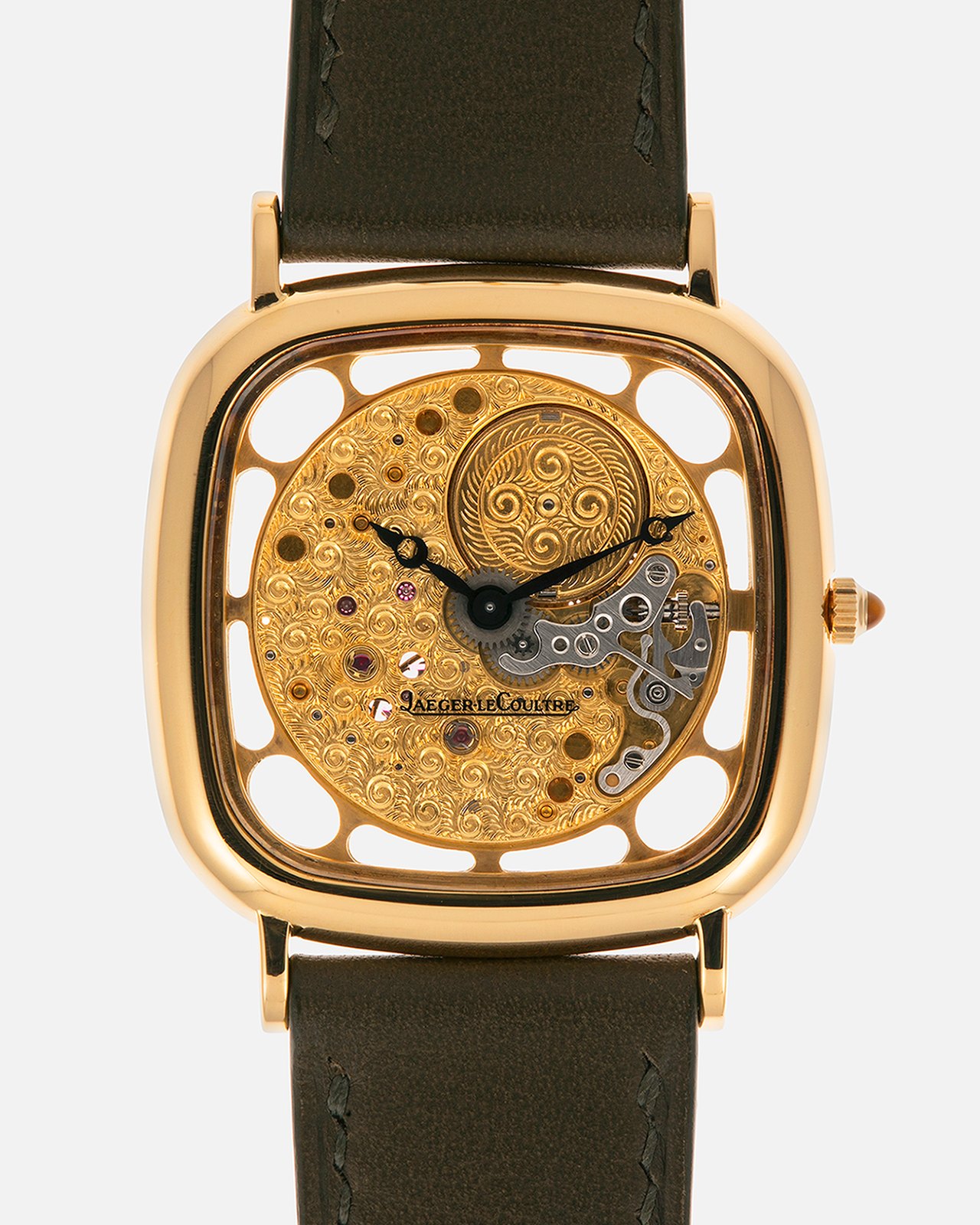
Jaeger-LeCoultre Vogue Skeleton 141.007.1 YG, 1981
- Maker / attribution
- Jaeger-LeCoultre (maker)
- Date
- 1981
- Historical period
- Quartz Revolution (1969 – 1990)
- Country of origin
- Switzerland
- Object type
- Wristwatch
- Stock no.
- Product 7692537954391
- Credit line
- Dealer listing, S.Song Watches (product 7692537954391)
- Catalogue title (original)
- Jaeger-LeCoultre Vogue Skeleton 141.007.1 YG (English)
View the source record (dealer listing) ↗ (opens another website in a new tab)Suggest a correction
Record summary
Catalogued by S.Song Watches (dealer), Seattle (stock number Product 7692537954391), this is a wristwatch by Jaeger-LeCoultre, made in Switzerland, dated 1981. The Atlas places it in the Quartz Revolution period (1969 – 1990) of its Wristwatches collection. The record is illustrated with 6 photographs.
Assembled from the source record's structured fields. Dates and attributions are given as the source states them; where a field is missing the Atlas leaves it blank rather than estimating.
Catalogue description
Dealer description — S.Song Watches
Few disciplines in watchmaking are as difficult to execute well as skeletonisation. When done poorly, the result feels busy and incoherent. When done successfully, every bridge, wheel, and engraving serves a purpose. The Jaeger-LeCoultre Ref. 141.007.1 offered here is a fine example of the latter. Introduced in 1981 as part of Jaeger-LeCoultre's Skeleton Collection, this is one of those watches that becomes more impressive the longer you spend with it. Skeletonisation was never simply about removing material from a calibre. Every bridge had to remain structurally sound, visually balanced, and mechanically functional. Every opening needed to contribute to the overall composition. Achieve that balance, and the movement no longer sits beneath the dial. Instead, it becomes the dial itself. Housed in an elegant 18-carat yellow gold case measuring just 4.9mm thick, the Ref. 141.007.1 wears with remarkable poise. Its slim, softly rounded square profile slips effortlessly beneath a cuff, while the restrained case serves primarily to frame the openworked calibre within. Even the crown rewards closer inspection, fitted with a tiger eye cabochon that introduces a subtle warmth against the yellow gold. To date, it remains the only watch I have encountered with a tiger eye cabochon, and one of my favourite details of the entire piece. Despite its visual intricacy, it never feels overwhelming. Instead, it wears exactly as a Jaeger-LeCoultre dress watch should. Powering the watch is the manually wound Cal. 839. Crafted from 14-carat yellow gold, the calibre was entrusted to master engravers MM. Blum & Zullig. Every visible bridge was painstakingly pierced by hand before being engraved with flowing scrollwork, transforming the calibre into a sculptural composition while preserving its mechanical integrity. The same philosophy extends to the dial side, where the calibre itself assumes the role of the dial. Even the Jaeger-LeCoultre signature is printed on the underside of the crystal, allowing the hand engraving beneath to remain uninterrupted. Save for the elegant handset, little distracts from the craftsmanship on display. What distinguishes this watch from so many other skeletonised pieces is its restraint. Every aperture feels intentional, every engraved surface flows naturally into the next, and despite the considerable amount of information presented, the display remains impressively legible. It is a reminder that skeletonisation is at its finest when it reveals the architecture of a movement rather than simply exposing it. Jaeger-LeCoultre has never publicly disclosed production numbers for this reference. While the exact figure remains unknown, it is widely understood to have been produced in very small quantities, making examples such as this one seldom encountered today. Accompanied by its Extract from the Archives, this watch represents an increasingly rare opportunity to acquire one of the manufacture's lesser-known creations. It's easy to think of the Reverso whenever the name Jaeger-LeCoultre comes up, and for good reason. But every now and then you come across a watch like this that reminds you just how deep the brand’s catalogue really is. If you're looking to venture a little further off the beaten path, I'd struggle to think of a better place to start.
Historical context
Quartz Revolution (1969 – 1990)
Seiko's Astron begins mass quartz timekeeping; traditional industries contract sharply.
Quartz and digital watches transformed the market after 1969. Swiss employment collapsed, Japanese and Hong Kong production soared, and the Swatch (1983) helped the Swiss industry recover; mechanical watches survived as luxury goods.
Read the period in the timelineMore wristwatches from this periodEarlier: Modern Mechanical Horology
Atlas type guide
Wristwatches
Bracelet watches were worn by women from the early nineteenth century — Breguet made one for Caroline Murat, Queen of Naples, in 1810–12 — but the wristwatch only became a man's instrument with military use and aviation in the early twentieth century. Between the World Wars it overtook the pocket watch; the 1920s and 1930s brought rectangular Art Deco cases, water-resistant cases and the first automatic winding systems.
After 1945 the wristwatch became a carrier of identity — dress watches, sports and dive watches, chronographs, calendars — produced by Swiss, American, Japanese, German, Soviet and Chinese industries. The quartz revolution after 1969 and the mechanical renaissance since the 1990s, including the rise of independent watchmakers, complete the story.
What to look for
- The reference number (between the lugs or inside the case back) and serial number, the starting point for dating.
- The calibre: its maker and number are often stamped under the dial or on the bridge.
- Originality of dial, hands and crown — refinished ('redial') dials are common.
- Case material marks: 18K/750, 14K/585, stainless steel, gold-filled, plated.
Dating clues
- Wire-lug cases: before c. 1925.
- Water-resistant screw-down cases: from 1926.
- Quartz movements: from 1969; sapphire crystals widespread after c. 1980.
General guidance written by the Atlas editors about this kind of object. It is not a statement about this particular piece; for that, rely on the source record above and on physical examination.
Related records
Clocks · 1937–1938
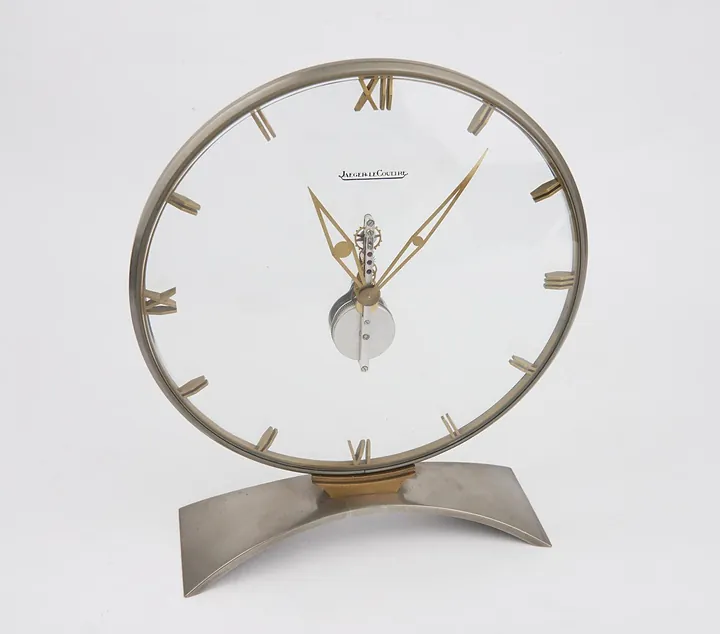
Skeleton clock by Jaeger-LeCoultre, Switzerland, 1937–1938
Science Museum Group, London
Movements & Components · 1953
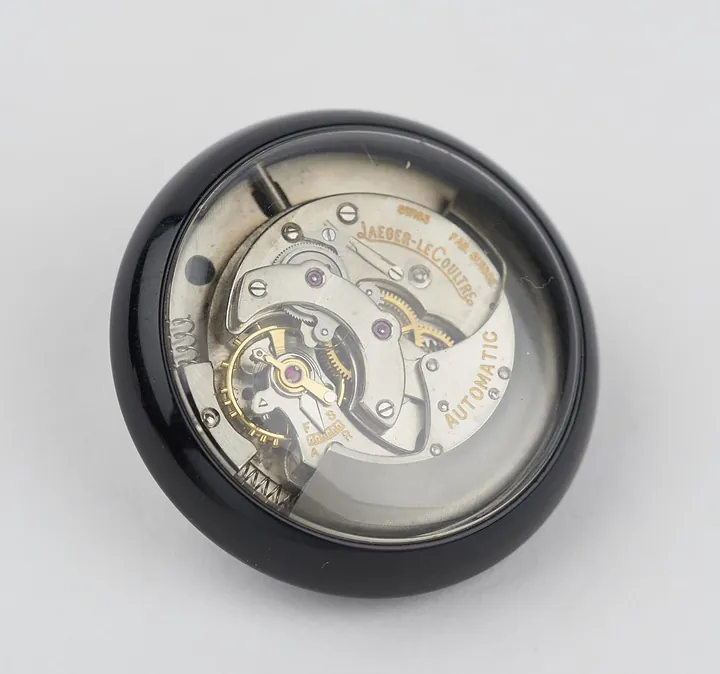
Automatic watch movement, Jaeger-LeCoultre, 1953, Geneva, Switzerland, showing self-winding mechanism
Science Museum Group, London
Wristwatches · 1953
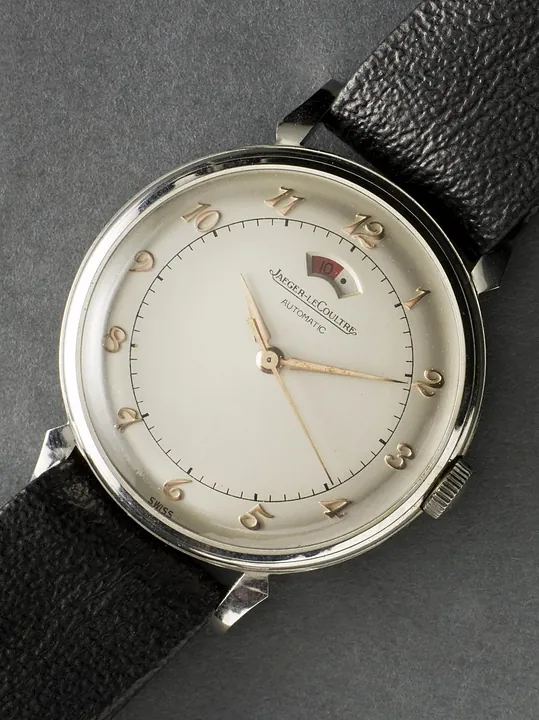
Automatic Wrist-watch, Jaeger-LeCoultre, Geneva, Switzerland, with reserve power indicator complete in steel case, 1953. Back numbered 564556.
Science Museum Group, London
Wristwatches · 1953
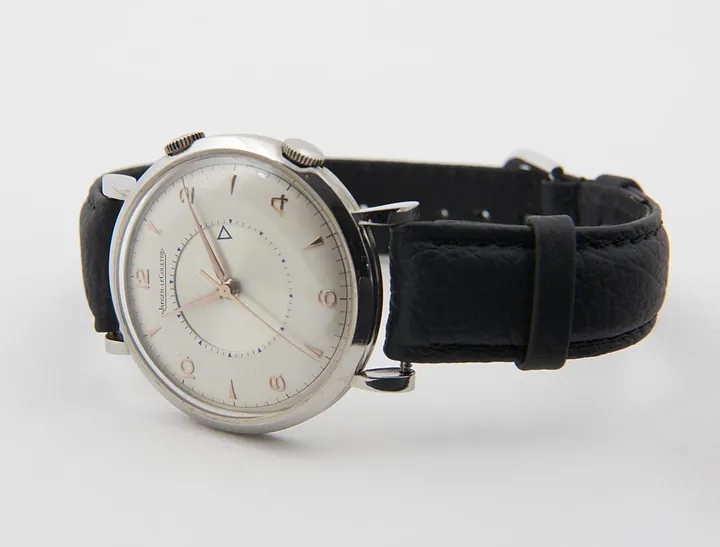
Wrist-watch, 'Memovox' alarm, Jaeger-LeCoultre, Geneva, Switzerland, complete in steel case, 1953.
Science Museum Group, London

Wristwatches · 1970
Wristwatch by Heno, Switzerland, 1970
Museum Rotterdam

Wristwatches · 1960–1986
'Tri-Compax' calendar chronograph wristwatch in gold case, by Universal, Geneva, Switzerland, 1960–1986.
Science Museum Group, London

Wristwatches · 1969–1970
Beta 21 Quartz wristwatch movement, made in Switzerland, 1970.
Science Museum Group, London

Wristwatches · c. 1969
Omega Speedmaster Moonwatch, ref. 145022-69st, c. 1969
Antiquorum auction archive, Geneva