
Wristwatches · Wristwatch
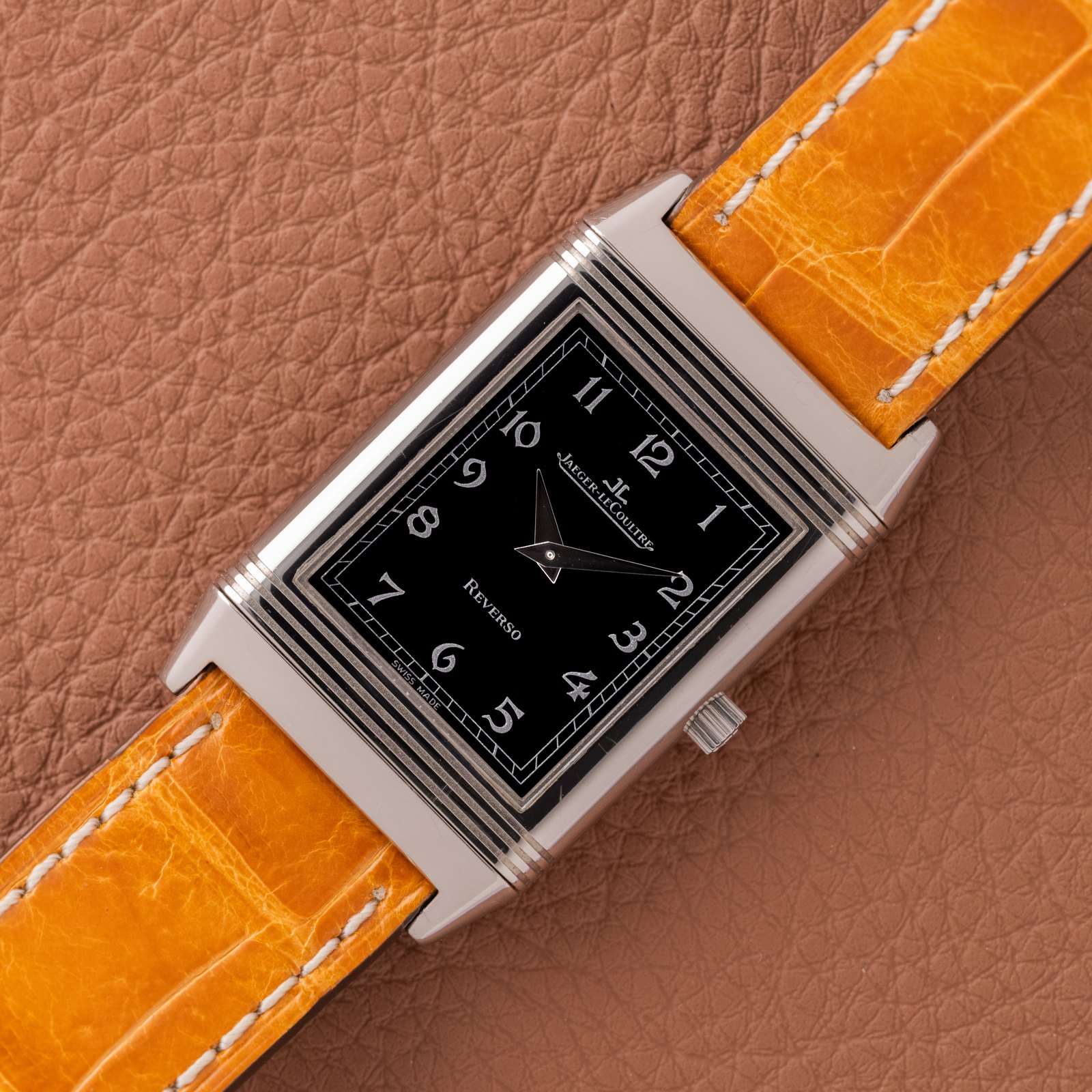
Jaeger-LeCoultre Reverso Limited Edition (Ref. 250.3.86), 1990s
- Maker / attribution
- Jaeger-LeCoultre (maker)
- Date
- 1990s
- Historical period
- Mechanical Renaissance (1990 – 2010)
- Country of origin
- Switzerland
- Object type
- Wristwatch
- Dimensions
- Case 26 mm
- Stock no.
- Product 8708796219575
- Credit line
- Dealer listing, Huntington Company (product 8708796219575)
- Catalogue title (original)
- 1990s Jaeger-LeCoultre Reverso Limited Edition (Ref. 250.3.86) (English)
View the source record (dealer listing) ↗ (opens another website in a new tab)Suggest a correction
Record summary
Catalogued by Huntington Company (dealer) (stock number Product 8708796219575), this is a wristwatch by Jaeger-LeCoultre, made in Switzerland, dated 1990s. The Atlas places it in the Mechanical Renaissance period (1990 – 2010) of its Wristwatches collection. Recorded dimensions: Case 26 mm. The record is illustrated with 6 photographs.
Assembled from the source record's structured fields. Dates and attributions are given as the source states them; where a field is missing the Atlas leaves it blank rather than estimating.
Catalogue description
Dealer description — Huntington Company
History and Significance The Reverso is one of the rare watches whose defining feature was born from necessity rather than decoration. Originally conceived in the 1930s with a case that could be flipped over to protect its crystal, the design eventually became one of Jaeger-LeCoultre's most recognizable signatures. The reverse side also created something unusual: a large, uninterrupted metal surface that could be personalized with engraving. That tradition makes this particular Reverso especially interesting. Produced as a limited edition of only 150 pieces, the reference 250.3.86 was executed in white gold and features an engraved Swiss coat of arms across the reverse of the case. Jaeger-LeCoultre used variations of the Swiss coat of arms on a small number of limited editions during the 1990s, sometimes through traditional engraving and in other instances with enamel decoration. The combination of the black dial, white gold case, and deeply traditional Swiss imagery gives this edition a character completely different from the standard Reverso. From the front it remains restrained and unmistakably Jaeger-LeCoultre. Flip the case over and the reason this particular reference exists becomes immediately apparent. Writer’s Thoughts The black dial is fantastic against the white metal case, particularly with the stylized Arabic numerals and railroad minute track. It feels formal without being overly delicate, and the proportions are classic Reverso. The Swiss coat of arms engraving completely changes the personality of the watch when the case is flipped. There is something especially appropriate about using the Reverso's blank reverse surface this way, and knowing the reference 250.3.86 was limited to only 150 pieces makes the detail even better. The white gold is another important part of the appeal. It gives the watch the understated appearance of steel while adding the weight and presence you expect from precious metal. You could easily wear this Reverso without anyone realizing what it is, which is part of the charm. It is a rare Jaeger-LeCoultre that doesn't need to advertise its rarity. Our Promise Every watch is thoroughly vetted, carefully described with complete transparency, and guaranteed authentic. Each piece is offered in honest condition, ensuring collectors receive a timepiece that reflects both originality and integrity. Specifications Brand: Jaeger-LeCoultre Model: Reverso Limited Edition Year: Circa 1990s Case Material: 18k white gold Case Size: Approximately 26mm x 42mm Dial: Black dial with stylized Arabic numerals Movement: Manual wind Strap/Bracelet: Generic orange leather strap Buckle/Clasp: Original Jaeger-LeCoultre 18k white gold deployant clasp Contents: Watch only Condition Case: White gold Reverso case presents very well with strong proportions and light signs of previous wear. The engraved Swiss coat of arms on the reverse remains crisp and clearly defined. Dial: Original black dial is very well preserved with clean printing and attractive contrast throughout. Hands: Original hands present well with no notable distractions visible. Crystal: Crystal is clean overall with no significant damage visible. Strap/Bracelet: Generic leather strap shows light wear. Buckle/Clasp: Original Jaeger-LeCoultre white gold deployant clasp is in great condition.
Historical context
Mechanical Renaissance (1990 – 2010)
Mechanical watches return as cultural objects; independent watchmaking flourishes.
Mechanical watches returned as cultural and luxury objects. Complications, tourbillons and new materials proliferated; independent watchmakers such as George Daniels, F.P. Journe and Philippe Dufour revived artisanal watchmaking; collecting vintage watches became a major field.
Read the period in the timelineMore wristwatches from this periodEarlier: Quartz Revolution
Atlas type guide
Wristwatches
Bracelet watches were worn by women from the early nineteenth century — Breguet made one for Caroline Murat, Queen of Naples, in 1810–12 — but the wristwatch only became a man's instrument with military use and aviation in the early twentieth century. Between the World Wars it overtook the pocket watch; the 1920s and 1930s brought rectangular Art Deco cases, water-resistant cases and the first automatic winding systems.
After 1945 the wristwatch became a carrier of identity — dress watches, sports and dive watches, chronographs, calendars — produced by Swiss, American, Japanese, German, Soviet and Chinese industries. The quartz revolution after 1969 and the mechanical renaissance since the 1990s, including the rise of independent watchmakers, complete the story.
What to look for
- The reference number (between the lugs or inside the case back) and serial number, the starting point for dating.
- The calibre: its maker and number are often stamped under the dial or on the bridge.
- Originality of dial, hands and crown — refinished ('redial') dials are common.
- Case material marks: 18K/750, 14K/585, stainless steel, gold-filled, plated.
Dating clues
- Wire-lug cases: before c. 1925.
- Water-resistant screw-down cases: from 1926.
- Quartz movements: from 1969; sapphire crystals widespread after c. 1980.
General guidance written by the Atlas editors about this kind of object. It is not a statement about this particular piece; for that, rely on the source record above and on physical examination.
Related records
Clocks · 1937–1938
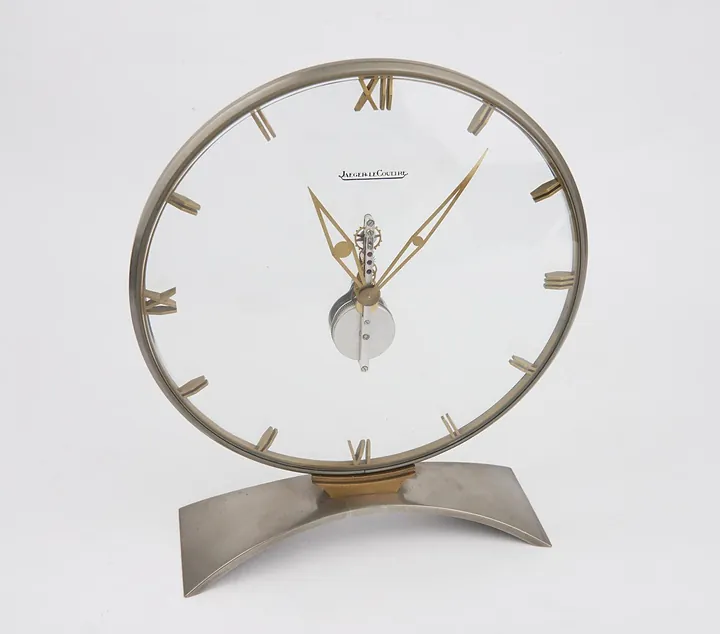
Skeleton clock by Jaeger-LeCoultre, Switzerland, 1937–1938
Science Museum Group, London
Movements & Components · 1953
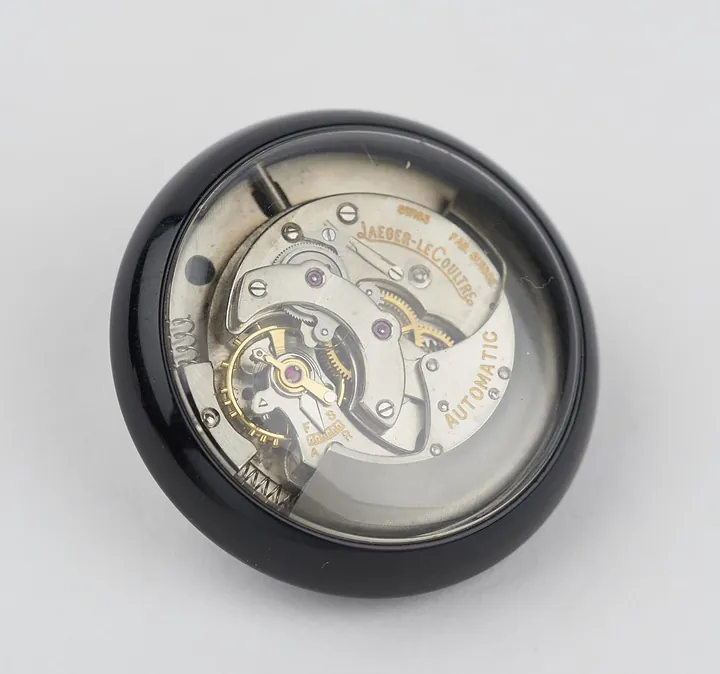
Automatic watch movement, Jaeger-LeCoultre, 1953, Geneva, Switzerland, showing self-winding mechanism
Science Museum Group, London
Wristwatches · 1953
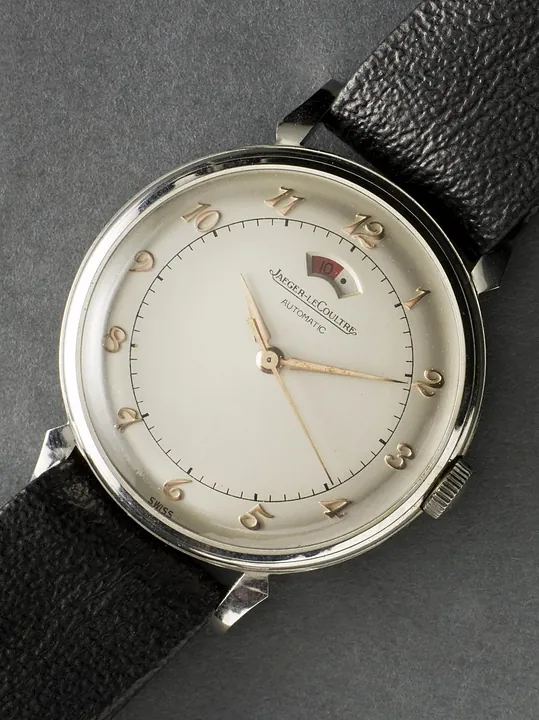
Automatic Wrist-watch, Jaeger-LeCoultre, Geneva, Switzerland, with reserve power indicator complete in steel case, 1953. Back numbered 564556.
Science Museum Group, London
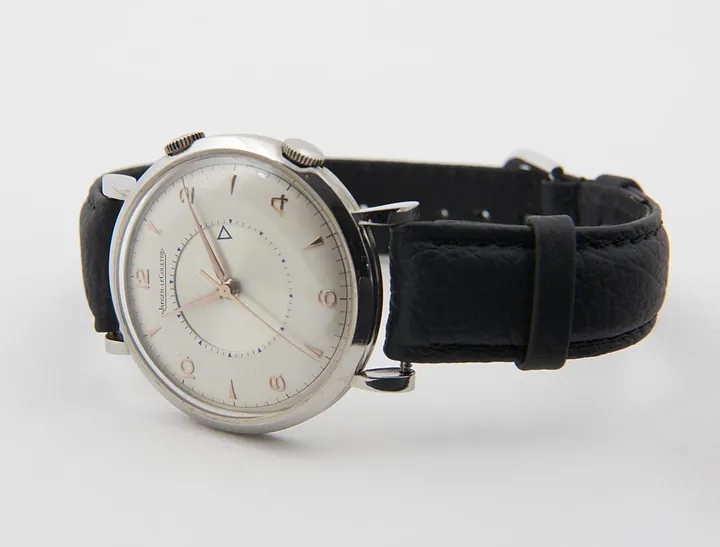
Wristwatches · 1953
Wrist-watch, 'Memovox' alarm, Jaeger-LeCoultre, Geneva, Switzerland, complete in steel case, 1953.
Science Museum Group, London

Wristwatches · 2008
Wristwatch by Breitling?, 2008
Museum Rotterdam

Wristwatches · c. 1990s
Audemars Piguet Bamboo, c. 1990s
Antiquorum auction archive, Geneva

Wristwatches · c. 1990
Audemars Piguet Huitieme Perpetual Calendar, ref. 25696PT, c. 1990
Antiquorum auction archive, Geneva

Wristwatches · c. 1990
Breitling Chronomat, ref. b13050.1, c. 1990
Antiquorum auction archive, Geneva