
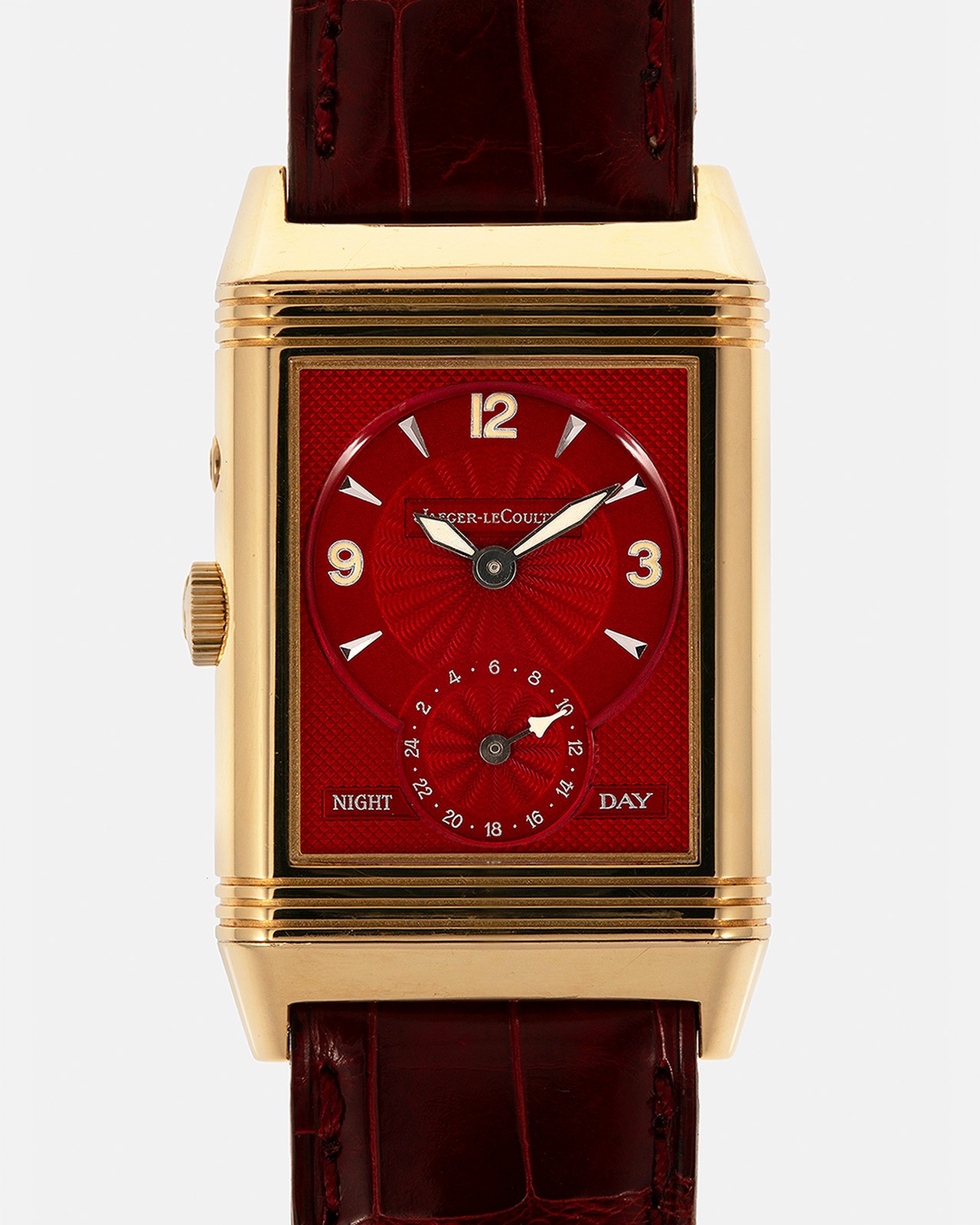
Wristwatches · Wristwatch
Jaeger-LeCoultre Reverso Duoface Japan Edition Red 270.1.54 Yellow Gold No.1, 1999
- Maker / attribution
- Jaeger-LeCoultre (maker)
- Date
- 1999
- Historical period
- Mechanical Renaissance (1990 – 2010)
- Country of origin
- Japan
- Object type
- Wristwatch
- Materials / technique
- yellow gold
- Stock no.
- Product 7665823154263
- Credit line
- Dealer listing, S.Song Watches (product 7665823154263)
- Catalogue title (original)
- Jaeger-LeCoultre Reverso Duoface Japan Edition Red 270.1.54 Yellow Gold No.1 (English)
View the source record (dealer listing) ↗ (opens another website in a new tab)Suggest a correction
Record summary
Catalogued by S.Song Watches (dealer), Seattle (stock number Product 7665823154263), this is a wristwatch by Jaeger-LeCoultre, made in Japan, dated 1999. The Atlas places it in the Mechanical Renaissance period (1990 – 2010) of its Wristwatches collection. Materials and techniques recorded by the source: yellow gold. The record is illustrated with 6 photographs.
Assembled from the source record's structured fields. Dates and attributions are given as the source states them; where a field is missing the Atlas leaves it blank rather than estimating.
Catalogue description
Dealer description — S.Song Watches
Created by Jacques-David LeCoultre in 1931, the Reverso was originally conceived to withstand the rigours of polo matches. Over time, it evolved into one of watchmaking's defining dress watches, celebrated for its timeless Art Deco design and elegant proportions. Unique in its ability to be opened, slid along a rail, rotated on its vertical axis, and snapped back into place, the Reverso's namesake mechanism provided Jaeger-LeCoultre with an ideal platform for innovation. Few developments would prove more significant than the introduction of the Duoface. Designed to capitalise on the Reverso's ingenious flip-case by incorporating a second dial, the Duoface expanded the model's practicality while preserving its refined character. Introduced in 1994 within the Grande Taille case, the original Duoface paired a light-coloured "home" dial with a darker secondary dial, allowing the wearer to track two time zones simultaneously. The present example takes that concept a step further. Produced as a rare Japan Edition, this Reverso Duoface features a classic silvered dial on one side and a striking red dial on the reverse, giving the watch two entirely distinct personalities within a single case. Crafted in 18-carat yellow gold, the Reverso Duoface retains the collection's famously balanced proportions, originally designed around the golden ratio, a mathematical principle long associated with visual harmony and classical architecture. Its clean rectangular lines, stepped gadroons, and sharply defined edges remain every bit as elegant today as they were nearly a century ago. The defining feature of this particular example is undoubtedly the striking contrast between its two dials, lending the watch an unmistakable "Dr Jekyll and Mr Hyde" character. On one side sits a refined silver dial with a guilloché centre, small seconds at 6:00, crisp Arabic numerals, and a set of thermally blued hands that reinforce the Reverso's classical roots. Turn the case over, however, and the personality changes entirely. The reverse reveals a rich burgundy Clous de Paris guilloché dial with evenly aged luminous numerals and hands, accompanied by a day/night indicator at 6:00 that mirrors the small seconds display on the front. The result is expressive, dramatic, and unexpectedly modern, creating a fascinating contrast with the otherwise restrained architecture of the Reverso case. The beauty of the Duoface lies in how naturally it adapts to different settings. One side feels discreet and traditionally elegant, while the other introduces a far more animated personality. It is effectively two watches in one, allowing the wearer to alternate between dressy and something considerably more vibrant depending on mood or occasion. Powering the watch is Jaeger-LeCoultre’s manually wound Cal. 854, an in-house movement that reinforces the manufacture’s long-standing reputation as ‘the watchmaker’s watchmaker.’ Hidden beneath the dual dials, the movement features the robust architecture, thoughtful engineering, and refined finishing characteristic of Jaeger-LeCoultre during this period. Beyond simply offering a second time zone display, the Duoface remains an impressively practical complication executed with the kind of elegance few manufactures managed to achieve during the era. With only 39 examples ever produced, this Japan Edition ranks among the rarest modern Reverso variants. Adding further appeal, this particular watch is numbered 1, a detail certain to resonate with collectors. Japan-exclusive watches have long occupied a unique corner of watch collecting, often produced in extremely small numbers and seldom encountered outside the domestic market. This reference was never widely publicised internationally, and many collectors remain unaware of its existence. To encounter an example today outside Japan is exceptionally uncommon, and precisely the sort of discovery that reminds collectors why the pursuit remains so rewarding.
Historical context
Mechanical Renaissance (1990 – 2010)
Mechanical watches return as cultural objects; independent watchmaking flourishes.
Mechanical watches returned as cultural and luxury objects. Complications, tourbillons and new materials proliferated; independent watchmakers such as George Daniels, F.P. Journe and Philippe Dufour revived artisanal watchmaking; collecting vintage watches became a major field.
Read the period in the timelineMore wristwatches from this periodEarlier: Quartz Revolution
Atlas type guide
Wristwatches
Bracelet watches were worn by women from the early nineteenth century — Breguet made one for Caroline Murat, Queen of Naples, in 1810–12 — but the wristwatch only became a man's instrument with military use and aviation in the early twentieth century. Between the World Wars it overtook the pocket watch; the 1920s and 1930s brought rectangular Art Deco cases, water-resistant cases and the first automatic winding systems.
After 1945 the wristwatch became a carrier of identity — dress watches, sports and dive watches, chronographs, calendars — produced by Swiss, American, Japanese, German, Soviet and Chinese industries. The quartz revolution after 1969 and the mechanical renaissance since the 1990s, including the rise of independent watchmakers, complete the story.
What to look for
- The reference number (between the lugs or inside the case back) and serial number, the starting point for dating.
- The calibre: its maker and number are often stamped under the dial or on the bridge.
- Originality of dial, hands and crown — refinished ('redial') dials are common.
- Case material marks: 18K/750, 14K/585, stainless steel, gold-filled, plated.
Dating clues
- Wire-lug cases: before c. 1925.
- Water-resistant screw-down cases: from 1926.
- Quartz movements: from 1969; sapphire crystals widespread after c. 1980.
General guidance written by the Atlas editors about this kind of object. It is not a statement about this particular piece; for that, rely on the source record above and on physical examination.
Related records
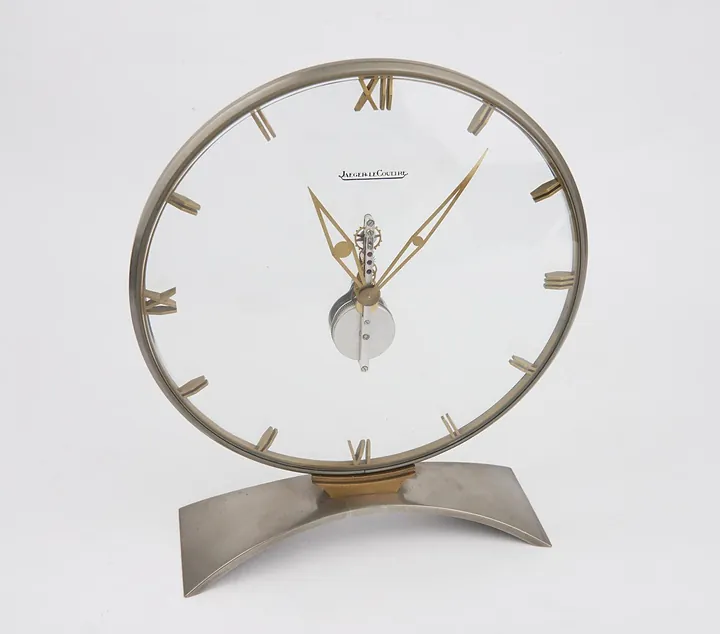
Clocks · 1937–1938
Skeleton clock by Jaeger-LeCoultre, Switzerland, 1937–1938
Science Museum Group, London
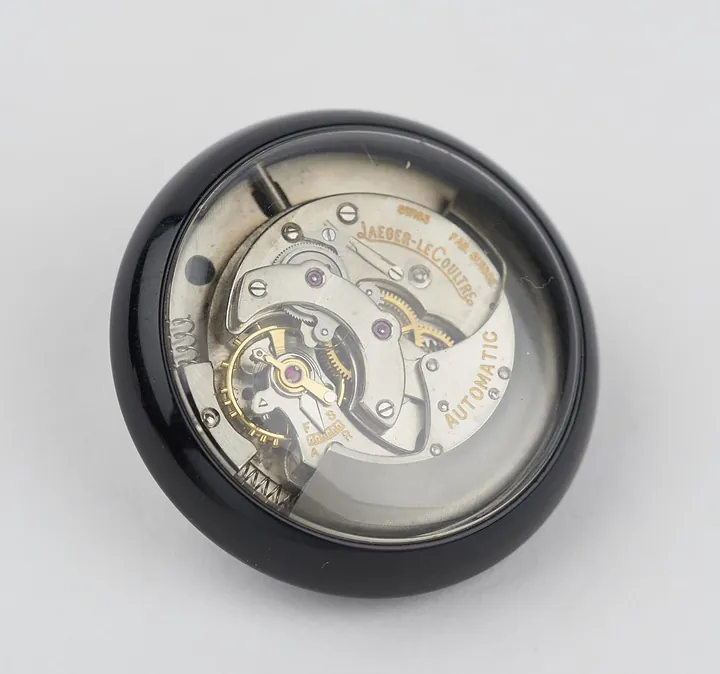
Movements & Components · 1953
Automatic watch movement, Jaeger-LeCoultre, 1953, Geneva, Switzerland, showing self-winding mechanism
Science Museum Group, London
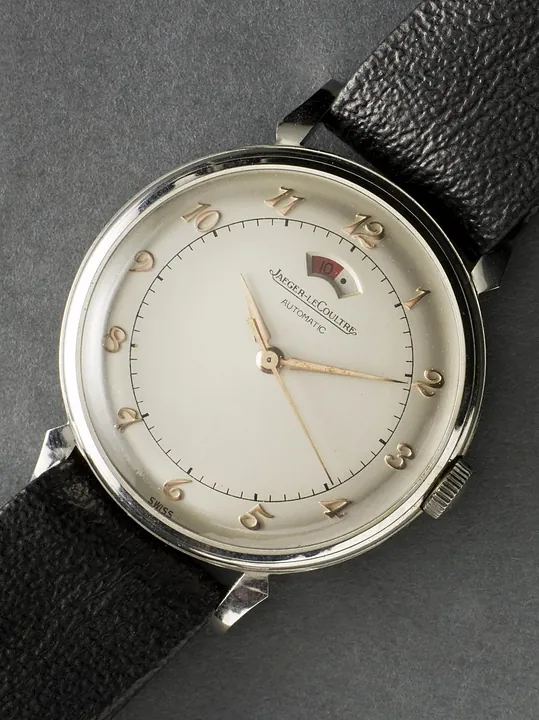
Wristwatches · 1953
Automatic Wrist-watch, Jaeger-LeCoultre, Geneva, Switzerland, with reserve power indicator complete in steel case, 1953. Back numbered 564556.
Science Museum Group, London
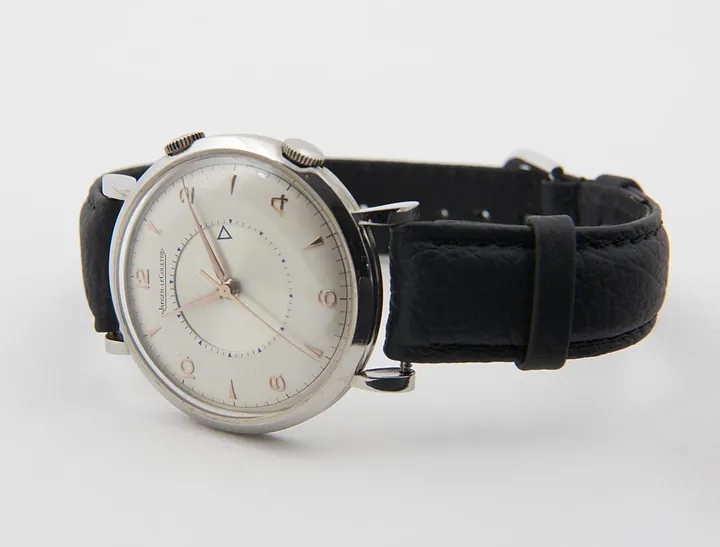
Wristwatches · 1953
Wrist-watch, 'Memovox' alarm, Jaeger-LeCoultre, Geneva, Switzerland, complete in steel case, 1953.
Science Museum Group, London
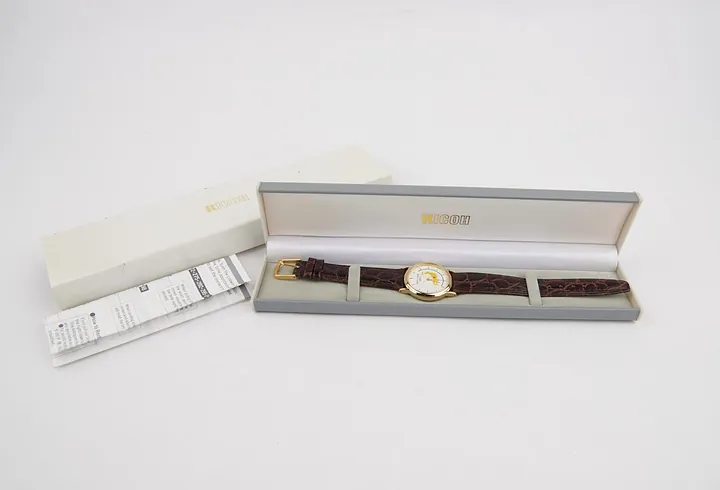
Wristwatches · 1990–1996
Wristwatch by Ricoh Elemex Corporation, Japan, 1990–1996
Science Museum Group, London
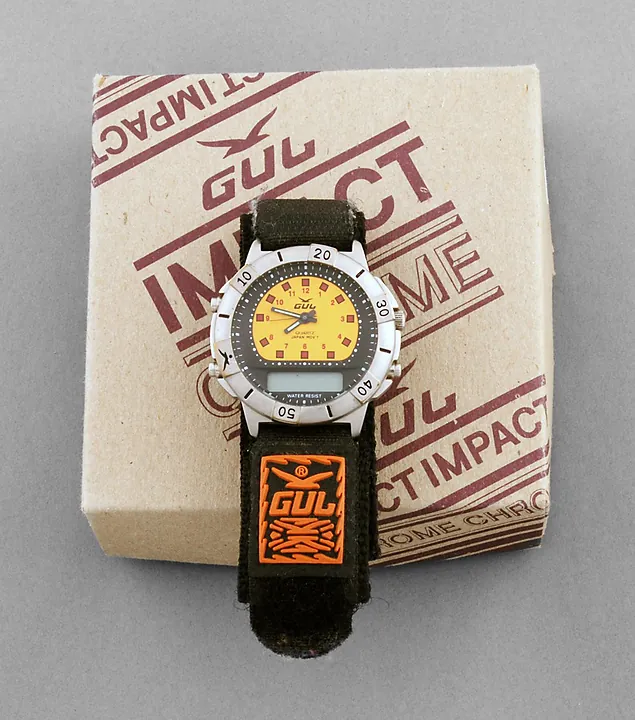
Wristwatches · 1990
Wristwatch, Japan, 1990
Blekinge Museum
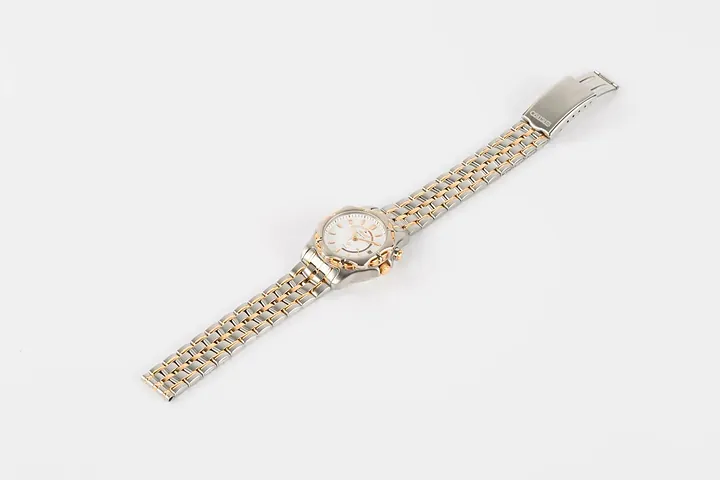
Wristwatches · 1995
Wristwatch, Japan, 1995 (no. 57932)
German Clock Museum
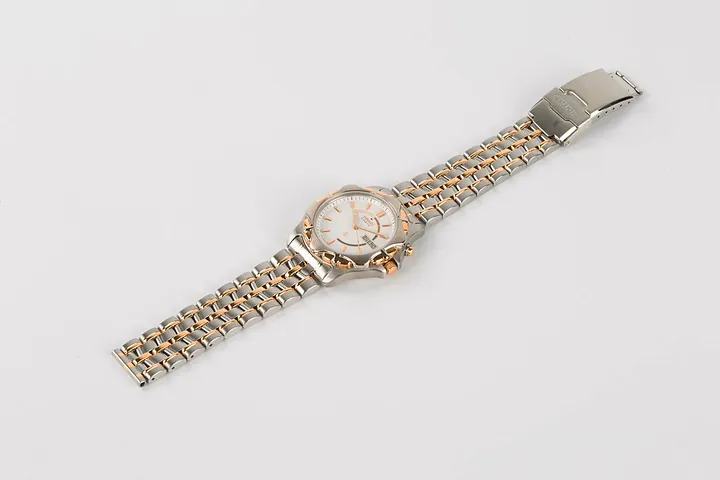
Wristwatches · 1995
Wristwatch, Japan, 1995 (no. 57933)
German Clock Museum