
Wristwatches · Wristwatch
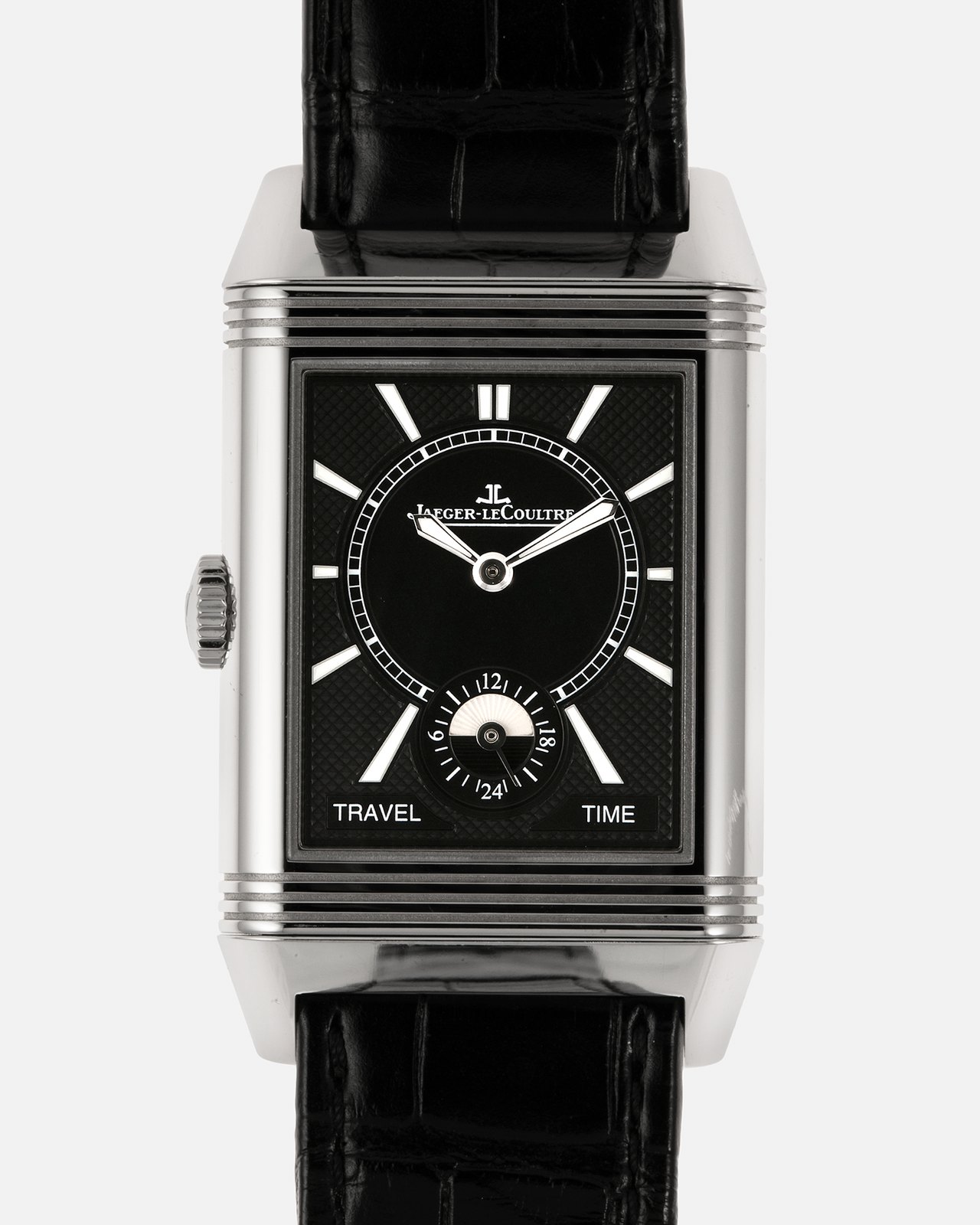
Jaeger-LeCoultre Reverso Classic Large Duoface Ref. 215.8.D4, 2020
- Maker / attribution
- Jaeger-LeCoultre (maker)
- Date
- 2020
- Historical period
- Contemporary Horology (2010 – Present)
- Country of origin
- Switzerland
- Object type
- Wristwatch
- Dimensions
- Case 47 mm
- Stock no.
- Product 7208888434775
- Credit line
- Dealer listing, S.Song Watches (product 7208888434775)
- Catalogue title (original)
- Jaeger-LeCoultre Reverso Classic Large Duoface Ref. 215.8.D4 (English)
View the source record (dealer listing) ↗ (opens another website in a new tab)Suggest a correction
Record summary
Catalogued by S.Song Watches (dealer), Seattle (stock number Product 7208888434775), this is a wristwatch by Jaeger-LeCoultre, made in Switzerland, dated 2020. The Atlas places it in the Contemporary Horology period (2010 – Present) of its Wristwatches collection. Recorded dimensions: Case 47 mm. The record is illustrated with 6 photographs.
Assembled from the source record's structured fields. Dates and attributions are given as the source states them; where a field is missing the Atlas leaves it blank rather than estimating.
Catalogue description
Dealer description — S.Song Watches
Designed by Jacques-David Le Coultre, the Reverso was conceived to withstand the harsh beating a watch would endure during a game of polo. Born in 1931 as a sports watch by its very definition, the Reverso has evolved into a dress watch thanks to its now-classical aesthetic and graceful design. Unique in that its case can be opened, slid along a rail, flipped around on its vertical axis, and snapped back into place so that its caseback faces out with its dial against the wrist, the Reverso's eponymous function has given JLC a powerful medium through which they could further adapt the Reverso's iconic design: cue in the Duoface. Designed to capitalize on its flip-action by giving it a second dial, the Duoface was, in fact, a means of increasing the Reverso's utility as a functional timepiece. First released in 1994, the first Duoface was split between a lighter-coloured 'home' dial and a darker-coloured secondary dial that the user would wear to indicate the time in two different parts of the world — making it a dual-time timepiece. The Reverso Classic Large Duoface Small Seconds Ref. 215.8.D4 that we have here features a similar mechanism. On one side, it presents a silver dial adorned with thermally-blued sword hands, highly sober Arabic numerals, and a central guilloché pattern, offering a precise time-only display with a small seconds sub-dial positioned at 6 o'clock. Flipping to the alternate side reveals a striking black dial embellished with a Clous de Paris guilloché outer sector, luminous hour markers, and sword hands. Additionally, it features a day/night indicator positioned at 6 o'clock, tastefully integrated and overlapping onto the minutes track. Made from stainless steel, the Duoface Ref. 215.8.D4 sports a case design based on the golden ratio, which is a ratio between two dimensions that equals 1.618. Also known mathematically as the divine proportion, it is, in general terms, a ratio that is known to be pleasing to the human eye. Furthermore, with its engraved decoration running horizontally across the top and bottom of the polished case, the Duoface Ref. 215.8.D4 features design flourishes that pair well with its two distinct dials. As a dual-time complication, the Duoface Ref. 215.8.D4 offers a convenient method for adjusting the hour-hand (for the local time) on the black dial. This is facilitated by a discreet sliding toggle located on the upper side of the case, concealed within the case when not in use and only visible when the case is slid open. Powering this work of art from within its elegantly sized 47mm x 28.3mm x 10.3mm stainless steel case is its in-house, manual-winding JLC Cal. 854A/2 — a movement that is a direct derivative of the JLC Cal. 854/1, which debuted in 1995 as the pioneering movement of the Duoface. It beats at 21,600 vph and carries a power reserve of 42 hours on a full wind. Two watches in one, literally, the Reverso Duoface Small Seconds is an incredibly versatile timepiece that allows the user two different watch faces to match his/her outfit or feeling of the day. Furthermore, this Jaeger-LeCoultre Reverso showcases its horological heritage with a robust and excellent manually-wound, in-house movement. While it's hidden beneath both dials, the Cal. 854A/2 features the same high-quality architecture and finishing that has earned Jaeger LeCoultre its deserved moniker; "the watchmaker's watchmaker."
Historical context
Contemporary Horology (2010 – Present)
Silicon components, connected watches, optical-lattice research clocks and a thriving independent scene.
Smartwatches became the world's best-selling watches, while mechanical watchmaking focuses on craft, innovation (silicon components, new escapements) and independent makers.
Read the period in the timelineMore wristwatches from this periodEarlier: Mechanical Renaissance
Atlas type guide
Wristwatches
Bracelet watches were worn by women from the early nineteenth century — Breguet made one for Caroline Murat, Queen of Naples, in 1810–12 — but the wristwatch only became a man's instrument with military use and aviation in the early twentieth century. Between the World Wars it overtook the pocket watch; the 1920s and 1930s brought rectangular Art Deco cases, water-resistant cases and the first automatic winding systems.
After 1945 the wristwatch became a carrier of identity — dress watches, sports and dive watches, chronographs, calendars — produced by Swiss, American, Japanese, German, Soviet and Chinese industries. The quartz revolution after 1969 and the mechanical renaissance since the 1990s, including the rise of independent watchmakers, complete the story.
What to look for
- The reference number (between the lugs or inside the case back) and serial number, the starting point for dating.
- The calibre: its maker and number are often stamped under the dial or on the bridge.
- Originality of dial, hands and crown — refinished ('redial') dials are common.
- Case material marks: 18K/750, 14K/585, stainless steel, gold-filled, plated.
Dating clues
- Wire-lug cases: before c. 1925.
- Water-resistant screw-down cases: from 1926.
- Quartz movements: from 1969; sapphire crystals widespread after c. 1980.
General guidance written by the Atlas editors about this kind of object. It is not a statement about this particular piece; for that, rely on the source record above and on physical examination.
Related records
Clocks · 1937–1938
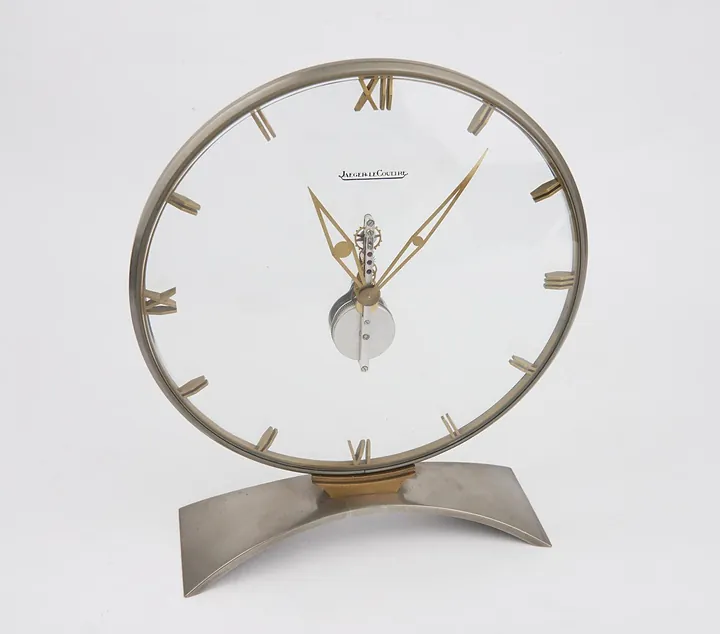
Skeleton clock by Jaeger-LeCoultre, Switzerland, 1937–1938
Science Museum Group, London
Movements & Components · 1953
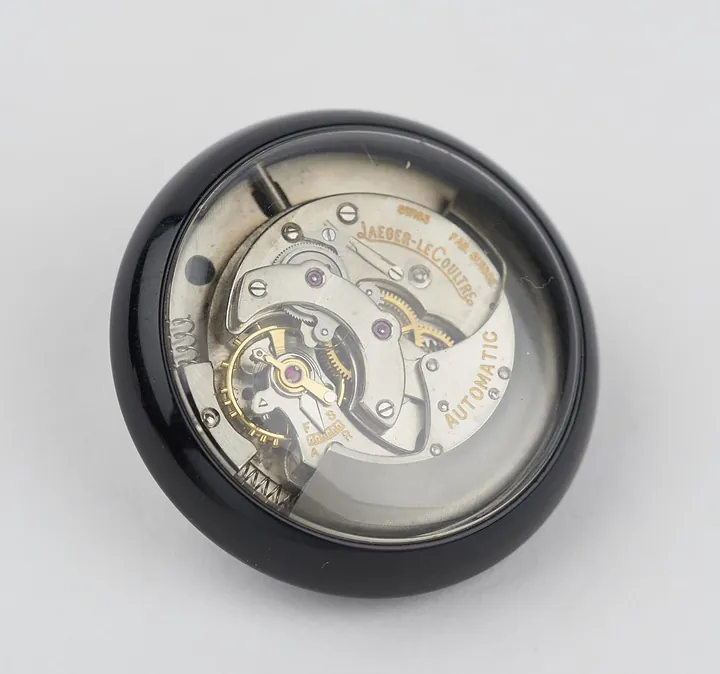
Automatic watch movement, Jaeger-LeCoultre, 1953, Geneva, Switzerland, showing self-winding mechanism
Science Museum Group, London
Wristwatches · 1953
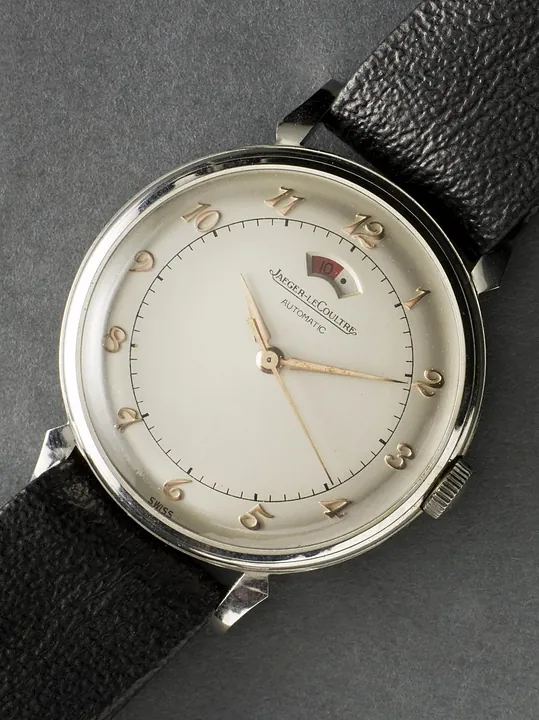
Automatic Wrist-watch, Jaeger-LeCoultre, Geneva, Switzerland, with reserve power indicator complete in steel case, 1953. Back numbered 564556.
Science Museum Group, London
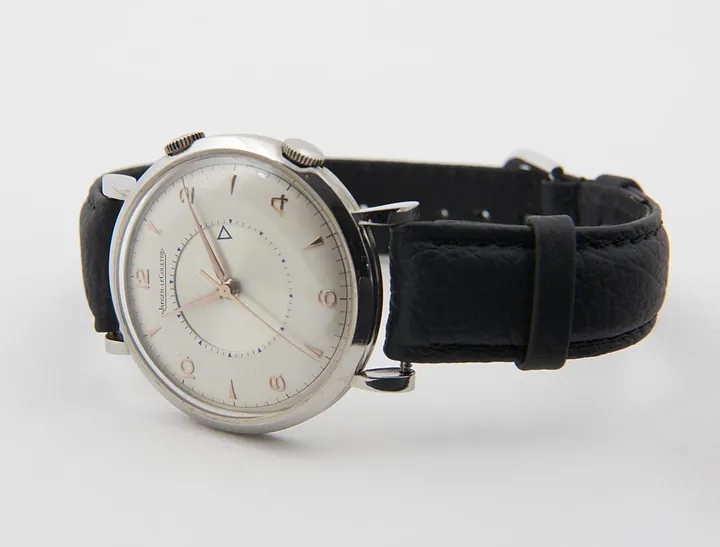
Wristwatches · 1953
Wrist-watch, 'Memovox' alarm, Jaeger-LeCoultre, Geneva, Switzerland, complete in steel case, 1953.
Science Museum Group, London

Wristwatches · c. 2010s
Breguet Type XXI, ref. 3810, c. 2010s (Antiquorum Lot 381-24)
Antiquorum auction archive, Geneva

Wristwatches · c. 2010s
Breguet Type XXI, ref. 3810, c. 2010s (Antiquorum Lot 386-229)
Antiquorum auction archive, Geneva

Wristwatches · Sold in September 2010
Breitling Cosmonaute, ref. A 22322, Sold in September 2010
Antiquorum auction archive, Geneva

Wristwatches · c. 2010
Corum Bubble Chrono, ref. 396.150.20, c. 2010
Antiquorum auction archive, Geneva