
Wristwatches · Wristwatch
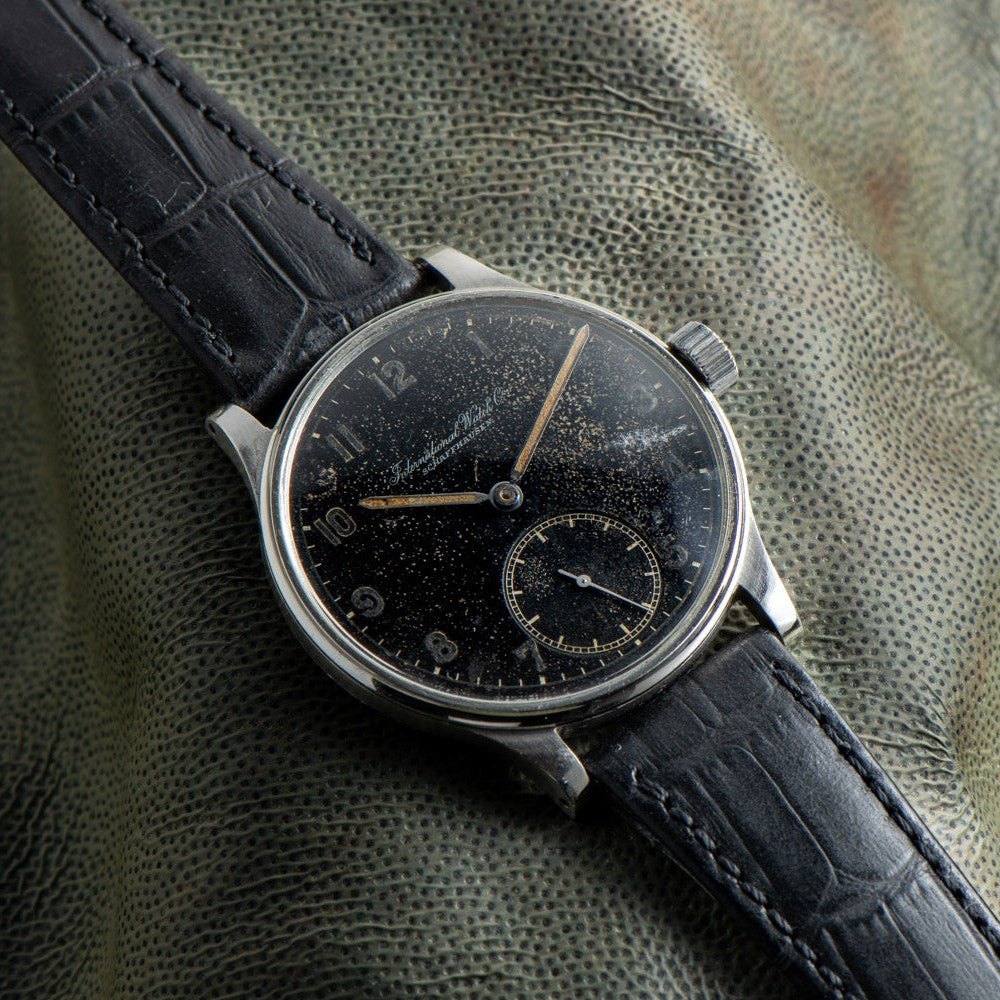
IWC Portugieser, 1943
- Maker / attribution
- IWC (maker)
- Date
- 1943
- Historical period
- Golden Age of Mechanical Watchmaking (1900 – 1945)
- Country of origin
- Switzerland
- Object type
- Wristwatch
- Dimensions
- Case 42 mm
- Stock no.
- 40970084
- Credit line
- Dealer listing, Analog/Shift (40970084)
- Catalogue title (original)
- IWC Portugieser (English)
View the source record (dealer listing) ↗ (opens another website in a new tab)Suggest a correction
Record summary
Catalogued by Analog/Shift (dealer), New York (stock number 40970084), this is a wristwatch by IWC, made in Switzerland, dated 1943. The Atlas places it in the Golden Age of Mechanical Watchmaking period (1900 – 1945) of its Wristwatches collection. Recorded dimensions: Case 42 mm. The record is illustrated with 6 photographs.
Assembled from the source record's structured fields. Dates and attributions are given as the source states them; where a field is missing the Atlas leaves it blank rather than estimating.
Catalogue description
Dealer description — Analog/Shift
Founder's Select The Reference 325 Portugieser from IWC is the first of the line — one of the very watches that spawned a collection, pushing towards a hundred years of history. It absolutely belongs in a museum... -James Lamdin Ever wonder why IWC makes such oversized tool watches? Well, here we have (at least part of) the answer: The Ref. 325 Portugieser. Developed to satisfy the request of two Portuguese merchants who desired an oversized, highly accurate wristwatch, the 325 paired one of the International Watch Company's pocket watch movements (initially the Calibre 74) with an oversized 42mm Staybrite steel wristwatch case ("Mod. 228") produced by Biel-based Wyss & Cie. Corrosion- and scratch-resistant — though not waterproof — it merged the pocket- and wristwatch worlds in a defiantly large package some 50 years before such a thing was trendy. Well under 1,000 pieces were produced across several references between 1931 and 1981, making original Portugieser watches incredibly rare and highly desirable. This particular example from 1943 is a thing of true tool-watch beauty: Measuring 42mm in the famous Mod. 228 Staybrite steel case with a satin caseband, a satin bezel, a snap-on caseback, polished 'holey' lugs, an easy-winding 'turbine crown, and an acrylic crystal, it features a heavily patinated black luminous dial that has taken on the aspect of the night sky — complete with hundreds of tiny stars. Boasting an outer open minute track, luminous 'Arabic' indices, a radial subsidiary-seconds display above 6 o'clock, and a luminous 'sword' handset, it's finished with the cursive 'International Watch Company' wordmark used on 20th-century IWC timepieces. Powered by the hand-wound IWC Calibre 74 pocket watch movement with 16 jewels and a beat rate of 18,000 vph — which was treated to a full recent service by IWC — it comes finished with a black alligator strap and an IWC-signed steel pin buckle. Accompanied by a certificate of authenticity from IWC, this superb example of vintage craftsmanship exists at the exciting convergence of several fascinating histories: That of the International Watch Company, the Second World War, and the transition from the pocket watch to the wristwatch. Who wouldn't want to own such an incredible horological object?
Historical context
Golden Age of Mechanical Watchmaking (1900 – 1945)
The wristwatch displaces the pocket watch; waterproof cases, self-winding and grand complications.
The wristwatch overtook the pocket watch. Military use in the First World War, aviation, water-resistant cases (1926), automatic winding (1923–31), rectangular Art Deco designs and early chronographs and calendars defined the period.
Read the period in the timelineMore wristwatches from this periodEarlier: Industrial Revolution
Atlas type guide
Wristwatches
Bracelet watches were worn by women from the early nineteenth century — Breguet made one for Caroline Murat, Queen of Naples, in 1810–12 — but the wristwatch only became a man's instrument with military use and aviation in the early twentieth century. Between the World Wars it overtook the pocket watch; the 1920s and 1930s brought rectangular Art Deco cases, water-resistant cases and the first automatic winding systems.
After 1945 the wristwatch became a carrier of identity — dress watches, sports and dive watches, chronographs, calendars — produced by Swiss, American, Japanese, German, Soviet and Chinese industries. The quartz revolution after 1969 and the mechanical renaissance since the 1990s, including the rise of independent watchmakers, complete the story.
What to look for
- The reference number (between the lugs or inside the case back) and serial number, the starting point for dating.
- The calibre: its maker and number are often stamped under the dial or on the bridge.
- Originality of dial, hands and crown — refinished ('redial') dials are common.
- Case material marks: 18K/750, 14K/585, stainless steel, gold-filled, plated.
Dating clues
- Wire-lug cases: before c. 1925.
- Water-resistant screw-down cases: from 1926.
- Quartz movements: from 1969; sapphire crystals widespread after c. 1980.
General guidance written by the Atlas editors about this kind of object. It is not a statement about this particular piece; for that, rely on the source record above and on physical examination.
Related records
Pocket Watches · c. 1950
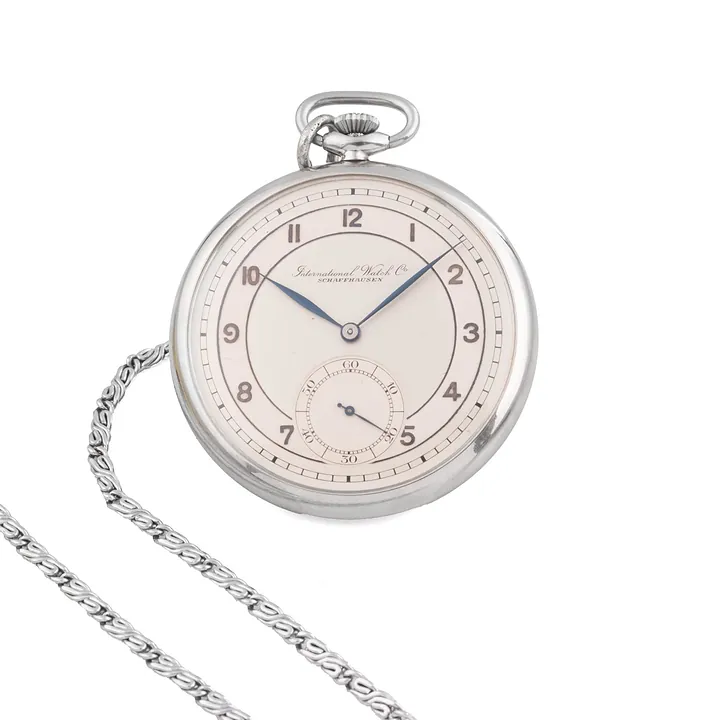
IWC Pocket Watch, c. 1950
Antiquorum auction archive, Geneva
Pocket Watches · c. 1980
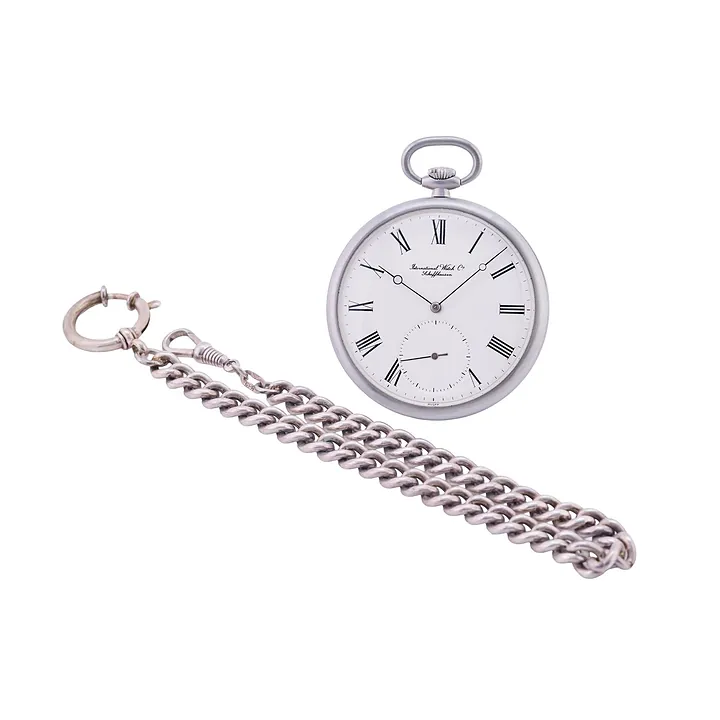
IWC pocket watch, ref. 5301, c. 1980
Antiquorum auction archive, Geneva
Wristwatches · originally sold in April 2016 (per the lot record)
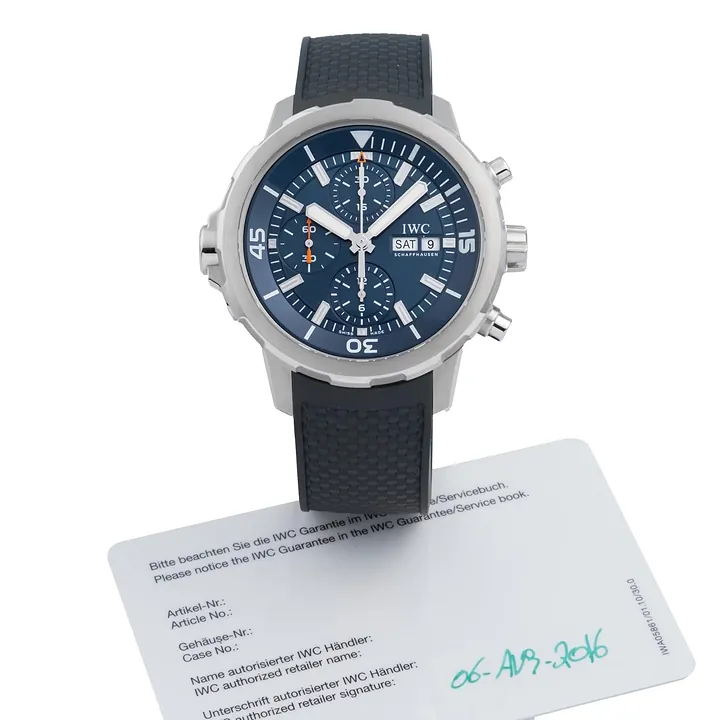
IWC Aquatimer Chronograph Cousteau, ref. IW3768, originally sold in April 2016
Antiquorum auction archive, Geneva
Wristwatches · c. 2010s
IWC wristwatch, ref. IW371918, Aquatimer, circa 2010s
Antiquorum auction archive, Geneva

Wristwatches · 1931
Rolex 'Oyster Perpetual' rotor self-winding wrist-watch, lever escapement, in steel case with glass in back, Montres Rolex SA, Geneva, Switzerland, 1931
Science Museum Group, London

Wristwatches · 1900–1999
Wristwatch by Certina, Switzerland, 1900–1999
Nordic Museum Foundation

Wristwatches · 1900–1999
Wristwatch by Omega, Västerås, 1900–1999
Nordic Museum Foundation

Wristwatches · 1900–1999
Wristwatch by Universal, Switzerland, 1900–1999
Nordic Museum Foundation