
Wristwatches · Wristwatch
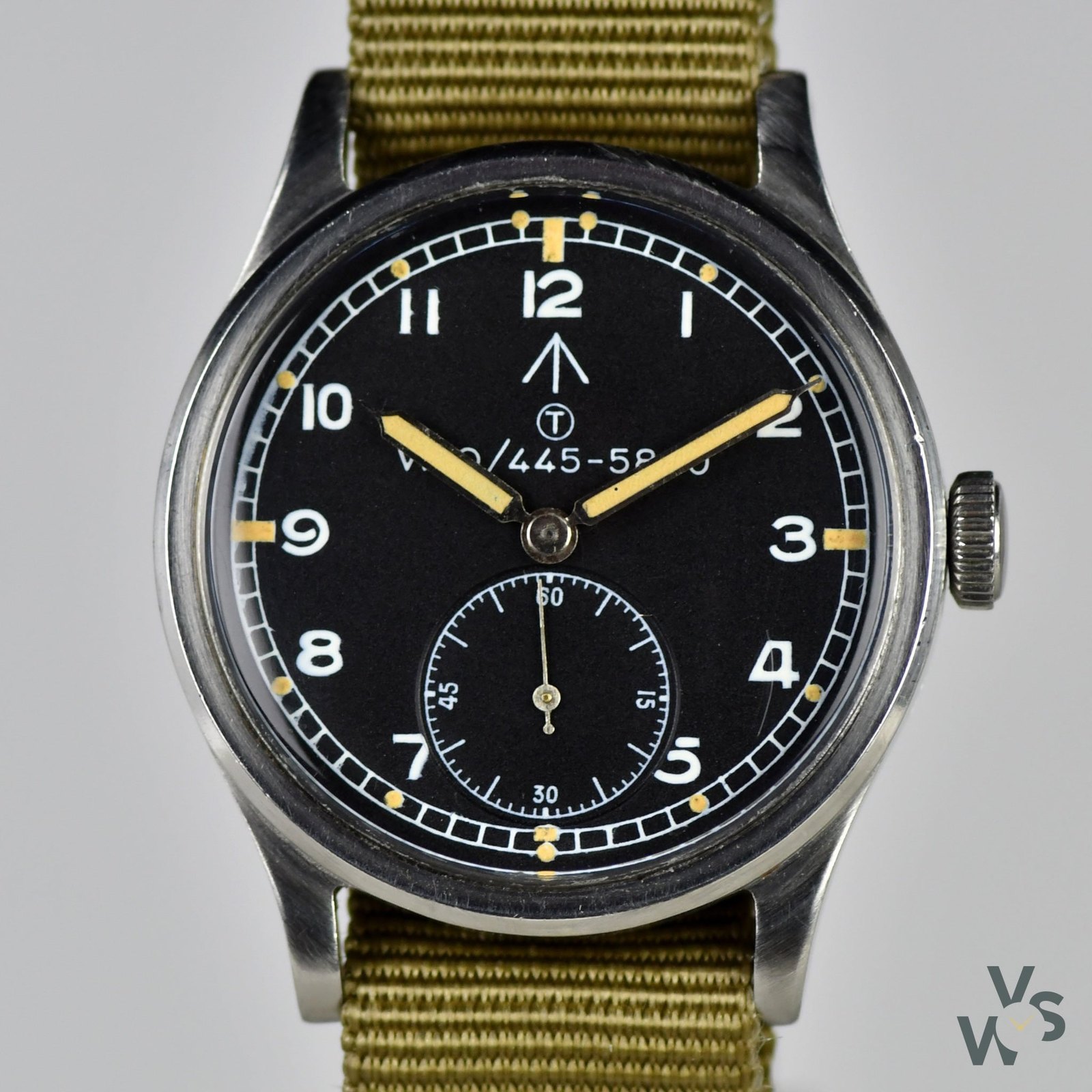
International Watch Company, Mark X, WWW Dirty Dozen Military Watch, With Rare NATO Dial, circa 1945
- Maker / attribution
- IWC (maker)
- Date
- c. 1945
- Historical period
- Modern Mechanical Horology (1945 – 1969)
- Country of origin
- Switzerland
- Object type
- Wristwatch
- Dimensions
- Case 35 mm
- Stock no.
- vws2341
- Credit line
- Dealer listing, Vintage Watch Specialist (vws2341)
- Catalogue title (original)
- International Watch Company - Mark X - WWW Dirty Dozen Military Watch C.1945 - With Rare NATO Dial***NOW SOLD*** (English)
View the source record (dealer listing) ↗ (opens another website in a new tab)Suggest a correction
Record summary
Catalogued by Vintage Watch Specialist (dealer), United Kingdom (stock number vws2341), this is a wristwatch by IWC, made in Switzerland, dated c. 1945. The Atlas places it in the Modern Mechanical Horology period (1945 – 1969) of its Wristwatches collection. Recorded dimensions: Case 35 mm. The record is illustrated with 6 photographs.
Assembled from the source record's structured fields. Dates and attributions are given as the source states them; where a field is missing the Atlas leaves it blank rather than estimating.
Catalogue description
Dealer description — Vintage Watch Specialist
The IWC Mark 10 is also Known for its Military 'WWW' Dirty Dozen Military Markings - Issued During WWII, c.1945 - NATO Dial (NATO issue codes on the dial with 'T' for tritium and MoD Broad Arrow). We Are Sorry But This Watch Is Now Sold - If However You Are Looking To Buy Or Sell Something Similar Then Please Email Sales@Vintagewatchspecialist.Com Or Whatsapp/Call +44 7831 454658. Thanks IWC or to give its full title, International Watch Co. AG, doing business as IWC Schaffhausen, is a luxury Swiss watch manufacturer located in Schaffhausen, Switzerland and founded by American watchmaker Florentine Ariosto Jones in 1868. In 1869 F.A. Jones rented the first factory premises in an industrial building owned by J.H. Moser at the Rheinstrasse. Very soon he had to rent further rooms in the Oberhaus, one of the oldest buildings in Schaffhausen. By 1874 plans were already being made for a new factory and a site was purchased from Moser's hydroelectric company which was directly adjacent to the banks of the Rhine and called the Baumgarten. During 1944 and 1945, twelve watchmakers (Buren, Cyma, Eterna, Grana, JLC, Lemania, Longines, IWC, Omega, Record, Timor and Vertex) produced a total of approximately 150,000 of these almost identical timepieces. Though there are subtle differences, they were produced to tight specifications - designed to be waterproof, have fixed lug bars, numbers and indices, a matte black dial with luminescent hands (originally made of radium) and a small, functional and reliable movement. Of the approximate 150,000 watches produced, only circa 5000 were from IWC making them incredibly rare and sought after among collectors. The 35mm stainless steel case wears very generously on the wrist and beating inside is the cal. 83 movement with pencil hands and broad arrow remaining very present on the dial. The watch on offer here is even rarer due to the NATO dial. These dials replaced by the R.E.M.E (Royal Electrical & Mechanical Engineers) are known as either MoD or NATO dials, depending on the dial inscriptions and period, inadvertently giving way to a whole host of variances within the dozen. Remember, at the time, it wasn’t about originality and collectability but about function. That, coupled with the lack of record keeping, is only through compiling and documenting the existing watches that collectors are able to determine what is deemed to be original. Although collectors often prefer originality, the sheer rarity of the IWC on offer teamed with the NATO dial makes the present watch all the more sought after and special. What's on offer The stainless steel case is sublime and unpolished and retains the W.W.W engraving on the back which is what we all come to expect from the infamous “Dirty Dozen”. The dial is crisp and legible with the wonderful seconds sub-dial finishing off this watch superbly. The NATO dial makes for an extra special variant over the IWC branded dial and creates an additional exclusivity within this already rare group of watches. The pumpkin lume on the hour plots and hands is in beautiful condition really punching out from the starkness of the black dial and adding much warmth. Stunning! For many collectors of watches, the “Dozen” represent something of a treasure hunt that many haven’t completed after a lot of hard work and searching. The task of compiling the full 12 is a tall order but one that gains the respect of watch collectors. This watch was serviced by the eminent military watch specialist and watchmaker, John Senior so rest assured it runs extremely well and looks great! Additional information Made from Case: Steel Case back: Clip back Dial: B lack, 'NATO' with issue numbers Crystal: Shatter-proof plexi Bracelet : NATO military-style Technical specifications Winding: Manually wound Movement type : mechanical Calibre : 83 Jewels: 16j Waterproof : when new! Purchase details Condition: Excellent Model Reference Number: WWW-NATO Date of issue : Circa 1944 Dimensions Width: 35mm Lug width : 17mm Lug height (lug to lug) : 46mm Wrist size : Adjustable
Historical context
Modern Mechanical Horology (1945 – 1969)
Tool watches for divers, pilots and astronauts; electric watches anticipate the electronic age.
The classic era of the mechanical wristwatch: dive watches, chronographs for motor racing and space flight, GMT watches for jet travel, slim dress watches, automatic calendars, and the rise of Japanese manufacturers alongside Swiss, American, German and Soviet industries.
Read the period in the timelineMore wristwatches from this periodEarlier: Golden Age of Mechanical Watchmaking
Atlas type guide
Military, pilot and travel watches
The wristwatch owes much of its adoption by men to warfare and aviation. Wristlets — small pocket watches soldered with lugs and worn on a strap — were used in colonial campaigns and became standard equipment in the First World War, with protective grilles over the crystal ('shrapnel guards'). Louis Cartier's Santos (1904), designed for the aviator Alberto Santos-Dumont, is often cited as an early purpose-made pilot's watch.
In the Second World War governments specified watches in detail: the German B-Uhr observation watches, the American A-11, and the British 'W.W.W.' (the 'Dirty Dozen' set of 1945). After the war, jet travel brought GMT and world-time watches, which show two or more time zones at once — Louis Cottier's world-time mechanism and the Rolex GMT-Master (1955) are examples.
What to look for
- Military markings on the case back: broad arrow, issue numbers, 'W.W.W.', 'A.T.P.'
- High-legibility black dials with luminous Arabic numerals; oversized crowns for gloved hands.
- 24-hour hands and rotating 24-hour bezels or city rings on GMT/world-time watches.
- Wire lugs on early wristlets converted from pocket watches.
Dating clues
- Wire-lug wristlets: c. 1900–1925.
- Military specifications of the Second World War: 1939–1945.
- GMT and world-time wristwatches: mainly after 1950.
General guidance written by the Atlas editors about this kind of object. It is not a statement about this particular piece; for that, rely on the source record above and on physical examination.
Related records
Pocket Watches · c. 1950
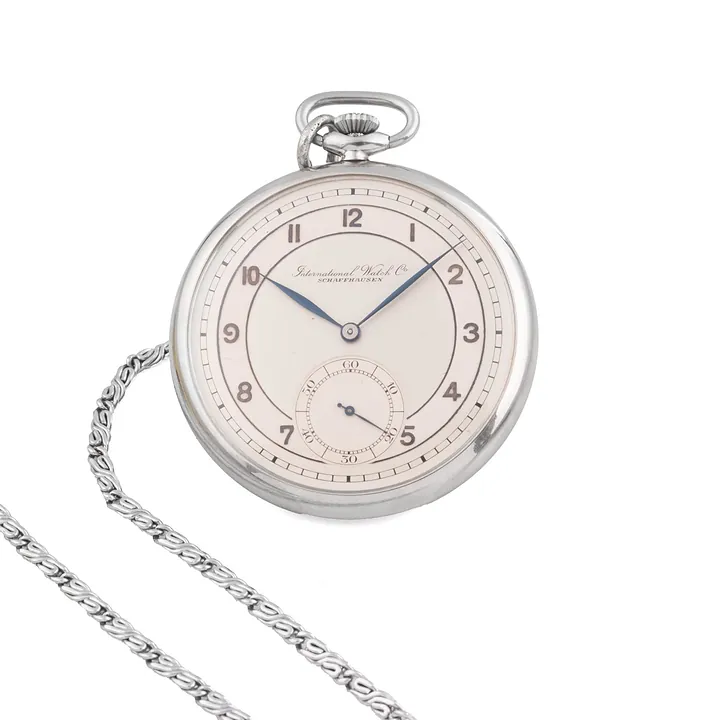
IWC Pocket Watch, c. 1950
Antiquorum auction archive, Geneva
Pocket Watches · c. 1980
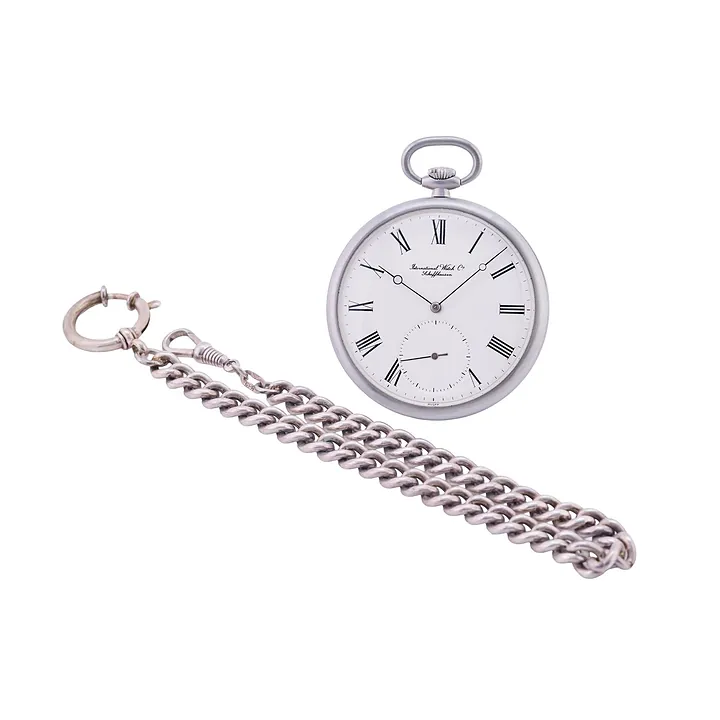
IWC pocket watch, ref. 5301, c. 1980
Antiquorum auction archive, Geneva
Wristwatches · originally sold in April 2016 (per the lot record)
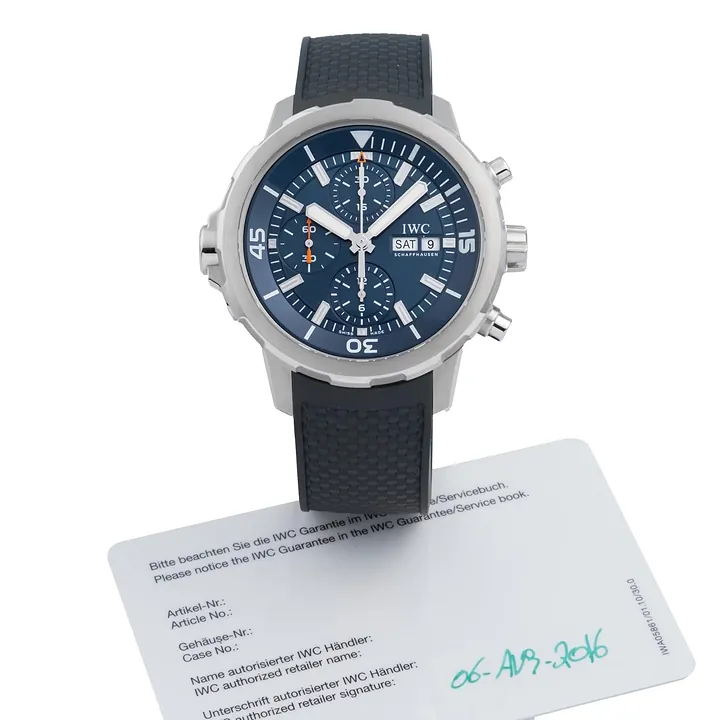
IWC Aquatimer Chronograph Cousteau, ref. IW3768, originally sold in April 2016
Antiquorum auction archive, Geneva
Wristwatches · c. 2010s
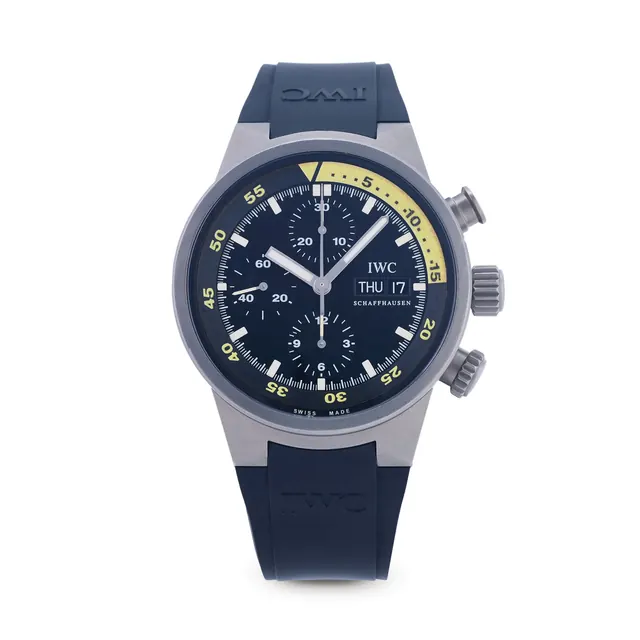
IWC wristwatch, ref. IW371918, Aquatimer, circa 2010s
Antiquorum auction archive, Geneva

Wristwatches · 1945
Wristwatch by Eterna, 1945
Museum Rotterdam

Wristwatches · c. 1945
Breitling Premier, ref. 790, c. 1945
Antiquorum auction archive, Geneva

Wristwatches · c. 1945
Universal Genève Uni-Compax, ref. 22492, c. 1945
Antiquorum auction archive, Geneva

Wristwatches · c. 1950s
Baume & Mercier wristwatch, c. 1950s
Antiquorum auction archive, Geneva