
Instruments · Hourglass
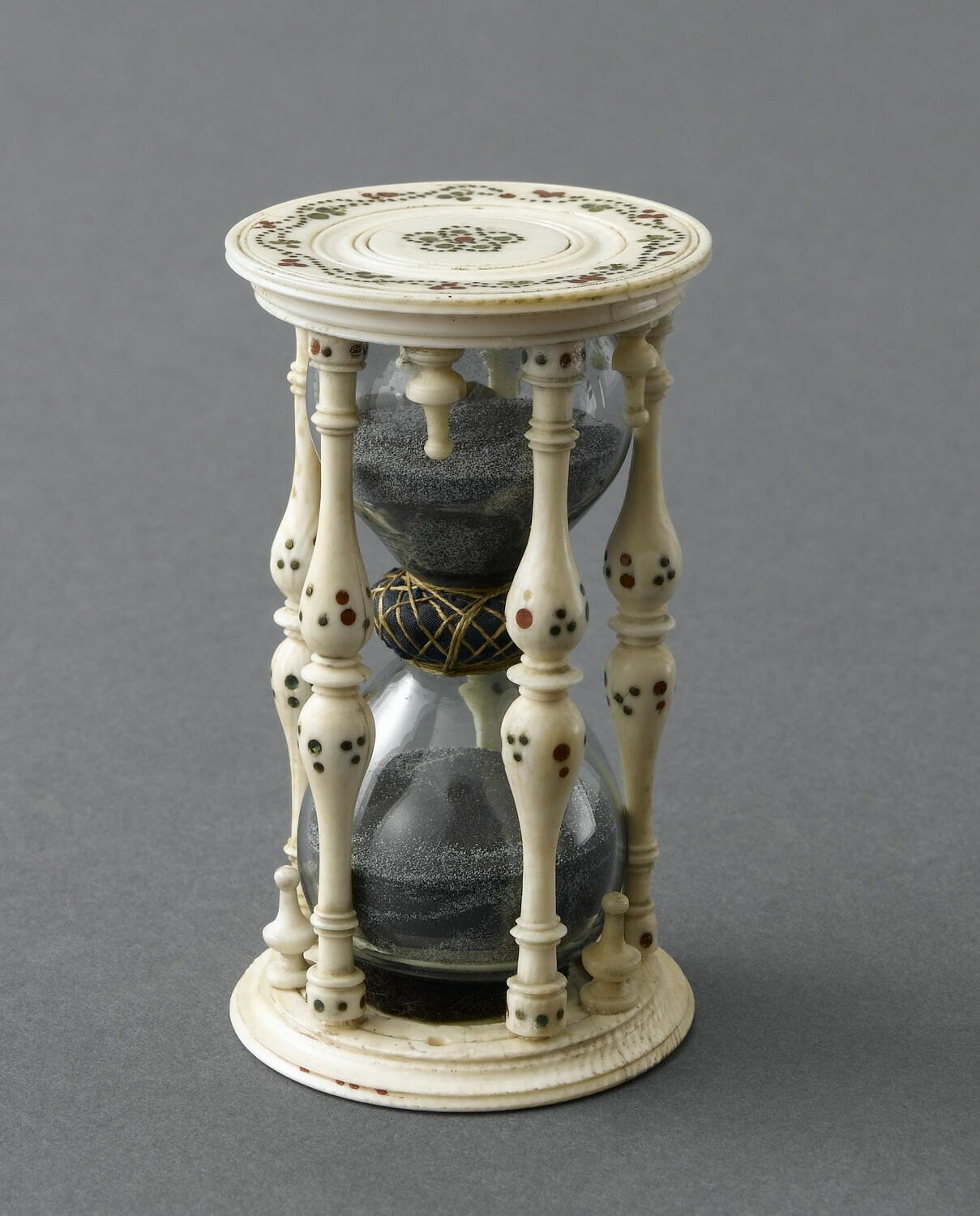
Hourglass, Italy, 1600–1700
- Maker / attribution
- Unrecorded in source
- Date
- 1600–1700
- Historical period
- Early Modern Horology (1600 – 1750)
- Country of origin
- Italy
- Place
- Italie, Italy
- Object type
- Hourglass
- Materials / technique
- glass, silk
- Dimensions
- height 7,5 cm; diameter 4,5 cm
- Holding institution
- Musée du Louvre, Paris
- Accession / object no.
- OA 184
- Credit line
- Musée du Louvre, Département des Objets d'art du Moyen Age, de la Renaissance et des temps modernes
- Catalogue title (original)
- Sablier (French)
View the source record ↗ (opens another website in a new tab)Suggest a correction
Record summary
Held and catalogued by Musée du Louvre, Paris (object number OA 184), this is a hourglass, made in Italie, Italy, dated 1600–1700. The Atlas places it in the Early Modern Horology period (1600 – 1750) of its Instruments collection. Materials and techniques recorded by the source: glass, silk. Recorded dimensions: height 7,5 cm; diameter 4,5 cm. The record is illustrated with 3 photographs.
Assembled from the source record's structured fields. Dates and attributions are given as the source states them; where a field is missing the Atlas leaves it blank rather than estimating.
Catalogue description
Catalogue description — Musée du Louvre (French)
Le verre est tenu entre deux plaques d'ivoire mouluré, unies par cinq balustres. Le temps d'écoulement du sablier est d'une heure. Tous les éléments d'ivoire sont réalisés au tour. Le décor est obtenu par une série de perforations qui sont remplies de pâte rouge ou verte. A cause de cette technique particulière, le sablier est décrit dans les anciens catalogue comme "piqué de cuivre". C'est en fait une imitation d'un type de décor particulièrement en vogue à Venise à partir de la fin du XVIIe siècle : de petits objets d'ivoire décorés de clous de cuivre et de perles de verre qui forment des motifs floraux très simples ou des volutes. Ici, ces pastilles colorées forment un décor de marqueterie sur les colonnes et, "sur les bases un décor de guirlande entourant une rosace centrale. Entre les colonnes, des petites formes tournées bordent la fiole. Cette dernière se compose de deux globules arrondis dont le joint est couvert de soie bleue serrée de fils dorés. Le sable est de couleur gris-bleu et s'écoule apparemment en 1 heure.n° " (Frémontier-Murphy, 2002)
Shown in the original language of the source catalogue. An editor-reviewed English translation has not yet been published; we do not publish machine translations as authoritative text.
Dating and period as catalogued (French)
Epoque / période : époque moderne = Ancien Régime (Occident) · · Date de création/fabrication : 1600 - 1700
Shown in the original language of the source catalogue. An editor-reviewed English translation has not yet been published; we do not publish machine translations as authoritative text.
Materials and techniques as catalogued (French)
Matériau : ivoire d'éléphant = défense d'éléphant · Matériau : verre · Matériau : sable (coloré) · Matériau : soie · Matériau : métal (fils de métal)
Shown in the original language of the source catalogue. An editor-reviewed English translation has not yet been published; we do not publish machine translations as authoritative text.
Provenance
Collection Alexandre-Charles Sauvageot (1781-1860) ; acquis par Sauvageot en 1855, cf. le Livre d'achat n° 2611 : "petit sablier à balustres, en ivoire piqué / 15 francs" ; minute de la donation Sauvageot 1DD139 série A n° 127 p. 19 : "Petit sablier en ivoire blanc avec 5 pilastres, le tout clouté en cuivre et marqueté d'ivoire de couleur du temps de Louis XIII", dim. 075 x 044 ; donation acceptée en 1856, acte notarié le 6 mars 1857, n° 129 : "Petit sablier en ivoire, estimé cent-cinquante francs".
Historical context
Early Modern Horology (1600 – 1750)
Huygens' pendulum and balance spring transform accuracy; English makers develop the anchor and deadbeat escapements.
Pocket sundials, Butterfield dials and sandglasses remained essential companions to imperfect clocks; navigators used sandglasses and the log line; observatories began to combine telescopes with pendulum clocks.
Read the period in the timelineMore instruments from this periodEarlier: Renaissance Horology
Atlas type guide
Sandglasses and hourglasses
A sandglass measures an interval rather than telling the time of day: a fixed quantity of fine material runs from one bulb into the other through a narrow neck. Documented in Europe from the fourteenth century, sandglasses were used on board ship to time watches and to measure speed with the log line, in churches to time sermons, in schools, laboratories and kitchens.
Early glasses were made as two separate bulbs bound together at the neck with a diaphragm and wax and thread; one-piece blown glasses only became usual in the nineteenth century. The 'sand' could be powdered marble, eggshell or metal filings, carefully sieved and dried. Sets of graduated glasses in one frame allowed several intervals to be timed.
What to look for
- Whether the two bulbs are separate and bound at the neck, or blown as one piece.
- The frame: turned wood, brass, silver or pewter, sometimes with pillars and decorated end plates.
- Multiple glasses in a single frame, giving quarter, half, three-quarter and full hours.
- Marine glasses of 30 seconds or 28 seconds used with the log line.
Dating clues
- Bound two-piece glasses predate about 1800; one-piece glasses are generally later.
- Sermon glasses on pulpits and multi-glass frames are characteristic of the sixteenth to eighteenth centuries.
General guidance written by the Atlas editors about this kind of object. It is not a statement about this particular piece; for that, rely on the source record above and on physical examination.
Related records
Instruments · 1575–1625
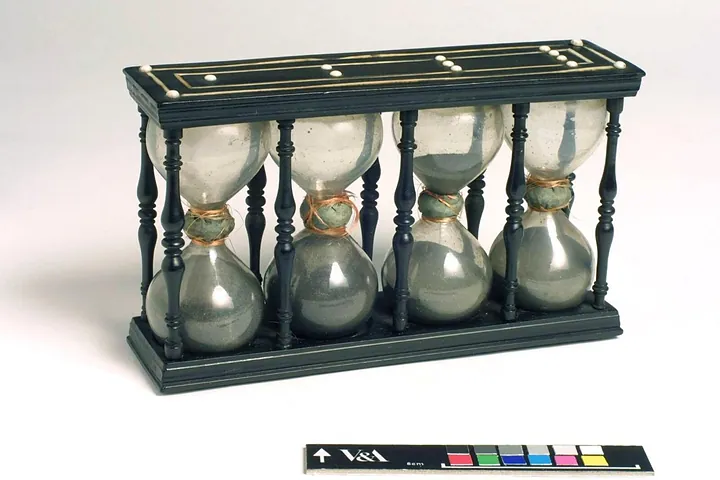
Sand-glass set (x4) fitted into an ebony case, inlaid with ivory. Italian, c1600
Victoria and Albert Museum, London
Instruments · 1601–1700
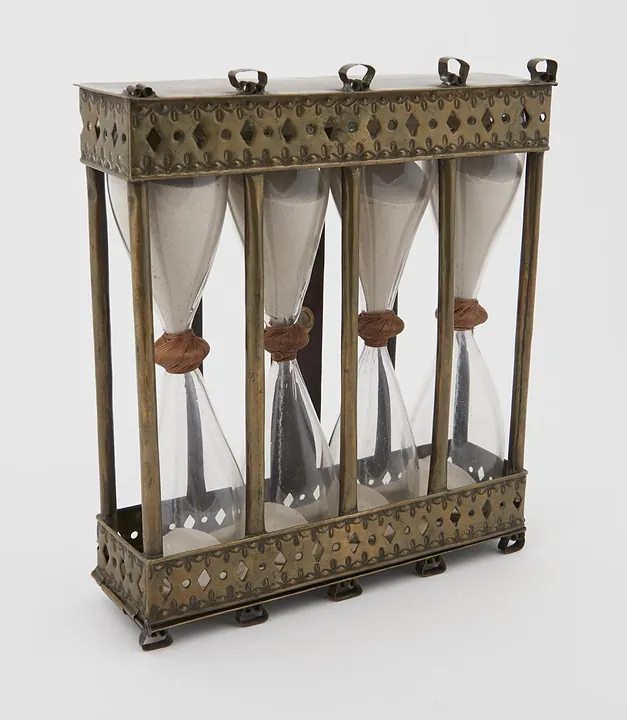
17th century Italian four-way hour glass with brass stand
Science Museum Group, London
Instruments · 1601–1700
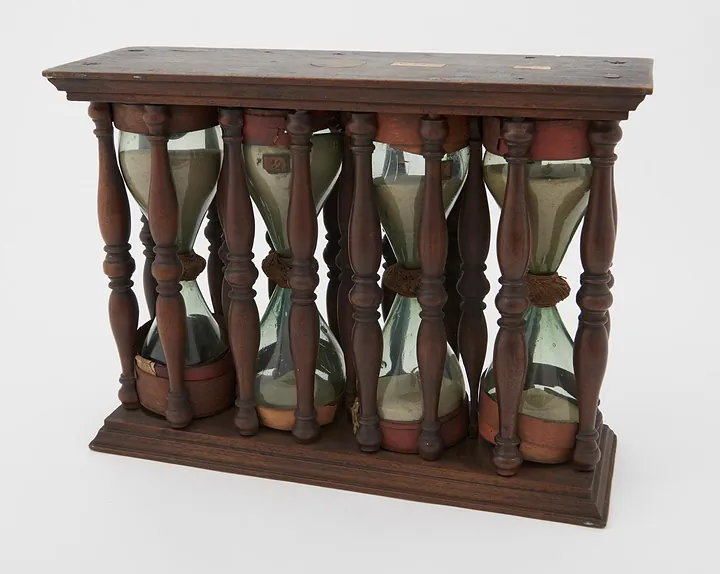
Italian four-way hour glass with wooden frame, 1601–1700
Science Museum Group, London
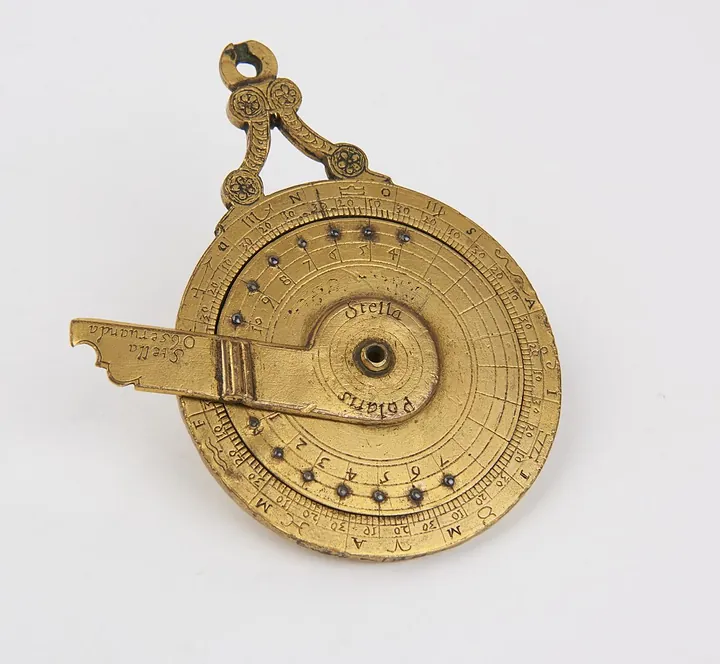
Instruments · 1601–1650
Nocturnal, brass gilt, diameter 2 3/4in. Italian, 1601–1650
Science Museum Group, London
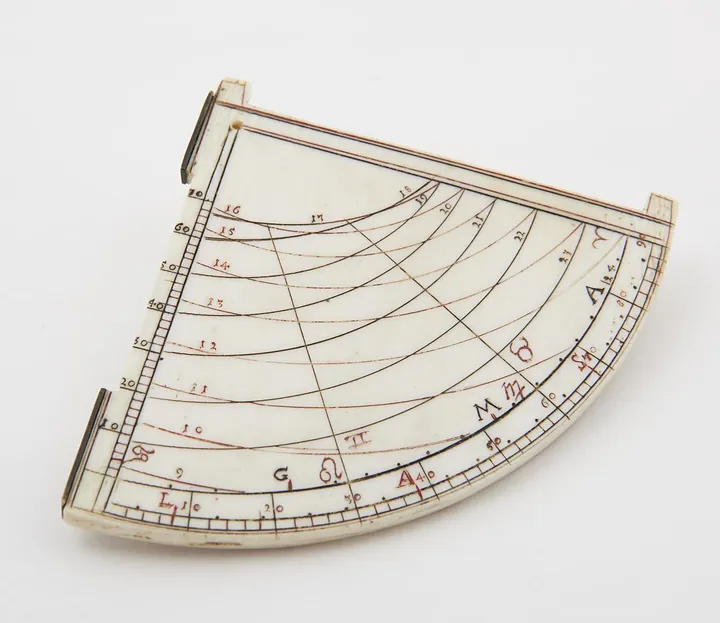
Instruments · 1601–1700
Quadrant sundial of ivory, Italian hours, for use at latitude 44°, Italy, 1601–1700.
Science Museum Group, London
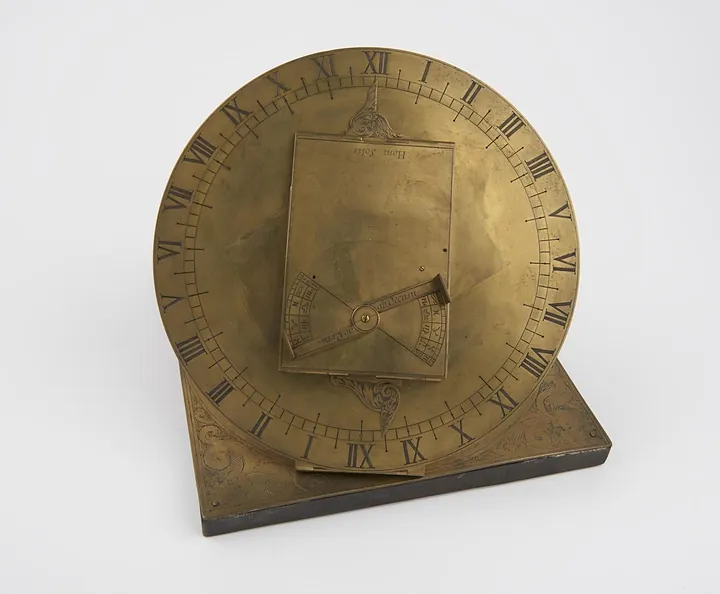
Instruments · 1651–1700
Azimuth Sundial, brass, "Jacobus Lusuerg" fa: Romae
Science Museum Group, London
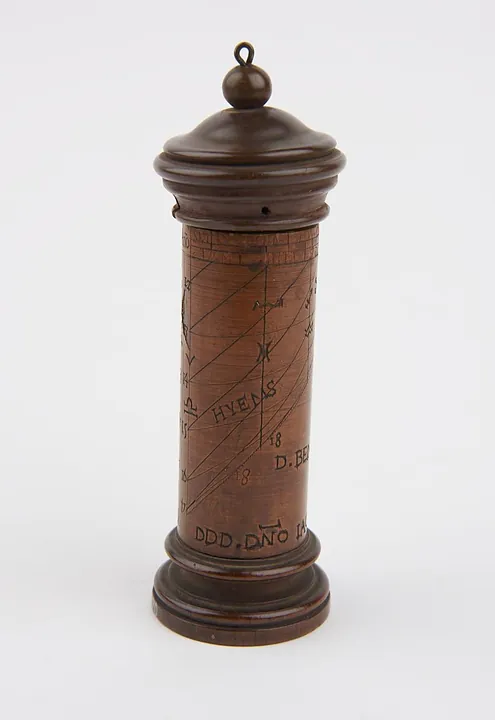
Instruments · 1677
Wooden column sundial, showing Italian hours, signed and dated 1677. Probably Italian.
Science Museum Group, London
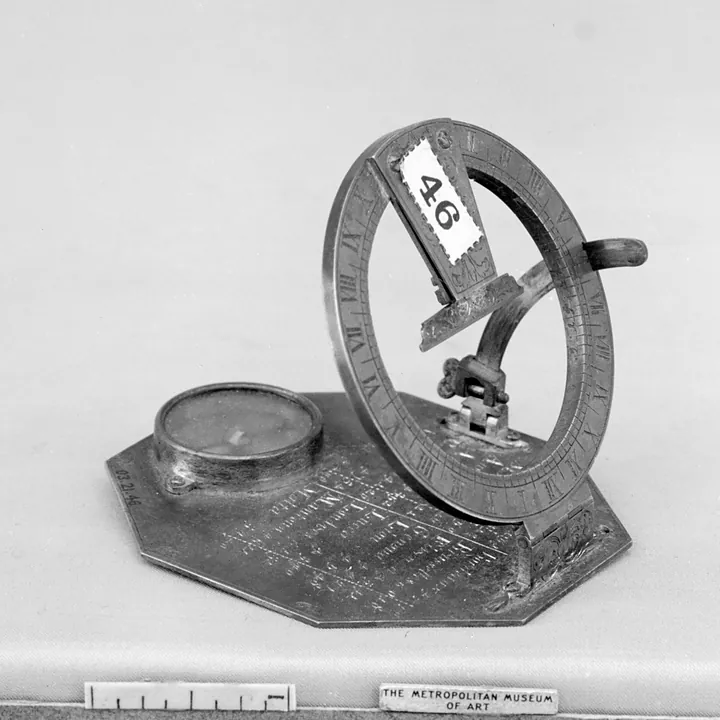
Instruments · 1701
Portable equatorial or equinoctial sundial by Dominicus Lusuerg, 1701
The Metropolitan Museum of Art, New York