Instruments · Sand-glass
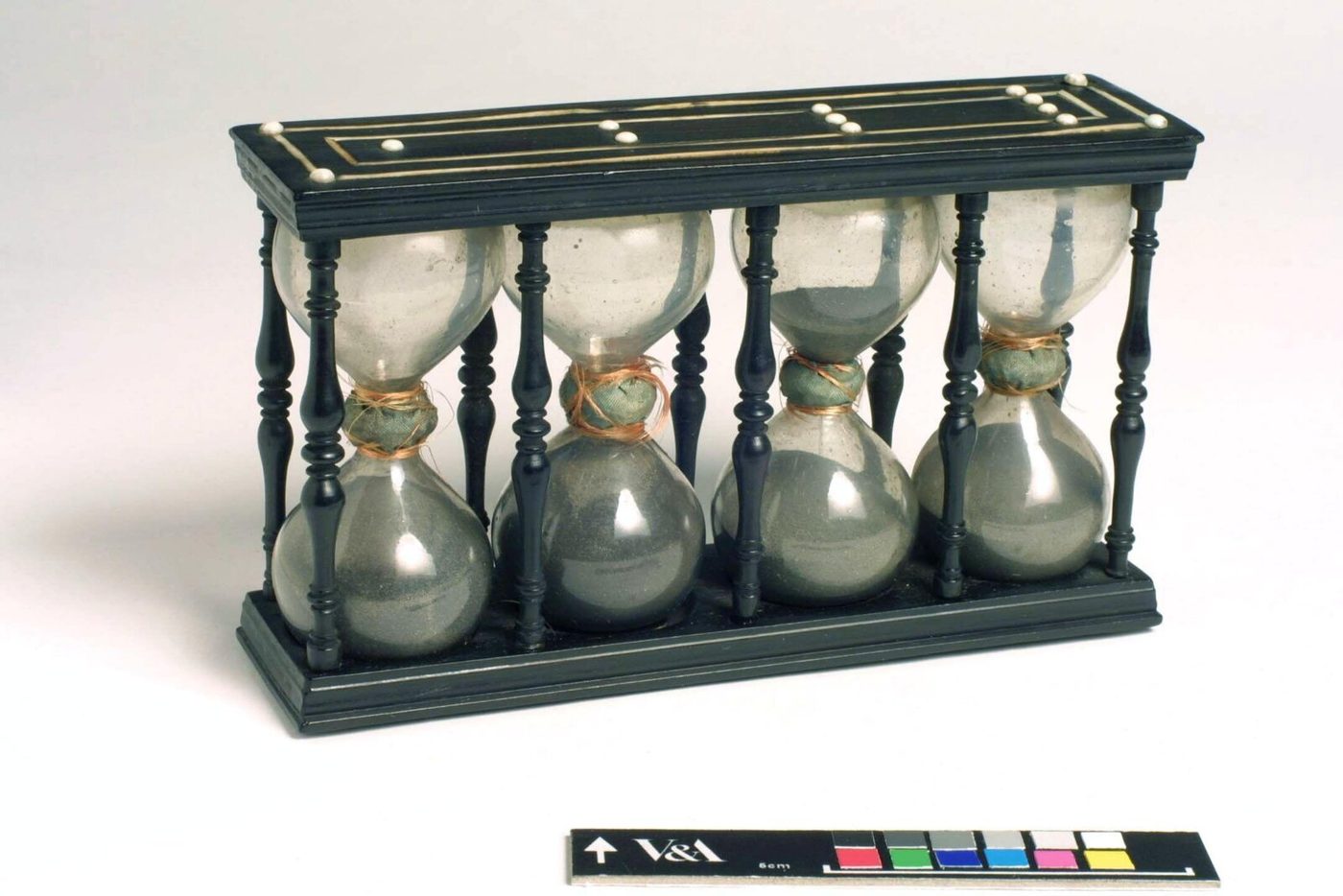
Sand-glass set (x4) fitted into an ebony case, inlaid with ivory. Italian, c1600
- Maker / attribution
- Unrecorded in source
- Date
- 1575-1625
- Historical period
- Early Modern Horology (1600 – 1750)
- Country of origin
- Italy
- Place
- Italy
- Object type
- Sand-glass
- Materials / technique
- Blown glass in a frame of ebony inlaid with ivory (or bone)
- Dimensions
- Height: 8.3 cm; Width: 14.5 cm
- Holding institution
- Victoria and Albert Museum, London
- Accession / object no.
- 82-1880
Record summary
Held and catalogued by Victoria and Albert Museum, London (object number 82-1880), this is a sand-glass, made in Italy, dated 1575-1625. The Atlas places it in the Early Modern Horology period (1600 – 1750) of its Instruments collection. Materials and techniques recorded by the source: Blown glass in a frame of ebony inlaid with ivory (or bone). Recorded dimensions: Height: 8.3 cm; Width: 14.5 cm. The record is illustrated with 1 photograph.
Assembled from the source record's structured fields. Dates and attributions are given as the source states them; where a field is missing the Atlas leaves it blank rather than estimating.
Catalogue description
V&A — Summary
During the 16th and 17th centuries sandglasses were used in various situations: in churches, typically to time the sermon; on ships to time the length of the watches; in the kitchens of wealthy households, probably to help judge cooking times. They are often illustrated in scholars' studies where they served meditation, or simply helped judge the time of day. Sandglasses in this period were constructed from two matching glass ampoules sealed (often with wax or pitch) and bound with fabric at the joint. The 'sand' was usually a material less sensitive to moisture such as powdered metal, rock or eggshell. These four sandglasses in a single frame run for different periods, probably subdivisions of an hour, but it has not been possible to time them precisely as the particles no longer run freely.
V&A — Physical description
A sand-glass set or ‘battery’ of four glasses each composed of two ampoules or phials, mounted in a frame of ebony with ivory or bone inlay.
V&A — Historical context
Comparable sand-glasses See: C. F. C. Beeson, 'Sandglass in cloth of gold’, in Antiquarian Horology,_ 1968, 417-418 and and front cover picture (p. 385). With numbers for the quarter hours painted on the ampoules. Possibly the same piece as included in Anna, Dominique and Eric Delalande, Sabliers d’autrfefois... , Paris 2015, pp. 170-173 The portait by Hans Eworth of William Cecil, First Baron Burghley, c.1565 (Hatfield House) depicts a broadly similar sand-glass.
V&A — Object history
Bought for £3 from Mons. Fulgence, Paris. Display history: displayed in room 5 (case W.129) by 1925 (with 83-1880), and in room 74 (1964); in store (room 125s) by the 1980s. These four sandglasses in a single frame run for different periods, probably 15min, 30min, 45min & 1 hour, although 5, 10, 15 & 20 minutes are also possible; it is not possible to time them as the particles no longer run freely. It is likely to have been used for timing private study or personal devotions.
Historical context
Early Modern Horology (1600 – 1750)
Huygens' pendulum and balance spring transform accuracy; English makers develop the anchor and deadbeat escapements.
Pocket sundials, Butterfield dials and sandglasses remained essential companions to imperfect clocks; navigators used sandglasses and the log line; observatories began to combine telescopes with pendulum clocks.
Read the period in the timelineMore instruments from this periodEarlier: Renaissance Horology
Atlas type guide
Sandglasses and hourglasses
A sandglass measures an interval rather than telling the time of day: a fixed quantity of fine material runs from one bulb into the other through a narrow neck. Documented in Europe from the fourteenth century, sandglasses were used on board ship to time watches and to measure speed with the log line, in churches to time sermons, in schools, laboratories and kitchens.
Early glasses were made as two separate bulbs bound together at the neck with a diaphragm and wax and thread; one-piece blown glasses only became usual in the nineteenth century. The 'sand' could be powdered marble, eggshell or metal filings, carefully sieved and dried. Sets of graduated glasses in one frame allowed several intervals to be timed.
What to look for
- Whether the two bulbs are separate and bound at the neck, or blown as one piece.
- The frame: turned wood, brass, silver or pewter, sometimes with pillars and decorated end plates.
- Multiple glasses in a single frame, giving quarter, half, three-quarter and full hours.
- Marine glasses of 30 seconds or 28 seconds used with the log line.
Dating clues
- Bound two-piece glasses predate about 1800; one-piece glasses are generally later.
- Sermon glasses on pulpits and multi-glass frames are characteristic of the sixteenth to eighteenth centuries.
General guidance written by the Atlas editors about this kind of object. It is not a statement about this particular piece; for that, rely on the source record above and on physical examination.
Related records
Instruments · 1601-1700
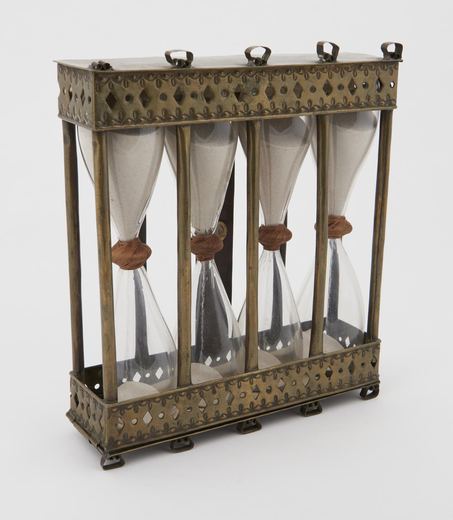
17th century Italian four-way hour glass with brass stand
Science Museum Group, London
Instruments · 1601-1700
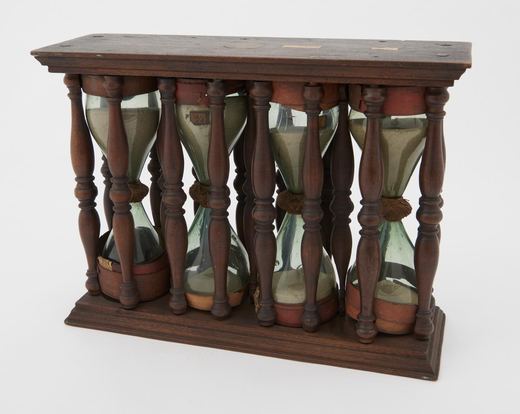
Italian four-way hour glass with wooden frame, 1601-1700
Science Museum Group, London
Instruments · 1601-1650
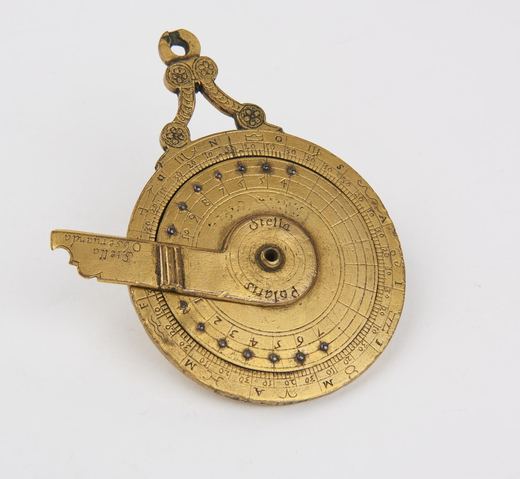
Nocturnal, brass gilt, diameter 2 3/4in. Italian, 1601-1650
Science Museum Group, London
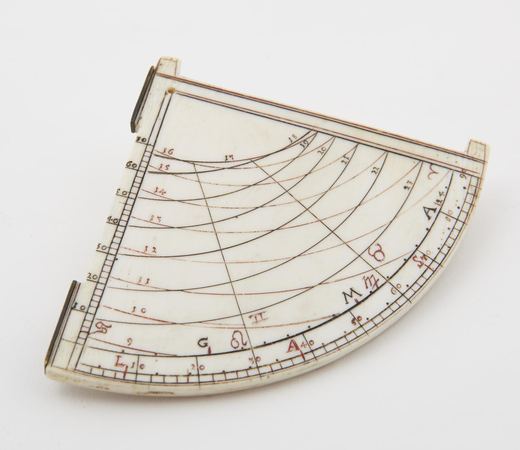
Instruments · 1601-1700
Quadrant sundial of ivory, Italian hours, for use at latitude 44°, Italy, 1601-1700.
Science Museum Group, London
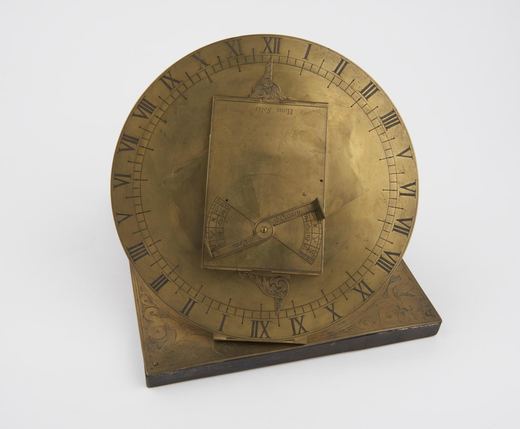
Instruments · 1651-1700
Azimuth Sundial, brass, "Jacobus Lusuerg" fa: Romae
Science Museum Group, London
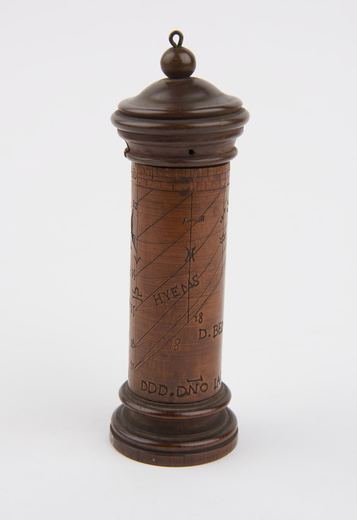
Instruments · 1677
Wooden column sundial, showing Italian hours, signed and dated 1677. Probably Italian.
Science Museum Group, London
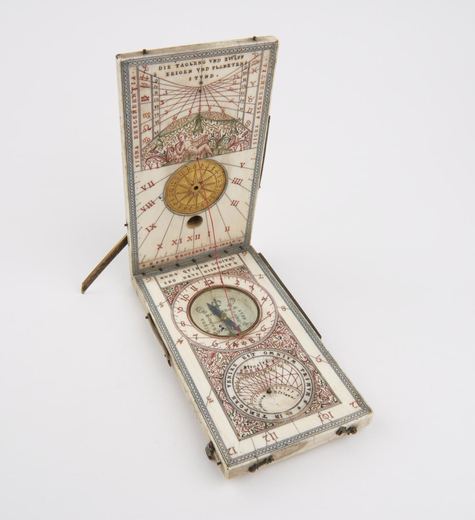
Instruments · 1578-1631
Tablet sun-dial 532-68, V & A M. reg, ivory inscribed "Hans Troschel faciebat", German, 6in by 3 1/4 in, 1578-1631
Science Museum Group, London
Instruments · 1593–1613
Sundial, Czech Republic, 1593–1613
MAK – Museum of Applied Arts