
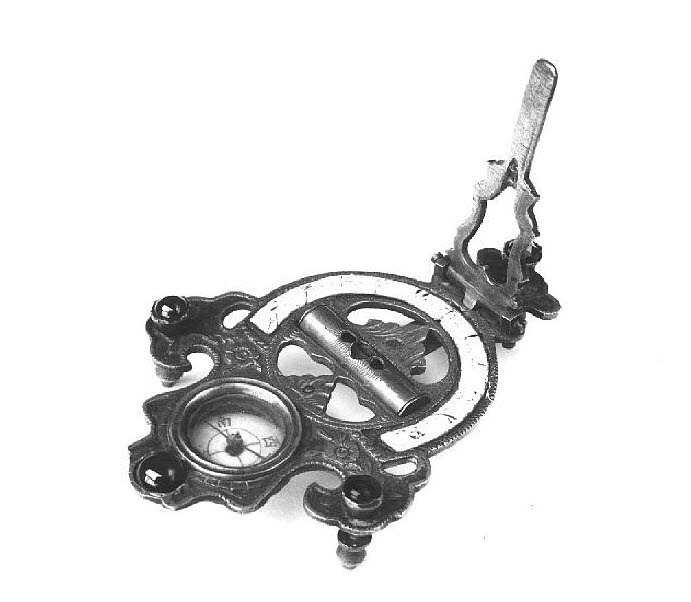
Instruments · Horizontal sundial
Horizontal sundial, 1800–1900
- Maker / attribution
- Unrecorded in source
- Date
- 1800–1900
- Historical period
- Precision & Scientific Horology (1750 – 1850)
- Country of origin
- Unrecorded in source
- Object type
- Horizontal sundial
- Materials / technique
- steel, copper alloy
- Dimensions
- length 10 cm; width 6,8 cm; height 2,5 cm; height 7,8 cm
- Holding institution
- Musée du Louvre, Paris
- Accession / object no.
- OA 10717
- Credit line
- Musée du Louvre, Département des Objets d'art du Moyen Age, de la Renaissance et des temps modernes
- Catalogue title (original)
- Cadran horizontal à fil-axe (French)
View the source record ↗ (opens another website in a new tab)Suggest a correction
Record summary
Held and catalogued by Musée du Louvre, Paris (object number OA 10717), this is a horizontal sundial, dated 1800–1900. The Atlas places it in the Precision & Scientific Horology period (1750 – 1850) of its Instruments collection. Materials and techniques recorded by the source: steel, copper alloy. Recorded dimensions: length 10 cm; width 6,8 cm; height 2,5 cm; height 7,8 cm. The record is illustrated with 1 photograph.
Assembled from the source record's structured fields. Dates and attributions are given as the source states them; where a field is missing the Atlas leaves it blank rather than estimating.
Catalogue description
Catalogue description — Musée du Louvre (French)
Ce cadran se compose d'une platine découpée à jour et décorée de feuillage ainsi que de fleurettes sur un fond sablé. Trois pieds à vis, surmontés de cabochons, et un niveau à bulle permettent de régler l'horizentalité de l'instrument. Le fil-axe (manquant) du cadran s'attache sur un support rabattable ; ce support devait posséder un plomb (également manquant). L'échelle horaire, en chiffres arabes et chinois, est inscrite sur un arc de cercle d'émail. La boussole, dont l'aiguille possède une petite traverse à sa queue, porte sur son fond la direction des quatres points cardinaux décalés d'environ 20° ouest pour la déclinaison magnétique
Shown in the original language of the source catalogue. An editor-reviewed English translation has not yet been published; we do not publish machine translations as authoritative text.
Dating and period as catalogued (French)
Date de création/fabrication : 1800 - 1900
Shown in the original language of the source catalogue. An editor-reviewed English translation has not yet been published; we do not publish machine translations as authoritative text.
Materials and techniques as catalogued (French)
Matériau/Technique : Alliage cuivreux, émail, verre, cabochons, acier, polychromie de l’émail · Matériau : acier · Matériau : alliage cuivreux · Technique : bleui (techniques métal) · Technique : émaillé = émaillage = émail = émaux (techniques métal)
Shown in the original language of the source catalogue. An editor-reviewed English translation has not yet been published; we do not publish machine translations as authoritative text.
Provenance
Collection Nicolas Landau (1887-1979) ; legs Marcelle Landau, 1980
Historical context
Precision & Scientific Horology (1750 – 1850)
Harrison solves longitude; Mudge invents the lever; Breguet's Paris workshop defines the modern watch.
The longitude problem was solved by the marine chronometer and lunar distance methods; dividing engines made precision scales possible, and observatories set time by transit instruments.
Read the period in the timelineMore instruments from this periodEarlier: Early Modern Horology
Atlas type guide
Sundials and solar time-finders
A sundial tells time from the position of a shadow cast by a gnomon or style. Because the sun's apparent motion depends on latitude, every fixed dial is laid out for a particular latitude, and portable dials either carry a latitude scale or are made for one region. Sundials show local apparent solar time, which drifts against mean (clock) time by up to about sixteen minutes over the year — the equation of time.
Portable dials were the pocket instruments of the sixteenth to eighteenth centuries. Nuremberg and Augsburg workshops produced folding ivory diptych dials with inset compasses; English and French makers sold brass horizontal dials, ring dials and the Butterfield type; Japanese and Chinese makers had their own traditions of compass dials. After mechanical watches became reliable, dials remained in use for setting them, and nineteenth-century heliochronometers were built to correct directly for the equation of time.
What to look for
- The latitude engraved on the dial plate or a latitude arc on the gnomon — it shows where the dial was meant to be used.
- The type of hour lines: equal (equinoctial) hours, Italian or Babylonian hours counted from sunset or sunrise, or unequal temporal hours on early and Islamic instruments.
- An inset magnetic compass and whether a magnetic-declination mark is drawn on its card — a useful dating clue because declination changes over time.
- Maker's signatures and town marks: Nuremberg compass-makers (Kompassmacher) often struck a personal mark and the town's punch.
- Additional scales such as lunar volvelles, wind roses, perpetual calendars or lists of cities with their latitudes.
Dating clues
- Ivory diptych dials are characteristic of Nuremberg between about 1500 and 1700.
- Butterfield-type dials with a bird-shaped adjustable gnomon point to Paris workshops from the late seventeenth century onward.
- Equation-of-time tables engraved on the plate became common after the mid-seventeenth century, once pendulum clocks made the difference between solar and mean time obvious.
General guidance written by the Atlas editors about this kind of object. It is not a statement about this particular piece; for that, rely on the source record above and on physical examination.
Read next:The history timeline
Related records
Instruments · 1726–1775
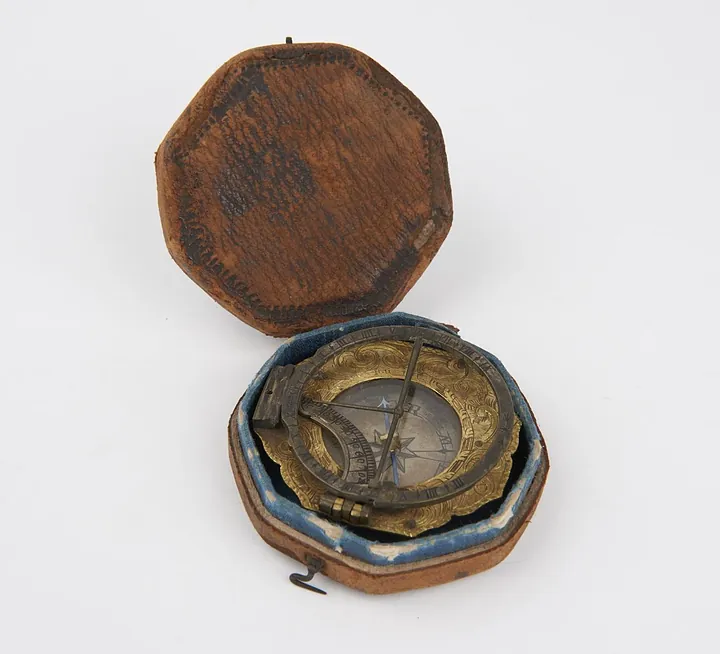
Universal equinoctial sundial of the Augsburg type, signed on the base "L T M" (Ludwig Theodatus Muller). In original case. German, mid 18th century. (B1670)
Science Museum Group, London
Instruments · 1731–1776
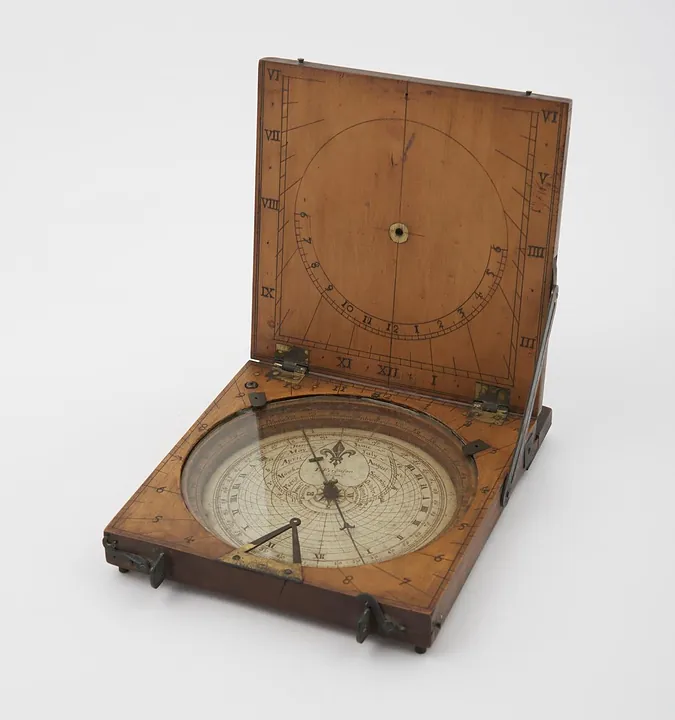
Azimuth compass sundial by James Ferguson, London, England, 1731–1776. Could also be used as a tablet sundial - string gnomon is missing (see note).
Science Museum Group, London
Instruments · 1734–1770
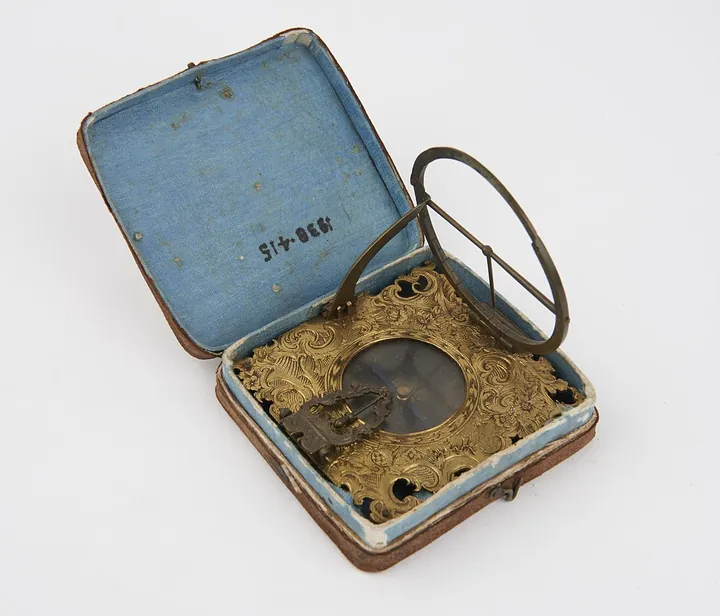
Sundial by Ludwig Theodatus Muller, Germany, 1734–1770 (no. 1938-415)
Science Museum Group, London
Instruments · 1734–1770
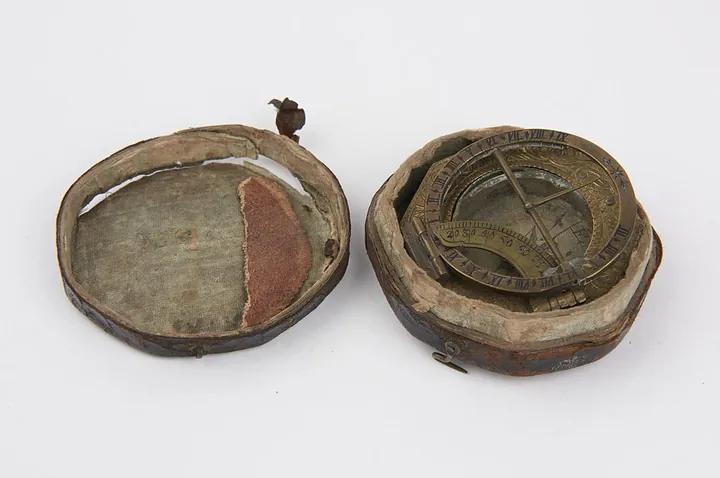
Sundial by Ludwig Theodatus Muller, Germany, 1734–1770 (no. 1991-138)
Science Museum Group, London
Instruments · 1734–1770
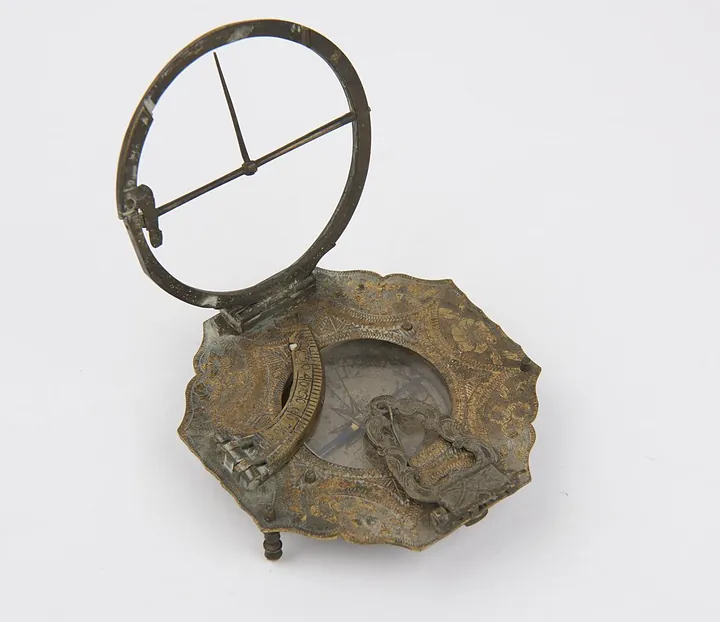
Sundial by Ludwig Theodatus Muller, Germany, 1734–1770 (no. 1991-192)
Science Museum Group, London
Instruments · 1738–1777
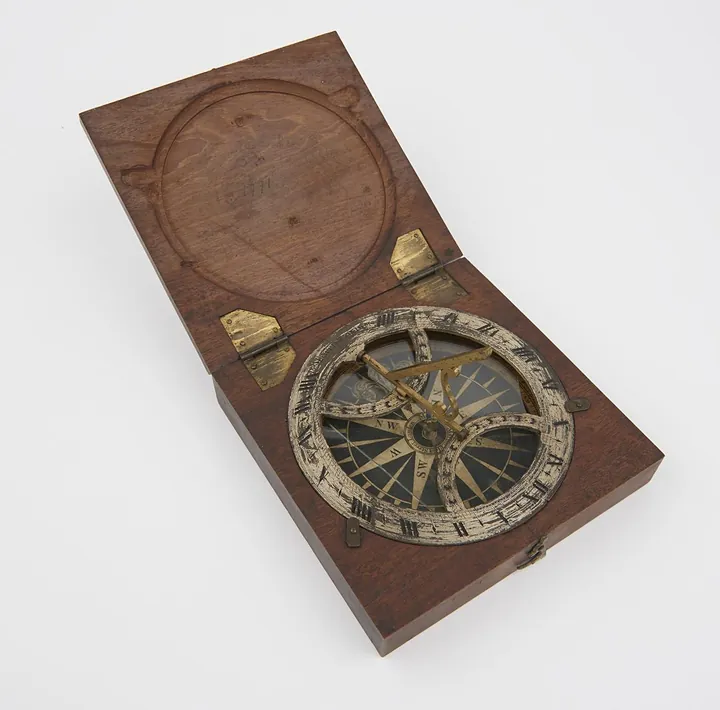
Azimuth sundial 4 3/8" diam, with folding gnomon fitted in mahogany case, made by B. Martin
Science Museum Group, London
Instruments · 1745–1755
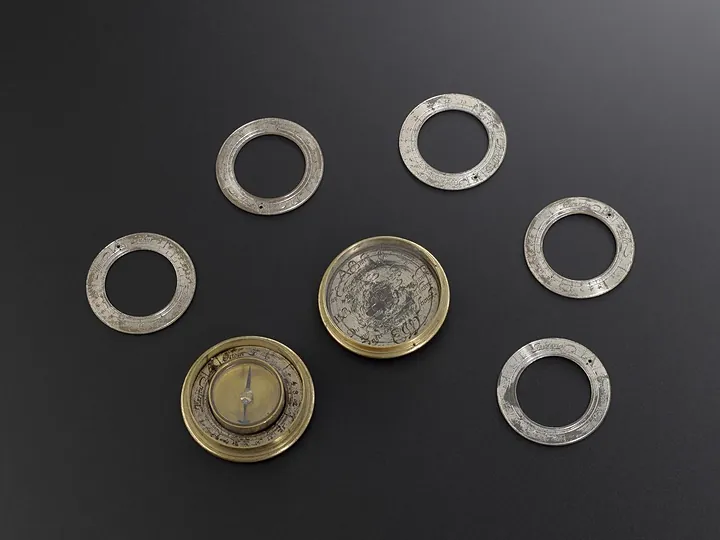
Magnetic Sundial with six loose hour rings
Science Museum Group, London
Instruments · 1745–1755
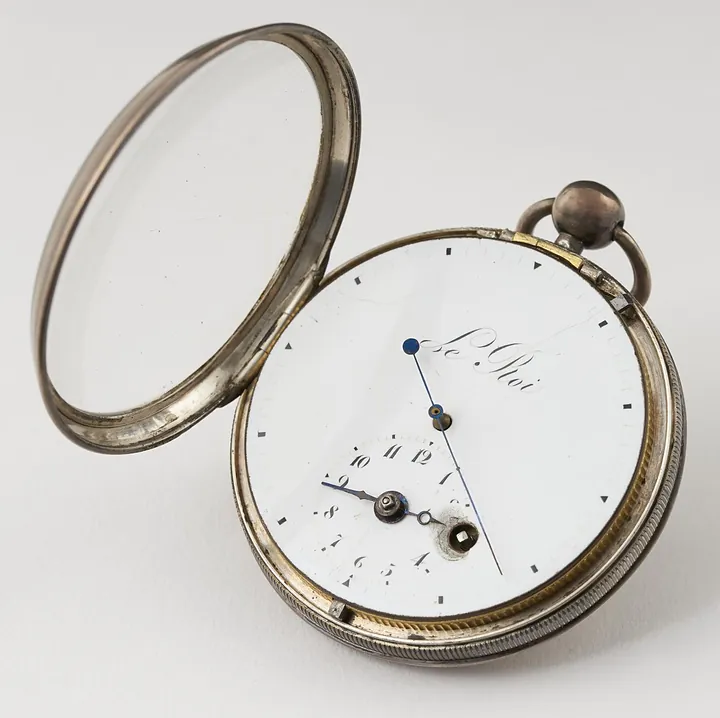
Verge stop-watch with centre seconds hand, by Le Roi, 1745–1755 (see note).
Science Museum Group, London