
Wristwatches · Wristwatch
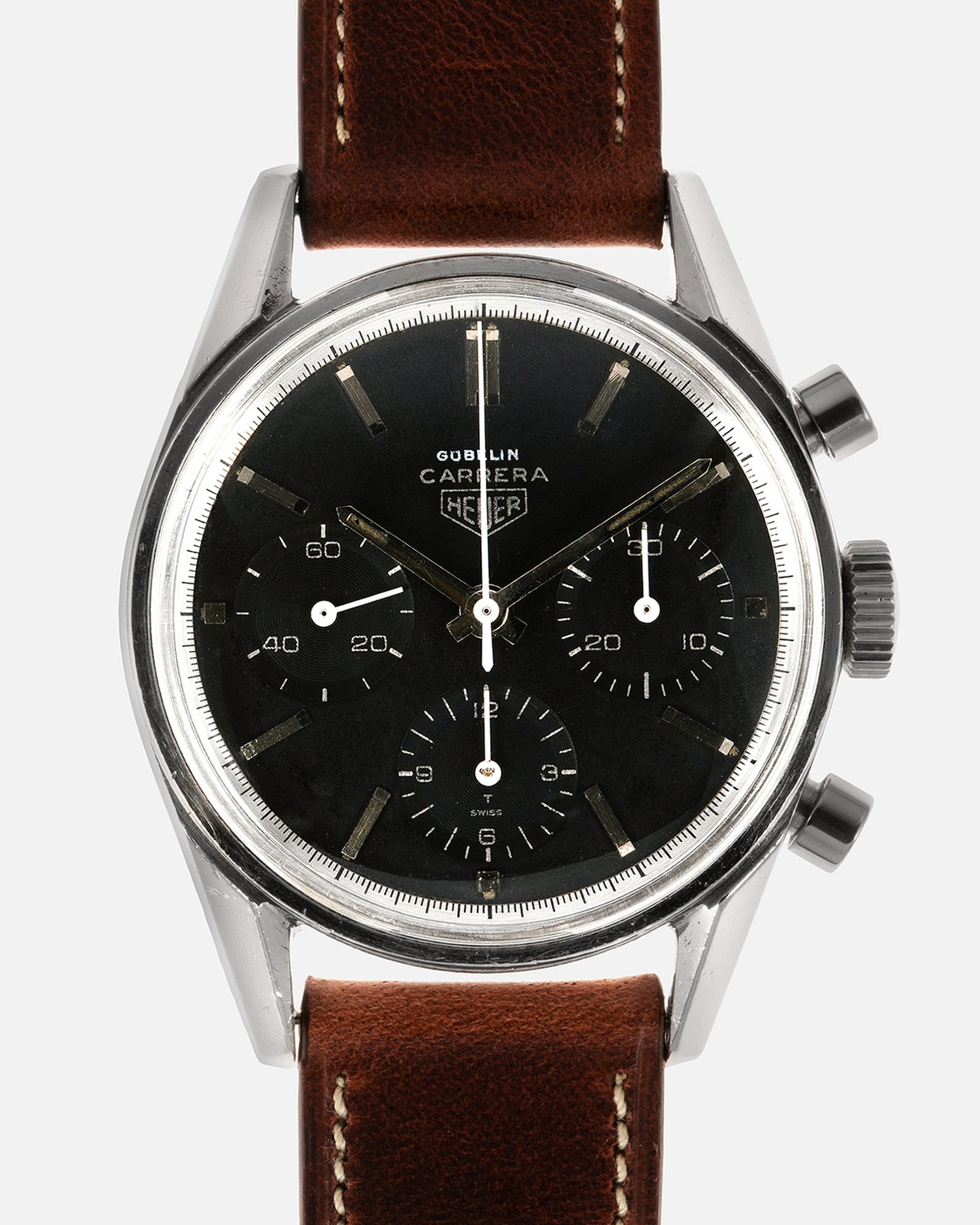
Heuer Carrera 2447N Gubelin Silver Script, 1960s
- Maker / attribution
- Heuer (maker)
- Date
- 1960s
- Historical period
- Modern Mechanical Horology (1945 – 1969)
- Country of origin
- Switzerland
- Object type
- Wristwatch
- Materials / technique
- silver
- Stock no.
- Product 6909830791255
- Credit line
- Dealer listing, S.Song Watches (product 6909830791255)
- Catalogue title (original)
- Heuer Carrera 2447N Gubelin Silver Script (English)
View the source record (dealer listing) ↗ (opens another website in a new tab)Suggest a correction
Record summary
Catalogued by S.Song Watches (dealer), Seattle (stock number Product 6909830791255), this is a wristwatch by Heuer, made in Switzerland, dated 1960s. The Atlas places it in the Modern Mechanical Horology period (1945 – 1969) of its Wristwatches collection. Materials and techniques recorded by the source: silver. The record is illustrated with 6 photographs.
Assembled from the source record's structured fields. Dates and attributions are given as the source states them; where a field is missing the Atlas leaves it blank rather than estimating.
Catalogue description
Dealer description — S.Song Watches
The Heuer Carrera is undeniably one of the most iconic timepieces ever created. Conceived by Jack Heuer in the early 1960s, the Carrera line continues to captivate watch enthusiasts today, with its early models becoming highly sought-after vintage pieces. Jack Heuer's design philosophy for the Carrera prioritized legibility above all else. He took an obsessive approach to streamlining the watch's aesthetics, eliminating unnecessary elements and presenting only the most essential information on the dial. The outcome? A sleek three-register chronograph adorned with baton markers and a contrasting outer tension ring featuring minute markers. Throughout its history, the Carrera has seen various dial variants, showcasing different colour combinations and scales. Among these variations, the Ref. 2447N stands out as one of the purest iterations of the Carrera, distinguished by its black dial. Notably, the early dials were crafted by Singer, the same renowned dial maker for Rolex, ensuring exceptional quality. This particular example of the Carrera is exceptionally rare. Upon closer examination, one can observe that it deviates from the traditional white text found on Carrera watches. Instead, it utilizes a silver script, a feature exclusive to a small batch of dials within the 60’s. This unique characteristic, combined with the fact that it is double-stamped by the renowned Swiss retailer Gübelin, contributes to the exceptional rarity of this Carrera. The meticulous attention to detail in watch collecting makes this Heuer Carrera truly intriguing and coveted. Powered by the esteemed Valjoux 72 movement, which has also graced watches such as the Rolex Daytona, this Carrera boasts a reliable and renowned workhorse movement that epitomizes the iconic movements of the 20th century. In my opinion, the Carrera stands as one of the most exquisite and timeless watches ever created. Its case, characterized by its angular inward lugs, exhibits remarkable proportionality. While it photographs beautifully, the Carrera truly shines when worn on the wrist, surpassing all expectations. Even by today's standards, the Ref. 2447N retains a contemporary allure. Its design philosophy exemplifies the idea that by focusing solely on what is necessary, without any superfluous elements, a product can transcend time and remain relevant for generations to come.
Historical context
Modern Mechanical Horology (1945 – 1969)
Tool watches for divers, pilots and astronauts; electric watches anticipate the electronic age.
The classic era of the mechanical wristwatch: dive watches, chronographs for motor racing and space flight, GMT watches for jet travel, slim dress watches, automatic calendars, and the rise of Japanese manufacturers alongside Swiss, American, German and Soviet industries.
Read the period in the timelineMore wristwatches from this periodEarlier: Golden Age of Mechanical Watchmaking
Atlas type guide
Wristwatches
Bracelet watches were worn by women from the early nineteenth century — Breguet made one for Caroline Murat, Queen of Naples, in 1810–12 — but the wristwatch only became a man's instrument with military use and aviation in the early twentieth century. Between the World Wars it overtook the pocket watch; the 1920s and 1930s brought rectangular Art Deco cases, water-resistant cases and the first automatic winding systems.
After 1945 the wristwatch became a carrier of identity — dress watches, sports and dive watches, chronographs, calendars — produced by Swiss, American, Japanese, German, Soviet and Chinese industries. The quartz revolution after 1969 and the mechanical renaissance since the 1990s, including the rise of independent watchmakers, complete the story.
What to look for
- The reference number (between the lugs or inside the case back) and serial number, the starting point for dating.
- The calibre: its maker and number are often stamped under the dial or on the bridge.
- Originality of dial, hands and crown — refinished ('redial') dials are common.
- Case material marks: 18K/750, 14K/585, stainless steel, gold-filled, plated.
Dating clues
- Wire-lug cases: before c. 1925.
- Water-resistant screw-down cases: from 1926.
- Quartz movements: from 1969; sapphire crystals widespread after c. 1980.
General guidance written by the Atlas editors about this kind of object. It is not a statement about this particular piece; for that, rely on the source record above and on physical examination.
Related records
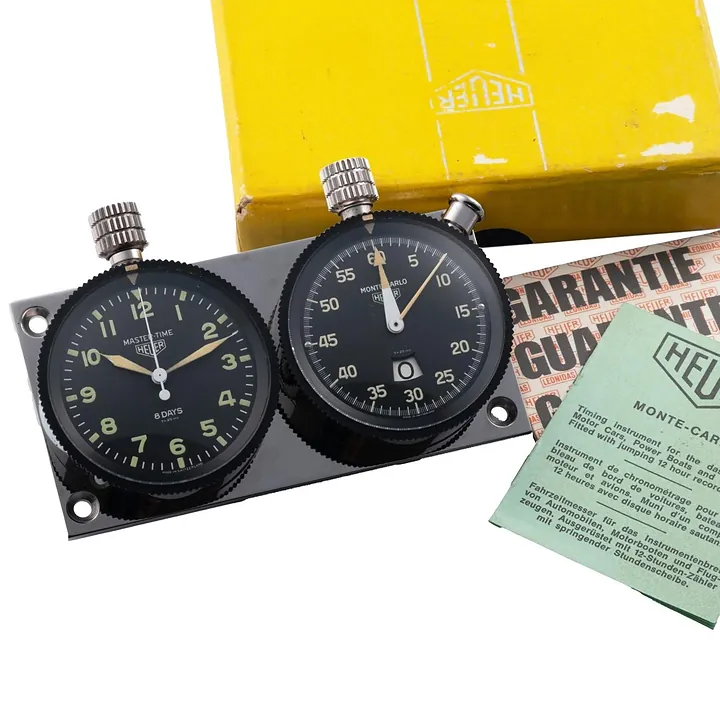
Pocket Watches · c. 1960
Heuer Racing SET, c. 1960
Antiquorum auction archive, Geneva
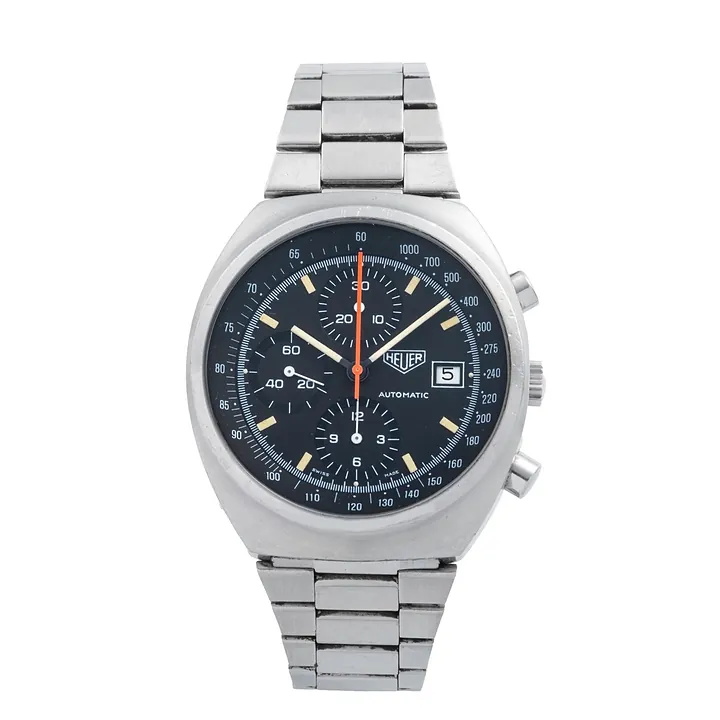
Wristwatches · c. 1980
Heuer Pasadena, ref. 750.501-3, c. 1980
Antiquorum auction archive, Geneva
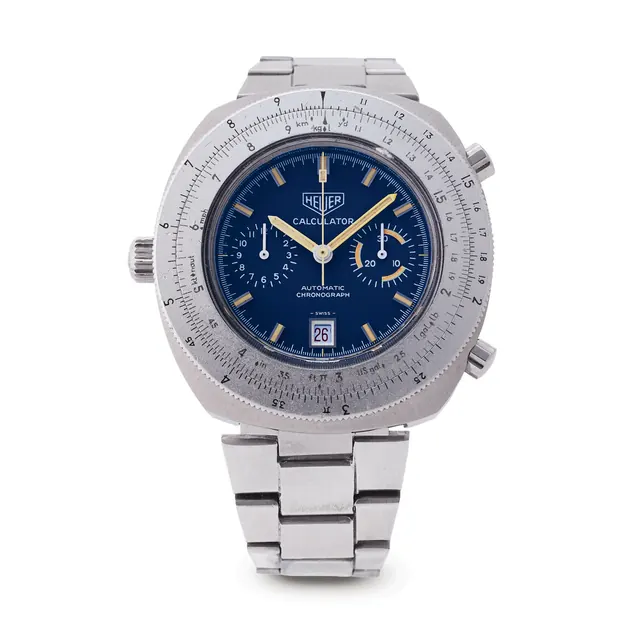
Wristwatches · c. 1970s
Heuer wristwatch, ref. 110.633, Calculator, circa 1970s
Antiquorum auction archive, Geneva
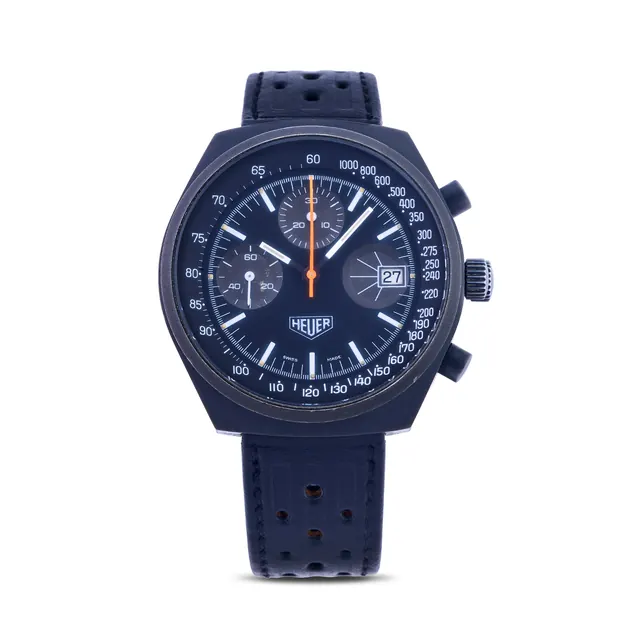
Wristwatches · c. 1975
Heuer wristwatch, ref. 13/1, circa 1975
Antiquorum auction archive, Geneva

Wristwatches · 1945
Wristwatch by Eterna, 1945
Museum Rotterdam

Wristwatches · c. 1945
Breitling Premier, ref. 790, c. 1945
Antiquorum auction archive, Geneva

Wristwatches · c. 1945
Universal Genève Uni-Compax, ref. 22492, c. 1945
Antiquorum auction archive, Geneva

Wristwatches · c. 1950s
Baume & Mercier wristwatch, c. 1950s
Antiquorum auction archive, Geneva