
Wristwatches · Wristwatch
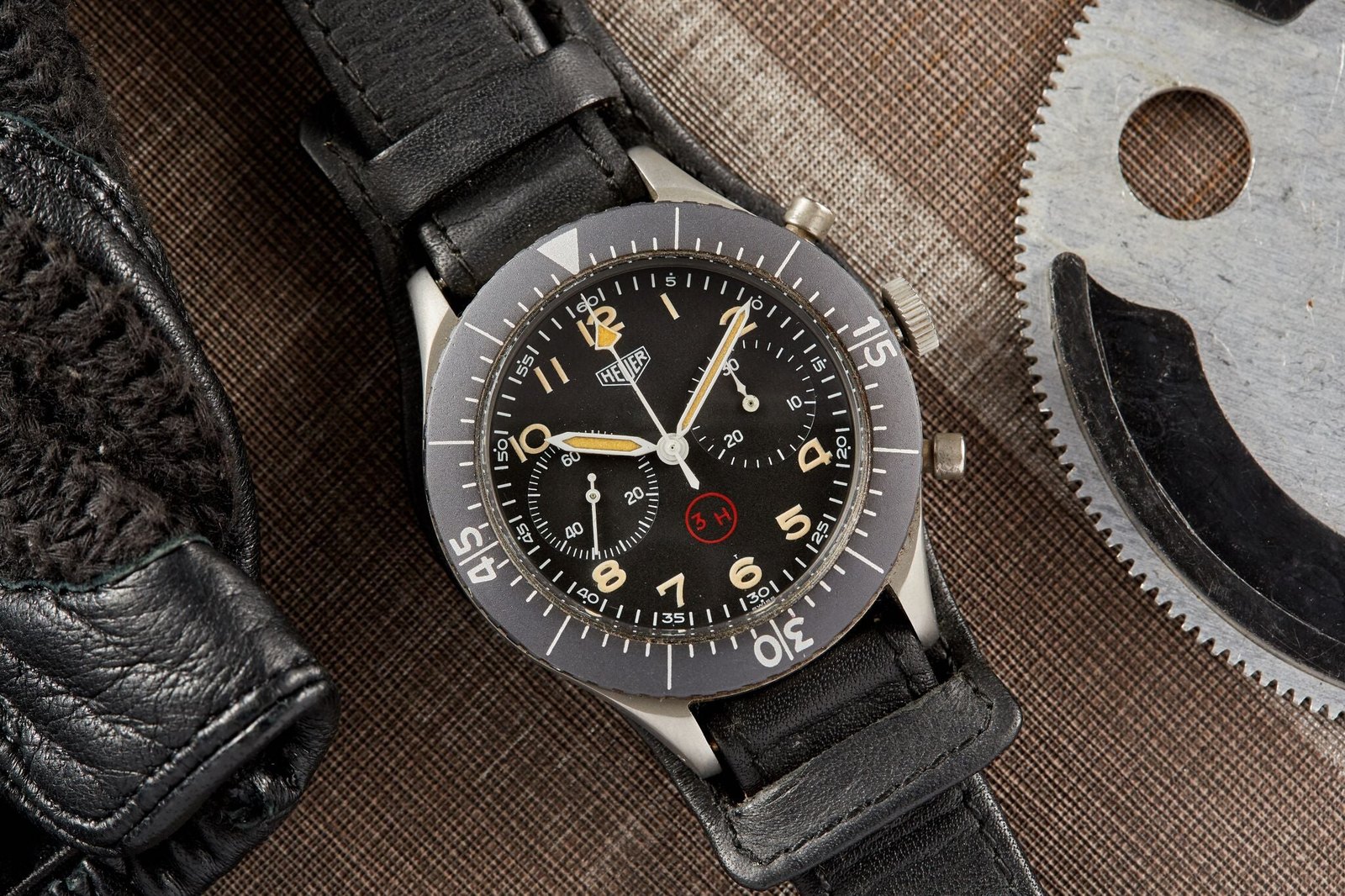
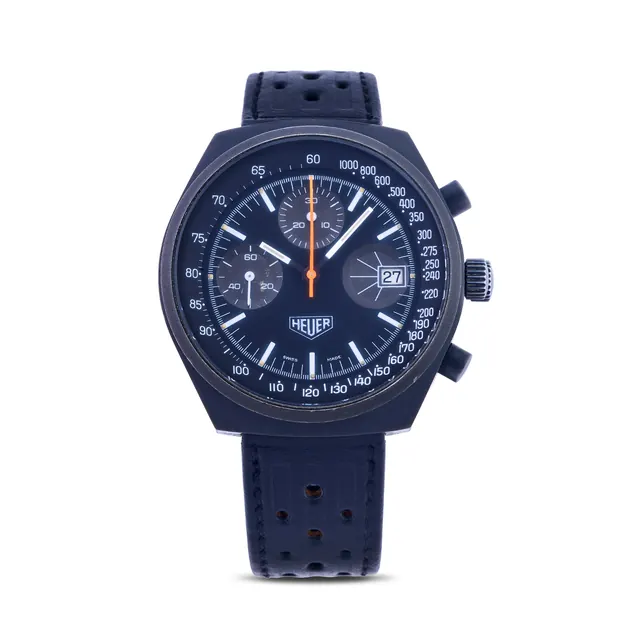
Heuer Bundeswehr 3H, 1960s
- Maker / attribution
- Heuer (maker)
- Date
- 1960s
- Historical period
- Modern Mechanical Horology (1945 – 1969)
- Country of origin
- Switzerland
- Object type
- Wristwatch
- Stock no.
- Product 3605520646231
- Credit line
- Dealer listing, Analog/Shift (product 3605520646231)
- Catalogue title (original)
- Heuer Bundeswehr 3H (English)
View the source record (dealer listing) ↗ (opens another website in a new tab)Suggest a correction
Record summary
Catalogued by Analog/Shift (dealer), New York (stock number Product 3605520646231), this is a wristwatch by Heuer, made in Switzerland, dated 1960s. The Atlas places it in the Modern Mechanical Horology period (1945 – 1969) of its Wristwatches collection. The record is illustrated with 6 photographs.
Assembled from the source record's structured fields. Dates and attributions are given as the source states them; where a field is missing the Atlas leaves it blank rather than estimating.
Catalogue description
Dealer description — Analog/Shift
Why We Love It Watches do more than tell time. They also tell stories. Some of the most epic stories are those of military watches- be they dive watches, field watches, or pilots watches. Among pilots watches, Heuer Bundeswehrs have achieved an almost cult like following. As most of you know, when it comes to military watches, we can't get enough. The example we have today is a cut above the rest. Not only does it have a supremely clean bezel, dial, and warmly patinated lume, it also features the often sought 3H signature (more on that in the story). A pilot's watch should be a few things- large, legible, and ideally a flyback chronograph. The Heuer Bundeswehr doesn't just check these boxes, it blows them away. And lets be honest, when you put a Bundeswehr on a proper bund-strap, it looks way more tough than you do. The Story The Heuer Bundeswehr was designed for the sole purpose of use in military aviation. It was General Issue for pilots in the air forces of many nations (including the Italian Air Force, under the brand Leonidas, which Heuer acquired in the 60s) but is best-known for its use by the Luftwaffe of West Germany . From the 1960s to the 1970s, the "Bund" (as it's affectionately known) saw a range of dial configurations, which are broken down here on On The Dash . There's one tell-tale sign that a Bund might have seen military service (or, to put less fine of a point on it, is from the period in which the Bund was issued to the Luftwaffe). It's one little symbol, in bright red above 6 o'clock on the dial: the letters "3H" surrounded by a circle. This indicates that the luminescent material on the numerals is tritium (Hydrogen-3). As one can tell from OnTheDash's breakdown, the 3H symbol came in four different variations, with the characters in varying sizes. However, no matter the size of the 3H symbol, it meant one thing: the watch can be dated to the 1960s to 1970s . As with many military watches, the Bund is a front-loader, with the movement being secured by the screw-mounted case back that is attached to the bezel. The Bund, being a manually-wound flyback chrono, used a host of Valjoux movements, from the Valjoux 22 to the Caliber 220 to the Caliber 230. Sturdy, dependable, it's the sort of watch you want strapped to your wrist whether you're dodging enemy fighters at 35,000 feet or engaged in more terrestrial pursuits.
Historical context
Modern Mechanical Horology (1945 – 1969)
Tool watches for divers, pilots and astronauts; electric watches anticipate the electronic age.
The classic era of the mechanical wristwatch: dive watches, chronographs for motor racing and space flight, GMT watches for jet travel, slim dress watches, automatic calendars, and the rise of Japanese manufacturers alongside Swiss, American, German and Soviet industries.
Read the period in the timelineMore wristwatches from this periodEarlier: Golden Age of Mechanical Watchmaking
Atlas type guide
Wristwatches
Bracelet watches were worn by women from the early nineteenth century — Breguet made one for Caroline Murat, Queen of Naples, in 1810–12 — but the wristwatch only became a man's instrument with military use and aviation in the early twentieth century. Between the World Wars it overtook the pocket watch; the 1920s and 1930s brought rectangular Art Deco cases, water-resistant cases and the first automatic winding systems.
After 1945 the wristwatch became a carrier of identity — dress watches, sports and dive watches, chronographs, calendars — produced by Swiss, American, Japanese, German, Soviet and Chinese industries. The quartz revolution after 1969 and the mechanical renaissance since the 1990s, including the rise of independent watchmakers, complete the story.
What to look for
- The reference number (between the lugs or inside the case back) and serial number, the starting point for dating.
- The calibre: its maker and number are often stamped under the dial or on the bridge.
- Originality of dial, hands and crown — refinished ('redial') dials are common.
- Case material marks: 18K/750, 14K/585, stainless steel, gold-filled, plated.
Dating clues
- Wire-lug cases: before c. 1925.
- Water-resistant screw-down cases: from 1926.
- Quartz movements: from 1969; sapphire crystals widespread after c. 1980.
General guidance written by the Atlas editors about this kind of object. It is not a statement about this particular piece; for that, rely on the source record above and on physical examination.
Related records
Pocket Watches · c. 1960
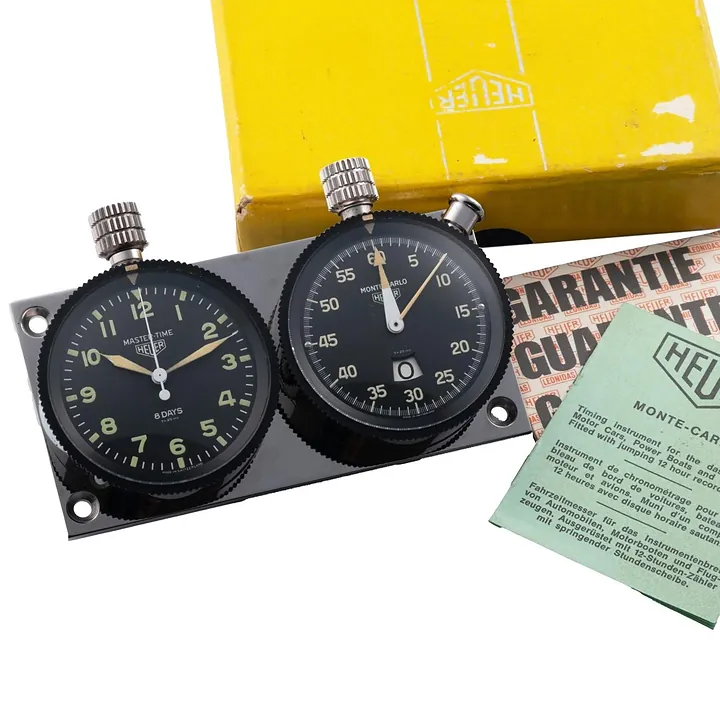
Heuer Racing SET, c. 1960
Antiquorum auction archive, Geneva
Wristwatches · c. 1980
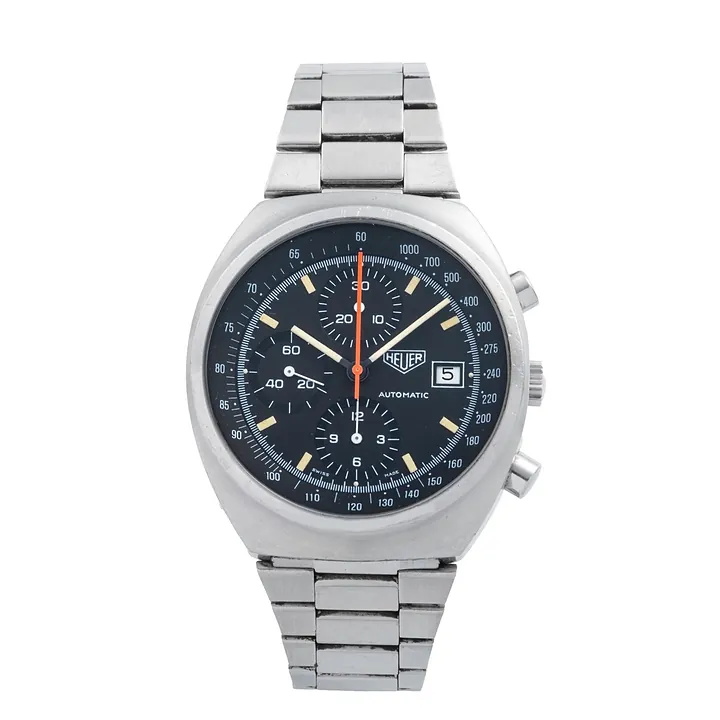
Heuer Pasadena, ref. 750.501-3, c. 1980
Antiquorum auction archive, Geneva
Wristwatches · c. 1970s
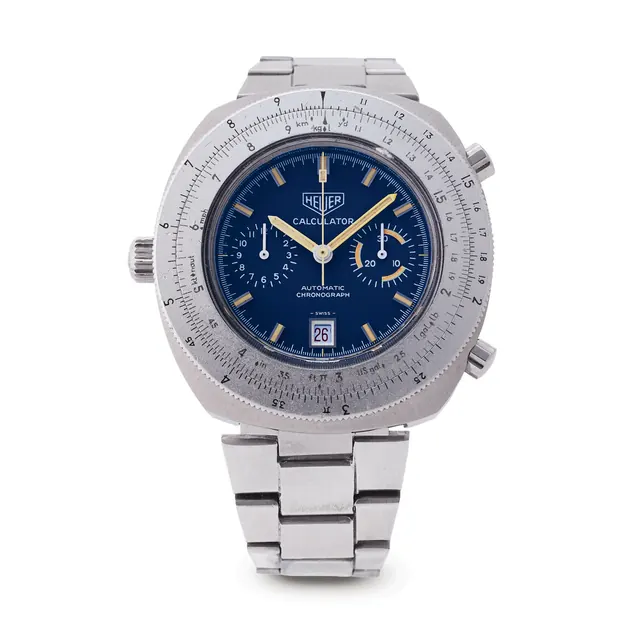
Heuer wristwatch, ref. 110.633, Calculator, circa 1970s
Antiquorum auction archive, Geneva
Wristwatches · c. 1975
Heuer wristwatch, ref. 13/1, circa 1975
Antiquorum auction archive, Geneva

Wristwatches · 1945
Wristwatch by Eterna, 1945
Museum Rotterdam

Wristwatches · c. 1945
Breitling Premier, ref. 790, c. 1945
Antiquorum auction archive, Geneva

Wristwatches · c. 1945
Universal Genève Uni-Compax, ref. 22492, c. 1945
Antiquorum auction archive, Geneva

Wristwatches · c. 1950s
Baume & Mercier wristwatch, c. 1950s
Antiquorum auction archive, Geneva