
Wristwatches · Wristwatch
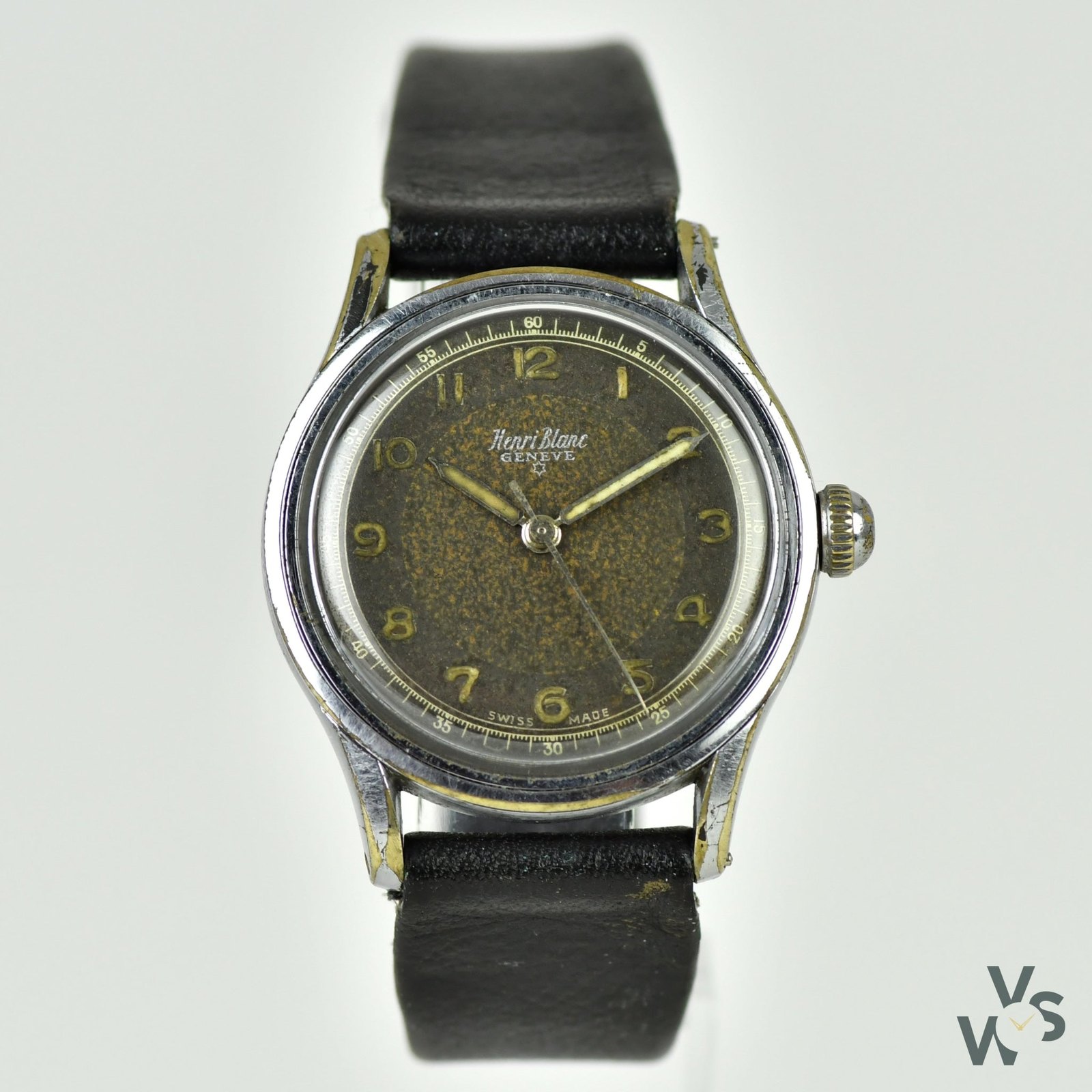
Henri Blanc, Wristwatch with Two Tone Chocolate Dial, Original Radium Lume, circa 1940s
- Maker / attribution
- Unrecorded in source
- Date
- c. 1940s
- Historical period
- Golden Age of Mechanical Watchmaking (1900 – 1945)
- Country of origin
- Unrecorded in source
- Object type
- Wristwatch
- Dimensions
- Case 32 mm
- Stock no.
- vws0626
- Credit line
- Dealer listing, Vintage Watch Specialist (vws0626)
- Catalogue title (original)
- c.1940s - Henri Blanc - A Vintage Wristwatch with Two Tone Chocolate Dial - Original Radium Lume (English)
View the source record (dealer listing) ↗ (opens another website in a new tab)Suggest a correction
Record summary
Catalogued by Vintage Watch Specialist (dealer), United Kingdom (stock number vws0626), this is a wristwatch, dated c. 1940s. The Atlas places it in the Golden Age of Mechanical Watchmaking period (1900 – 1945) of its Wristwatches collection. Recorded dimensions: Case 32 mm. The record is illustrated with 6 photographs.
Assembled from the source record's structured fields. Dates and attributions are given as the source states them; where a field is missing the Atlas leaves it blank rather than estimating.
Catalogue description
Dealer description — Vintage Watch Specialist
A charismatic Henri Blanc vintage wristwatch dated c.1940s with rich chocolate and pumpkin tropicalisation. Henri Blanc was born in Neuchâtel (Switzerland) in 1873. He was the son of the watchmaker Sylvain Blanc who moved to Geneva around 1886. Henri attended the Geneva watchmaking school from 1889 to 1894. In 1894, Henri Blanc opened a watch shop in Geneva. The company was located at 37 Rue du Rhone. Henri Blanc initially specialized in clocks and looked after the city's pendulum clocks, his good name making him responsible for the maintenance of the city's clocks. He was also involved in the renovation of the bells of the Saint-Pierre cathedral. After the First World War, he entered the world of wristwatches. What's on offer Even though set in a 32mm case, this watch look and wears both on and off the wrist, much larger. This Henri Blanc oozes vintage character with its deliciously two-tone chocolate dial and beautiful freckling of pumpkin patina, giving the illusion of a slight pie pan adding a rich depth and bucket loads of charm. The applied radium Arabic numerals are in remarkable condition as are the elegant pencil hands with lume intact, a rather magnificent feat given the age of the watch. This would make a beautiful vintage dress for that special occasion, or indeed even a tool watch to be worn on a daily basis. The delightful scripted signature at 12 o'clock, the ornate chapter ring with 5 second markers, the needle-like seconds hand, and of course, the tantalising tropicalisation, come together in a watch ameliorated by time. The watch keeps excellent time having been fully inspected, cleaned, and serviced by our most trusted watchmaker. The nickel chrome plated case has also been ultrasonically cleaned (NOT polished!) to remove rubbed in dirt and grease etc. In conclusion, this watch is the 'Toffee Penny' of the chocolate box and whoever acquires it will treasure it for years to come.
Historical context
Golden Age of Mechanical Watchmaking (1900 – 1945)
The wristwatch displaces the pocket watch; waterproof cases, self-winding and grand complications.
The wristwatch overtook the pocket watch. Military use in the First World War, aviation, water-resistant cases (1926), automatic winding (1923–31), rectangular Art Deco designs and early chronographs and calendars defined the period.
Read the period in the timelineMore wristwatches from this periodEarlier: Industrial Revolution
Atlas type guide
Wristwatches
Bracelet watches were worn by women from the early nineteenth century — Breguet made one for Caroline Murat, Queen of Naples, in 1810–12 — but the wristwatch only became a man's instrument with military use and aviation in the early twentieth century. Between the World Wars it overtook the pocket watch; the 1920s and 1930s brought rectangular Art Deco cases, water-resistant cases and the first automatic winding systems.
After 1945 the wristwatch became a carrier of identity — dress watches, sports and dive watches, chronographs, calendars — produced by Swiss, American, Japanese, German, Soviet and Chinese industries. The quartz revolution after 1969 and the mechanical renaissance since the 1990s, including the rise of independent watchmakers, complete the story.
What to look for
- The reference number (between the lugs or inside the case back) and serial number, the starting point for dating.
- The calibre: its maker and number are often stamped under the dial or on the bridge.
- Originality of dial, hands and crown — refinished ('redial') dials are common.
- Case material marks: 18K/750, 14K/585, stainless steel, gold-filled, plated.
Dating clues
- Wire-lug cases: before c. 1925.
- Water-resistant screw-down cases: from 1926.
- Quartz movements: from 1969; sapphire crystals widespread after c. 1980.
General guidance written by the Atlas editors about this kind of object. It is not a statement about this particular piece; for that, rely on the source record above and on physical examination.
Related records
Wristwatches · 1900–1999
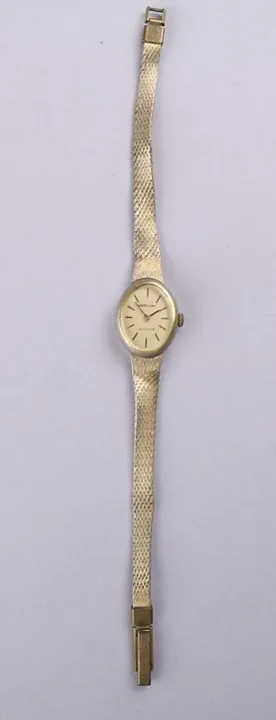
Wristwatch by Mercury, 1900–1999
Modemuseum Hasselt
Wristwatches · 1900–1999
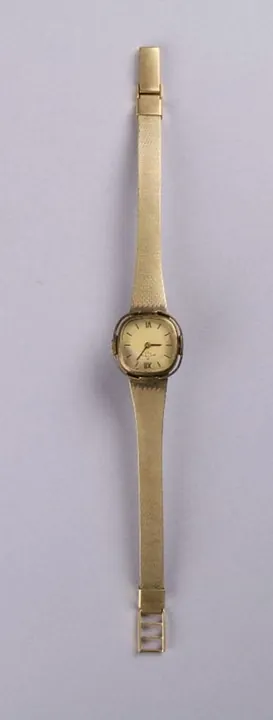
Wristwatch by Nutrix, 1900–1999
Modemuseum Hasselt
Wristwatches · 1920
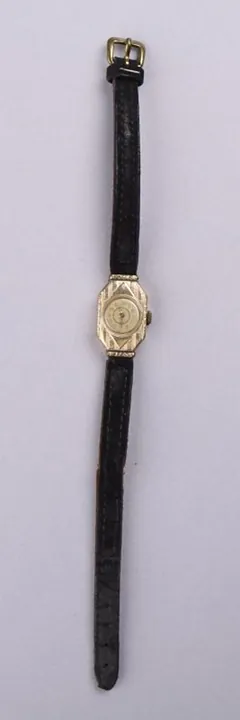
Wristwatch, 1920
Modemuseum Hasselt

Wristwatches · 1931
Rolex 'Oyster Perpetual' rotor self-winding wrist-watch, lever escapement, in steel case with glass in back, Montres Rolex SA, Geneva, Switzerland, 1931
Science Museum Group, London
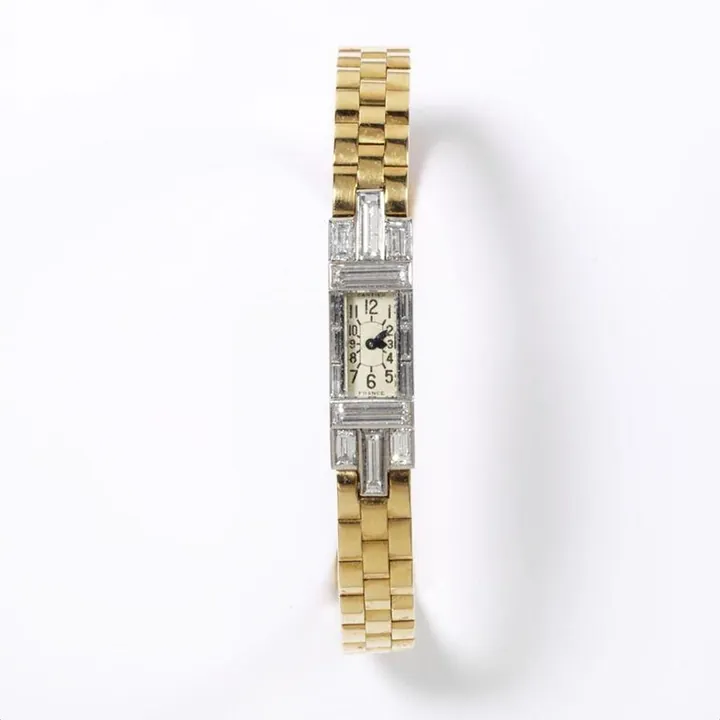
Wristwatches · c. 1936
Watch with diamond-set platinum case and gold link bracelet, Cartier, Paris, c. 1936.
Victoria and Albert Museum, London
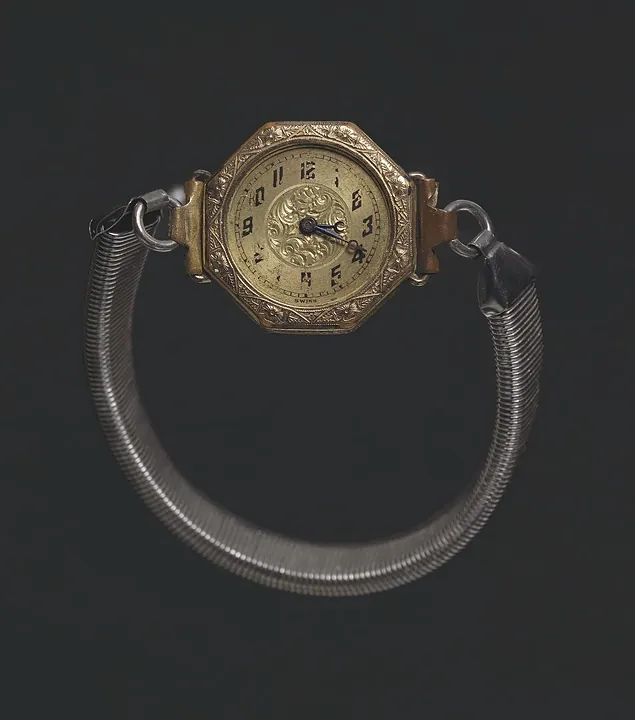
Wristwatches · early to mid 20th century
Woman's wristwatch worn by Harriette Vyda Simms Moore, early to mid 20th century
National Museum of African American History and Culture, Smithsonian Institution, Washington DC

Wristwatches · 1900–1999
Wristwatch by Certina, Switzerland, 1900–1999
Nordic Museum Foundation
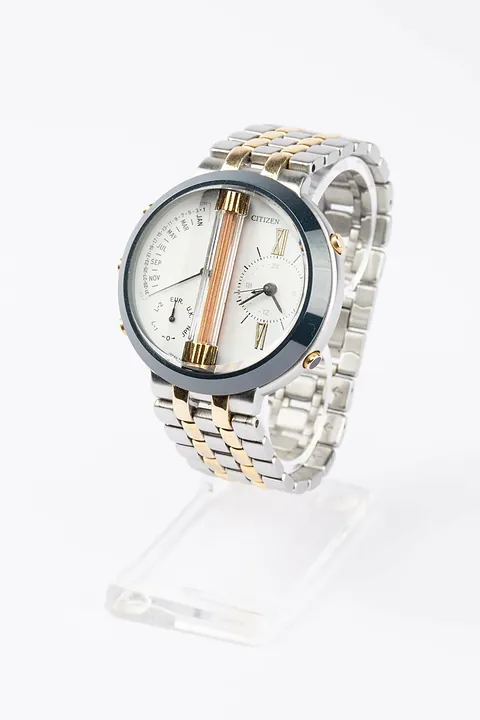
Wristwatches · 1900–1999
Wristwatch by Citizen, Japan, 1900–1999
German Clock Museum