
Wristwatches · Wristwatch
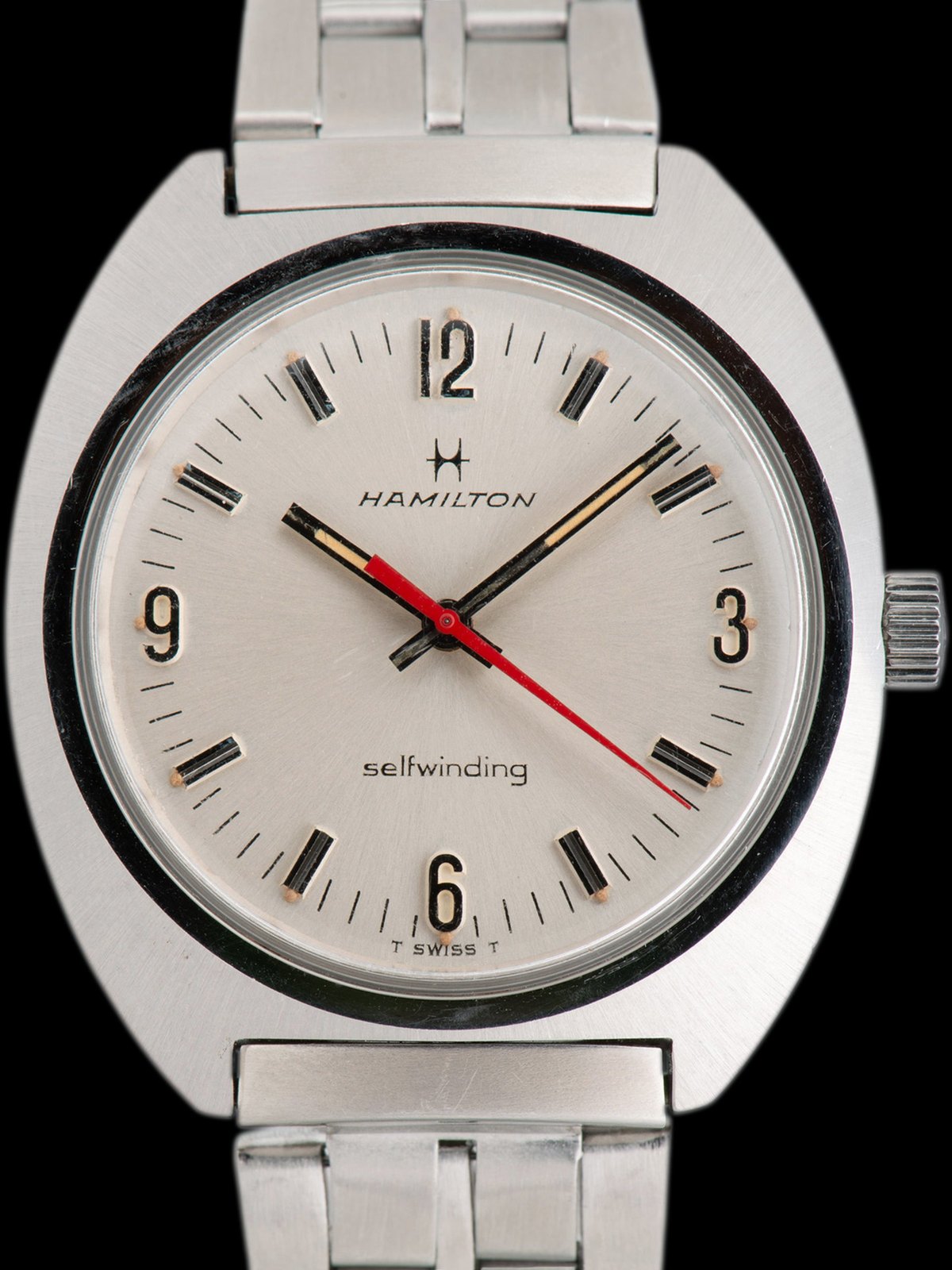
Hamilton Saratoga Selfwinding (Ref. 815001-3), 1970s
- Maker / attribution
- Hamilton (maker)
- Date
- 1970s
- Historical period
- Quartz Revolution (1969 – 1990)
- Country of origin
- Switzerland
- Object type
- Wristwatch
- Stock no.
- HAM815001-3
- Credit line
- Dealer listing, Craft & Tailored (HAM815001-3)
- Catalogue title (original)
- 1970s Hamilton Saratoga Selfwinding (Ref. 815001-3) (English)
View the source record (dealer listing) ↗ (opens another website in a new tab)Suggest a correction
Record summary
Catalogued by Craft & Tailored (dealer), Los Angeles (stock number HAM815001-3), this is a wristwatch by Hamilton, made in Switzerland, dated 1970s. The Atlas places it in the Quartz Revolution period (1969 – 1990) of its Wristwatches collection. The record is illustrated with 6 photographs.
Assembled from the source record's structured fields. Dates and attributions are given as the source states them; where a field is missing the Atlas leaves it blank rather than estimating.
Catalogue description
Dealer description — Craft & Tailored
Hamilton was founded in Lancaster, Pennsylvania in 1882, initially specializing in producing pocket watches. The brand boasts a long and impressive history of breakthroughs in design and technology and perhaps is most famously known for their extensive work as the official supplier to the U.S. Armed Forces. While this piece was not designed expressly for the military, it still had distinct military ties as these Selfwinding ref. 815001-3 were also known as the Auto Saratoga (when in 14k yellow gold plating) and the Auto Yorktowne (when presented in stainless steel), like this one), though in 1975, both versions started being called the Saratoga. The names Yorktowne and Saratoga were used in homage to a pair of American aircraft carriers. This "Yorktowne" is simple yet beautiful with it's "C"-shaped case, 3-6-9-12 dial and red sweep seconds hand. It's one of the many very cool offerings from this brand, which tap into American heritage like no other watch brand can. SPECS Stock # HAM 815001-3 Brand Hamilton Style Saratoga Model 815001-3 Serial N/A Size Men's Material Stainless Steel Dial Silver Millimeters 36 Bracelet Hamilton "Kevin Drema" Bracelet CASE & BRACELET The stainless steel "C"-shaped case is in original and unpolished condition, and retains its original Hamilton-signed crown. The case back is clean and retains all of its factory markings. The watch will be supplied on its original stainless steel bracelet with Hamilton-signed clasp. DIAL & HANDS The silver dial has a matte finish with numerical markers at 3, 6, 9 and 12 o'clock. The rectangular indices at the rest of the hours are black. Each hour also features a lume plot that has aged to a cream color The lume is intact on the slim, cigarette-style hour and minute hands, with a solid red sweep seconds hand completing the design. ACCESSORIES None. The watch is functioning correctly and keeping time, previous service history is unknown.
Historical context
Quartz Revolution (1969 – 1990)
Seiko's Astron begins mass quartz timekeeping; traditional industries contract sharply.
Quartz and digital watches transformed the market after 1969. Swiss employment collapsed, Japanese and Hong Kong production soared, and the Swatch (1983) helped the Swiss industry recover; mechanical watches survived as luxury goods.
Read the period in the timelineMore wristwatches from this periodEarlier: Modern Mechanical Horology
Atlas type guide
Automatic (self-winding) watches
Self-winding watches use the wearer's motion to wind the mainspring. Abraham-Louis Perrelet and Breguet made 'perpétuelle' pocket watches with oscillating weights in the late eighteenth century, but the principle only became practical in the wristwatch. John Harwood patented a bumper automatic in 1923; Rolex's Perpetual rotor (1931) winding in one direction, and later bidirectional rotors (Eterna, Felsa Bidynator), established the modern form. Micro-rotors (Universal Genève, Buren) and peripheral rotors made automatic watches thinner.
What to look for
- A semicircular rotor turning 360° over the movement, or a 'bumper' weight that rebounds between springs.
- 'Automatic', 'Perpetual' or 'Self-winding' on the dial.
- A sealed screw-back case, since automatic watches are wound less often by the crown.
Dating clues
- Bumper automatics: 1923–c. 1955.
- Full rotors: from 1931 (Rolex); widespread after c. 1950.
- Micro-rotors: from 1954–1958.
General guidance written by the Atlas editors about this kind of object. It is not a statement about this particular piece; for that, rely on the source record above and on physical examination.
Related records
Pocket Watches · c. 1943
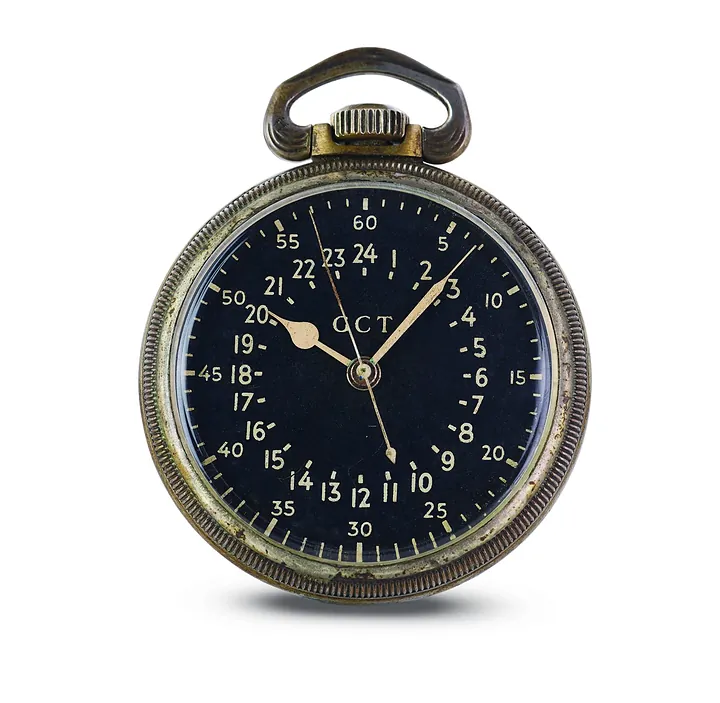
Hamilton 4992B, GCT Navigation U.S Air Force, c. 1943
Antiquorum auction archive, Geneva
Wristwatches · c. 1940s
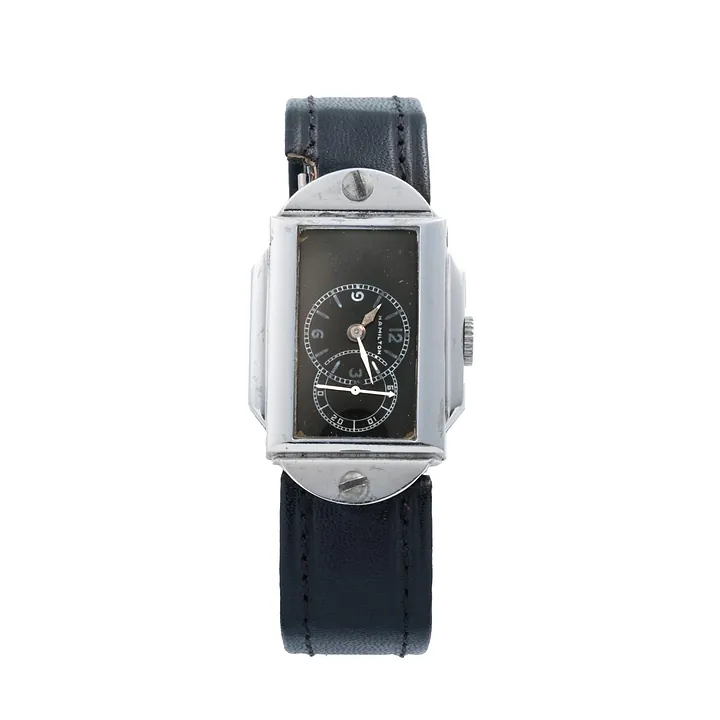
Hamilton Bomb Timer, c. 1940s
Antiquorum auction archive, Geneva
Wristwatches · originally sold in February 2025 (per the lot record)
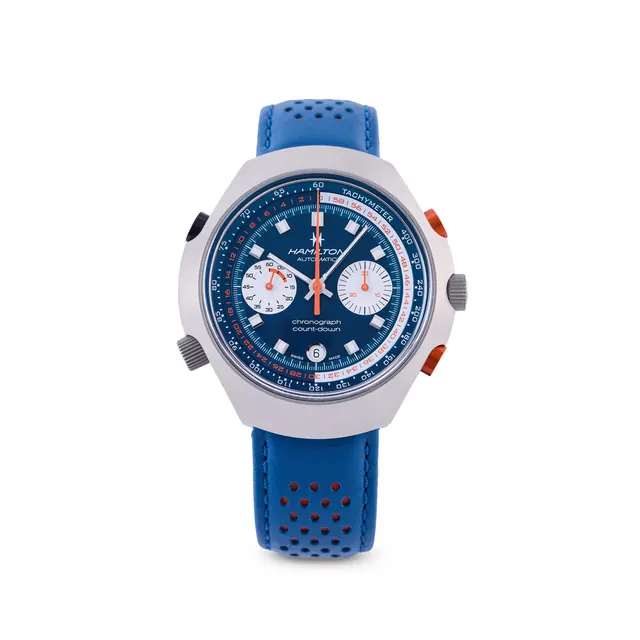
Hamilton wristwatch, ref. H51606640, American Classic Chrono-Matic 50 Limited Edition, originally sold in February 2025 (per the lot record)
Antiquorum auction archive, Geneva
Wristwatches · c. 1940s
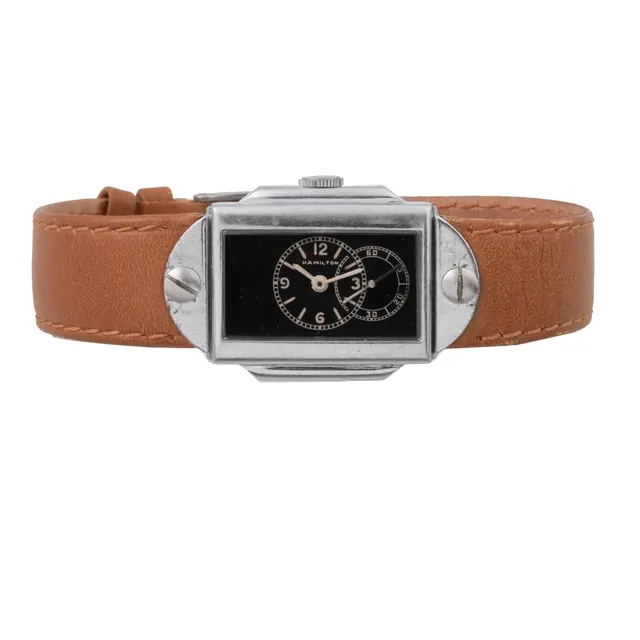
Hamilton wristwatch, Bomb Timer Watch, circa 1940's
Antiquorum auction archive, Geneva

Wristwatches · 1970
Wristwatch by Heno, Switzerland, 1970
Museum Rotterdam

Wristwatches · 1960–1986
'Tri-Compax' calendar chronograph wristwatch in gold case, by Universal, Geneva, Switzerland, 1960–1986.
Science Museum Group, London

Wristwatches · 1969–1970
Beta 21 Quartz wristwatch movement, made in Switzerland, 1970.
Science Museum Group, London

Wristwatches · c. 1969
Omega Speedmaster Moonwatch, ref. 145022-69st, c. 1969
Antiquorum auction archive, Geneva