
Wristwatches · Wristwatch
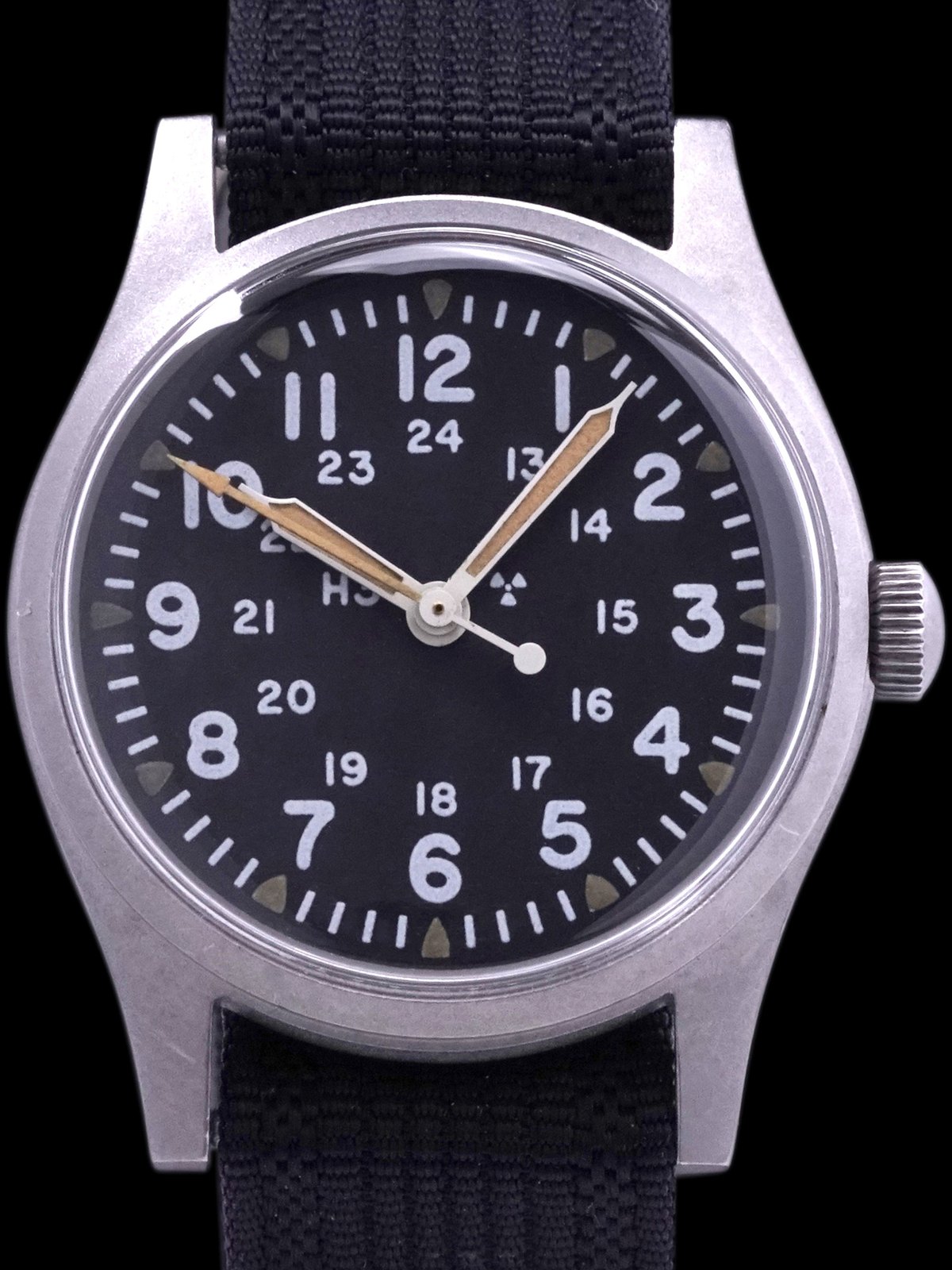
Hamilton Military Watch (Mil-W-46374B), 1983
- Maker / attribution
- Hamilton (maker)
- Date
- 1983
- Historical period
- Quartz Revolution (1969 – 1990)
- Country of origin
- Switzerland
- Object type
- Wristwatch
- Stock no.
- HMLTUSMIL
- Credit line
- Dealer listing, Craft & Tailored (HMLTUSMIL)
- Catalogue title (original)
- 1983 Hamilton Military Watch (Mil-W-46374B) (English)
View the source record (dealer listing) ↗ (opens another website in a new tab)Suggest a correction
Record summary
Catalogued by Craft & Tailored (dealer), Los Angeles (stock number HMLTUSMIL), this is a wristwatch by Hamilton, made in Switzerland, dated 1983. The Atlas places it in the Quartz Revolution period (1969 – 1990) of its Wristwatches collection. The record is illustrated with 6 photographs.
Assembled from the source record's structured fields. Dates and attributions are given as the source states them; where a field is missing the Atlas leaves it blank rather than estimating.
Catalogue description
Dealer description — Craft & Tailored
The original Mil-W-46374 specification was first issued in the late 1960s during the Vietnam War, although it was revised multiple times over the years. Following the original model designation, each subsequent modification was assigned a letter. This model B watch was part of the second generation of improved timepieces that began manufacture in 1975, following the Vietnam War's end. The B model was the first run of these watches to have all of the dials printed with the H3 and radioactive markings. These were designed to alert the wearer that the watch contained tritium (also known as hydrogen-3). From the bead-blasted anti-reflective case, the radioactive markings on the matte black dial, the fixed spring bars, the military designations on the case back, and the modest overall size make for an excellent everyday military watch that is both stylish and flies under the radar. Stock # HMLTUSMIL Brand Hamilton Style Military Model Mil-W-46374B Serial N/A Size Men's Material Stainless Steel Dial Matte Black Millimeters 33 Strap Era-Correct Single Pass Nylon Ribbon Strap CASE & BRACELET The unpolished case retains its factory bead-blasted finishing and remains in exceptional condition showing no major signs of use. The bead-blasted smooth bezel also is in excellent condition and shows minimal signs of use. The case retains its original unsigned bead-blasted crown. The case back retains all of its original military markings. The watch comes supplied on an era-correct black single pass nylon ribbon strap. DIAL & HANDS The matte black dial "H3" dial is remarkably well preserved, showing no signs of age. The tritium lume plots have taken on a dark brown patina and show no degradation when inspected under U.V. light. The original tritium hands have aged to a lighter tan patina and are in great condition, showing no degradation under U.V. light inspection. ACCESSORIES None. Watch is functioning and keeping time perfectly, previous service history is unknown.
Historical context
Quartz Revolution (1969 – 1990)
Seiko's Astron begins mass quartz timekeeping; traditional industries contract sharply.
Quartz and digital watches transformed the market after 1969. Swiss employment collapsed, Japanese and Hong Kong production soared, and the Swatch (1983) helped the Swiss industry recover; mechanical watches survived as luxury goods.
Read the period in the timelineMore wristwatches from this periodEarlier: Modern Mechanical Horology
Atlas type guide
Military, pilot and travel watches
The wristwatch owes much of its adoption by men to warfare and aviation. Wristlets — small pocket watches soldered with lugs and worn on a strap — were used in colonial campaigns and became standard equipment in the First World War, with protective grilles over the crystal ('shrapnel guards'). Louis Cartier's Santos (1904), designed for the aviator Alberto Santos-Dumont, is often cited as an early purpose-made pilot's watch.
In the Second World War governments specified watches in detail: the German B-Uhr observation watches, the American A-11, and the British 'W.W.W.' (the 'Dirty Dozen' set of 1945). After the war, jet travel brought GMT and world-time watches, which show two or more time zones at once — Louis Cottier's world-time mechanism and the Rolex GMT-Master (1955) are examples.
What to look for
- Military markings on the case back: broad arrow, issue numbers, 'W.W.W.', 'A.T.P.'
- High-legibility black dials with luminous Arabic numerals; oversized crowns for gloved hands.
- 24-hour hands and rotating 24-hour bezels or city rings on GMT/world-time watches.
- Wire lugs on early wristlets converted from pocket watches.
Dating clues
- Wire-lug wristlets: c. 1900–1925.
- Military specifications of the Second World War: 1939–1945.
- GMT and world-time wristwatches: mainly after 1950.
General guidance written by the Atlas editors about this kind of object. It is not a statement about this particular piece; for that, rely on the source record above and on physical examination.
Related records
Pocket Watches · c. 1943
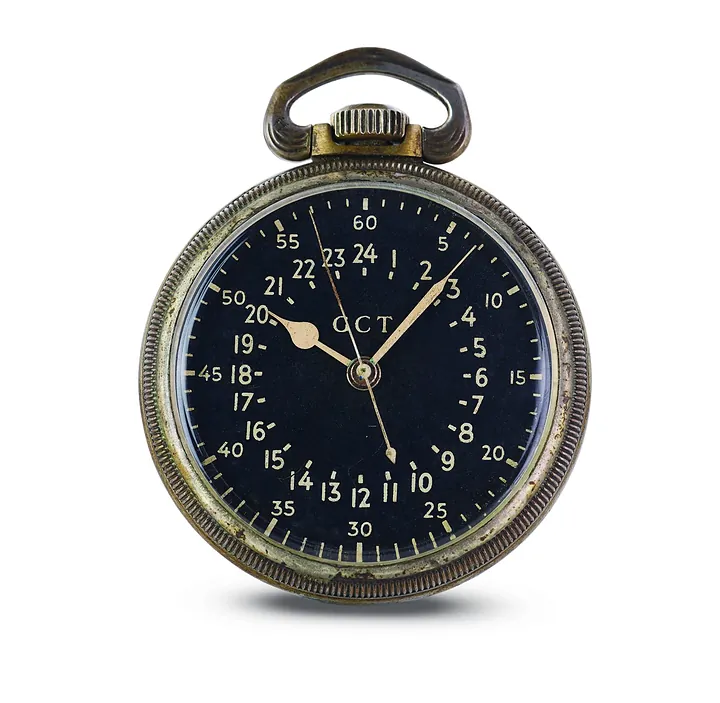
Hamilton 4992B, GCT Navigation U.S Air Force, c. 1943
Antiquorum auction archive, Geneva
Wristwatches · c. 1940s
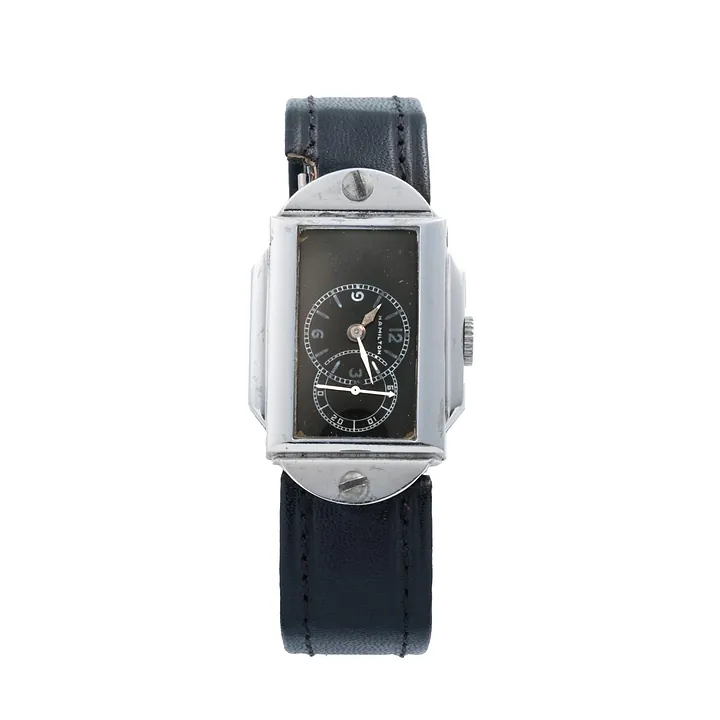
Hamilton Bomb Timer, c. 1940s
Antiquorum auction archive, Geneva
Wristwatches · originally sold in February 2025 (per the lot record)
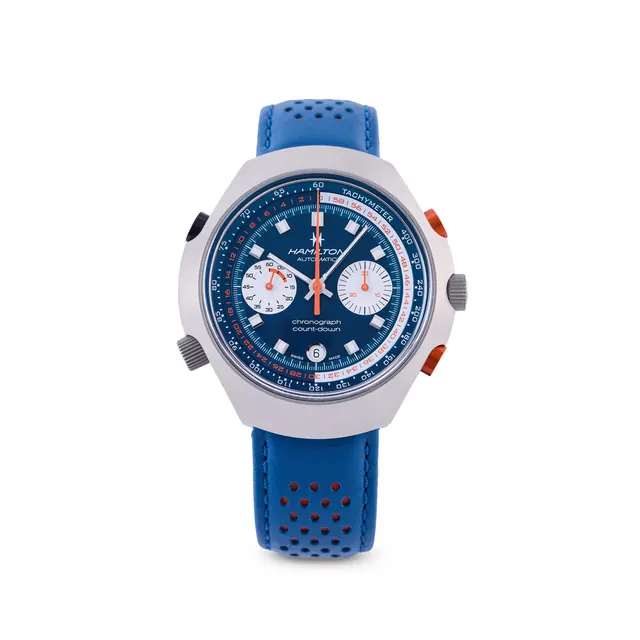
Hamilton wristwatch, ref. H51606640, American Classic Chrono-Matic 50 Limited Edition, originally sold in February 2025 (per the lot record)
Antiquorum auction archive, Geneva
Wristwatches · c. 1940s
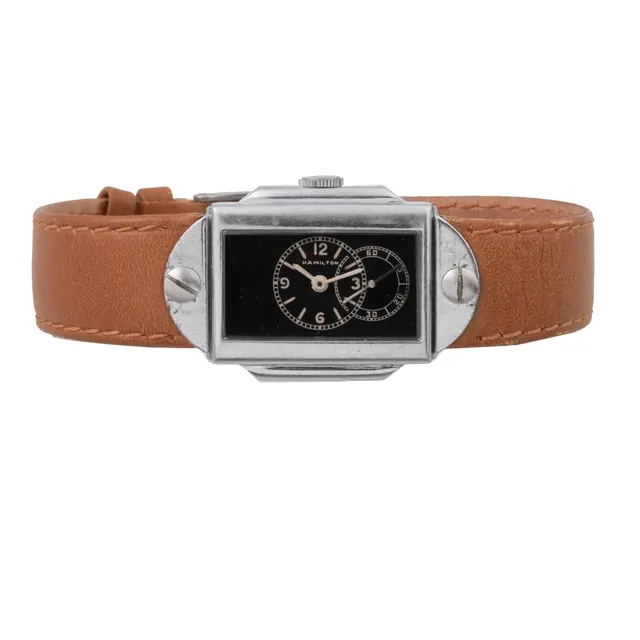
Hamilton wristwatch, Bomb Timer Watch, circa 1940's
Antiquorum auction archive, Geneva

Wristwatches · 1970
Wristwatch by Heno, Switzerland, 1970
Museum Rotterdam

Wristwatches · 1960–1986
'Tri-Compax' calendar chronograph wristwatch in gold case, by Universal, Geneva, Switzerland, 1960–1986.
Science Museum Group, London

Wristwatches · 1969–1970
Beta 21 Quartz wristwatch movement, made in Switzerland, 1970.
Science Museum Group, London

Wristwatches · c. 1969
Omega Speedmaster Moonwatch, ref. 145022-69st, c. 1969
Antiquorum auction archive, Geneva