
Wristwatches · Wristwatch
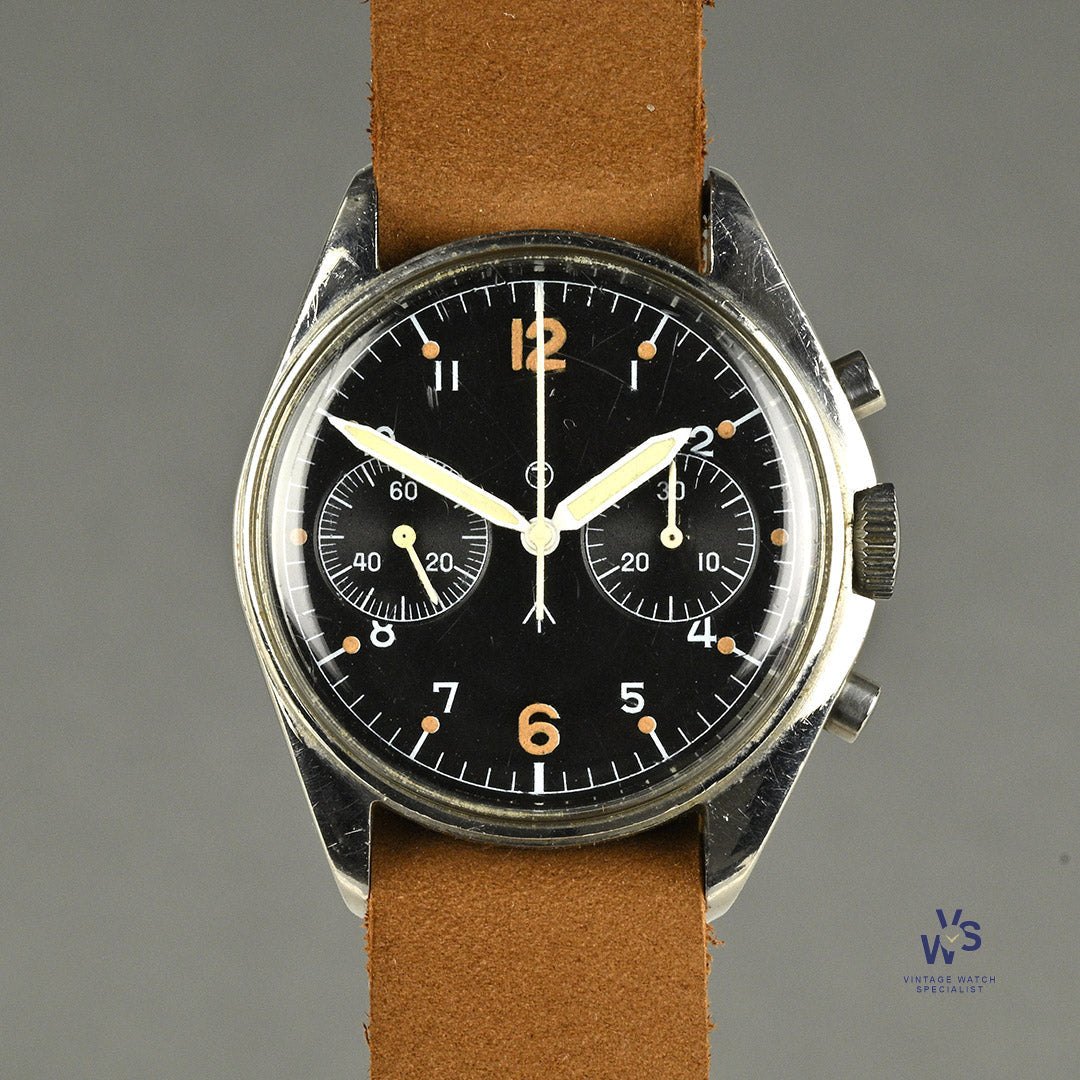
Hamilton Fab Four Military Issued Chronograph, With Rare W10 Marking, circa 1970
- Maker / attribution
- Hamilton (maker)
- Date
- c. 1970
- Historical period
- Quartz Revolution (1969 – 1990)
- Country of origin
- Switzerland
- Object type
- Wristwatch
- Stock no.
- vws3689
- Credit line
- Dealer listing, Vintage Watch Specialist (vws3689)
- Catalogue title (original)
- Hamilton - Fab Four Military Issued Chronograph - c.1970 - With Rare W10 Marking (English)
View the source record (dealer listing) ↗ (opens another website in a new tab)Suggest a correction
Record summary
Catalogued by Vintage Watch Specialist (dealer), United Kingdom (stock number vws3689), this is a wristwatch by Hamilton, made in Switzerland, dated c. 1970. The Atlas places it in the Quartz Revolution period (1969 – 1990) of its Wristwatches collection. The record is illustrated with 6 photographs.
Assembled from the source record's structured fields. Dates and attributions are given as the source states them; where a field is missing the Atlas leaves it blank rather than estimating.
Catalogue description
Dealer description — Vintage Watch Specialist
A Fascinating and rare W10-marked British Military Chronograph combining an original Hamilton-issued case, Fab Four dial and dependable Valjoux 7733 movement. Hamilton Watch Company was founded in 1892 in Lancaster, Pennsylvania, before eventually relocating production to Switzerland. The brand has a long association with military timepieces, supplying watches to Allied forces during the Second World War and continuing to produce military-issued watches throughout the Cold War. Hamilton's robust chronographs, particularly those built around the dependable Valjoux movements, remain highly sought after by collectors for their military heritage, reliability and timeless utilitarian design. What's on Offer This fascinating military chronograph is one of the more unusual variants encountered by collectors (and by us). Exceptionally rare amongst surviving examples, it features an anonymous dial within a Hamilton case and is engraved with the W.10 designation. While the vast majority of "Fab Four" chronographs went to the RAF (engraved 6BB ) or the Royal Navy (engraved 0552 ), the British Army (W10) also ordered a smaller batch for its own personnel, including the Army Air Corps and its artillery regiments. Because far fewer of these high-end chronographs were ordered for Army use than standard field watches, genuine W10 Fab Fours are considerably rarer than their RAF 6BB counterparts. While some Fab Fours had their original 6BB caseback marks "struck out" and re-marked with "W10" during MoD servicing, this example's NATO stock number, Broad Arrow symbol, and original 1970 issue-date engravings confirm it's an original, purpose-built W10. Overall, the watch is presented in excellent vintage condition . The stainless steel case displays honest wear consistent with military use while retaining clear military engravings on the caseback. The black chronograph dial features large luminous sword hands, a two-register chronograph layout and highly legible lumed Arabic numerals. It remains attractive and highly legible with evenly aged gorgeous pumpkin lume, and the hands complement the dial well. For further utility, the spring bars are actually welded to the case, with the joints visible on the side where they were inserted and likely polished afterwards for a smooth look. The plexiglass crystal shows light age-related wear appropriate for a military watch of this age. Inside beats the respected Valjoux 7733 manual-wind chronograph movement, complete with a Hamilton-marked bridge. It is running well at the time of listing (+15 seconds per day and an amplitude of 323 degrees), having been serviced recently! Fitted to a brown leather single-pass strap, it offers a rugged vintage aesthetic that suits both collectors and enthusiasts looking for something with genuine military character and history. Watches like this have become increasingly appreciated within collecting circles. This example is an early iteration, making it an intriguing addition to any military watch collection.
Historical context
Quartz Revolution (1969 – 1990)
Seiko's Astron begins mass quartz timekeeping; traditional industries contract sharply.
Quartz and digital watches transformed the market after 1969. Swiss employment collapsed, Japanese and Hong Kong production soared, and the Swatch (1983) helped the Swiss industry recover; mechanical watches survived as luxury goods.
Read the period in the timelineMore wristwatches from this periodEarlier: Modern Mechanical Horology
Atlas type guide
Chronographs and split-seconds watches
A chronograph is a watch with an additional seconds hand that can be started, stopped and returned to zero independently of the timekeeping. Louis Moinet built an early example in 1816 and Nicolas Rieussec a recording 'chronographe' in 1821; Adolphe Nicole's heart-shaped reset cam (patented 1862) made the modern return-to-zero possible. Split-seconds (rattrapante) chronographs add a second hand that can be stopped for intermediate times; flyback chronographs restart instantly.
Chronographs were essential tools for doctors (pulsometer scales), artillery (telemeter), engineers and sport. In wristwatches, Valjoux, Venus, Lemania and later the automatic chronographs of 1969 (Zenith El Primero, the Chronomatic Calibre 11 group and Seiko 6139) are milestones.
What to look for
- Push-pieces on the case band or a single button in the crown (monopusher).
- Subsidiary registers for minutes and hours; tachymeter, telemeter or pulsometer scales.
- Column wheel versus cam control visible in the movement.
- Calibre markings of specialist makers (Valjoux, Lemania, Venus, Landeron).
Dating clues
- Pocket chronographs with heart cam reset: after 1862.
- Wrist chronographs: from c. 1910; two-button designs from the 1930s.
- Automatic chronographs: from 1969.
General guidance written by the Atlas editors about this kind of object. It is not a statement about this particular piece; for that, rely on the source record above and on physical examination.
Read next:Flyback chronographChronograph
Related records
Pocket Watches · c. 1943
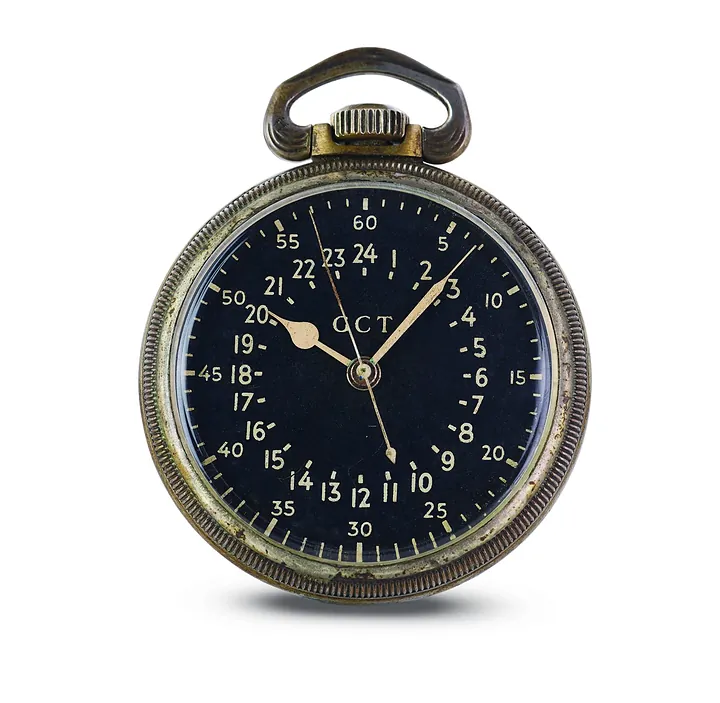
Hamilton 4992B, GCT Navigation U.S Air Force, c. 1943
Antiquorum auction archive, Geneva
Wristwatches · c. 1940s
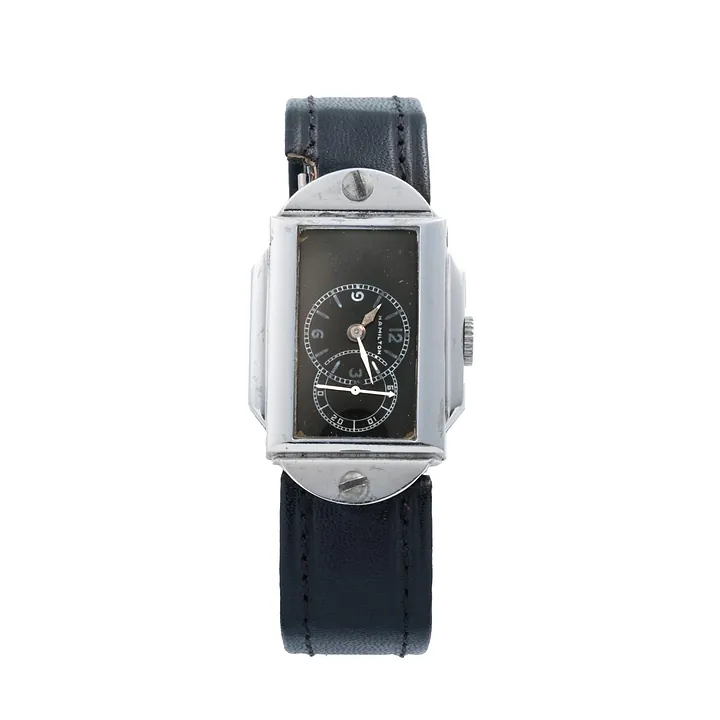
Hamilton Bomb Timer, c. 1940s
Antiquorum auction archive, Geneva
Wristwatches · originally sold in February 2025 (per the lot record)
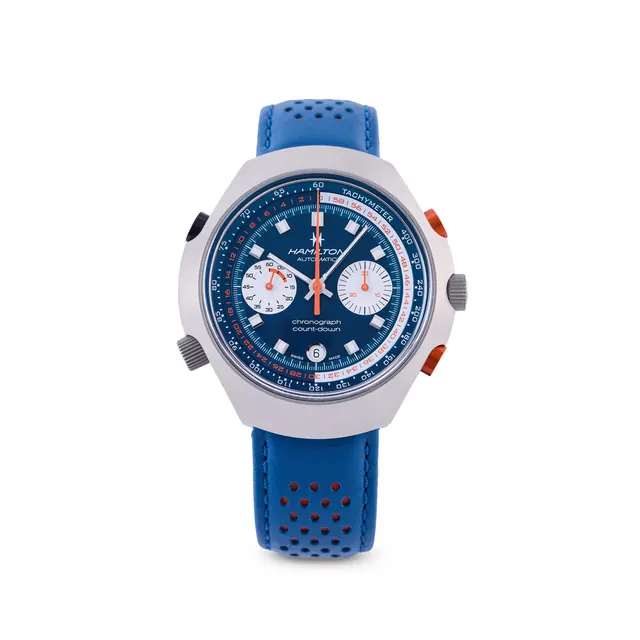
Hamilton wristwatch, ref. H51606640, American Classic Chrono-Matic 50 Limited Edition, originally sold in February 2025 (per the lot record)
Antiquorum auction archive, Geneva
Wristwatches · c. 1940s
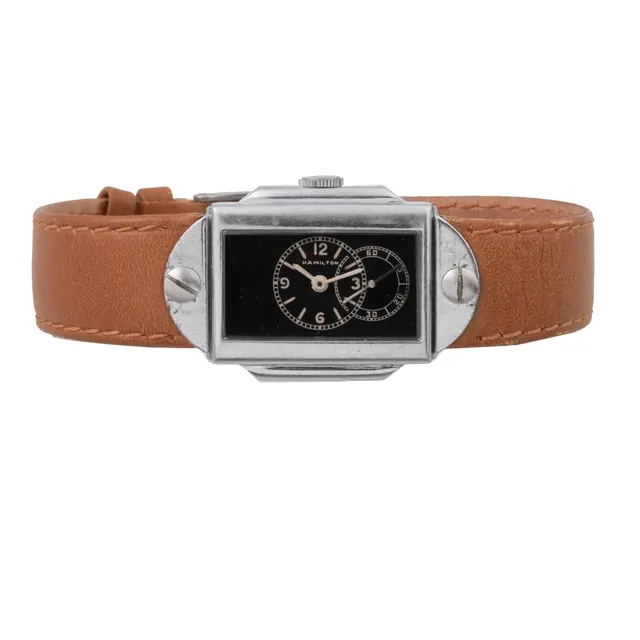
Hamilton wristwatch, Bomb Timer Watch, circa 1940's
Antiquorum auction archive, Geneva

Wristwatches · 1970
Wristwatch by Heno, Switzerland, 1970
Museum Rotterdam

Wristwatches · 1960–1986
'Tri-Compax' calendar chronograph wristwatch in gold case, by Universal, Geneva, Switzerland, 1960–1986.
Science Museum Group, London

Wristwatches · 1969–1970
Beta 21 Quartz wristwatch movement, made in Switzerland, 1970.
Science Museum Group, London

Wristwatches · c. 1969
Omega Speedmaster Moonwatch, ref. 145022-69st, c. 1969
Antiquorum auction archive, Geneva