
Wristwatches · Wristwatch
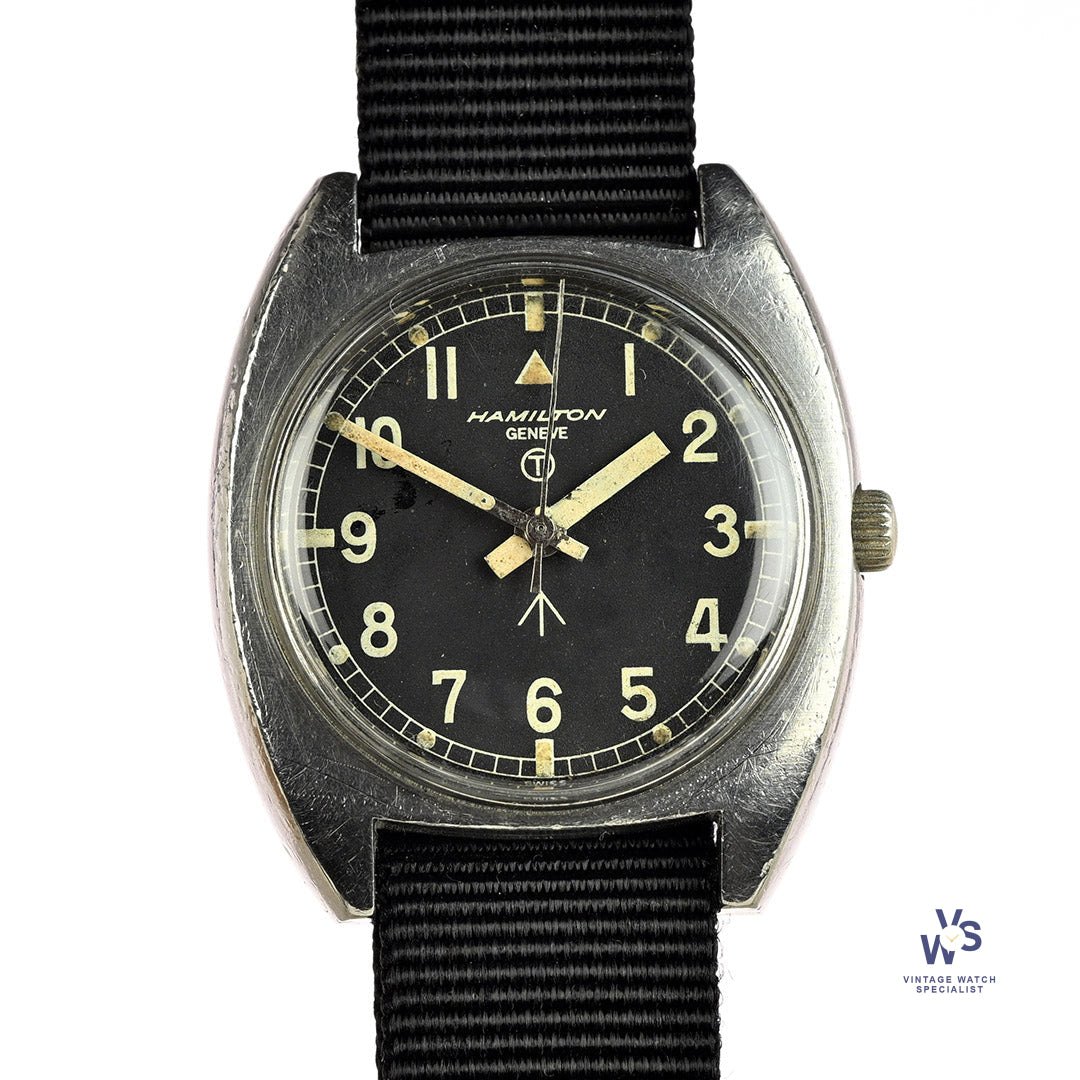
Hamilton British Military Issued, 6bb/5238290 279/74, 1974
- Maker / attribution
- Hamilton (maker)
- Date
- 1974
- Historical period
- Quartz Revolution (1969 – 1990)
- Country of origin
- Switzerland
- Object type
- Wristwatch
- Stock no.
- vws4063
- Credit line
- Dealer listing, Vintage Watch Specialist (vws4063)
- Catalogue title (original)
- Hamilton - British Military Issued - 6bb/5238290 279/74 - Original Condition - 1974 (English)
View the source record (dealer listing) ↗ (opens another website in a new tab)Suggest a correction
Record summary
Catalogued by Vintage Watch Specialist (dealer), United Kingdom (stock number vws4063), this is a wristwatch by Hamilton, made in Switzerland, dated 1974. The Atlas places it in the Quartz Revolution period (1969 – 1990) of its Wristwatches collection. The record is illustrated with 6 photographs.
Assembled from the source record's structured fields. Dates and attributions are given as the source states them; where a field is missing the Atlas leaves it blank rather than estimating.
Catalogue description
Dealer description — Vintage Watch Specialist
A Striking British Military Issued Hamilton 6bb in Original Condition with Original Military Engravings - 1974 Hamilton was founded in the United States in 1892 and later established its base in Switzerland, becoming known for practical, military-ready timepieces. Its strongest connection to the British military came in the 1970s, when Hamilton supplied robust hand-wound field watches to the Ministry of Defence. Among them were RAF-issued models marked 6BB, produced to meet demanding service standards. These watches remain a key part of Hamilton’s respected military heritage. What's on Offer A superb example of a British Army–issued Hamilton, identified by its 6BB military designation, this purposeful tool watch captures the rugged, no-nonsense design language of 1970s service timepieces. The stainless steel case shows honest, service-earned wear, retaining strong lines and a confident presence on the wrist. The matte black dial remains highly legible, with bold Arabic numerals, a clear minute track and luminous hands and hour plots designed for instant readability in all conditions. The original Ministry of Defence engravings to the caseback, including the broad arrow and 6BB NATO Stock Number with period issue markings, firmly root this watch in its military history, adding genuine provenance and collector appeal. Paired with a practical textile strap, it wears comfortably and securely, just as intended. A highly wearable slice of British military horology, offering authentic character, historical interest and everyday usability in equal measure.
Historical context
Quartz Revolution (1969 – 1990)
Seiko's Astron begins mass quartz timekeeping; traditional industries contract sharply.
Quartz and digital watches transformed the market after 1969. Swiss employment collapsed, Japanese and Hong Kong production soared, and the Swatch (1983) helped the Swiss industry recover; mechanical watches survived as luxury goods.
Read the period in the timelineMore wristwatches from this periodEarlier: Modern Mechanical Horology
Atlas type guide
Military, pilot and travel watches
The wristwatch owes much of its adoption by men to warfare and aviation. Wristlets — small pocket watches soldered with lugs and worn on a strap — were used in colonial campaigns and became standard equipment in the First World War, with protective grilles over the crystal ('shrapnel guards'). Louis Cartier's Santos (1904), designed for the aviator Alberto Santos-Dumont, is often cited as an early purpose-made pilot's watch.
In the Second World War governments specified watches in detail: the German B-Uhr observation watches, the American A-11, and the British 'W.W.W.' (the 'Dirty Dozen' set of 1945). After the war, jet travel brought GMT and world-time watches, which show two or more time zones at once — Louis Cottier's world-time mechanism and the Rolex GMT-Master (1955) are examples.
What to look for
- Military markings on the case back: broad arrow, issue numbers, 'W.W.W.', 'A.T.P.'
- High-legibility black dials with luminous Arabic numerals; oversized crowns for gloved hands.
- 24-hour hands and rotating 24-hour bezels or city rings on GMT/world-time watches.
- Wire lugs on early wristlets converted from pocket watches.
Dating clues
- Wire-lug wristlets: c. 1900–1925.
- Military specifications of the Second World War: 1939–1945.
- GMT and world-time wristwatches: mainly after 1950.
General guidance written by the Atlas editors about this kind of object. It is not a statement about this particular piece; for that, rely on the source record above and on physical examination.
Related records
Pocket Watches · c. 1943
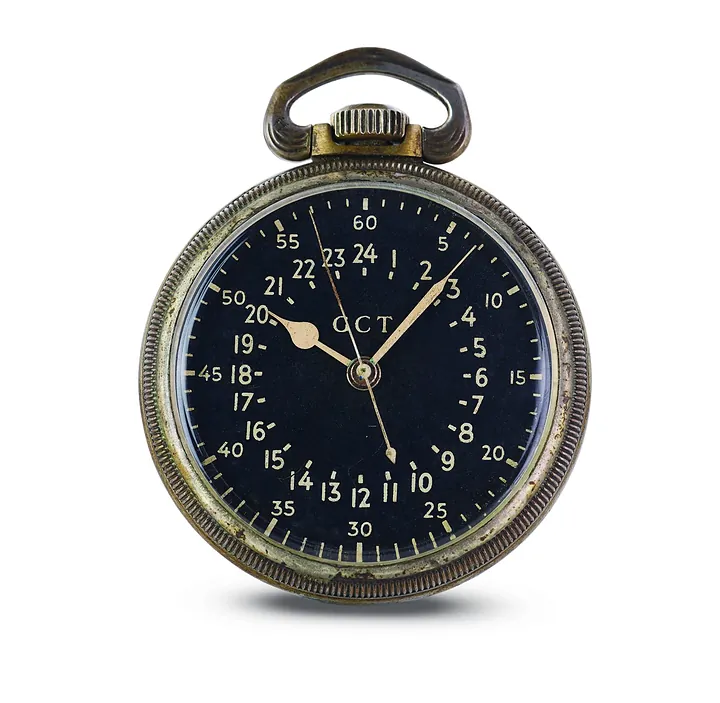
Hamilton 4992B, GCT Navigation U.S Air Force, c. 1943
Antiquorum auction archive, Geneva
Wristwatches · c. 1940s
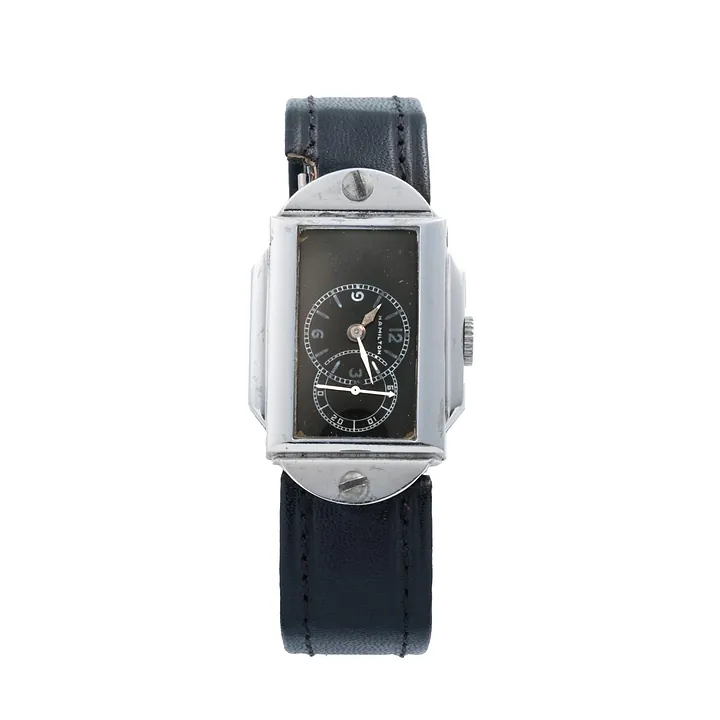
Hamilton Bomb Timer, c. 1940s
Antiquorum auction archive, Geneva
Wristwatches · originally sold in February 2025 (per the lot record)
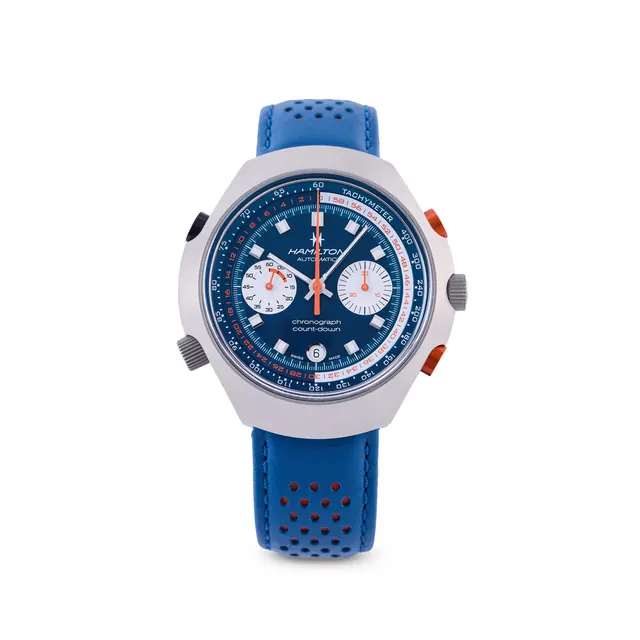
Hamilton wristwatch, ref. H51606640, American Classic Chrono-Matic 50 Limited Edition, originally sold in February 2025 (per the lot record)
Antiquorum auction archive, Geneva
Wristwatches · c. 1940s
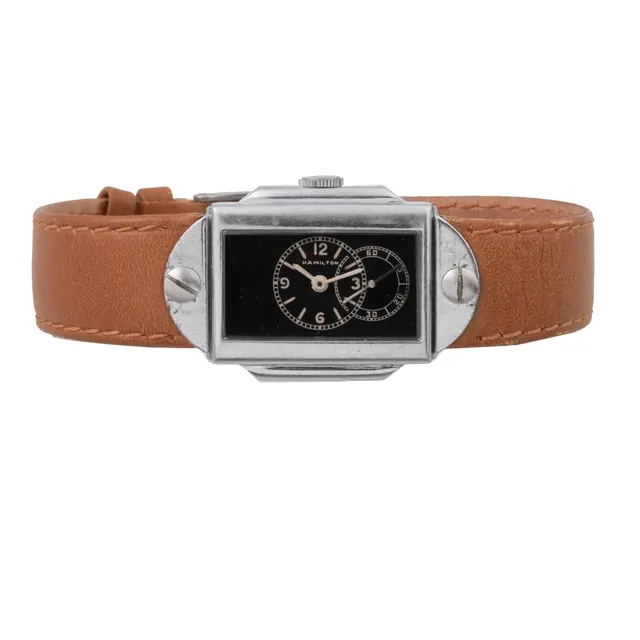
Hamilton wristwatch, Bomb Timer Watch, circa 1940's
Antiquorum auction archive, Geneva

Wristwatches · 1970
Wristwatch by Heno, Switzerland, 1970
Museum Rotterdam

Wristwatches · 1960–1986
'Tri-Compax' calendar chronograph wristwatch in gold case, by Universal, Geneva, Switzerland, 1960–1986.
Science Museum Group, London

Wristwatches · 1969–1970
Beta 21 Quartz wristwatch movement, made in Switzerland, 1970.
Science Museum Group, London

Wristwatches · c. 1969
Omega Speedmaster Moonwatch, ref. 145022-69st, c. 1969
Antiquorum auction archive, Geneva