
Wristwatches · Wristwatch
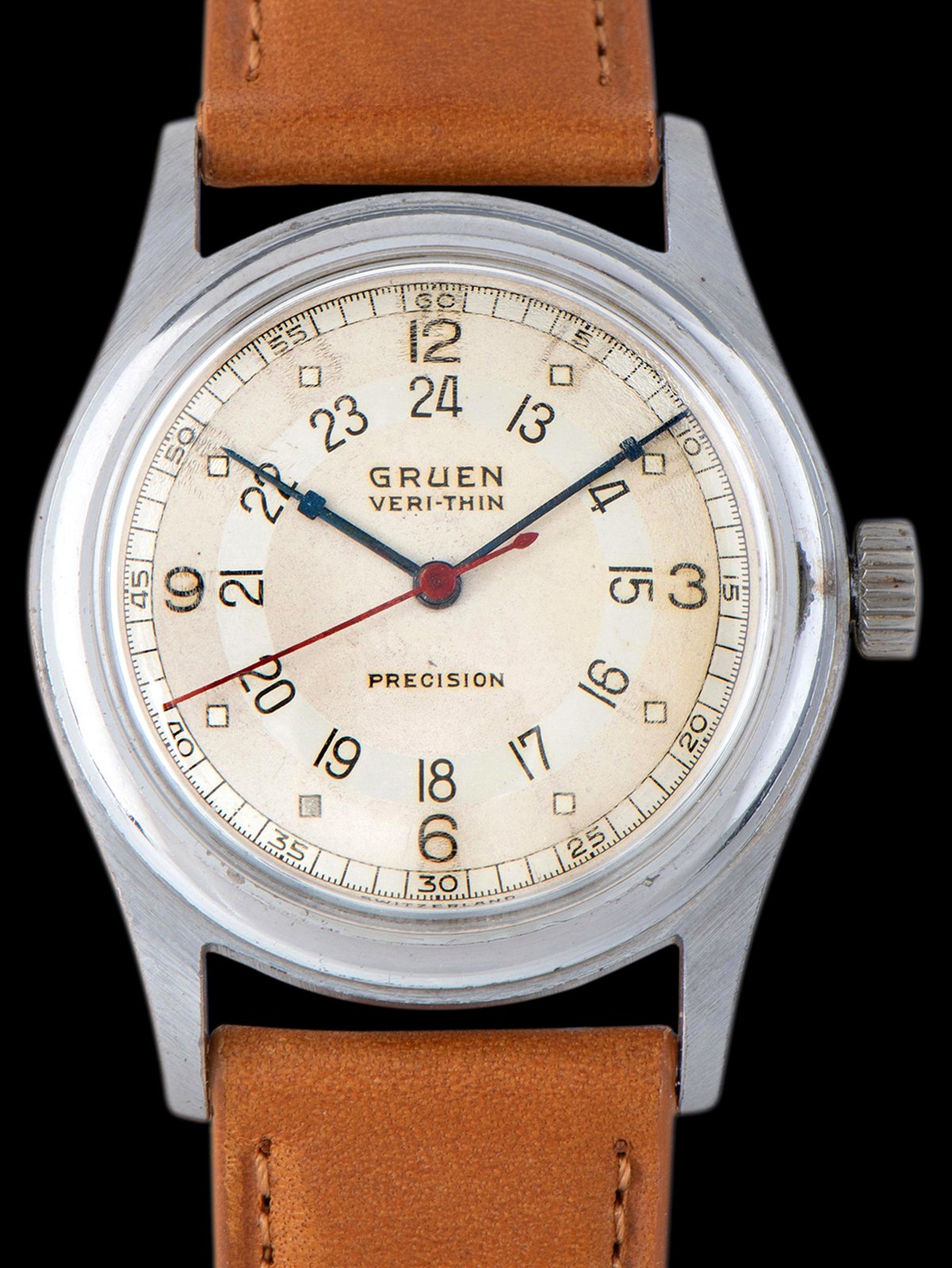
Gruen Veri-Thin Precision 'Cal. 420SS' Two-Tone Dial, 1940s
- Maker / attribution
- Gruen (maker)
- Date
- 1940s
- Historical period
- Golden Age of Mechanical Watchmaking (1900 – 1945)
- Country of origin
- Unrecorded in source
- Object type
- Wristwatch
- Materials / technique
- two-tone
- Stock no.
- GRNPVT
- Credit line
- Dealer listing, Craft & Tailored (GRNPVT)
- Catalogue title (original)
- 1940s Gruen Veri-Thin Precision 'Cal. 420SS' Two-Tone Dial (English)
View the source record (dealer listing) ↗ (opens another website in a new tab)Suggest a correction
Record summary
Catalogued by Craft & Tailored (dealer), Los Angeles (stock number GRNPVT), this is a wristwatch by Gruen, dated 1940s. The Atlas places it in the Golden Age of Mechanical Watchmaking period (1900 – 1945) of its Wristwatches collection. Materials and techniques recorded by the source: two-tone. The record is illustrated with 6 photographs.
Assembled from the source record's structured fields. Dates and attributions are given as the source states them; where a field is missing the Atlas leaves it blank rather than estimating.
Catalogue description
Dealer description — Craft & Tailored
Founded by German immigrant Dietrich Gruen in the late 19th century, Gruen grew to become one of the largest watchmakers in the United States, rivaling the likes of Hamilton Watch Company and Bulova at its peak. The wartime years of the 1940s proved especially significant for the brand, as Gruen navigated the complexities of being an American company deeply tied to Swiss production during World War II. While many American manufacturers halted civilian watchmaking entirely in favor of military contracts, Gruen continued producing watches in limited quantities, carefully balancing patriotic wartime messaging with ongoing Swiss manufacturing. It was during this era that Gruen’s celebrated Pan American series emerged, watches closely tied to aviation and the pioneering transatlantic operations of Pan American World Airways. Initially produced exclusively for PanAm personnel between 1943 and 1945, these watches introduced features rarely seen on wristwatches of the time, including central seconds and 24-hour inner chapter rings designed for aviation and military timekeeping. Presented here, this Gruen Precision Veri-Thin embodies that fascinating chapter of horological history. Powered by the reliable Cal. 420SS movement from Gruen’s renowned Veri-Thin series, the watch showcases a beautifully preserved two-tone dial, balanced proportions, and an unmistakably elegant mid-century aesthetic that reflects the refined utility of the era’s aviation-inspired designs. Adding further intrigue, the side of the case bears the engraving “Capt. M. Feinberg,” an evocative detail that hints at the watch’s past life and likely connection to PanAm or military service. While research has yet to uncover the identity behind the name, the engraving adds an undeniable sense of character, provenance, and mystery to an already compelling wartime-era timepiece. SPECS Stock # GRNPVT Brand Gruen Style Precision Veri-Thin Model N/A Serial 57XXX Size Men's Material Chrome-Plated Brass W/ Stainless Steel Back Dial Silver "Two-Tone" Millimeters 32 Strap 2pc Handmade Leather Strap CASE & BRACELET The chrome-plated brass case remains in exceptionally well-preserved condition, exhibiting only minimal loss to the plating, nominal wear, and no notable evidence of prior polishing. The full and symmetrical lugs retain factory dimensions and finishing throughout. The original domed acrylic crystal is in excellent condition, but does show some micro-crazing throughout, which is expected for its age. The unsigned crown is likely an early replacement, but it matches the aesthetic of the watch perfectly. The left side of the case features an engraving that reads "Capt. M. Feinberg". The stainless steel or "Guildite" screw-down case back features some minor tool marks and retains its factory engravings in deep and crisp condition. The watch comes supplied on a 2pc handmade leather strap. DIAL & HANDS The original and beautifully preserved two-tone dial consists of alternating bands of satin and metallic silver finishes that separate the minutes, hour markers, and 24-hour sections. The dial itself exhibits minimal marks or elements of age and has achieved a charming, warm patina throughout. The original and unique blued steel hour and minutes hands, along with the red center seconds hand, remain in exceptional condition and complete the watch by providing a touch of color. ACCESSORIES None. The watch is keeping time perfectly, but the service history is unknown. A movement service can be purchased upon request.
Historical context
Golden Age of Mechanical Watchmaking (1900 – 1945)
The wristwatch displaces the pocket watch; waterproof cases, self-winding and grand complications.
The wristwatch overtook the pocket watch. Military use in the First World War, aviation, water-resistant cases (1926), automatic winding (1923–31), rectangular Art Deco designs and early chronographs and calendars defined the period.
Read the period in the timelineMore wristwatches from this periodEarlier: Industrial Revolution
Atlas type guide
Wristwatches
Bracelet watches were worn by women from the early nineteenth century — Breguet made one for Caroline Murat, Queen of Naples, in 1810–12 — but the wristwatch only became a man's instrument with military use and aviation in the early twentieth century. Between the World Wars it overtook the pocket watch; the 1920s and 1930s brought rectangular Art Deco cases, water-resistant cases and the first automatic winding systems.
After 1945 the wristwatch became a carrier of identity — dress watches, sports and dive watches, chronographs, calendars — produced by Swiss, American, Japanese, German, Soviet and Chinese industries. The quartz revolution after 1969 and the mechanical renaissance since the 1990s, including the rise of independent watchmakers, complete the story.
What to look for
- The reference number (between the lugs or inside the case back) and serial number, the starting point for dating.
- The calibre: its maker and number are often stamped under the dial or on the bridge.
- Originality of dial, hands and crown — refinished ('redial') dials are common.
- Case material marks: 18K/750, 14K/585, stainless steel, gold-filled, plated.
Dating clues
- Wire-lug cases: before c. 1925.
- Water-resistant screw-down cases: from 1926.
- Quartz movements: from 1969; sapphire crystals widespread after c. 1980.
General guidance written by the Atlas editors about this kind of object. It is not a statement about this particular piece; for that, rely on the source record above and on physical examination.
Related records
Wristwatches · c. 1950s
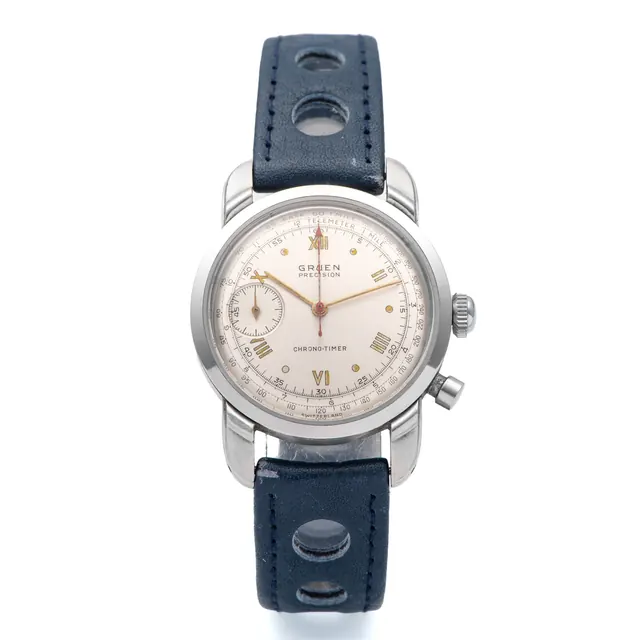
Gruen wristwatch, Chrono-Timer, circa 1950's
Antiquorum auction archive, Geneva
Pocket Watches · 20th century
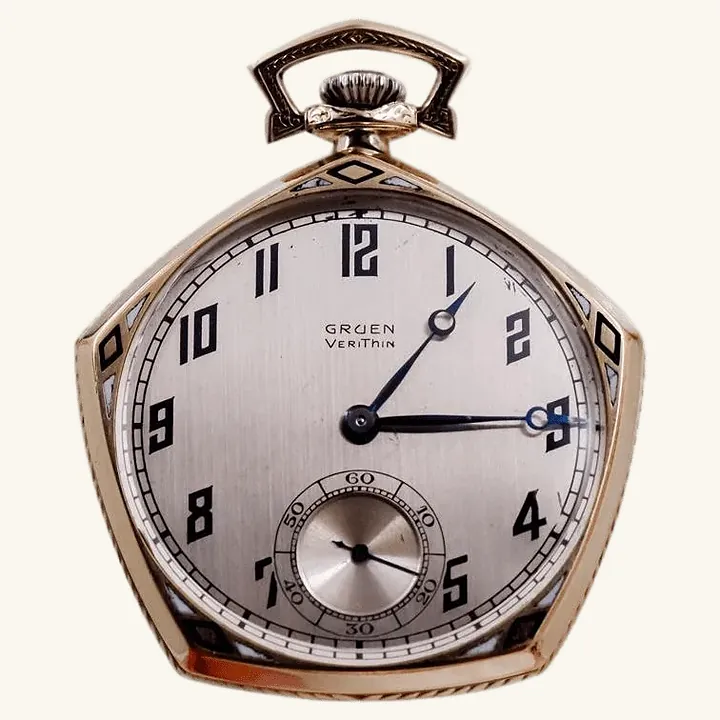
Gruen Yellow Gold Filled Art Deco Pocket Watch with Original Stern Dial – 1920”s
WatchMuseum.org shop
Wristwatches · c. 1960
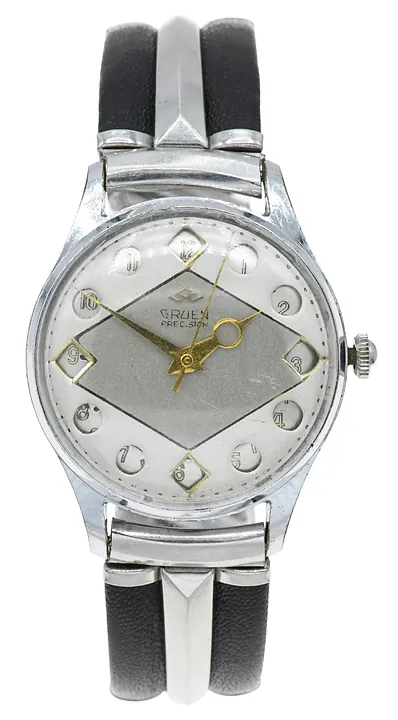
Gruen Airflight Jump Hour Wristwatch, circa 1960's
LiveAuctioneers auction archive
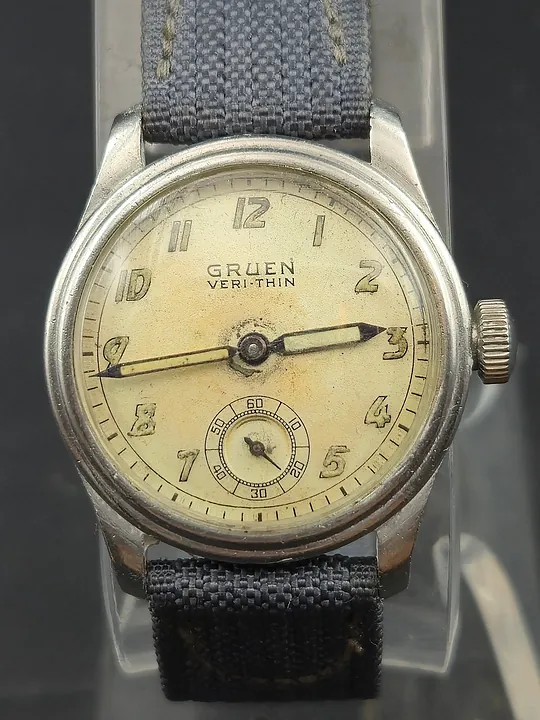
Wristwatches · 1940s
1940s Gruen Veri-Thin 15J Military-Style Swiss Wristwatch, Stainless Case w/ Sub-Seconds, Running
LiveAuctioneers auction archive
Wristwatches · 1900–1999
Wristwatch by Mercury, 1900–1999
Modemuseum Hasselt
Wristwatches · 1900–1999
Wristwatch by Nutrix, 1900–1999
Modemuseum Hasselt
Wristwatches · 1920
Wristwatch, 1920
Modemuseum Hasselt

Wristwatches · 1931
Rolex 'Oyster Perpetual' rotor self-winding wrist-watch, lever escapement, in steel case with glass in back, Montres Rolex SA, Geneva, Switzerland, 1931
Science Museum Group, London