
Wristwatches · Wristwatch
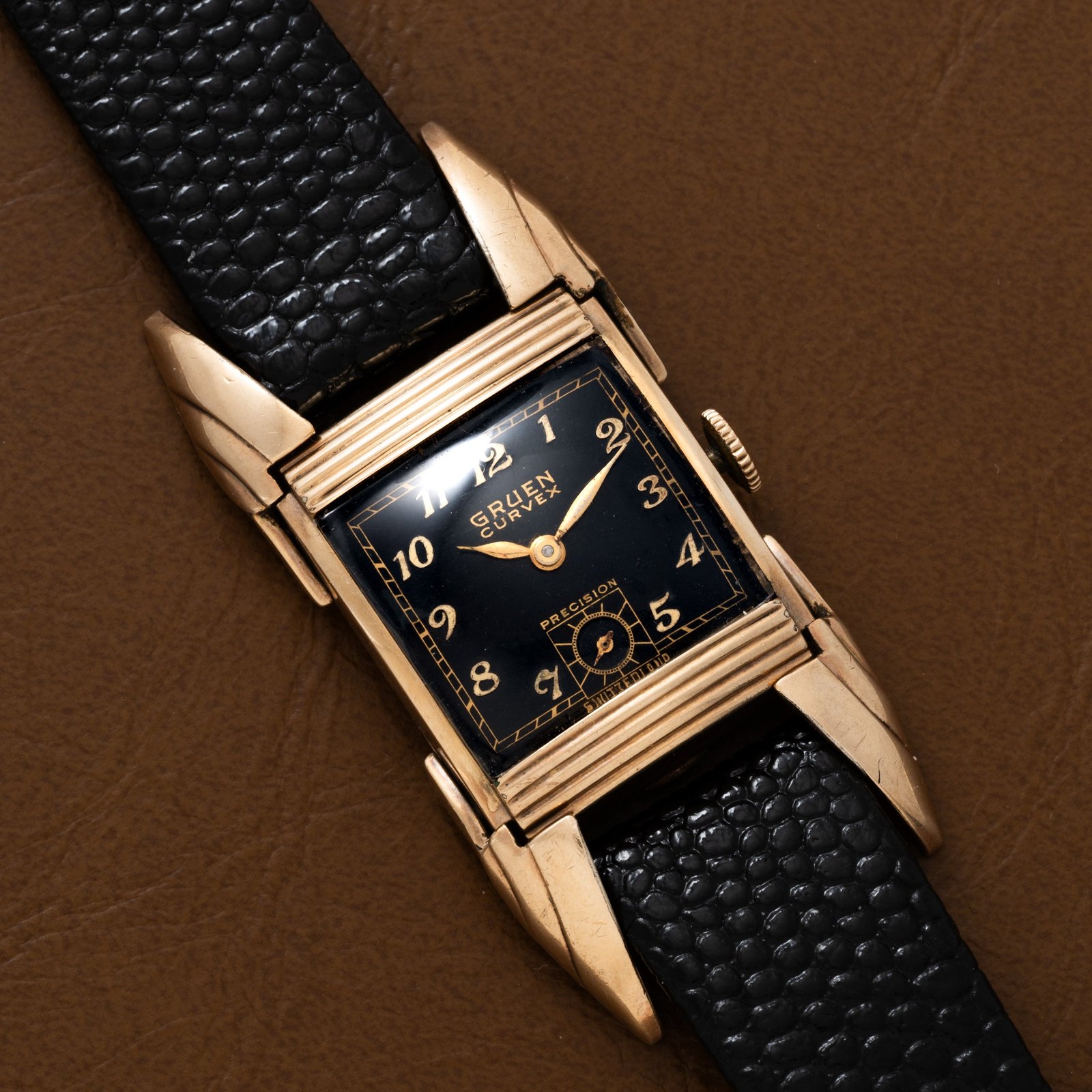
Gruen Curvex "Falcon", 1949
- Maker / attribution
- Gruen (maker)
- Date
- 1949
- Historical period
- Modern Mechanical Horology (1945 – 1969)
- Country of origin
- Unrecorded in source
- Object type
- Wristwatch
- Dimensions
- Case 48 mm
- Stock no.
- 40992028
- Credit line
- Dealer listing, Analog/Shift (40992028)
- Catalogue title (original)
- Gruen Curvex "Falcon" (English)
View the source record (dealer listing) ↗ (opens another website in a new tab)Suggest a correction
Record summary
Catalogued by Analog/Shift (dealer), New York (stock number 40992028), this is a wristwatch by Gruen, dated 1949. The Atlas places it in the Modern Mechanical Horology period (1945 – 1969) of its Wristwatches collection. Recorded dimensions: Case 48 mm. The record is illustrated with 6 photographs.
Assembled from the source record's structured fields. Dates and attributions are given as the source states them; where a field is missing the Atlas leaves it blank rather than estimating.
Catalogue description
Dealer description — Analog/Shift
The Bulova Curv, with its curved quartz movement, might have taken the watch world by storm when it was released last year. But it was by no means the first curved wristwatch ever created. For example, in 1916, Tissot created the “Banana” watch, with a specially curved crystal. It was made for a Russian aristocrat, who sent it back to Tissot’s headquarters for maintenance just before the outbreak of the Russian Revolution. However, it remained in Switzerland after the Revolution broke out, and served as inspiration for the Banana Centenary Edition released this year. However, the most famous curved wristwatch is without a doubt the Gruen Curvex, which was introduced in 1935 and almost single-handedly saw Gruen through the Great Depression. Thanks to strategic partnerships with Swiss companies like Rolex and movement manufacturer Aegler, Gruen had enjoyed success with its doctor’s watch, the Techni-Quadron (which Rolex marketed as the Prince in Europe and the British Empire). But the brand also earned a reputation for innovation in aesthetics. Throughout the 1920s, Gruen experimented with different movement and watch designs, including the Quadron, which housed a tonneau-shaped movement in a rectangular case. However, despite the economic setbacks and political changeovers, the brand was poised for a comeback—which came in the form of this watch, the Curvex. Gruen had actually applied for a patent for a curved movement in 1929, through its Bienne-based agent, Emile Frey. It was granted to Frey in 1932, but assigned to Gruen. Accordingly, the movement designers at the Precision Factory set to work designing what would become a revolutionary watch movement: the Calibre 311. The Calibre 311 was the world’s first curved wristwatch movement. It became so famous, and such a best-seller, that the name “curvex” became associated with the style of watch. However, since the patent was registered exclusively to Gruen, the only true “curvex” watch from the period is the Curvex. The Curvex that we offer here measures 48mm lug to lug, features the Calibre 440- the third generation of the movement--- and dates to 1949. Featuring a 14K gold filled case, this watch has developed a beautiful lemony tone. The dial, a dark charcoal black has patinaed evenly and beautifully. The dial is complete with gilt finishes and signed "Gruen Curvex Precision". This model, named the Falcon for its articulating lugs, was only made for 3 years. Without the Curvex, it’s quite possible that the brand would have gone under a lot sooner than it did. Fortunately, the sales of the watch—Gruen’s flagship—would bolster the company well into the 1950s, when the model was discontinued. Shortly after, Gruen would sell off the Precision Factory, which was eventually bought by Rolex. The Curvex occupies a special place in the hearts of many collectors, who appreciate it for its revolutionary design.
Historical context
Modern Mechanical Horology (1945 – 1969)
Tool watches for divers, pilots and astronauts; electric watches anticipate the electronic age.
The classic era of the mechanical wristwatch: dive watches, chronographs for motor racing and space flight, GMT watches for jet travel, slim dress watches, automatic calendars, and the rise of Japanese manufacturers alongside Swiss, American, German and Soviet industries.
Read the period in the timelineMore wristwatches from this periodEarlier: Golden Age of Mechanical Watchmaking
Atlas type guide
Wristwatches
Bracelet watches were worn by women from the early nineteenth century — Breguet made one for Caroline Murat, Queen of Naples, in 1810–12 — but the wristwatch only became a man's instrument with military use and aviation in the early twentieth century. Between the World Wars it overtook the pocket watch; the 1920s and 1930s brought rectangular Art Deco cases, water-resistant cases and the first automatic winding systems.
After 1945 the wristwatch became a carrier of identity — dress watches, sports and dive watches, chronographs, calendars — produced by Swiss, American, Japanese, German, Soviet and Chinese industries. The quartz revolution after 1969 and the mechanical renaissance since the 1990s, including the rise of independent watchmakers, complete the story.
What to look for
- The reference number (between the lugs or inside the case back) and serial number, the starting point for dating.
- The calibre: its maker and number are often stamped under the dial or on the bridge.
- Originality of dial, hands and crown — refinished ('redial') dials are common.
- Case material marks: 18K/750, 14K/585, stainless steel, gold-filled, plated.
Dating clues
- Wire-lug cases: before c. 1925.
- Water-resistant screw-down cases: from 1926.
- Quartz movements: from 1969; sapphire crystals widespread after c. 1980.
General guidance written by the Atlas editors about this kind of object. It is not a statement about this particular piece; for that, rely on the source record above and on physical examination.
Related records
Wristwatches · c. 1950s
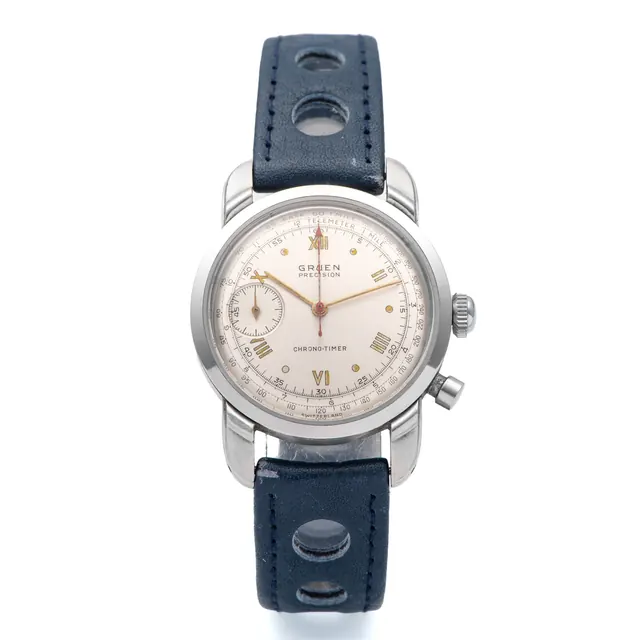
Gruen wristwatch, Chrono-Timer, circa 1950's
Antiquorum auction archive, Geneva
Pocket Watches · 20th century
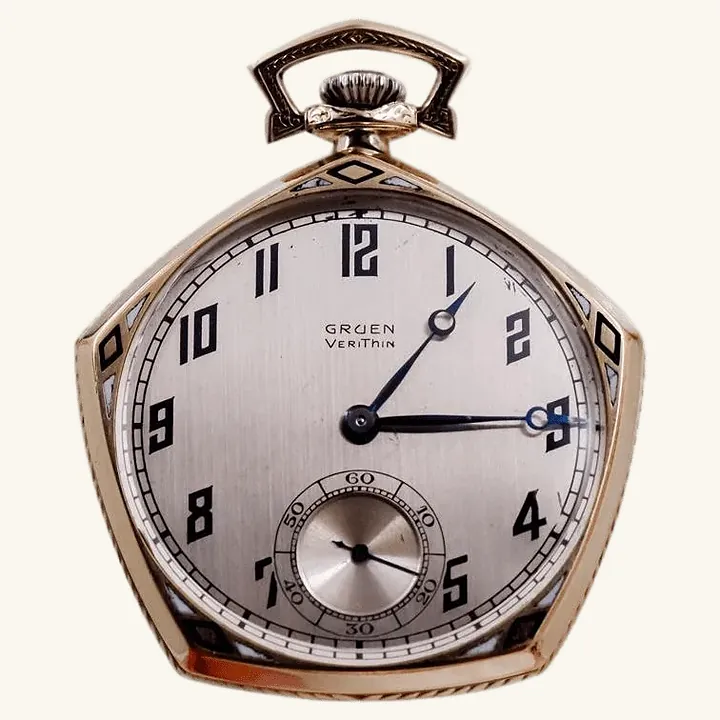
Gruen Yellow Gold Filled Art Deco Pocket Watch with Original Stern Dial – 1920”s
WatchMuseum.org shop
Wristwatches · c. 1960
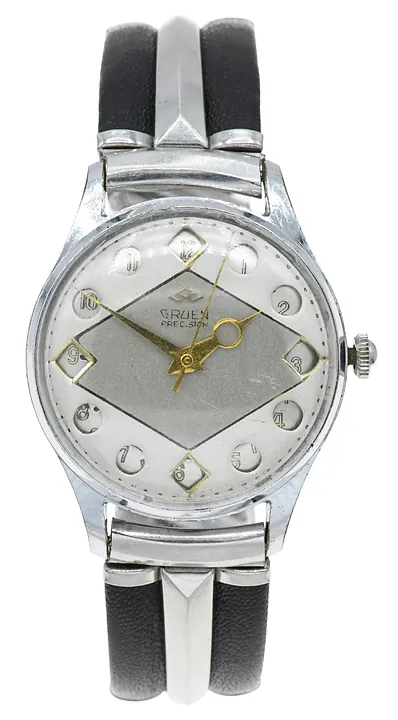
Gruen Airflight Jump Hour Wristwatch, circa 1960's
LiveAuctioneers auction archive
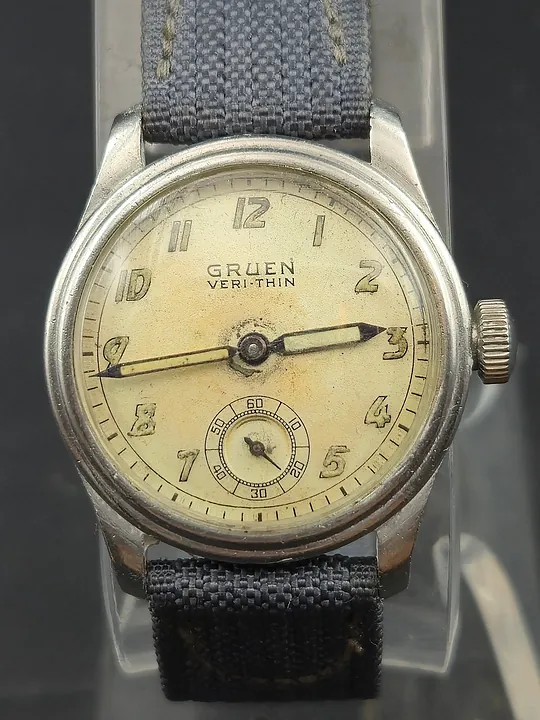
Wristwatches · 1940s
1940s Gruen Veri-Thin 15J Military-Style Swiss Wristwatch, Stainless Case w/ Sub-Seconds, Running
LiveAuctioneers auction archive

Wristwatches · 1945
Wristwatch by Eterna, 1945
Museum Rotterdam

Wristwatches · c. 1945
Breitling Premier, ref. 790, c. 1945
Antiquorum auction archive, Geneva

Wristwatches · c. 1945
Universal Genève Uni-Compax, ref. 22492, c. 1945
Antiquorum auction archive, Geneva
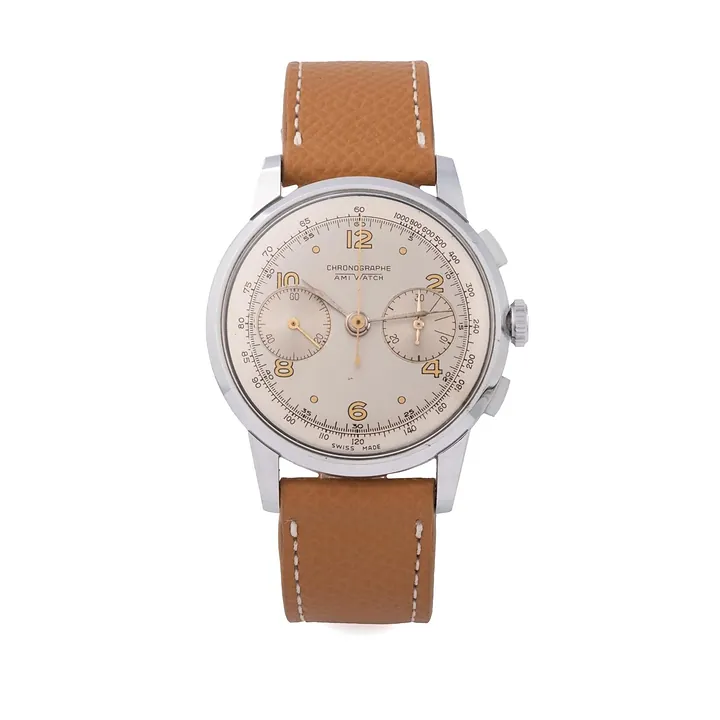
Wristwatches · c. 1950s
Ami Watch Chronographe, c. 1950s
Antiquorum auction archive, Geneva