
Pocket Watches · Pocket watch
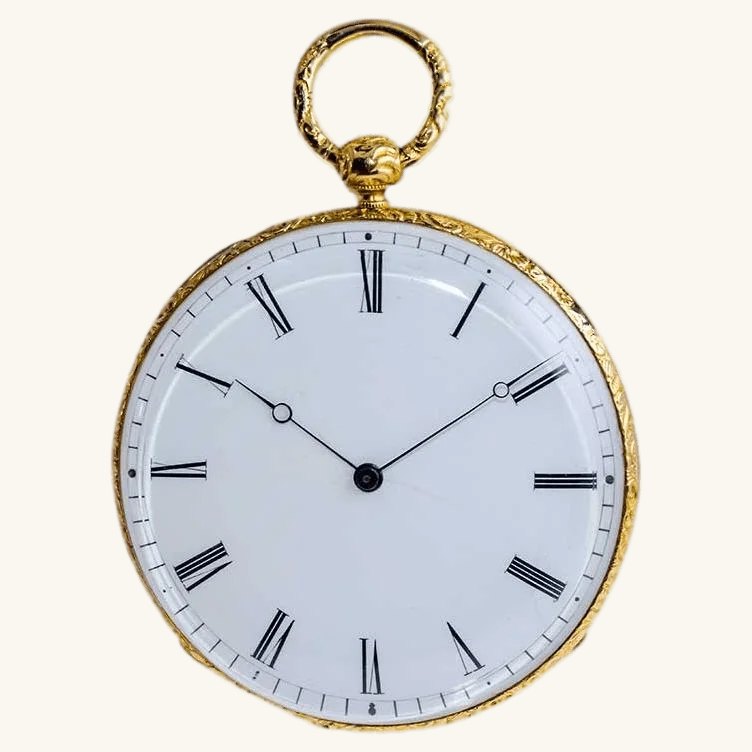
Gorini & Cie. 18 Karat Yellow Gold Pocket Watch, c. 1840s
- Maker / attribution
- Unrecorded in source
- Date
- c. 1840s
- Historical period
- Precision & Scientific Horology (1750 – 1850)
- Country of origin
- Unrecorded in source
- Object type
- Pocket watch
- Materials / technique
- gold
- Dealer
- WatchMuseum.org shop
- Stock no.
- Product 5071
- Credit line
- Dealer listing, WatchMuseum.org shop (product 5071)
- Catalogue title (original)
- Gorini & Cie. 18 Karat Yellow Gold Pocket Watch (English)
View the source record (dealer listing) ↗ (opens another website in a new tab)Suggest a correction
Record summary
Catalogued by WatchMuseum.org shop (stock number Product 5071), this is a pocket watch, dated c. 1840s. The Atlas places it in the Precision & Scientific Horology period (1750 – 1850) of its Pocket Watches collection. Materials and techniques recorded by the source: gold. The record is illustrated with 6 photographs.
Assembled from the source record's structured fields. Dates and attributions are given as the source states them; where a field is missing the Atlas leaves it blank rather than estimating.
Catalogue description
Dealer description — WatchMuseum.org shop
The Gorini & Cie. 18 Karat Yellow Gold Pocket Watch from the 1840s is a magnificent piece that embodies the elegance and precision of a bygone era, reflecting the impeccable craftsmanship synonymous with Gorini & Cie. Paris. This exquisite antique is a celebration of the Baroque style, hailing from France, and is a testament to the meticulous artistry of the mid-19th century. The watch features a beautifully crafted enamel dial adorned with kiln-fired Roman numerals, a hallmark of the period’s attention to detail and aesthetic sophistication. The 18K yellow gold case is a masterpiece in itself, intricately engraved by hand, highlighting the artisanal skill and dedication to quality that defined the era. Despite being over a century old, this pocket watch remains in excellent condition, with a key winding movement that ensures it keeps accurate time, making it not only a stunning collector’s item but also a functional piece in today’s fast-paced world. The Gorini & Cie. pocket watch is more than just a timepiece; it is a bridge between the past and present, a reminder of the timeless beauty and enduring craftsmanship that transcends generations. This exquisite Keywind pocket watch is a true testament to the craftsmanship of Gorini & Cie. Paris. Dating back to the 1840s, this timepiece features a stunning enamel dial with flawless kiln-fired Roman numerals. The 18K yellow gold case is meticulously engraved by hand, showcasing the attention to detail that was characteristic of the era. Despite its age, this pocket watch still keeps accurate time thanks to its reliable key winding movement. It’s truly remarkable to think that this antique timepiece can still serve as a functional instrument in today’s fast-paced world. Creator: Gorini & Cie. Style: Baroque Place of Origin: France Period: 1850-1859 Date of Manufacture: 1850’s Condition: Excellent
Historical context
Precision & Scientific Horology (1750 – 1850)
Harrison solves longitude; Mudge invents the lever; Breguet's Paris workshop defines the modern watch.
From 1750 to 1850 the watch became a precision instrument. Mudge's lever escapement, the cylinder escapement, Lépine's thin bar calibre, Breguet's innovations (overcoil, tourbillon, perpétuelle) and the pocket chronometer of Arnold and Earnshaw all date from this period, while verge watches remained common in cheaper production.
Read the period in the timelineMore pocket watches from this periodEarlier: Early Modern Horology
Atlas type guide
Pocket watches
The pocket watch was the dominant personal timekeeper from the late seventeenth century until the First World War. Its development tracks the history of the escapement: verge watches with fusees until the late eighteenth century; Thomas Mudge's lever escapement (c. 1755) and the cylinder escapement popularised by George Graham and later by Swiss makers; and the Swiss and English lever watches of the nineteenth century. Lépine's bar-bridge calibre and keyless winding made watches thinner and easier to use.
Industrialisation transformed the trade: American factories such as Waltham (from 1850) and Elgin produced interchangeable parts by machine, and Swiss makers responded with their own mechanisation after the 1876 Philadelphia Exhibition. By 1900 a reliable watch was affordable to millions; the finest makers continued to produce complications and precision watches.
What to look for
- The escapement: verge (crown wheel), cylinder, duplex, English or Swiss lever.
- Key winding (a square arbor in dial or back) or keyless crown winding.
- Signatures and serial numbers on the movement, dial and inside case back.
- Hallmarks, case maker's marks and gold or silver standards stamped in the case.
- Dial material: enamel, silver, gold, later printed metal.
Dating clues
- Verge watches dominate before c. 1800; cylinder watches c. 1770–1900; lever watches after c. 1820.
- Keyless winding: increasingly common after c. 1860.
- Manufacturer serial number lists exist for Waltham, Elgin, Longines, Omega, Patek Philippe and others.
General guidance written by the Atlas editors about this kind of object. It is not a statement about this particular piece; for that, rely on the source record above and on physical examination.
Read next:Verge escapementDetached lever escapementFuseeIdentification Centre
Related records
Pocket Watches · 1800–1899
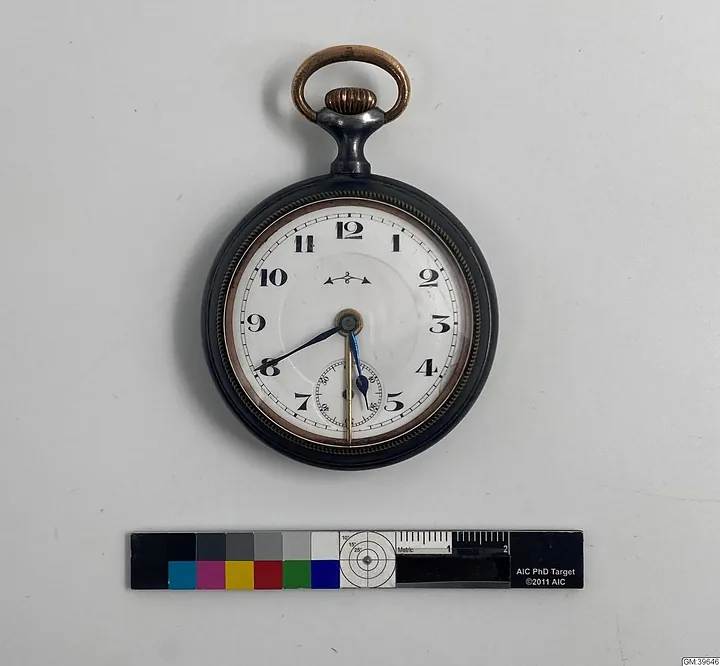
Alarm pocket watch by Eterna w, Gothenburg, 1800–1899
Museum of Gothenburg
Pocket Watches · 1820
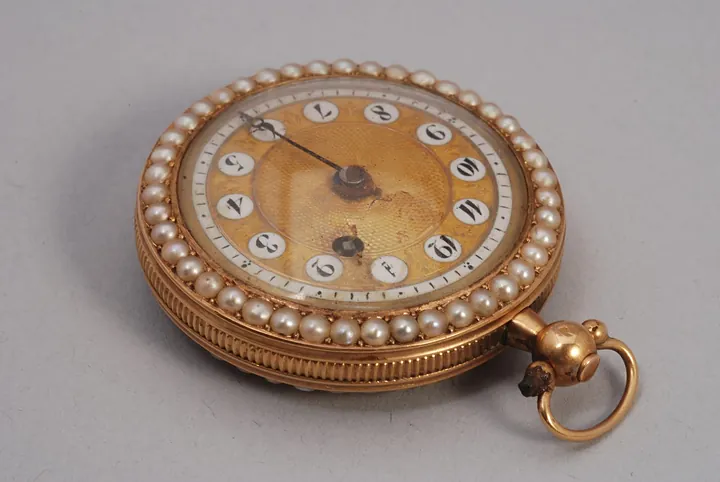
Pocket watch by Chevalier & Cochet, 1820
Museum Rotterdam
Pocket Watches · c. 1740–60
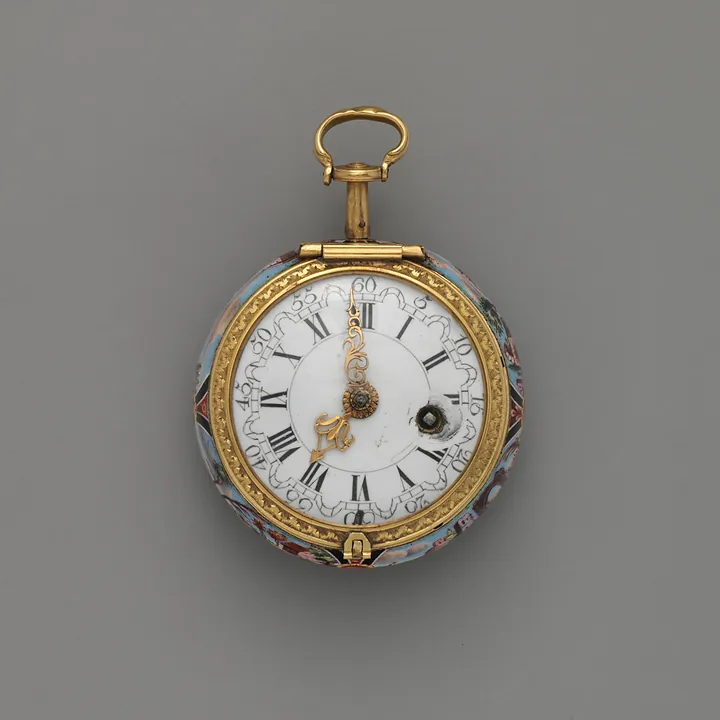
Watch by Charles Cabrier II, England, c. 1740–60 (The Met 17.190.1458)
The Metropolitan Museum of Art, New York
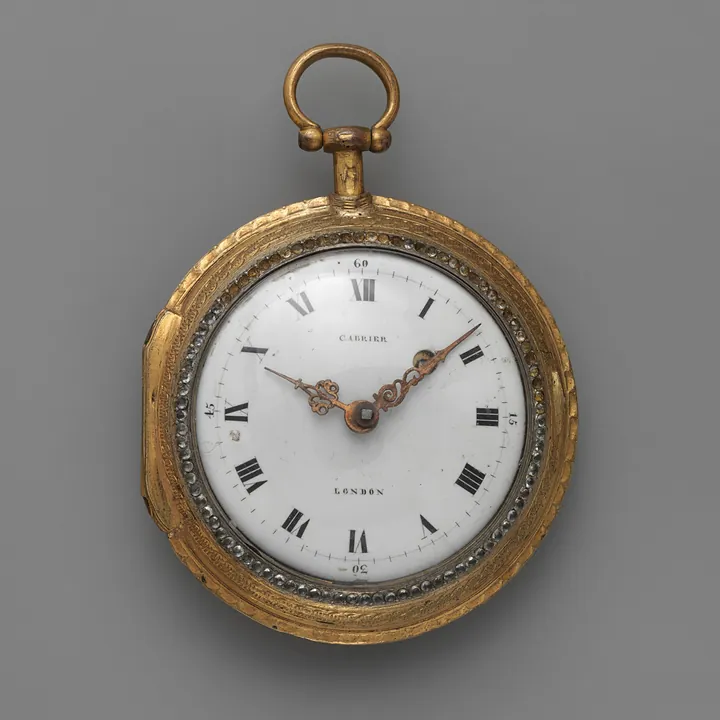
Pocket Watches · c. 1740–60
Watch by Charles Cabrier II, England, c. 1740–60 (The Met 17.190.1461)
The Metropolitan Museum of Art, New York
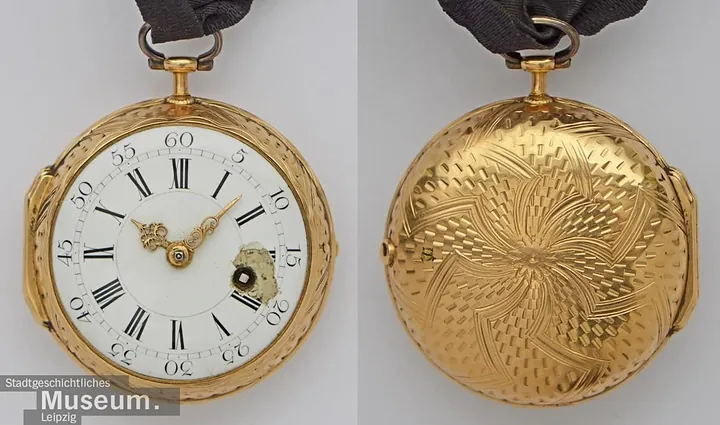
Pocket Watches · 1745–1755
Pocket watch by Jean Baptiste Baillon, France, 1745–1755
Museum of City History Leipzig
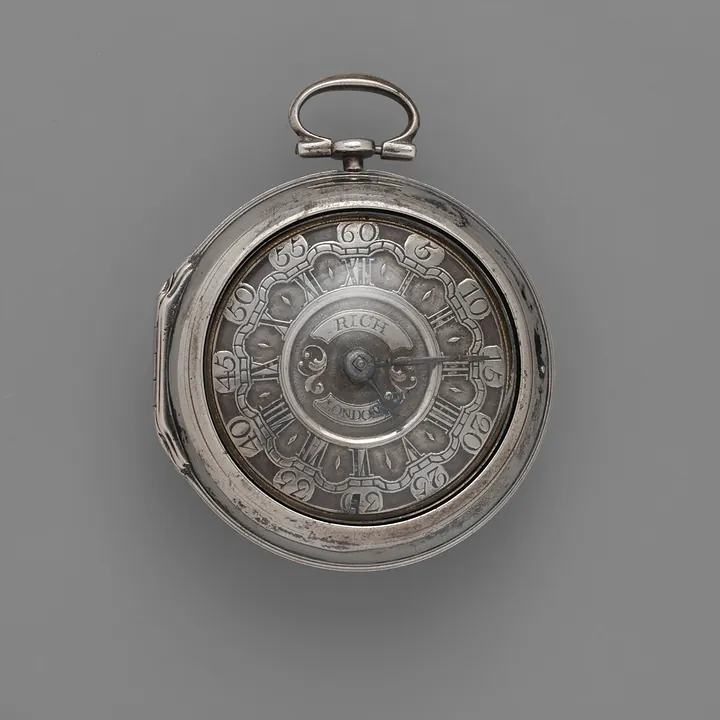
Pocket Watches · c. 1751–52
Watch by John Rich, England, c. 1751–52
The Metropolitan Museum of Art, New York
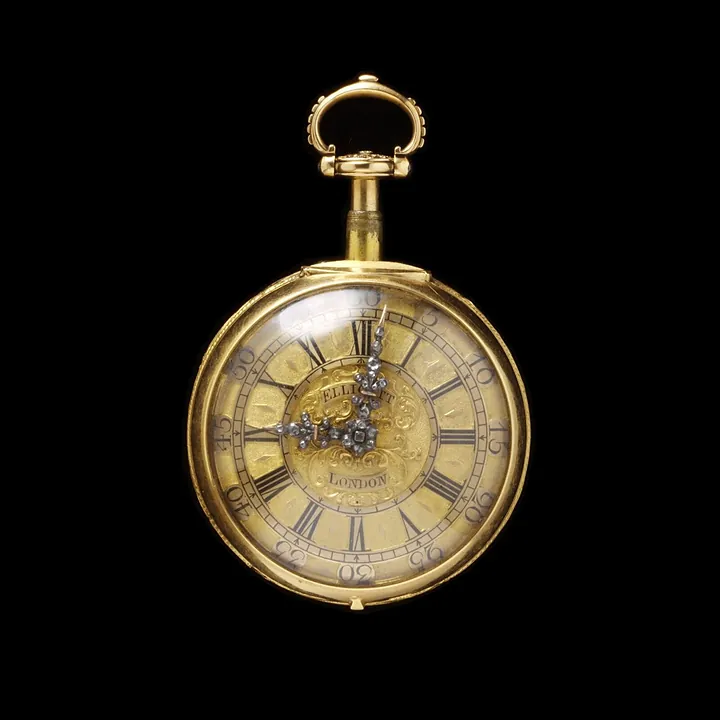
Pocket Watches · c. 1753
Gold watch, signed 'Jno. Ellicott, London, 3719', the inner case pierced and engraved, with a casemaker's mark 'JB', London, about 1753
Victoria and Albert Museum, London
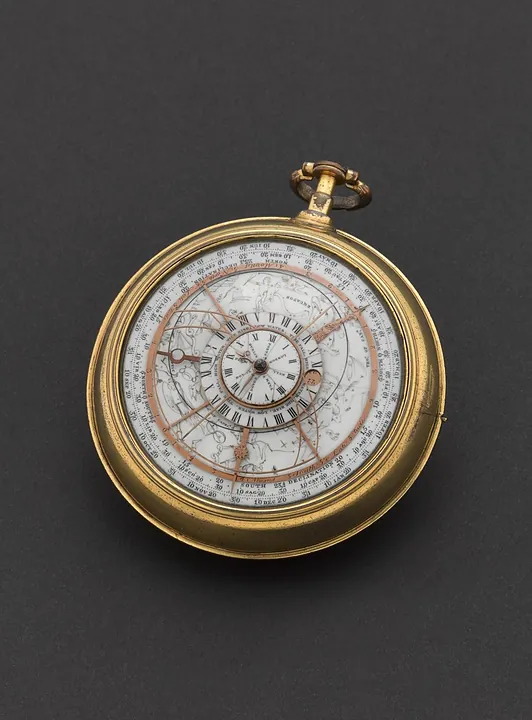
Pocket Watches · 1750–1810
Astronomical watch by George Margetts No.3043 in pair case, 1750–1810
Science Museum Group, London