
Pocket Watches · Pocket watch
Gold Calendar Fob, c. 1790
- Maker / attribution
- Unrecorded in source
- Date
- c. 1790
- Historical period
- Precision & Scientific Horology (1750 – 1850)
- Country of origin
- Unrecorded in source
- Object type
- Pocket watch
- Materials / technique
- gold
- Dealer
- WatchMuseum.org shop
- Stock no.
- Product 1146
- Credit line
- Dealer listing, WatchMuseum.org shop (product 1146)
- Catalogue title (original)
- Gold Calendar Fob (English)
View the source record (dealer listing) ↗ (opens another website in a new tab)Suggest a correction
Record summary
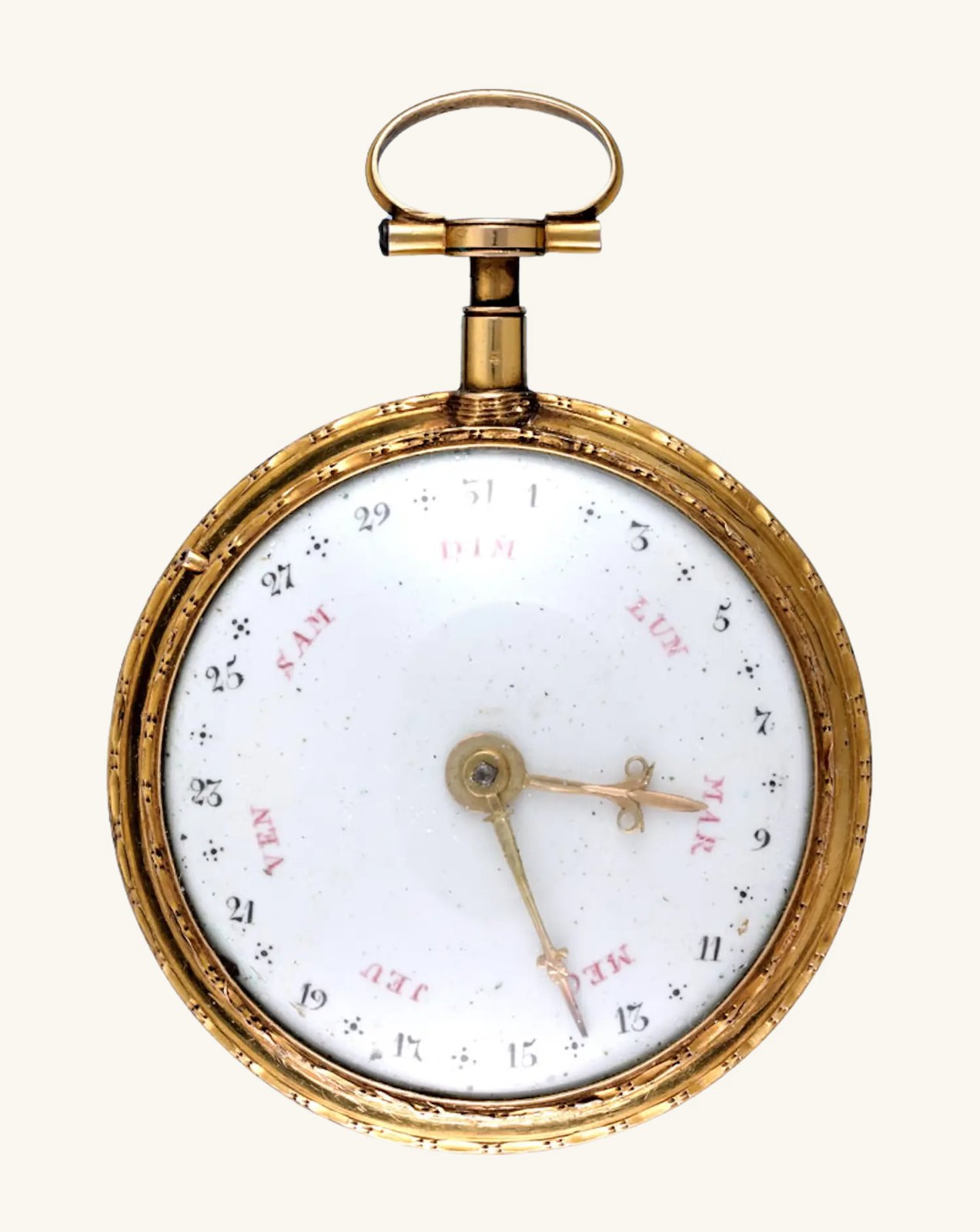
Catalogued by WatchMuseum.org shop (stock number Product 1146), this is a pocket watch, dated c. 1790. The Atlas places it in the Precision & Scientific Horology period (1750 – 1850) of its Pocket Watches collection. Materials and techniques recorded by the source: gold. The record is illustrated with 4 photographs.
Assembled from the source record's structured fields. Dates and attributions are given as the source states them; where a field is missing the Atlas leaves it blank rather than estimating.
Catalogue description
Dealer description — WatchMuseum.org shop
Step back in time with the exquisite Gold Calendar Fob, a remarkable piece of horological history dating back to circa 1790. This 18th-century marvel is not just a timepiece but a testament to the intricate craftsmanship and sophisticated engineering of its era. Encased in intricately engraved and engine-turned gold, this fob features a white enamel dial adorned with black Arabic numerals for the day of the month and red French abbreviations for the days of the week. The clever design includes a push pendant that allows for easy adjustment by moving the hands forward one division with each press, and a small button on the band to lock the day of the week hand, making it possible to advance the date for shorter months. Likely a part of a chatelaine ensemble, this anonymous Swiss creation boasts a diameter of 37 mm and is a rare blend of beauty and functionality. Crafted from premium materials such as enamel and gold, the Gold Calendar Fob is an exceptional accessory that captures the elegance and innovation of a bygone era. This is a highly unique and valuable 18th-century fob that displays both the day and date in the form of a small pocket watch. The white enamel dial has black Arabic numerals for the day of the month and a red abbreviation in French for the day of the week. The gold case is intricately engraved and engine turned and features a push pendant for easy adjustment. By depressing the pendant, the hands move forward by one division. In addition, there is a small button on the band that locks the day of the week hand, allowing the date to be advanced for shorter months. This pocket watch would have most likely been part of a chatelaine, accompanying a watch of similar style. This is an anonymous Swiss piece, dating back to around 1790 and has a diameter of 37 mm. Overall, this is an exceptional accessory that is as beautiful as it is rare. Anonymous Swiss Circa 1790 Diameter 37 mm Materials Enamel Gold
Historical context
Precision & Scientific Horology (1750 – 1850)
Harrison solves longitude; Mudge invents the lever; Breguet's Paris workshop defines the modern watch.
From 1750 to 1850 the watch became a precision instrument. Mudge's lever escapement, the cylinder escapement, Lépine's thin bar calibre, Breguet's innovations (overcoil, tourbillon, perpétuelle) and the pocket chronometer of Arnold and Earnshaw all date from this period, while verge watches remained common in cheaper production.
Read the period in the timelineMore pocket watches from this periodEarlier: Early Modern Horology
Atlas type guide
Calendar, moon-phase and perpetual calendar watches
Calendar complications range from a simple date to the perpetual calendar, which automatically allows for months of different lengths and leap years until 2100. Pocket watches with perpetual calendars were made in the eighteenth and nineteenth centuries; Patek Philippe made the first perpetual calendar wristwatch in 1925, and series production followed in 1941. The annual calendar (Patek Philippe, 1996) needs correction only once a year.
Moon-phase displays use a disc with two moons and 59 teeth advanced daily, approximating the 29.5-day lunation; more precise trains reduce the error to one day in over a century.
What to look for
- Apertures or subsidiary dials for day, date, month and leap year.
- Moon disc under a 'bosom' shaped aperture.
- Recessed correctors on the case band for setting the calendar.
Dating clues
- Triple-date wristwatches: popular c. 1940–1955.
- Perpetual calendar wristwatches: from 1925 (unique) and 1941 (series).
General guidance written by the Atlas editors about this kind of object. It is not a statement about this particular piece; for that, rely on the source record above and on physical examination.
Related records
Pocket Watches · 1800–1899
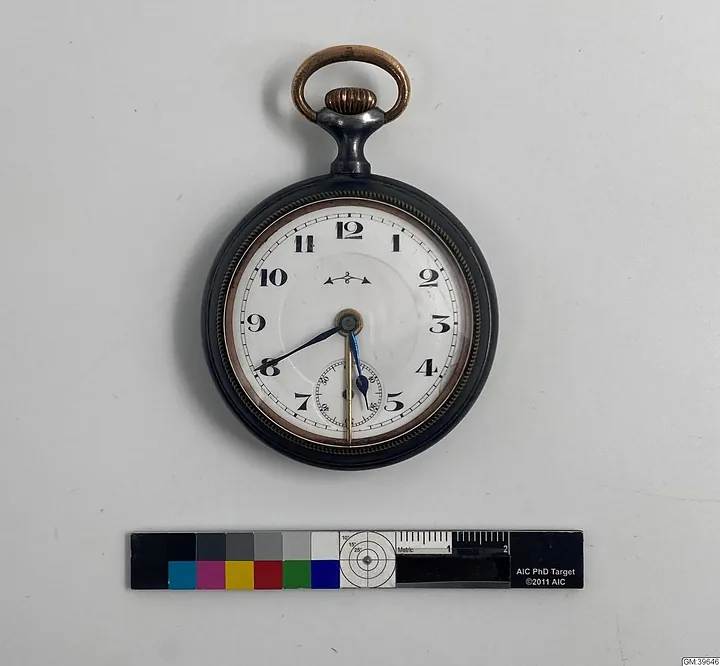
Alarm pocket watch by Eterna w, Gothenburg, 1800–1899
Museum of Gothenburg
Pocket Watches · 1820
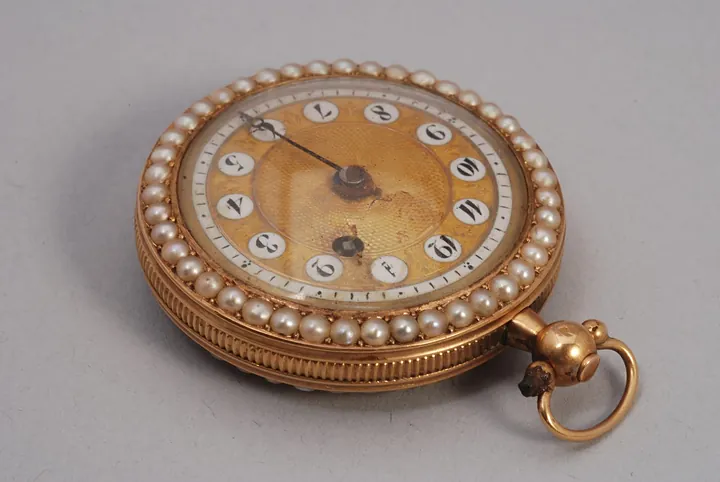
Pocket watch by Chevalier & Cochet, 1820
Museum Rotterdam
Pocket Watches · c. 1740–60
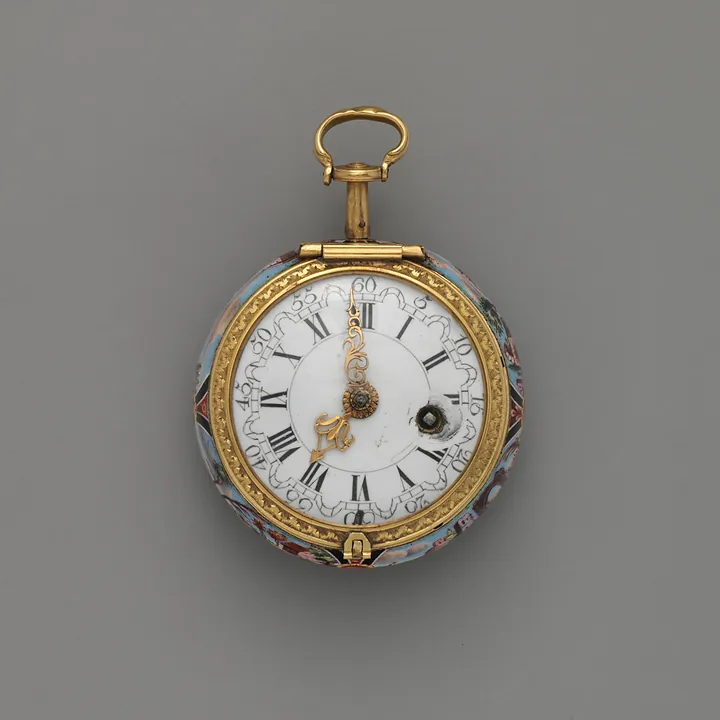
Watch by Charles Cabrier II, England, c. 1740–60 (The Met 17.190.1458)
The Metropolitan Museum of Art, New York
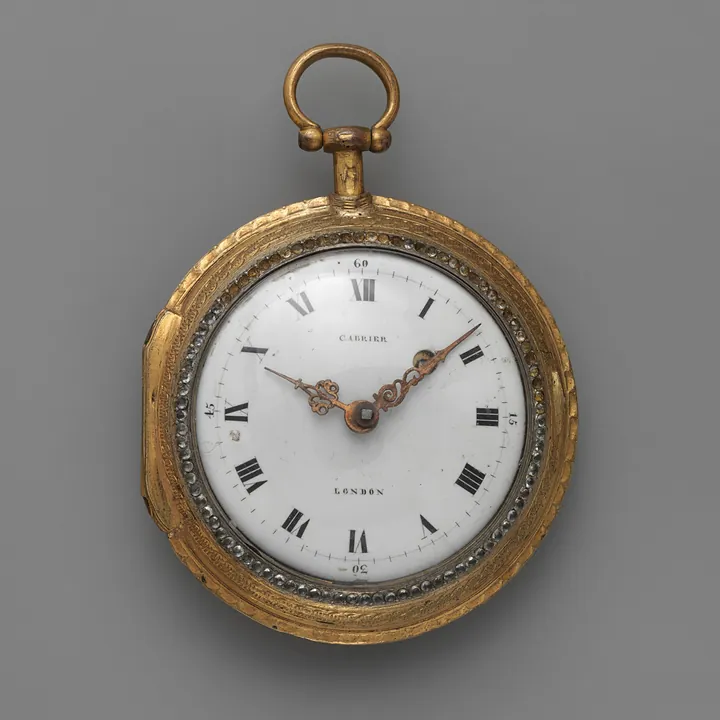
Pocket Watches · c. 1740–60
Watch by Charles Cabrier II, England, c. 1740–60 (The Met 17.190.1461)
The Metropolitan Museum of Art, New York
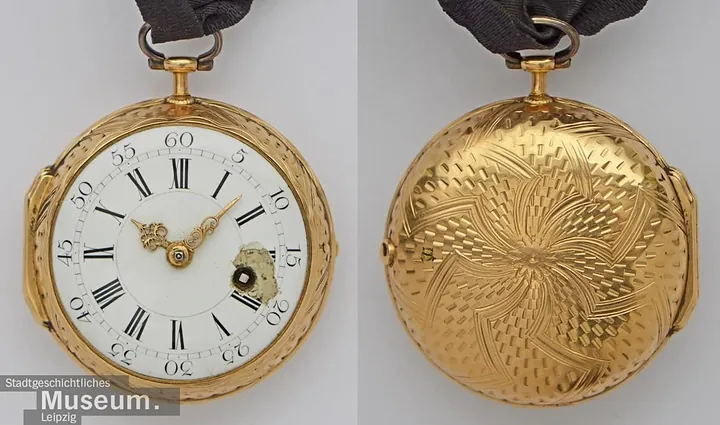
Pocket Watches · 1745–1755
Pocket watch by Jean Baptiste Baillon, France, 1745–1755
Museum of City History Leipzig
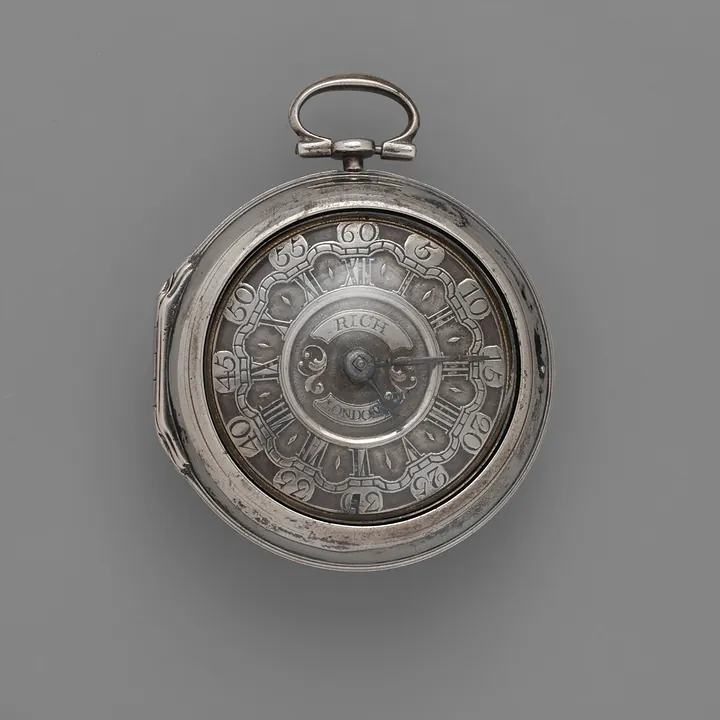
Pocket Watches · c. 1751–52
Watch by John Rich, England, c. 1751–52
The Metropolitan Museum of Art, New York
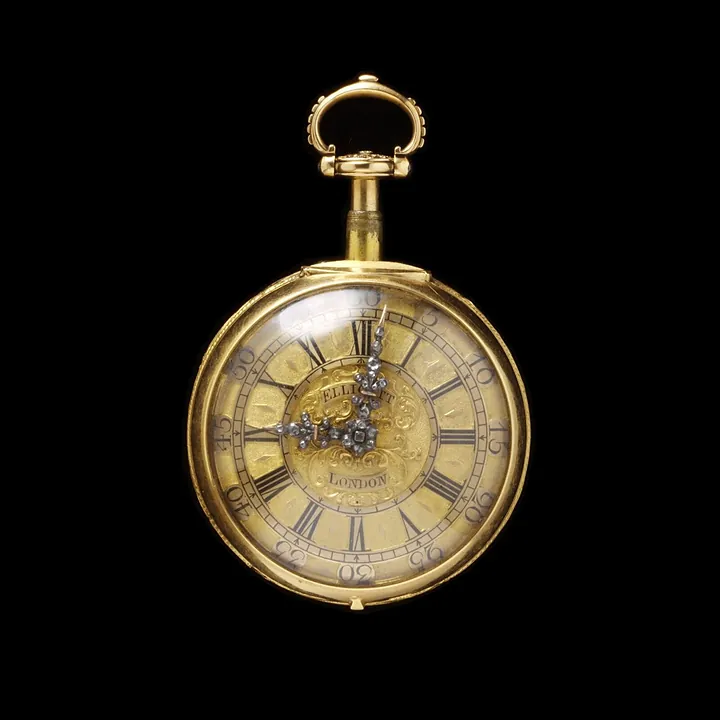
Pocket Watches · c. 1753
Gold watch, signed 'Jno. Ellicott, London, 3719', the inner case pierced and engraved, with a casemaker's mark 'JB', London, about 1753
Victoria and Albert Museum, London
Pocket Watches · 1750–1810
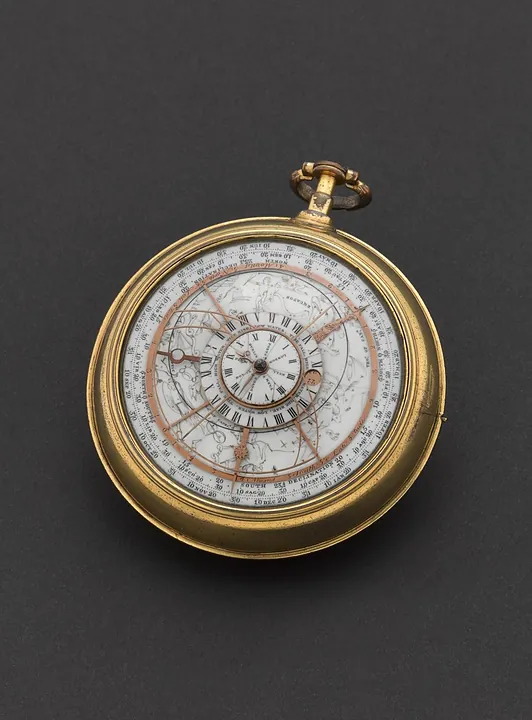
Astronomical watch by George Margetts No.3043 in pair case, 1750–1810
Science Museum Group, London