
Wristwatches · Wristwatch
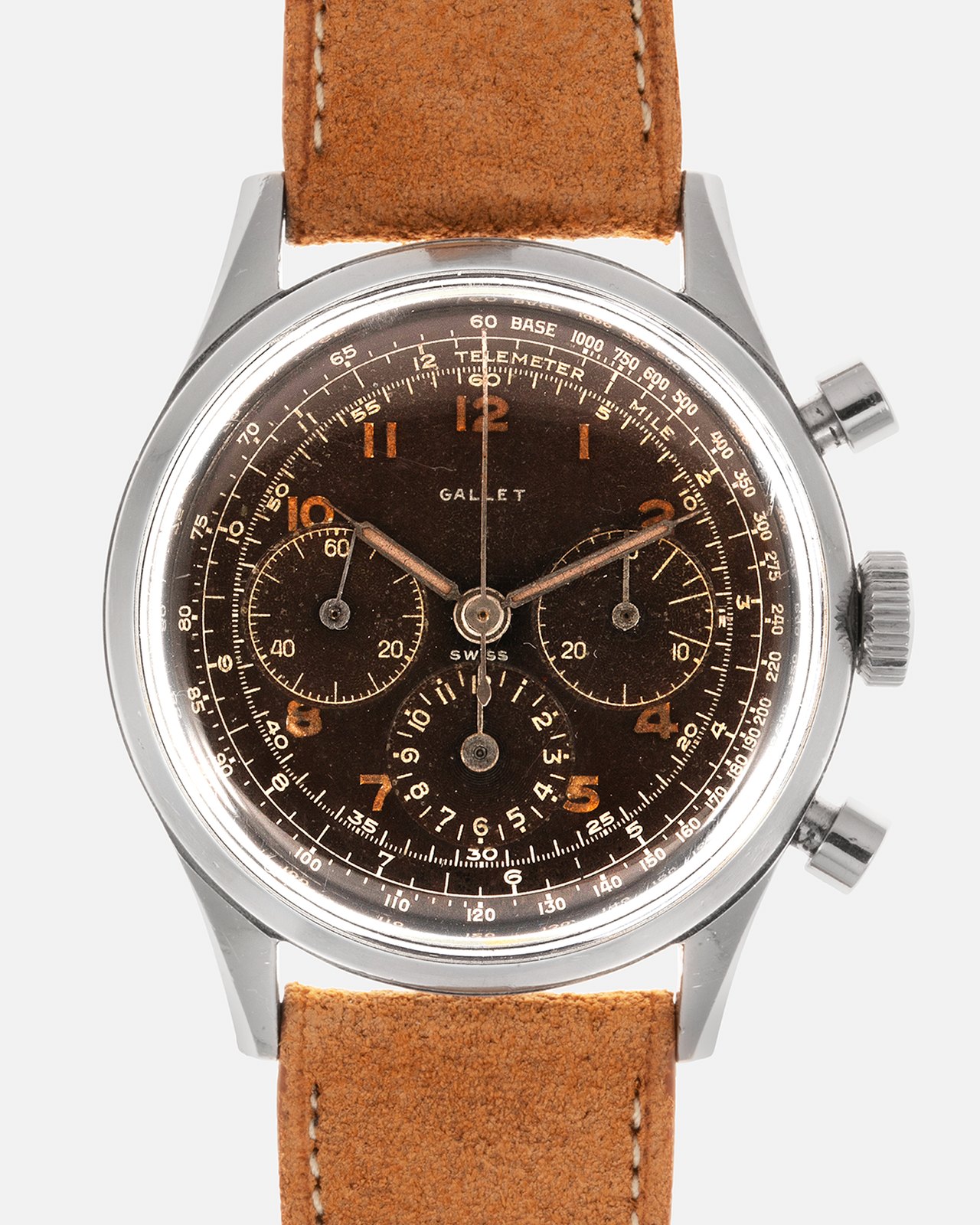
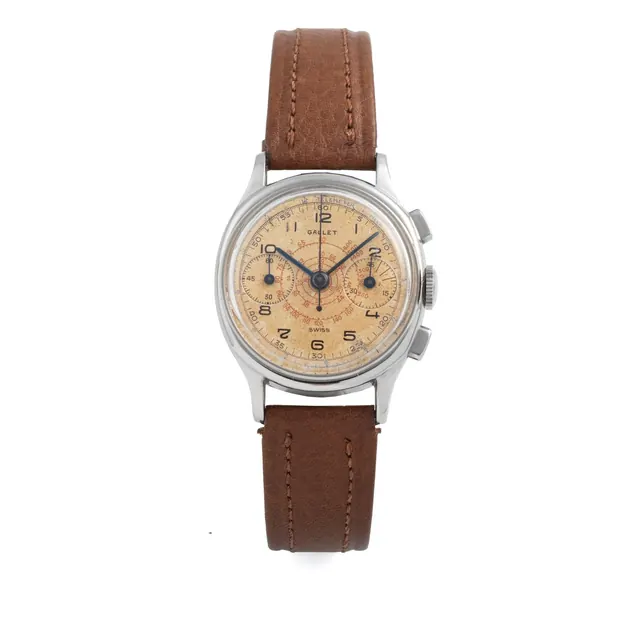
Gallet Multichron 'Jim Clark' Chronograph 12H Tropical, 1950s
- Maker / attribution
- Gallet (maker)
- Date
- 1950s
- Historical period
- Modern Mechanical Horology (1945 – 1969)
- Country of origin
- Switzerland
- Object type
- Wristwatch
- Dimensions
- Case 37 mm
- Stock no.
- Product 6909830529111
- Credit line
- Dealer listing, S.Song Watches (product 6909830529111)
- Catalogue title (original)
- Gallet Multichron 'Jim Clark' Chronograph 12H Tropical (English)
View the source record (dealer listing) ↗ (opens another website in a new tab)Suggest a correction
Record summary
Catalogued by S.Song Watches (dealer), Seattle (stock number Product 6909830529111), this is a wristwatch by Gallet, made in Switzerland, dated 1950s. The Atlas places it in the Modern Mechanical Horology period (1945 – 1969) of its Wristwatches collection. Recorded dimensions: Case 37 mm. The record is illustrated with 6 photographs.
Assembled from the source record's structured fields. Dates and attributions are given as the source states them; where a field is missing the Atlas leaves it blank rather than estimating.
Catalogue description
Dealer description — S.Song Watches
Ask any vintage chronograph collector and chances are that ‘Gallet’ will be mentioned. You see, Gallet made some of the best chronographs in the 20th century and today, vintage examples (such as the Multichron) are extremely sought after. Despite their refined and stylish aesthetics, they were actually originally designed as tool watches, serving the needs of military and industrial professionals. Their dials often include various functional tracks such as decimal scales, pulsometers and telemeter scales, enhancing their practicality for specific tasks and measurements. The example we have here today is the Gallet Multichron 12H, made famous by the legendary Formula 1 and Indy500 champion, Jim Clark, who won the 1965 Indy500 while wearing his Gallet Multichron 12H. It features a robust stainless steel case measuring 37mm and a highly sought-after black dial that is equipped with a tachymeter and a telemeter scale on its periphery, a small-seconds sub-dial to the left, a 30-minute counter to the right, and a 12-hour recording sub-register at the bottom. The beauty of vintage watches lies in the fact that each individual example varies as they all aged differently, depending on how it was stored and used. This particular Gallet Multichron 12H has developed a fantastic tropical brown dial overtime, making it an even rarer watch than it already is. At the time, these Multichrons were equipped with either the rare Excelsior Park 40 movement, as seen in this example at hand, or the Valjoux 72 movement, both of which are excellent manual-winding calibres sourced from different ébauche manufacturers. Considering their rich history, exceptional aesthetics, and mechanical movements, there is no doubt as to why vintage Gallet chronographs are considered by many to be some of the most desirable and collectable vintage chronographs in the watch collecting space. To be able to offer this extraordinary example on our site today is a real delight.
Historical context
Modern Mechanical Horology (1945 – 1969)
Tool watches for divers, pilots and astronauts; electric watches anticipate the electronic age.
The classic era of the mechanical wristwatch: dive watches, chronographs for motor racing and space flight, GMT watches for jet travel, slim dress watches, automatic calendars, and the rise of Japanese manufacturers alongside Swiss, American, German and Soviet industries.
Read the period in the timelineMore wristwatches from this periodEarlier: Golden Age of Mechanical Watchmaking
Atlas type guide
Chronographs and split-seconds watches
A chronograph is a watch with an additional seconds hand that can be started, stopped and returned to zero independently of the timekeeping. Louis Moinet built an early example in 1816 and Nicolas Rieussec a recording 'chronographe' in 1821; Adolphe Nicole's heart-shaped reset cam (patented 1862) made the modern return-to-zero possible. Split-seconds (rattrapante) chronographs add a second hand that can be stopped for intermediate times; flyback chronographs restart instantly.
Chronographs were essential tools for doctors (pulsometer scales), artillery (telemeter), engineers and sport. In wristwatches, Valjoux, Venus, Lemania and later the automatic chronographs of 1969 (Zenith El Primero, the Chronomatic Calibre 11 group and Seiko 6139) are milestones.
What to look for
- Push-pieces on the case band or a single button in the crown (monopusher).
- Subsidiary registers for minutes and hours; tachymeter, telemeter or pulsometer scales.
- Column wheel versus cam control visible in the movement.
- Calibre markings of specialist makers (Valjoux, Lemania, Venus, Landeron).
Dating clues
- Pocket chronographs with heart cam reset: after 1862.
- Wrist chronographs: from c. 1910; two-button designs from the 1930s.
- Automatic chronographs: from 1969.
General guidance written by the Atlas editors about this kind of object. It is not a statement about this particular piece; for that, rely on the source record above and on physical examination.
Read next:Flyback chronographChronograph
Related records
Wristwatches · c. 1960-1970s
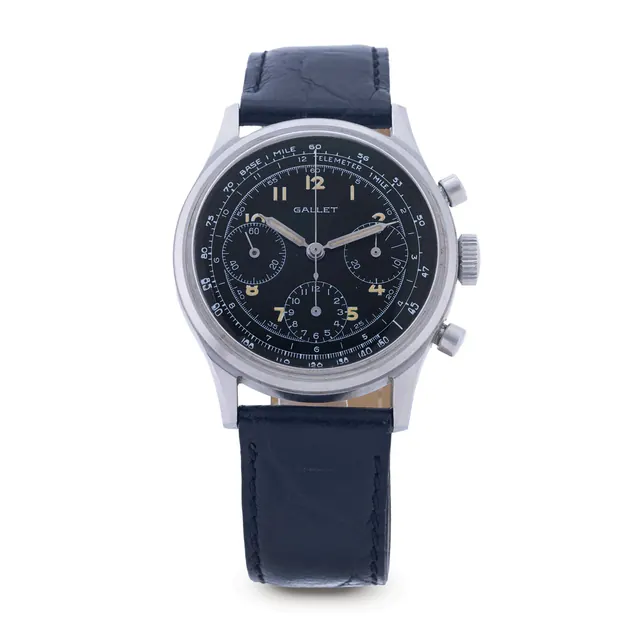
Gallet wristwatch, Chronograph, circa 1960-1970s
Antiquorum auction archive, Geneva
Wristwatches · c. 1960-70’s
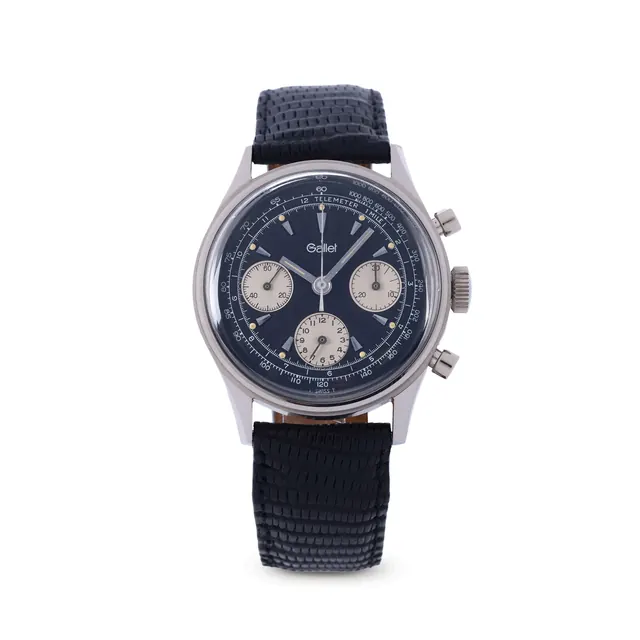
Gallet wristwatch, Multichron Chronograph, circa 1960-70’s
Antiquorum auction archive, Geneva
Wristwatches · c. 1940s
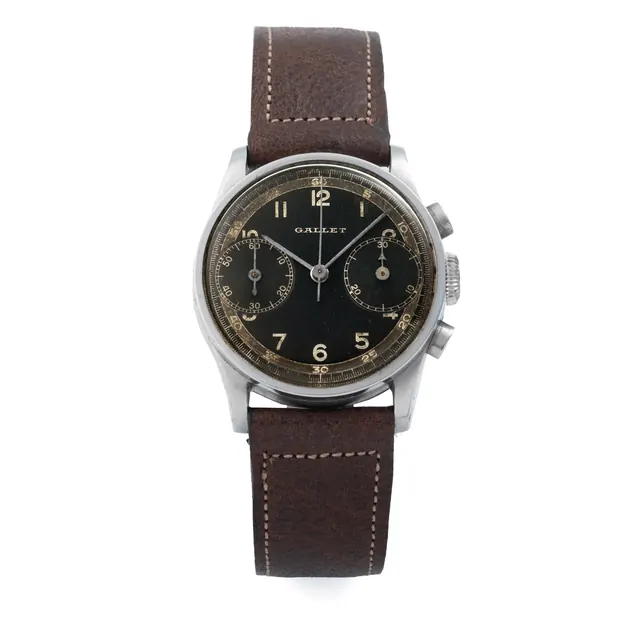
Gallet wristwatch, circa 1940's
Antiquorum auction archive, Geneva
Wristwatches · c. 1940
Gallet wristwatch, Commander, CIrca 1940
Antiquorum auction archive, Geneva

Wristwatches · 1945
Wristwatch by Eterna, 1945
Museum Rotterdam

Wristwatches · c. 1945
Breitling Premier, ref. 790, c. 1945
Antiquorum auction archive, Geneva

Wristwatches · c. 1945
Universal Genève Uni-Compax, ref. 22492, c. 1945
Antiquorum auction archive, Geneva

Wristwatches · c. 1950s
Baume & Mercier wristwatch, c. 1950s
Antiquorum auction archive, Geneva