
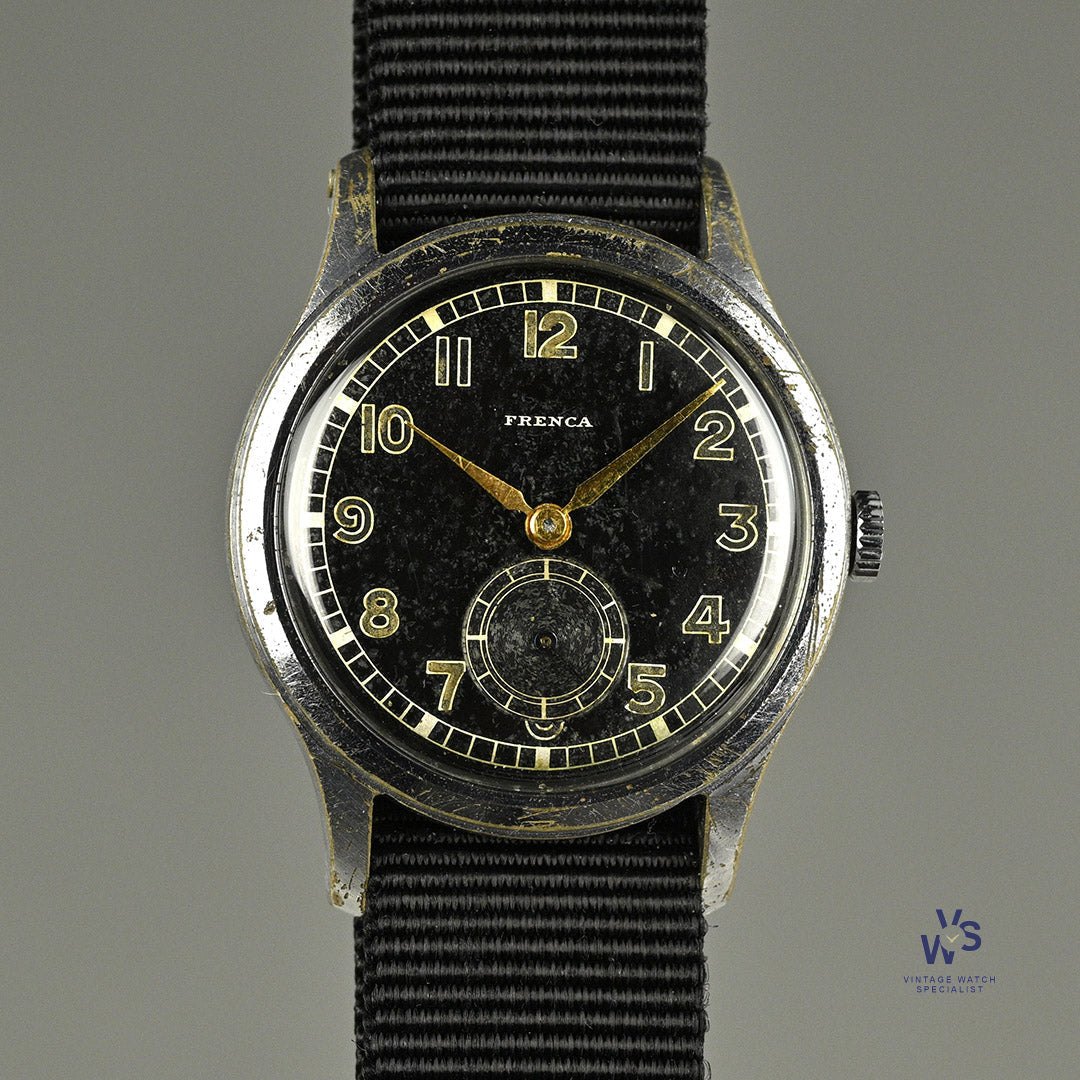
Wristwatches · Wristwatch
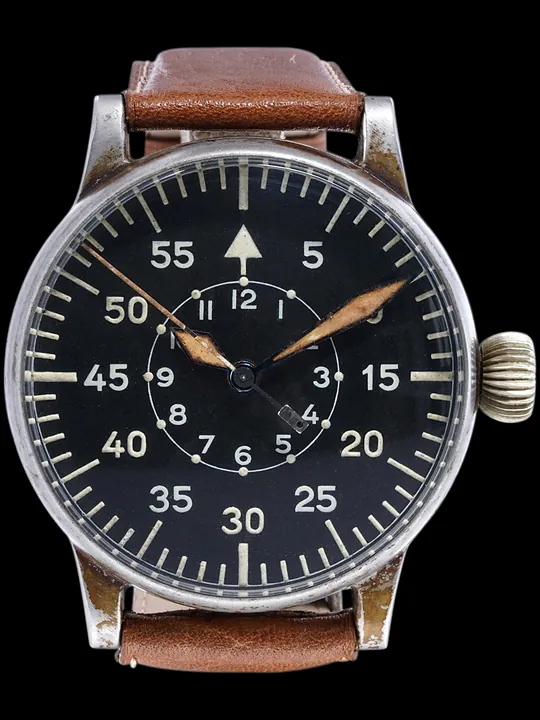
Frenca German Military-Issued Watch, circa 1940s
- Maker / attribution
- Unrecorded in source
- Date
- c. 1940s
- Historical period
- Golden Age of Mechanical Watchmaking (1900 – 1945)
- Country of origin
- Germany
- Object type
- Wristwatch
- Dimensions
- Case 34 mm
- Stock no.
- vws4288cs
- Credit line
- Dealer listing, Vintage Watch Specialist (vws4288cs)
- Catalogue title (original)
- Frenca German Military-Issued Watch - c.1940s (English)
View the source record (dealer listing) ↗ (opens another website in a new tab)Suggest a correction
Record summary
Catalogued by Vintage Watch Specialist (dealer), United Kingdom (stock number vws4288cs), this is a wristwatch, made in Germany, dated c. 1940s. The Atlas places it in the Golden Age of Mechanical Watchmaking period (1900 – 1945) of its Wristwatches collection. Recorded dimensions: Case 34 mm. The record is illustrated with 6 photographs.
Assembled from the source record's structured fields. Dates and attributions are given as the source states them; where a field is missing the Atlas leaves it blank rather than estimating.
Catalogue description
Dealer description — Vintage Watch Specialist
Frenca German Military-Issued Watch - Case Back Reference "1960 D.U" - c.1940s Frenca was a subsidiary brand of Swiss watch company, Buser Frères & Cie S.A, founded in 1892 in Niederdorf, Switzerland. Buser was a true manufacture d'horlogerie, meaning they designed, engineered, and built their own raw movements (ébauches) and complete timepieces entirely in-house. The quartz crisis brought production to a halt in 1978, and the name lay dormant for 45 years. German brand DEKLA then acquired and relaunched Buser Frères, honouring their roots with vintage and military-inspired watches. What’s On Offer Here we have a fantastically rugged example of a c.1940s Frenca German military-issued watch. The caseback is engraved, “Wasserdicht (Waterproof) Stahlboden (Steel Back)”, “1960” (a serial number, not date) and “D.U.” (Dienstuhr, meaning service watch). The “D.U.” stamp is a broad specification, but is often associated with the Verwaltung (Administrative & Civil Services), comprising government administrators, logistics staff, and military railway (Reichsbahn) personnel. The original radium dial has developed a faded black finish with a grainy speckling of patina. Large Arabic numerals circle the dial, surrounded by an elaborate railroad-style chapter ring. A seconds sub-dial sits at 6 o’clock, also with a chapter ring. The Arabic numerals retain their original lume, which has aged to a faded sand colour. The dial is completed by contrasting gold syringe hands. Unfortunately, the hands and crown are not original this example, but they suit the watch nevertheless. The 34mm chrome-plated case shows signs of military service, bearing the rust and wear you’d expect from a watch that was worn on the wrist of an active WWII serviceman. Inside is the original 15-jewel Buser Calibre 25/115 manual-wind movement, which was recently serviced by one of our watchmakers and runs well. The number engraved inside the caseback matches the one between the lugs at 6 o'clock. That’s a detail you can't take for granted on a watch that passed through German military servicing, where efficiency tended to win out over consistency. Overall, this is a great example of an authentic, historical timepiece that evidently saw action throughout WWII. Condition Report: Crystal: Excellent Dial: Good Bezel: Fair Case: Fair Movement: Serviced Overall: Good
Historical context
Golden Age of Mechanical Watchmaking (1900 – 1945)
The wristwatch displaces the pocket watch; waterproof cases, self-winding and grand complications.
The wristwatch overtook the pocket watch. Military use in the First World War, aviation, water-resistant cases (1926), automatic winding (1923–31), rectangular Art Deco designs and early chronographs and calendars defined the period.
Read the period in the timelineMore wristwatches from this periodEarlier: Industrial Revolution
Atlas type guide
Military, pilot and travel watches
The wristwatch owes much of its adoption by men to warfare and aviation. Wristlets — small pocket watches soldered with lugs and worn on a strap — were used in colonial campaigns and became standard equipment in the First World War, with protective grilles over the crystal ('shrapnel guards'). Louis Cartier's Santos (1904), designed for the aviator Alberto Santos-Dumont, is often cited as an early purpose-made pilot's watch.
In the Second World War governments specified watches in detail: the German B-Uhr observation watches, the American A-11, and the British 'W.W.W.' (the 'Dirty Dozen' set of 1945). After the war, jet travel brought GMT and world-time watches, which show two or more time zones at once — Louis Cottier's world-time mechanism and the Rolex GMT-Master (1955) are examples.
What to look for
- Military markings on the case back: broad arrow, issue numbers, 'W.W.W.', 'A.T.P.'
- High-legibility black dials with luminous Arabic numerals; oversized crowns for gloved hands.
- 24-hour hands and rotating 24-hour bezels or city rings on GMT/world-time watches.
- Wire lugs on early wristlets converted from pocket watches.
Dating clues
- Wire-lug wristlets: c. 1900–1925.
- Military specifications of the Second World War: 1939–1945.
- GMT and world-time wristwatches: mainly after 1950.
General guidance written by the Atlas editors about this kind of object. It is not a statement about this particular piece; for that, rely on the source record above and on physical examination.
Related records
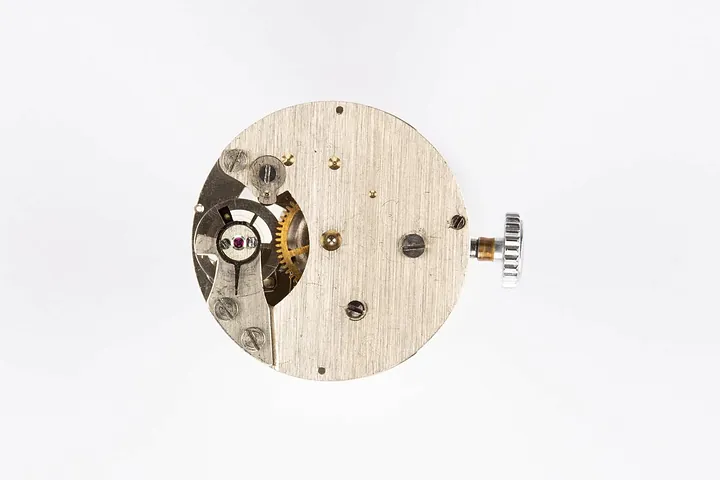
Wristwatches · c. 1925
Wristwatch, Germany, c. 1925
German Clock Museum
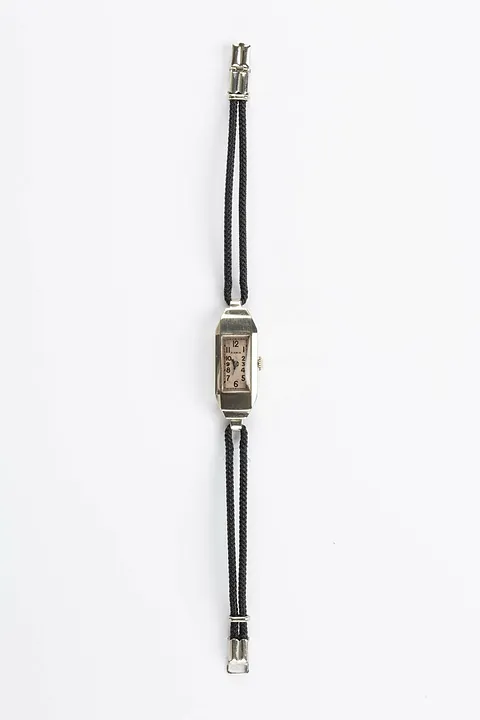
Wristwatches · c. 1930
Wristwatch by Rena, Germany, c. 1930
German Clock Museum
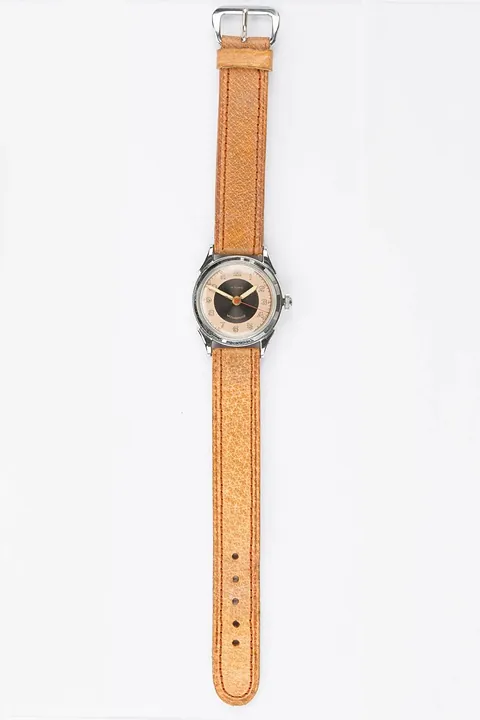
Wristwatches · c. 1940
Wristwatch, Germany, c. 1940
German Clock Museum
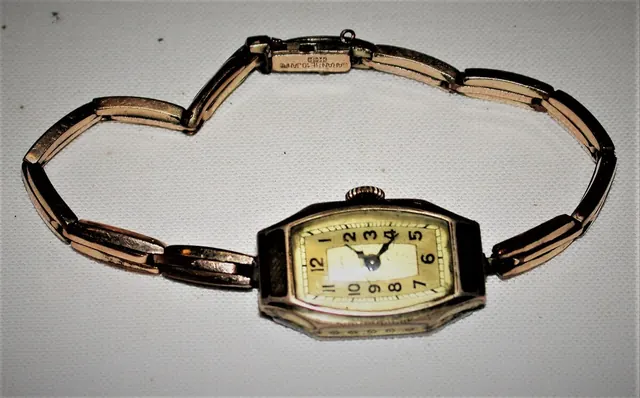
Wristwatches · 1920 - 1930s
Wristwatch, Germany, 1920 - 1930s
HKM / Kulttuurihistoriallinen
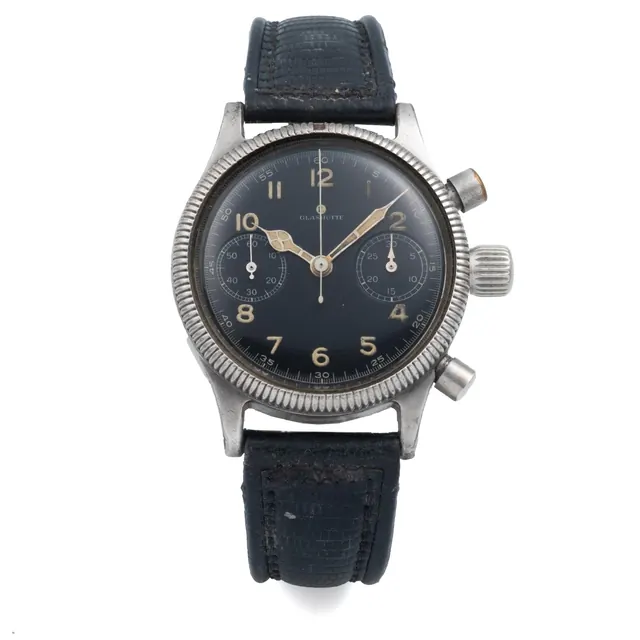
Wristwatches · c. 1940s
Glashütte wristwatch, Germany Pilot Chronograph, circa 1940's
Antiquorum auction archive, Geneva
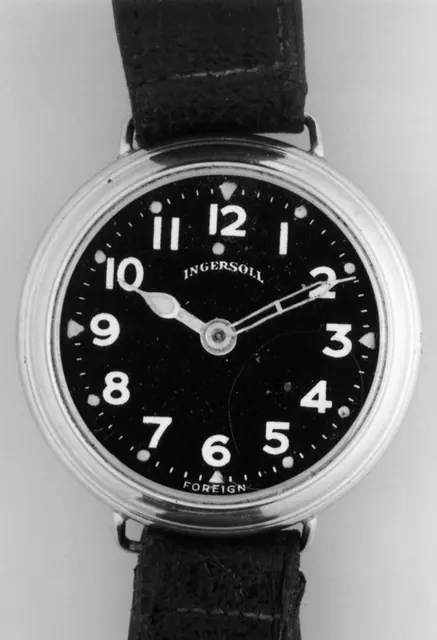
Wristwatches · 1937
Chrome-plated cased pin-pallet lever wrist-watch with leather wrist-strap
British Museum
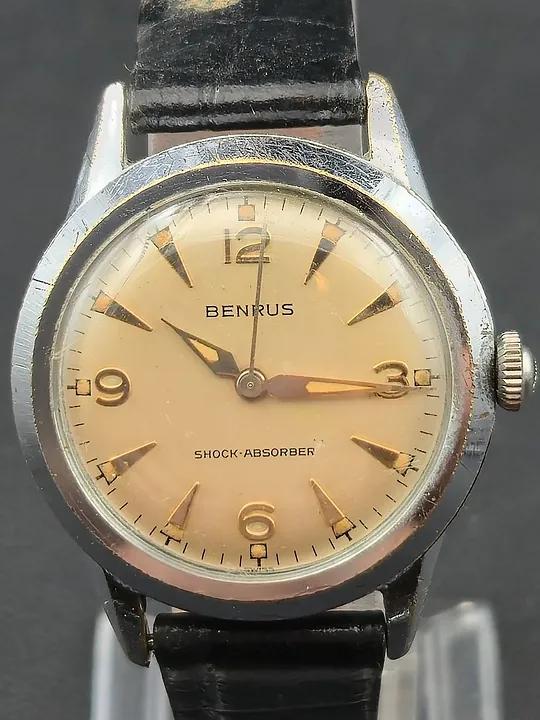
Wristwatches · 1940s
1940s Benrus Shock Absorber 17J U.S. Zone Germany 32mm Runs
LiveAuctioneers auction archive
Wristwatches · 1940s
WWII Lange & Söhne Lange Beobachtungsuhr, 1940s
Craft & Tailored (dealer), Los Angeles