
Wristwatches · Wristwatch
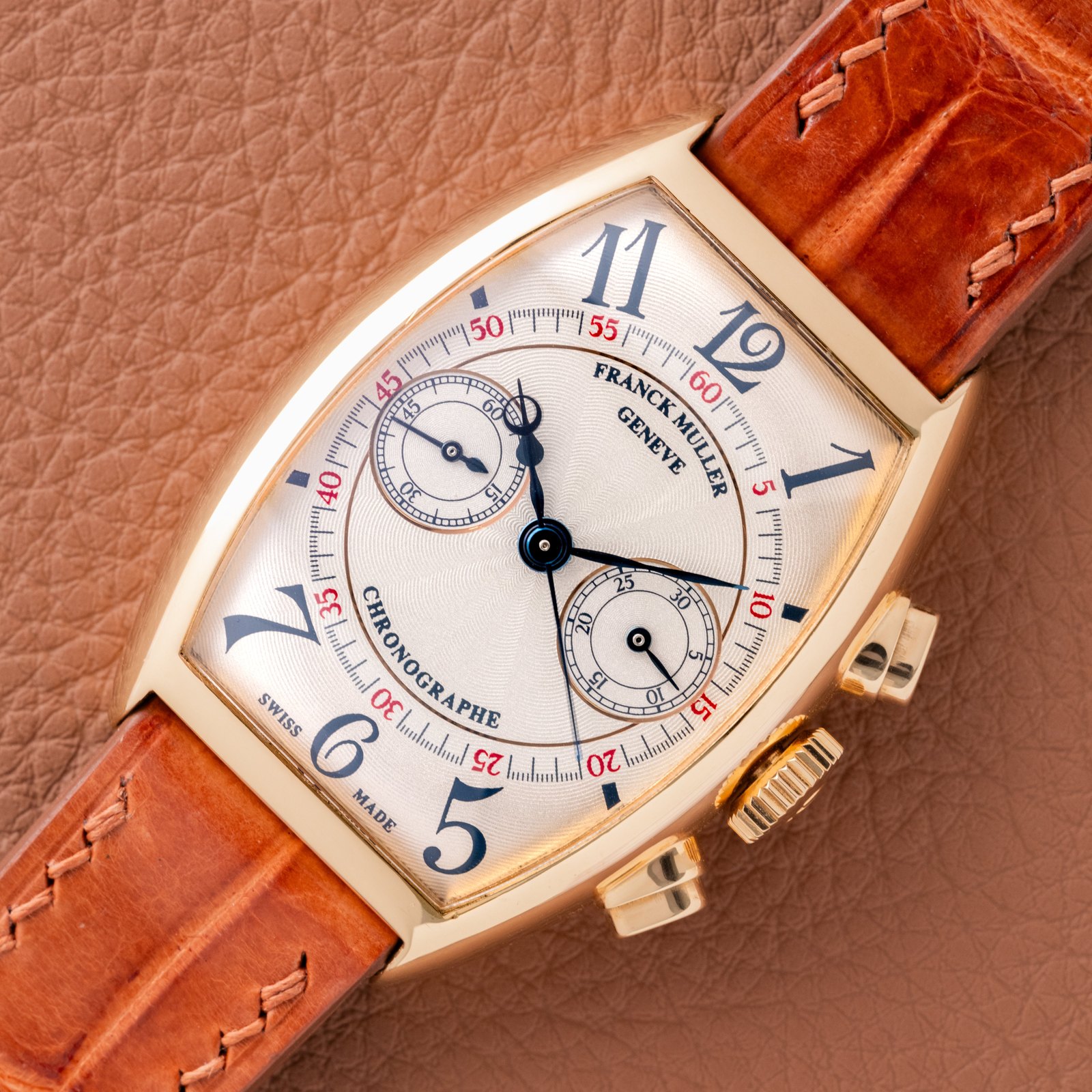
Franck Muller Cintrée Curvex Early Chronograph (Ref. 5850 CC), 1990s
- Maker / attribution
- Franck Muller (maker)
- Date
- 1990s
- Historical period
- Mechanical Renaissance (1990 – 2010)
- Country of origin
- Switzerland
- Object type
- Wristwatch
- Dimensions
- Case 32 mm
- Stock no.
- Product 15932537634999
- Credit line
- Dealer listing, Huntington Company (product 15932537634999)
- Catalogue title (original)
- 1990s Franck Muller Cintrée Curvex Early Chronograph (Ref. 5850 CC) (English)
View the source record (dealer listing) ↗ (opens another website in a new tab)Suggest a correction
Record summary
Catalogued by Huntington Company (dealer) (stock number Product 15932537634999), this is a wristwatch by Franck Muller, made in Switzerland, dated 1990s. The Atlas places it in the Mechanical Renaissance period (1990 – 2010) of its Wristwatches collection. Recorded dimensions: Case 32 mm. The record is illustrated with 6 photographs.
Assembled from the source record's structured fields. Dates and attributions are given as the source states them; where a field is missing the Atlas leaves it blank rather than estimating.
Catalogue description
Dealer description — Huntington Company
History and Significance Before the Cintrée Curvex became the defining silhouette of Franck Muller, the brand was still experimenting with how traditional complications could be incorporated into its unconventional case designs. The reference 5850 CC belongs to that formative period, when the company's identity was being established through a combination of classical mechanical watchmaking and unusual proportions. Its two-register chronograph is particularly significant, representing an early approach to a complication that would eventually become an important part of the Franck Muller collection. Unlike the more familiar round chronographs produced by established Swiss manufacturers, the reference 5850 CC placed a traditional manually wound chronograph movement inside a dramatically curved tonneau case. The movement is central to understanding the appeal of these early watches. Franck Muller selected a manually wound Lemania chronograph caliber, drawing upon a movement manufacturer with an exceptional history in mechanical chronograph production. Lemania movements had been used by several of Switzerland's most respected watchmakers, earning a reputation for dependable construction and well-developed chronograph architecture. The use of such a movement gave the early Franck Muller chronographs a mechanical foundation that was considerably more traditional than their outward appearance might suggest. This contrast between established watchmaking and experimental design became one of the defining characteristics of the manufacturer's earliest production. The dial of this example is particularly attractive, featuring a finely executed guilloché surface that extends across the central section and surrounding indications. Two recessed chronograph registers are positioned horizontally, maintaining a pleasing symmetry despite the unusual shape of the case. The oversized Arabic numerals at twelve, one, two, seven, six, and five o'clock follow the contours of the dial, creating the expressive typography that would become synonymous with Franck Muller. Blued hands and red accents on the chronograph scale provide subtle contrast against the silver surface. The resulting arrangement is complex without sacrificing the visual clarity of a traditional two-register chronograph. An exceptionally early two-digit serial number adds considerable historical interest to this particular watch. Early serial numbers are especially appealing in the context of Franck Muller's first decade, when the company was developing the references and design language that would later define its international reputation. The reference 5850 CC represents an important chapter in that development, combining the original Cintrée Curvex architecture with a traditional Lemania chronograph movement. For collectors studying the earliest years of the manufacturer, these manually wound guilloché chronographs are among the most interesting watches to examine. Writer’s Thoughts There is a strong argument that the earliest manually wound Cintrée Curvex chronographs represent some of Franck Muller's most interesting work. The reference 5850 CC has the expressive appearance that made the brand famous, but beneath that unusual exterior is a thoroughly traditional Lemania chronograph movement. The combination feels particularly appropriate for the brand's identity in the early 1990s. The early two-digit serial number is another important part of the appeal. While later Franck Muller chronographs became more widely recognized, these early manual-winding examples capture a period when the manufacturer's design identity was still being established. The reference 5850 CC is particularly compelling because of its connection to the development of the Casablanca chronographs that followed. Among early Cintrée Curvex watches, the guilloché dial, manual Lemania movement, and two-register configuration make this an especially desirable combination. Our Promise Every watch is thoroughly vetted, carefully described with complete transparency, and guaranteed authentic. Each piece is offered in honest condition, ensuring collectors receive a timepiece that reflects both originality and integrity. Specifications Brand: Franck Muller Model: Cintrée Curvex Chronograph Reference: 5850 CC Year: 1990s Case Material: 18k Yellow Gold Case Size: 32mm Dial: Silver Guilloché Dial with Oversized Arabic Numerals and Two Chronograph Registers Movement: Manual-Winding Lemania Chronograph Movement Strap/Buckle: New H.C. Leather Strap Buckle/Clasp: Generic Pin Buckle Contents: Watch only Condition Case: Yellow gold case remains in excellent condition with attractive polished surfaces and light signs of normal wear. Dial: Silver guilloché dial remains in excellent condition with well-preserved decorative finishing, crisp printing, and clean chronograph registers. Hands: Blued hands remain in excellent condition with attractive, consistent finishing. Crystal: Crystal remains in excellent condition with no notable visible wear. Strap/Buckle: Newly fitted H.C. leather strap remains in excellent condition. Buckle/Clasp: Generic pin buckle remains in excellent condition.
Historical context
Mechanical Renaissance (1990 – 2010)
Mechanical watches return as cultural objects; independent watchmaking flourishes.
Mechanical watches returned as cultural and luxury objects. Complications, tourbillons and new materials proliferated; independent watchmakers such as George Daniels, F.P. Journe and Philippe Dufour revived artisanal watchmaking; collecting vintage watches became a major field.
Read the period in the timelineMore wristwatches from this periodEarlier: Quartz Revolution
Atlas type guide
Chronographs and split-seconds watches
A chronograph is a watch with an additional seconds hand that can be started, stopped and returned to zero independently of the timekeeping. Louis Moinet built an early example in 1816 and Nicolas Rieussec a recording 'chronographe' in 1821; Adolphe Nicole's heart-shaped reset cam (patented 1862) made the modern return-to-zero possible. Split-seconds (rattrapante) chronographs add a second hand that can be stopped for intermediate times; flyback chronographs restart instantly.
Chronographs were essential tools for doctors (pulsometer scales), artillery (telemeter), engineers and sport. In wristwatches, Valjoux, Venus, Lemania and later the automatic chronographs of 1969 (Zenith El Primero, the Chronomatic Calibre 11 group and Seiko 6139) are milestones.
What to look for
- Push-pieces on the case band or a single button in the crown (monopusher).
- Subsidiary registers for minutes and hours; tachymeter, telemeter or pulsometer scales.
- Column wheel versus cam control visible in the movement.
- Calibre markings of specialist makers (Valjoux, Lemania, Venus, Landeron).
Dating clues
- Pocket chronographs with heart cam reset: after 1862.
- Wrist chronographs: from c. 1910; two-button designs from the 1930s.
- Automatic chronographs: from 1969.
General guidance written by the Atlas editors about this kind of object. It is not a statement about this particular piece; for that, rely on the source record above and on physical examination.
Read next:Flyback chronographChronograph
Related records
Wristwatches · c. 1996-99
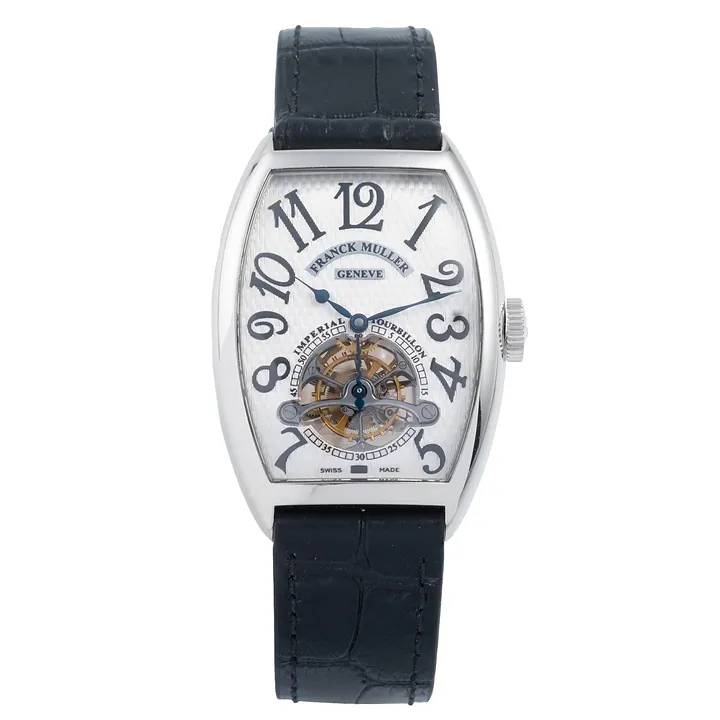
Franck Muller Imperial Tourbillon, ref. 5850T, c. 1996-99
Antiquorum auction archive, Geneva
Wristwatches · c. 2005
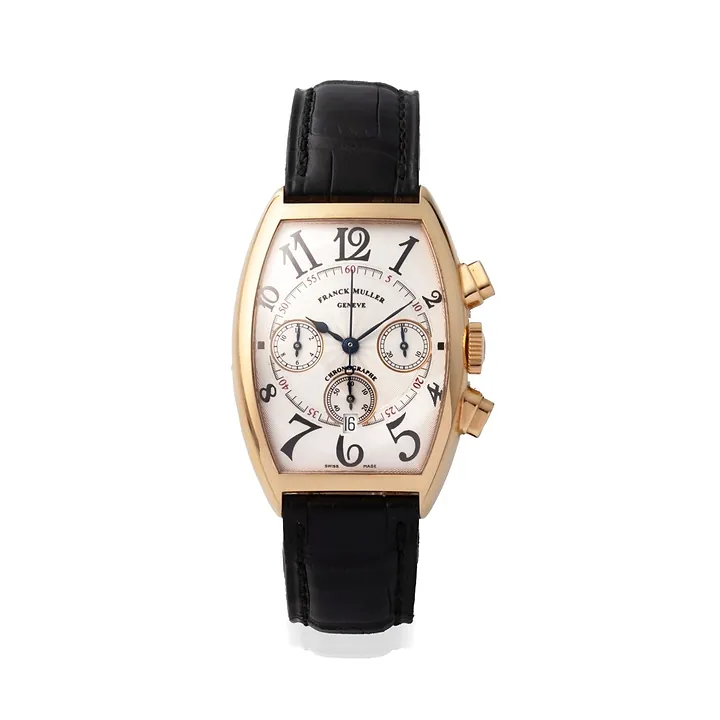
Franck Muller Casablanca Chronograph, ref. 5850 CC AT, c. 2005
Antiquorum auction archive, Geneva
Wristwatches · c. 2010-2020
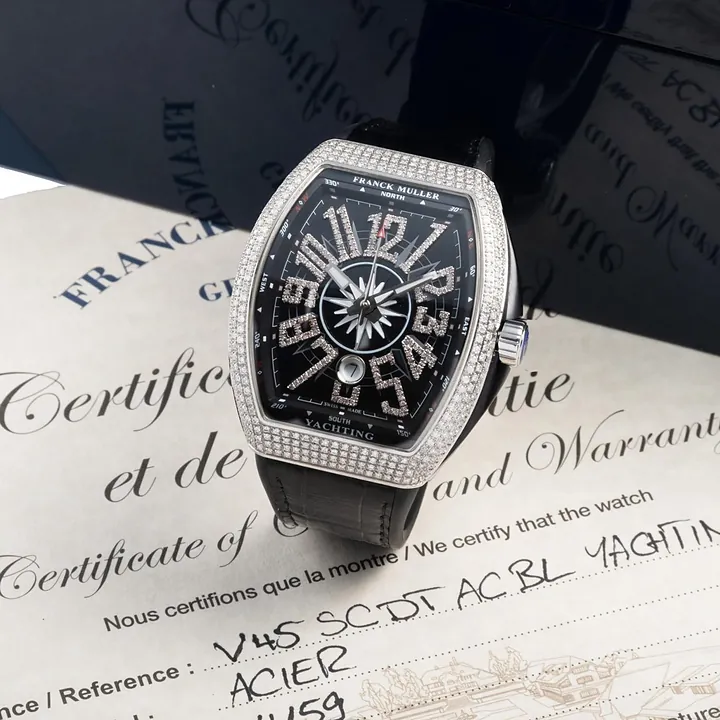
Franck Muller Vanguard Yachting, ref. V45SCDT, c. 2010-2020
Antiquorum auction archive, Geneva
Wristwatches · Sold in August 2016
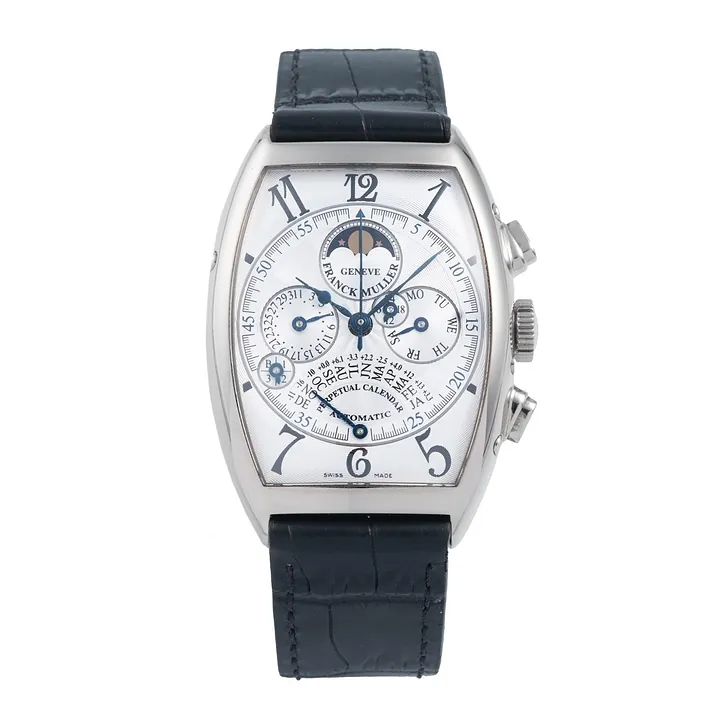
Franck Muller wristwatch, ref. 6850 QPE, Sold in August 2016
Antiquorum auction archive, Geneva

Wristwatches · 2008
Wristwatch by Breitling?, 2008
Museum Rotterdam

Wristwatches · c. 1990s
Audemars Piguet Bamboo, c. 1990s
Antiquorum auction archive, Geneva

Wristwatches · c. 1990
Audemars Piguet Huitieme Perpetual Calendar, ref. 25696PT, c. 1990
Antiquorum auction archive, Geneva

Wristwatches · c. 1990
Breitling Chronomat, ref. b13050.1, c. 1990
Antiquorum auction archive, Geneva