
Wristwatches · Wristwatch
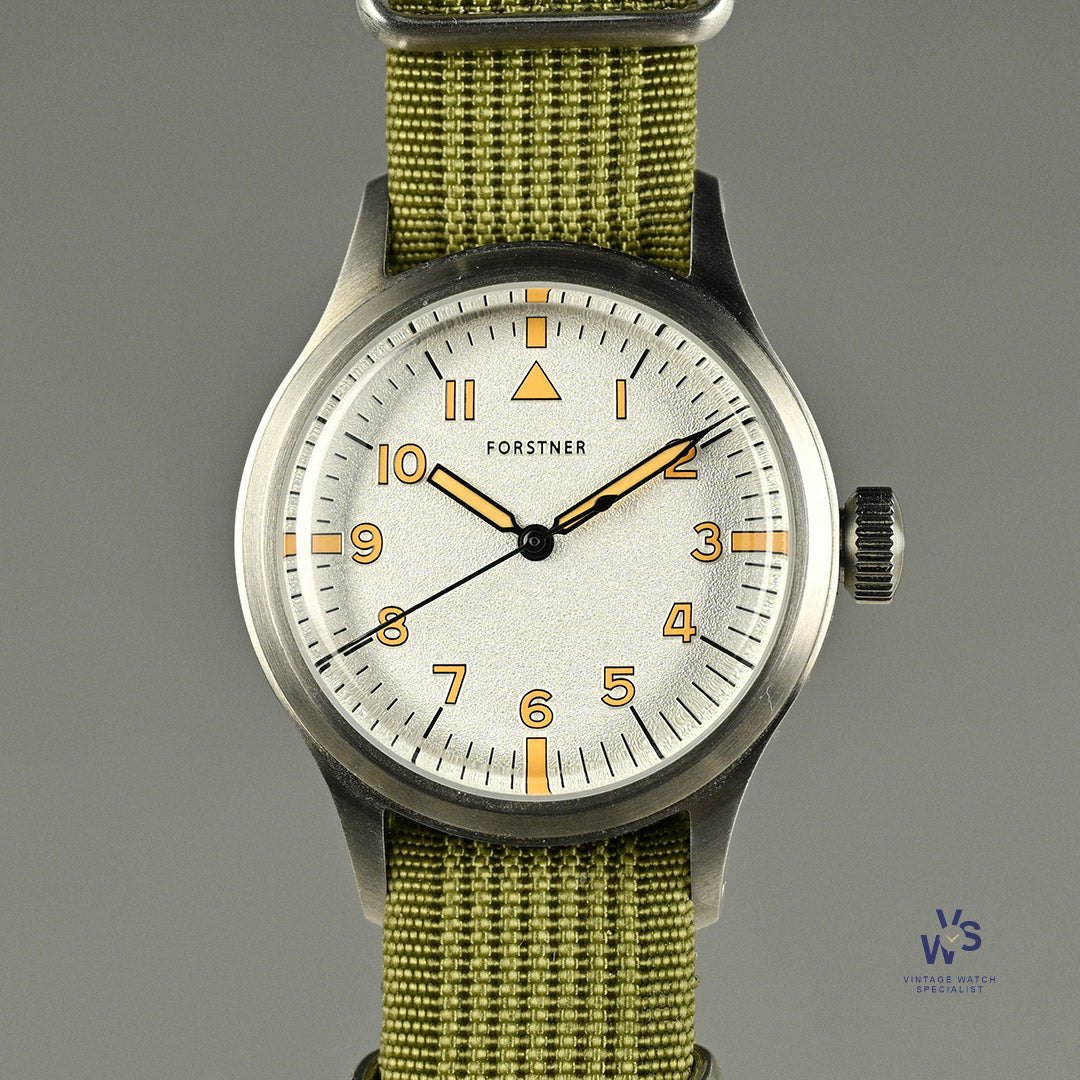
Forstner Pilot Watch, Mark XI Style Model, ref. F-6B/346, circa 2023
- Maker / attribution
- Forstner (maker)
- Date
- c. 2023
- Historical period
- Contemporary Horology (2010 – Present)
- Country of origin
- Unrecorded in source
- Object type
- Wristwatch
- Dimensions
- Case 36 mm
- Stock no.
- vws4350cs
- Credit line
- Dealer listing, Vintage Watch Specialist (vws4350cs)
- Catalogue title (original)
- Forstner - Pilot Watch - Mark XI Style Model - Reference F-6B/346 - c.2023 (English)
View the source record (dealer listing) ↗ (opens another website in a new tab)Suggest a correction
Record summary
Catalogued by Vintage Watch Specialist (dealer), United Kingdom (stock number vws4350cs), this is a wristwatch by Forstner, dated c. 2023. The Atlas places it in the Contemporary Horology period (2010 – Present) of its Wristwatches collection. Recorded dimensions: Case 36 mm. The record is illustrated with 6 photographs.
Assembled from the source record's structured fields. Dates and attributions are given as the source states them; where a field is missing the Atlas leaves it blank rather than estimating.
Catalogue description
Dealer description — Vintage Watch Specialist
The original military pilot's watches of the mid-twentieth century remain some of the most influential tool watches ever produced. Among the most celebrated is the British Mark XI , introduced in 1948 and supplied by manufacturers including IWC and Jaeger-LeCoultre. Designed to Ministry of Defence specifications, it became renowned for its exceptional legibility, precision and understated military styling. Forstner has long been associated with vintage watch enthusiasts, originally earning its reputation through high-quality watch bracelets supplied during the twentieth century. In recent years, the company has expanded into producing complete watches that celebrate classic military and sporting designs while incorporating modern engineering and contemporary reliability. The Forstner Pilot Watch draws clear inspiration from the Mark XI without attempting to be a direct reproduction. Instead, it combines the familiar military proportions, highly legible Arabic numerals and broad-arrow-inspired dial layout with modern materials such as sapphire crystal and stainless steel construction. Powered by the hand-wound Sellita 589 (Forstner DM 22.6) movement, it offers the tactile experience of a traditional manually wound military watch while benefiting from current Swiss manufacturing standards. The result is a watch that captures the spirit of one of Britain's most iconic service watches while remaining a practical daily wearer for modern enthusiasts. What's on Offer We are delighted to offer for sale this Forstner Pilot Watch Mark XI Style, reference F-6B/346, dating from approximately 2023. The watch perfectly captures the restrained elegance of classic RAF navigation watches. Its 36mm brushed stainless steel case closely mirrors the proportions of the original military pieces, while the subtly textured silver-white dial offers a contemporary interpretation with warm faux-aged luminous numerals and hands that provide excellent contrast and readability. Unlike many vintage-inspired watches, this example balances heritage styling with modern practicality. A domed sapphire crystal offers outstanding scratch resistance, while the manually wound Sellita 589 (Forstner DM 22.6) movement delivers dependable Swiss performance together with the engaging ritual of daily winding. The military-inspired design continues with a green NATO-style strap that perfectly complements the pilot aesthetic, making it equally suited to everyday wear or inclusion within a collection of modern military-inspired watches. Offered in excellent overall condition, this is an opportunity to acquire one of the most faithful contemporary interpretations of the legendary Mark XI design—combining vintage character with the reliability expected of a modern Swiss mechanical watch. The brushed stainless steel case remains in excellent condition with only the lightest signs of careful wear. The silver-white textured dial is clean and unmarked, with crisp printing and excellent luminous detailing throughout. The hands remain equally well preserved. The domed sapphire crystal is free from noticeable scratches, while the manual-wind Sellita 589 movement is running as intended. The watch is fitted to a green NATO-style strap that complements its military-inspired design.
Historical context
Contemporary Horology (2010 – Present)
Silicon components, connected watches, optical-lattice research clocks and a thriving independent scene.
Smartwatches became the world's best-selling watches, while mechanical watchmaking focuses on craft, innovation (silicon components, new escapements) and independent makers.
Read the period in the timelineMore wristwatches from this periodEarlier: Mechanical Renaissance
Atlas type guide
Military, pilot and travel watches
The wristwatch owes much of its adoption by men to warfare and aviation. Wristlets — small pocket watches soldered with lugs and worn on a strap — were used in colonial campaigns and became standard equipment in the First World War, with protective grilles over the crystal ('shrapnel guards'). Louis Cartier's Santos (1904), designed for the aviator Alberto Santos-Dumont, is often cited as an early purpose-made pilot's watch.
In the Second World War governments specified watches in detail: the German B-Uhr observation watches, the American A-11, and the British 'W.W.W.' (the 'Dirty Dozen' set of 1945). After the war, jet travel brought GMT and world-time watches, which show two or more time zones at once — Louis Cottier's world-time mechanism and the Rolex GMT-Master (1955) are examples.
What to look for
- Military markings on the case back: broad arrow, issue numbers, 'W.W.W.', 'A.T.P.'
- High-legibility black dials with luminous Arabic numerals; oversized crowns for gloved hands.
- 24-hour hands and rotating 24-hour bezels or city rings on GMT/world-time watches.
- Wire lugs on early wristlets converted from pocket watches.
Dating clues
- Wire-lug wristlets: c. 1900–1925.
- Military specifications of the Second World War: 1939–1945.
- GMT and world-time wristwatches: mainly after 1950.
General guidance written by the Atlas editors about this kind of object. It is not a statement about this particular piece; for that, rely on the source record above and on physical examination.
Related records
Wristwatches · 2010
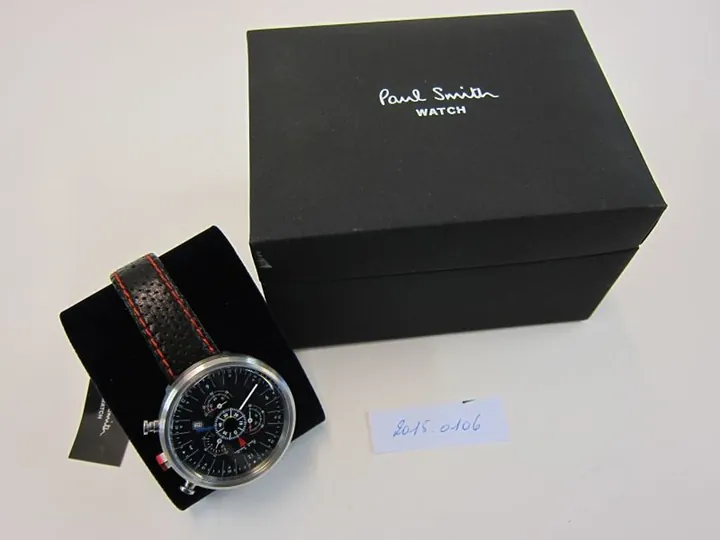
Wristwatch, 2010
Modemuseum Hasselt
Wristwatches · 2018 (Series 4 released in September 2018; '1977' in the source is the model number A1977)
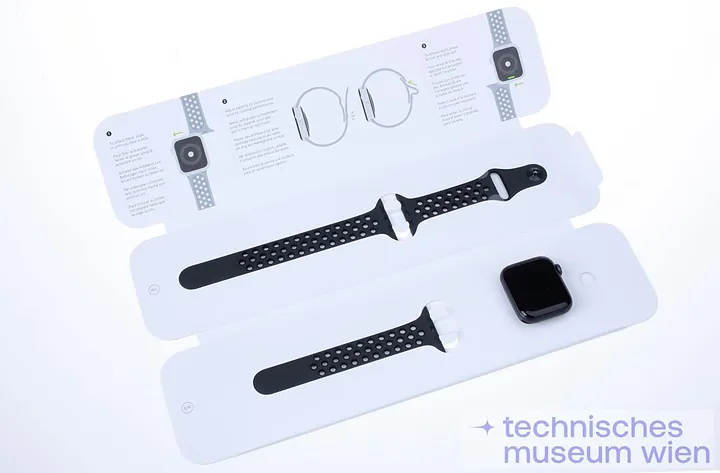
Apple Watch Series 4 (GPS, 40 mm, model A1977), 2018
Vienna Museum of Science and Technology
Wristwatches · c. 2010s
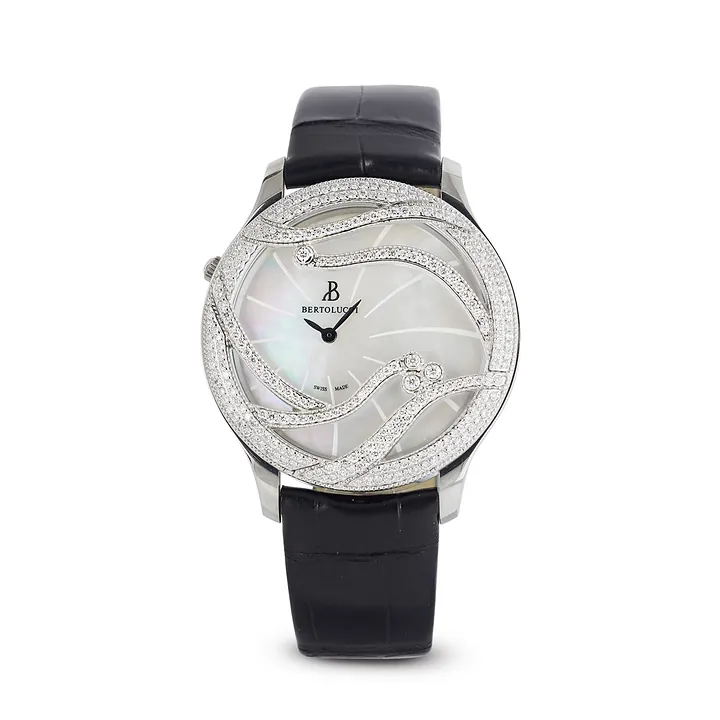
Bertolucci Stria III, ref. 11513.50.45.B88.6C1.501, c. 2010s
Antiquorum auction archive, Geneva
Wristwatches · c. 2010s
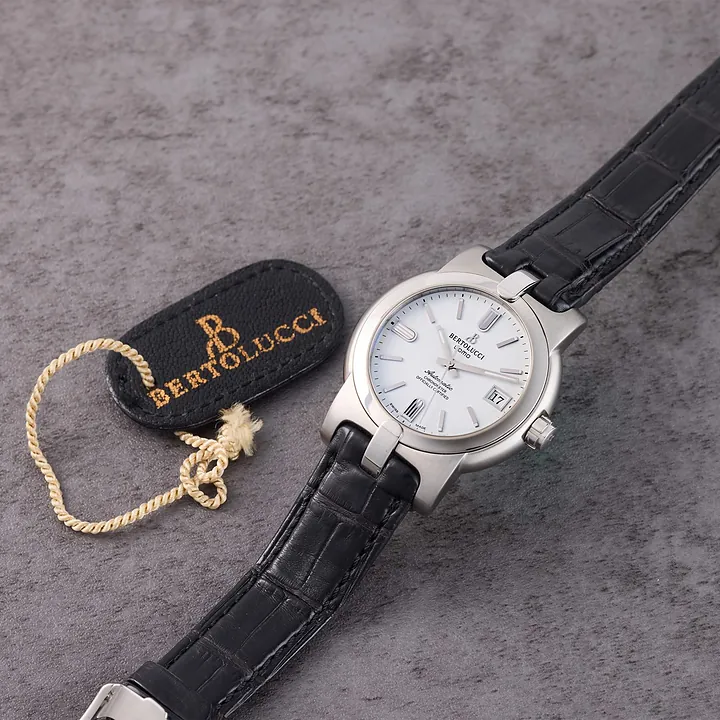
Bertolucci Uoma, ref. 824.51.41.10B, c. 2010s
Antiquorum auction archive, Geneva

Wristwatches · c. 2010s
Breguet Type XXI, ref. 3810, c. 2010s (Antiquorum Lot 381-24)
Antiquorum auction archive, Geneva

Wristwatches · c. 2010s
Breguet Type XXI, ref. 3810, c. 2010s (Antiquorum Lot 386-229)
Antiquorum auction archive, Geneva

Wristwatches · Sold in September 2010
Breitling Cosmonaute, ref. A 22322, Sold in September 2010
Antiquorum auction archive, Geneva
Wristwatches · c. 2010s
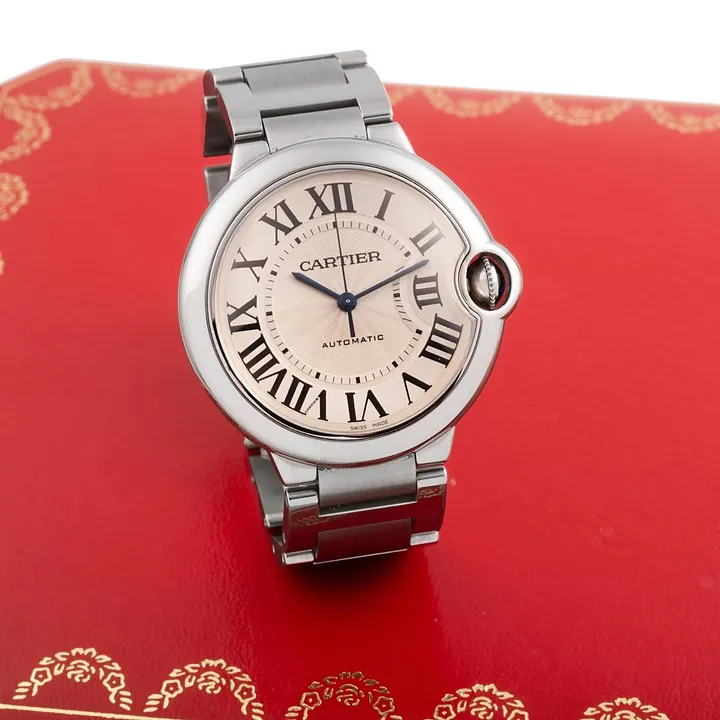
Cartier Ballon Bleu, ref. 3284, c. 2010s
Antiquorum auction archive, Geneva