
Wristwatches · Wristwatch
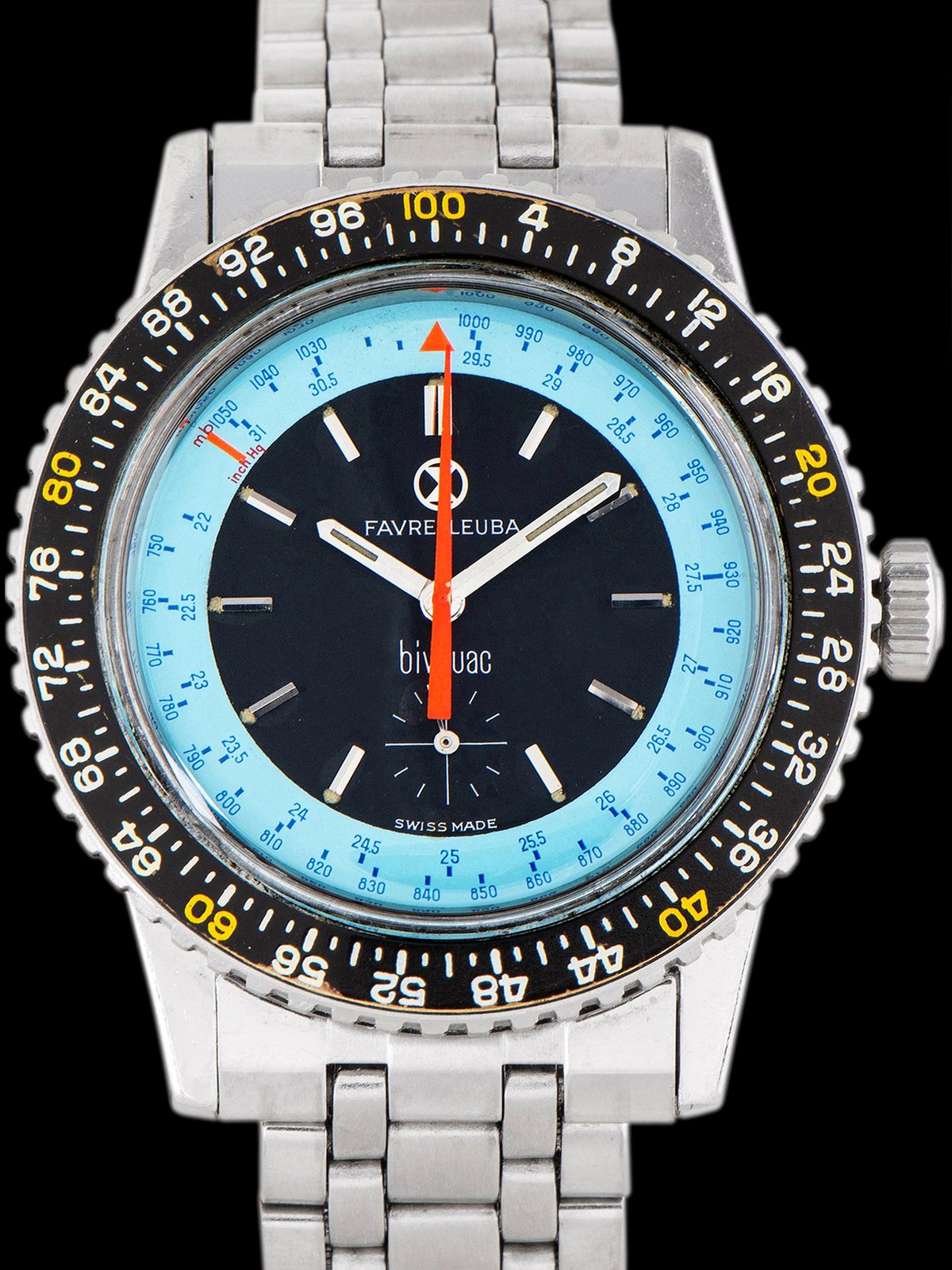
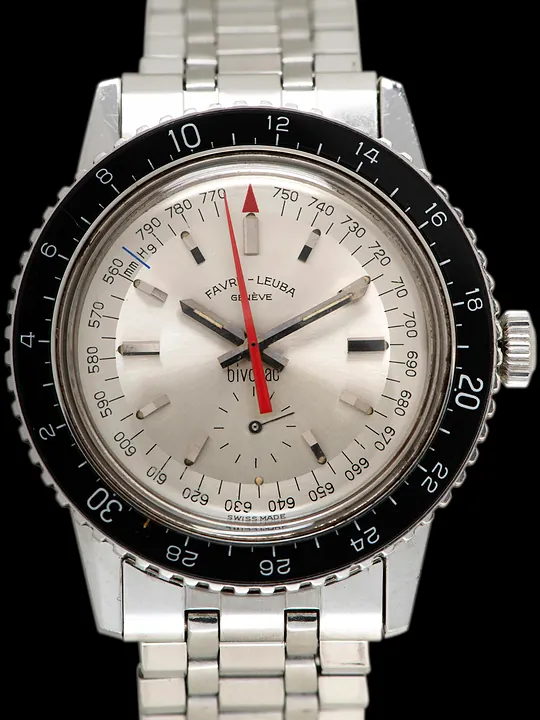
Favre-Leuba Bivouac (Ref. 53203) Blue Dial, 1960s
- Maker / attribution
- Favre-Leuba (maker)
- Date
- 1960s
- Historical period
- Modern Mechanical Horology (1945 – 1969)
- Country of origin
- Switzerland
- Object type
- Wristwatch
- Stock no.
- FVLBB53203
- Credit line
- Dealer listing, Craft & Tailored (FVLBB53203)
- Catalogue title (original)
- 1960s Favre-Leuba Bivouac (Ref. 53203) Blue Dial (English)
View the source record (dealer listing) ↗ (opens another website in a new tab)Suggest a correction
Record summary
Catalogued by Craft & Tailored (dealer), Los Angeles (stock number FVLBB53203), this is a wristwatch by Favre-Leuba, made in Switzerland, dated 1960s. The Atlas places it in the Modern Mechanical Horology period (1945 – 1969) of its Wristwatches collection. The record is illustrated with 6 photographs.
Assembled from the source record's structured fields. Dates and attributions are given as the source states them; where a field is missing the Atlas leaves it blank rather than estimating.
Catalogue description
Dealer description — Craft & Tailored
Despite being less familiar to many collectors than some of its Swiss contemporaries, Favre-Leuba holds a remarkable place in horological history. Founded in 1737, it is the second-oldest continuously operating Swiss watch manufacture, with nearly three centuries of innovation behind its name. Throughout the 20th century, Favre-Leuba distinguished itself by developing highly specialized tool watches built for explorers, mountaineers, and professionals operating in extreme environments. Among its greatest achievements was the introduction of the Bivouac in 1962, the world's first wristwatch equipped with a fully functional aneroid barometer. Powered by the in-house manual-winding Caliber 10032, the Bivouac allowed its wearer to simultaneously tell the time while measuring atmospheric pressure and estimating altitude, a groundbreaking accomplishment that predated the age of electronic outdoor instruments by decades. The Bivouac quickly earned a reputation as a serious expedition companion. Legendary Italian mountaineer Walter Bonatti famously relied on one during his first ascent of Pointe Whymper's north face and later on the Matterhorn, while renowned French polar explorer Paul-Émile Victor wore the model throughout his celebrated Endless Ice expeditions. At a time when exploration captured the world's imagination, the Bivouac represented the pinnacle of mechanical ingenuity and practical adventure. The striking blue-dial variant offered here is among the rarest and most desirable executions of the reference. Preserved in exceptional condition, its vivid blue barometric scale and bold black center create one of the most visually captivating designs of the era. More than simply an uncommon colorway, it perfectly embodies the optimism and adventurous spirit of the 1960s, a period when mechanical innovation empowered mankind to push ever farther into the unknown. SPECS Stock # FVLBB53203 Brand Favre-Leuba Style Bivouac Model 53203 Serial 67X Size Men's Material Stainless Steel Dial Black / Blue Millimeters 40 Bracelet Favre-Leuba "JB Champion" Bracelet CASE & BRACELET The well-preserved and honest case features light wear throughout, while retaining its factory dimensions and geometry, with minimal evidence of prior polishing present. The original bidirectional ratcheting bezel is in excellent condition, with no fading and only gentle wear present. The case retains its original Favre-Leuba signed crown. The case back is also in great condition, with all of the factory markings fully present. The original Favre-Leuba stainless steel bracelet made by JB Champion is in excellent condition, showing minimal signs of use and only light stretch. The bracelet retains 22 links and will fit up to a 7.5-inch wrist. DIAL & HANDS The original two-tone matte black and powder blue dial remain in excellent condition, showing nominal wear and no damage. The tritium lume plots features degradation throughout when inspected under UV light and feature a cream patina present. The original tritium lume hands have acheived a dark beige patina and exhibit no degradation under UV light. ACCESSORIES None. The watch is keeping time ; the aneroid barometer is also functional. Though, the service history is unknown. A movement service can be purchased upon request.
Historical context
Modern Mechanical Horology (1945 – 1969)
Tool watches for divers, pilots and astronauts; electric watches anticipate the electronic age.
The classic era of the mechanical wristwatch: dive watches, chronographs for motor racing and space flight, GMT watches for jet travel, slim dress watches, automatic calendars, and the rise of Japanese manufacturers alongside Swiss, American, German and Soviet industries.
Read the period in the timelineMore wristwatches from this periodEarlier: Golden Age of Mechanical Watchmaking
Atlas type guide
Wristwatches
Bracelet watches were worn by women from the early nineteenth century — Breguet made one for Caroline Murat, Queen of Naples, in 1810–12 — but the wristwatch only became a man's instrument with military use and aviation in the early twentieth century. Between the World Wars it overtook the pocket watch; the 1920s and 1930s brought rectangular Art Deco cases, water-resistant cases and the first automatic winding systems.
After 1945 the wristwatch became a carrier of identity — dress watches, sports and dive watches, chronographs, calendars — produced by Swiss, American, Japanese, German, Soviet and Chinese industries. The quartz revolution after 1969 and the mechanical renaissance since the 1990s, including the rise of independent watchmakers, complete the story.
What to look for
- The reference number (between the lugs or inside the case back) and serial number, the starting point for dating.
- The calibre: its maker and number are often stamped under the dial or on the bridge.
- Originality of dial, hands and crown — refinished ('redial') dials are common.
- Case material marks: 18K/750, 14K/585, stainless steel, gold-filled, plated.
Dating clues
- Wire-lug cases: before c. 1925.
- Water-resistant screw-down cases: from 1926.
- Quartz movements: from 1969; sapphire crystals widespread after c. 1980.
General guidance written by the Atlas editors about this kind of object. It is not a statement about this particular piece; for that, rely on the source record above and on physical examination.
Related records
Wristwatches · c. 1970s
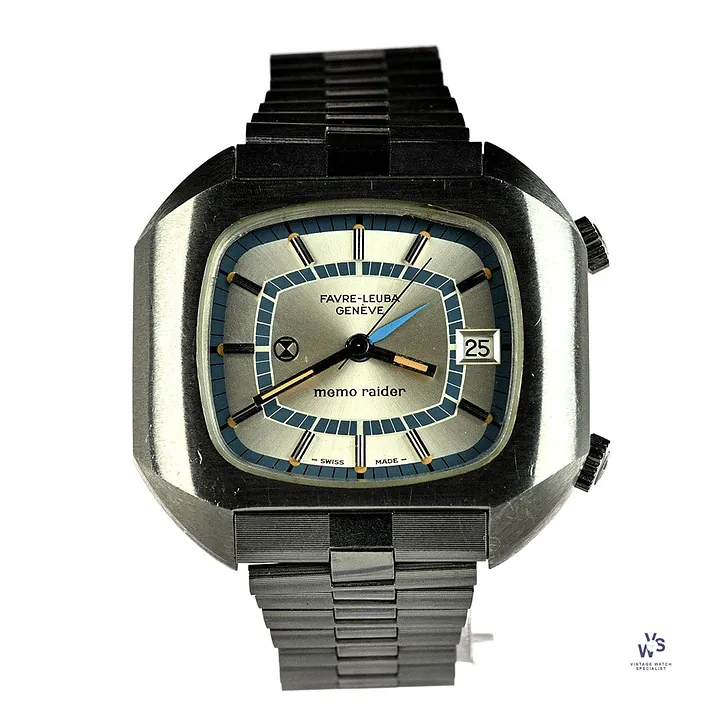
Favre Leuba Geneve Memo Raider Alarm Watch, Silver Dial, circa 1970s
Vintage Watch Specialist (dealer), United Kingdom
Wristwatches · c. 1970s
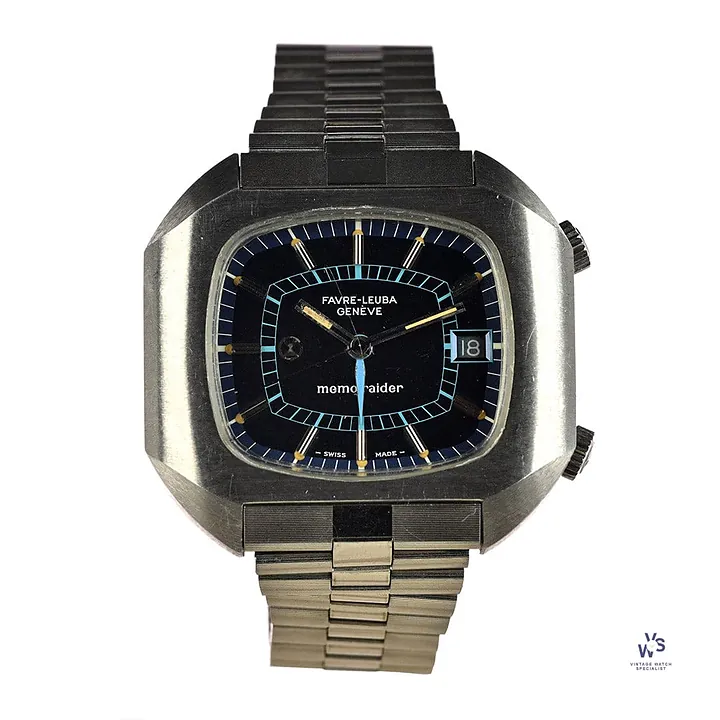
Favre Leuba Geneve Memo Raider Alarm, ref. 53153, circa 1970s
Vintage Watch Specialist (dealer), United Kingdom
Wristwatches · c. 1975
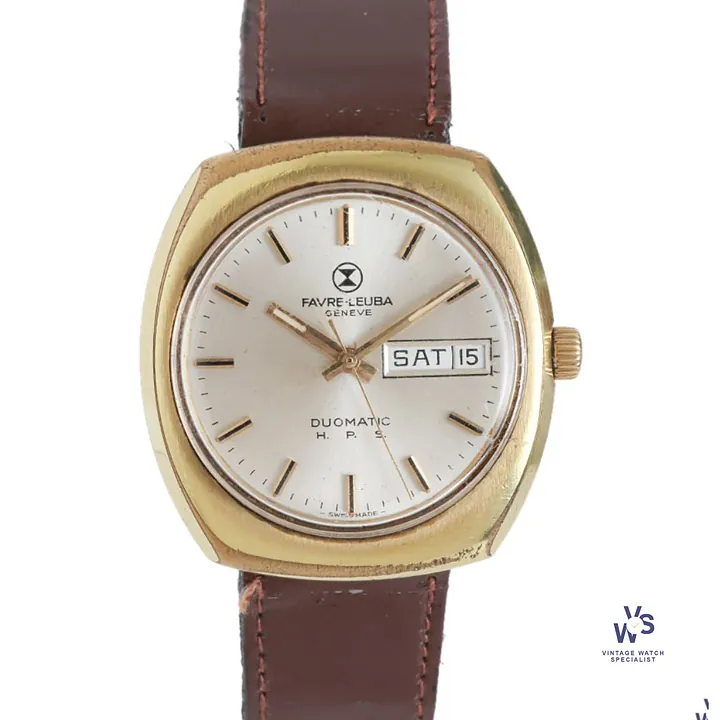
Favre-Leuba Duomatic H.P.S. Automatic Calendar, Gold Plated Cushion Case, circa 1975
Vintage Watch Specialist (dealer), United Kingdom
Wristwatches · 1960s
Favre-Leuba Bivouac (Ref. 53213) "Barometer & Altimeter", 1960s
Craft & Tailored (dealer), Los Angeles

Wristwatches · 1945
Wristwatch by Eterna, 1945
Museum Rotterdam

Wristwatches · c. 1945
Breitling Premier, ref. 790, c. 1945
Antiquorum auction archive, Geneva

Wristwatches · c. 1945
Universal Genève Uni-Compax, ref. 22492, c. 1945
Antiquorum auction archive, Geneva

Wristwatches · c. 1950s
Baume & Mercier wristwatch, c. 1950s
Antiquorum auction archive, Geneva