
Wristwatches · Wristwatch
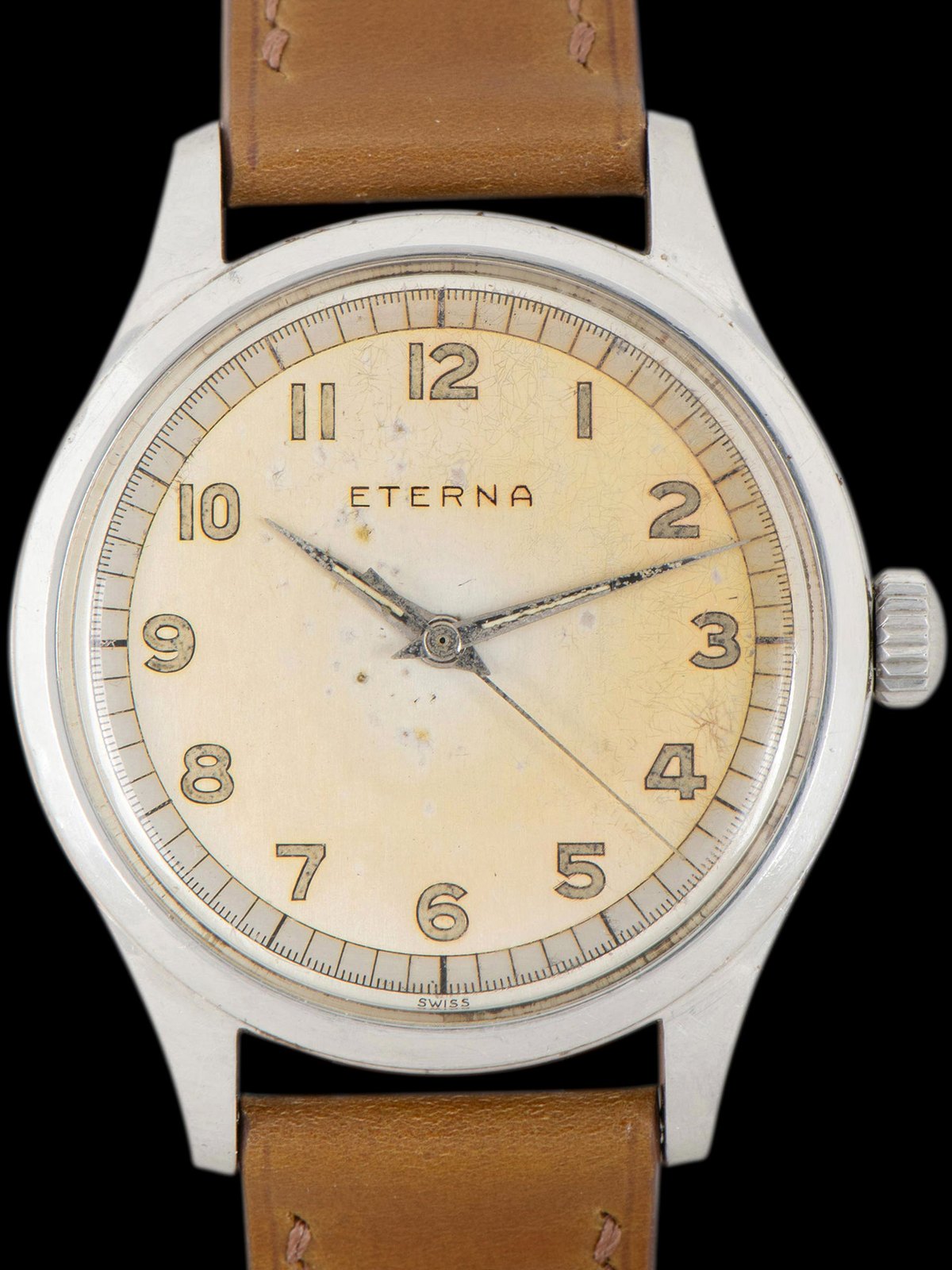
Eterna Manual-Wind Field Watch "Oversized", 1940s
- Maker / attribution
- Eterna (maker)
- Date
- 1940s
- Historical period
- Golden Age of Mechanical Watchmaking (1900 – 1945)
- Country of origin
- Switzerland
- Object type
- Wristwatch
- Dimensions
- Case 36.5 mm
- Stock no.
- ETRMNWND-2
- Credit line
- Dealer listing, Craft & Tailored (ETRMNWND-2)
- Catalogue title (original)
- 1940s Eterna Manual-Wind Field Watch "Oversized" (English)
View the source record (dealer listing) ↗ (opens another website in a new tab)Suggest a correction
Record summary
Catalogued by Craft & Tailored (dealer), Los Angeles (stock number ETRMNWND-2), this is a wristwatch by Eterna, made in Switzerland, dated 1940s. The Atlas places it in the Golden Age of Mechanical Watchmaking period (1900 – 1945) of its Wristwatches collection. Recorded dimensions: Case 36.5 mm. The record is illustrated with 6 photographs.
Assembled from the source record's structured fields. Dates and attributions are given as the source states them; where a field is missing the Atlas leaves it blank rather than estimating.
Catalogue description
Dealer description — Craft & Tailored
In 1856, a couple of guys named Josef Girard and Urs Schild started a watch movement manufacturer called, appropriately enough, Dr. Girard & Schild. They rebranded a few times, first to Schild Freres, then—perhaps after realizing that neither of the previous names rolled off the tongue—they started putting the name Eterna on their watch dials. That one stuck. The Eterna brand put out some truly incredible pieces over the years, most of which fall under the sports-driven tool watch category. But this one is more military-inspired from the ‘40s—calling to mind some of the Dirty Dozen pieces—featuring a hand-wound movement housed within a stout 36.5mm case. Dress it up or dress it down, either way, there's no doubt this beauty will work as a perfect accompaniment for any wardrobe. SPECS Stock # ETRMNWND-2 Brand Eterna Style Manual-Wind Field Watch Model N/A Serial 33XXXXX Size Men's Material Stainless Steel Dial White "Aged" Millimeters 36.5 Strap 2pc Handmade Leather Strap CASE & BRACELET The large-for-the-era and robust case is in impressive condition, showcasing long, broad, and symmetrical lugs that feature minimal signs of previous polishing. The unsigned crown appears to be original to the watch. The case back features a faint medallion engraving along with engraved text that reads in French "Oscar Joray, Pour Ses Bons Et, Loyaux Services, 1916-1948". The watch comes supplied on a 2pc handmade leather strap. DIAL & HANDS The original and beautifully patinated cream dial is simple, yet effective, with gentle elements of age that add to the vintage aesthetic of the watch. The dial features large radium-lume Arabic numerals that remain fully intact with a charming matching cream color to the dial. The original dauphine-style hands match the dial lume perfectly and exhibit no degradation when inspected under UV light. ACCESSORIES None. The watch is keeping time, but the service history is unknown. A movement service can be provided upon request.
Historical context
Golden Age of Mechanical Watchmaking (1900 – 1945)
The wristwatch displaces the pocket watch; waterproof cases, self-winding and grand complications.
The wristwatch overtook the pocket watch. Military use in the First World War, aviation, water-resistant cases (1926), automatic winding (1923–31), rectangular Art Deco designs and early chronographs and calendars defined the period.
Read the period in the timelineMore wristwatches from this periodEarlier: Industrial Revolution
Atlas type guide
Wristwatches
Bracelet watches were worn by women from the early nineteenth century — Breguet made one for Caroline Murat, Queen of Naples, in 1810–12 — but the wristwatch only became a man's instrument with military use and aviation in the early twentieth century. Between the World Wars it overtook the pocket watch; the 1920s and 1930s brought rectangular Art Deco cases, water-resistant cases and the first automatic winding systems.
After 1945 the wristwatch became a carrier of identity — dress watches, sports and dive watches, chronographs, calendars — produced by Swiss, American, Japanese, German, Soviet and Chinese industries. The quartz revolution after 1969 and the mechanical renaissance since the 1990s, including the rise of independent watchmakers, complete the story.
What to look for
- The reference number (between the lugs or inside the case back) and serial number, the starting point for dating.
- The calibre: its maker and number are often stamped under the dial or on the bridge.
- Originality of dial, hands and crown — refinished ('redial') dials are common.
- Case material marks: 18K/750, 14K/585, stainless steel, gold-filled, plated.
Dating clues
- Wire-lug cases: before c. 1925.
- Water-resistant screw-down cases: from 1926.
- Quartz movements: from 1969; sapphire crystals widespread after c. 1980.
General guidance written by the Atlas editors about this kind of object. It is not a statement about this particular piece; for that, rely on the source record above and on physical examination.
Related records

Wristwatches · 1945
Wristwatch by Eterna, 1945
Museum Rotterdam
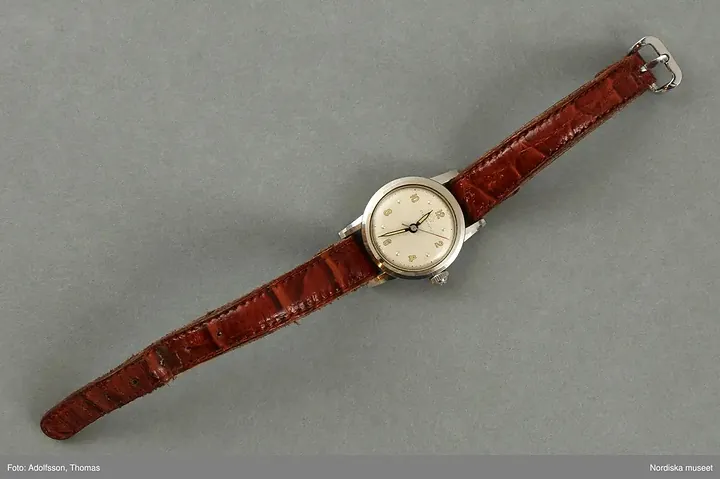
Wristwatches · 1900–1999
Wristwatch by Eterna, Sweden, 1900–1999
Nordic Museum Foundation
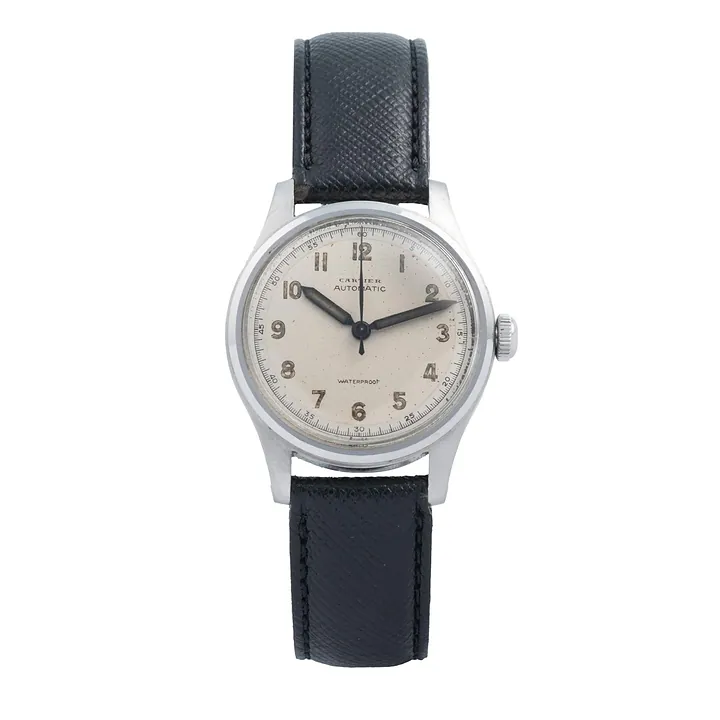
Wristwatches · c. 1930s
Eterna wristwatch, c. 1930s
Antiquorum auction archive, Geneva
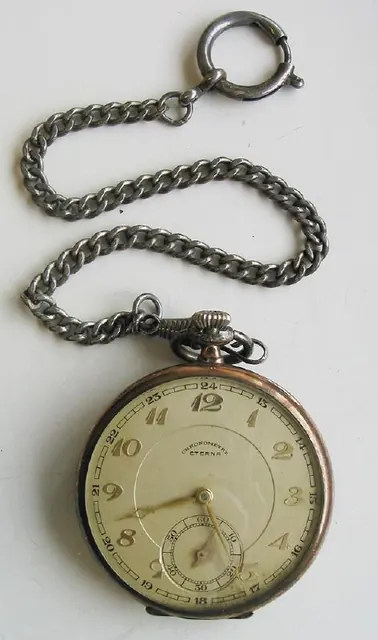
Pocket Watches · 1934
Pocket watch by Eterna, Switzerland, 1934
Turun kaupunginmuseo

Wristwatches · 1931
Rolex 'Oyster Perpetual' rotor self-winding wrist-watch, lever escapement, in steel case with glass in back, Montres Rolex SA, Geneva, Switzerland, 1931
Science Museum Group, London

Wristwatches · 1900–1999
Wristwatch by Certina, Switzerland, 1900–1999
Nordic Museum Foundation

Wristwatches · 1900–1999
Wristwatch by Omega, Västerås, 1900–1999
Nordic Museum Foundation

Wristwatches · 1900–1999
Wristwatch by Universal, Switzerland, 1900–1999
Nordic Museum Foundation