
Wristwatches · Wristwatch
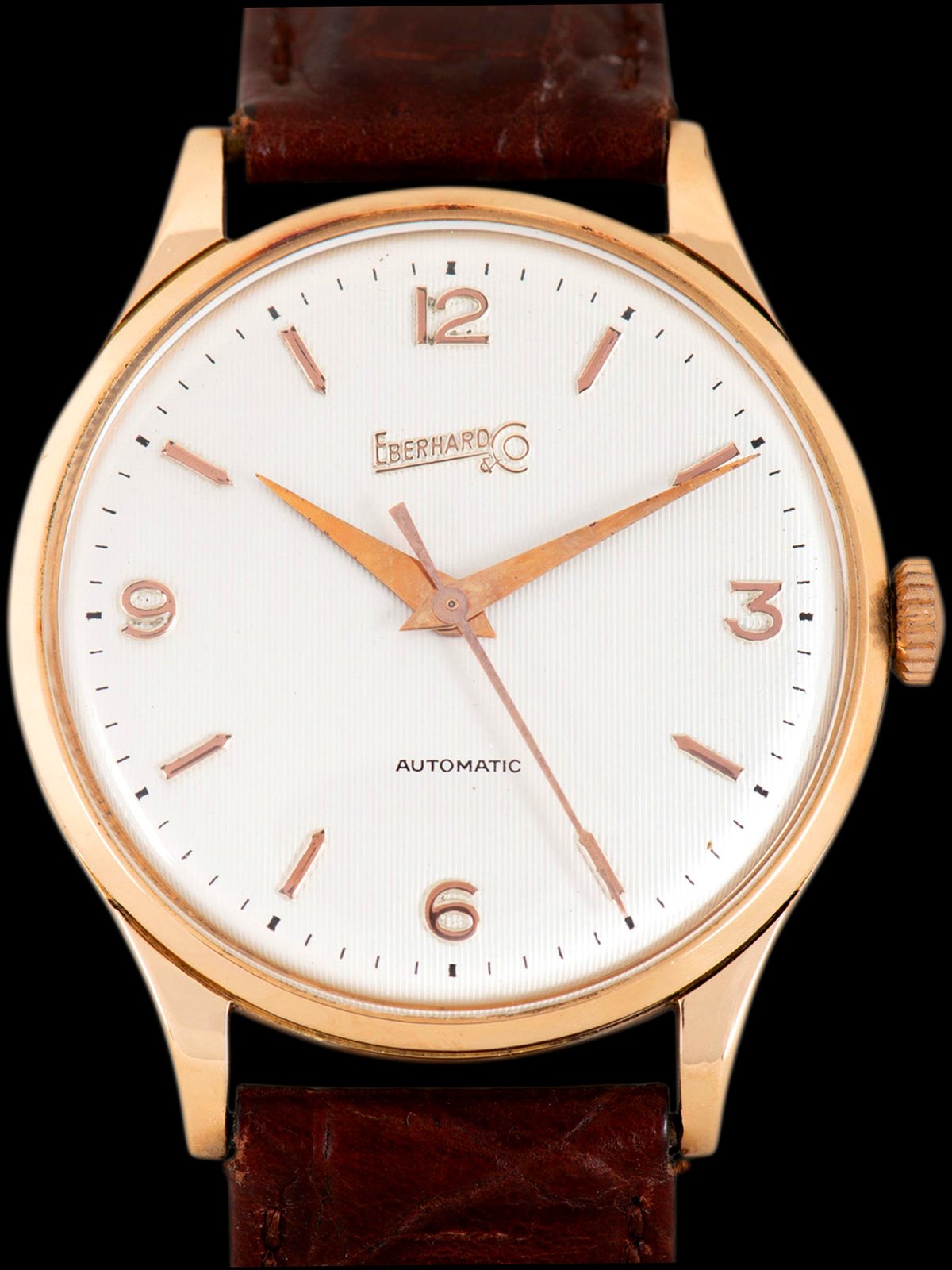
Eberhard Oversized Automatic 18K RG (Ref. 11601 642) "Cal. 11500", 1950s
- Maker / attribution
- Eberhard (maker)
- Date
- 1950s
- Historical period
- Modern Mechanical Horology (1945 – 1969)
- Country of origin
- Switzerland
- Object type
- Wristwatch
- Dimensions
- Case 36 mm
- Stock no.
- EBHA11601642
- Credit line
- Dealer listing, Craft & Tailored (EBHA11601642)
- Catalogue title (original)
- 1950s Eberhard Oversized Automatic 18K RG (Ref. 11601 642) "Cal. 11500" (English)
View the source record (dealer listing) ↗ (opens another website in a new tab)Suggest a correction
Record summary
Catalogued by Craft & Tailored (dealer), Los Angeles (stock number EBHA11601642), this is a wristwatch by Eberhard, made in Switzerland, dated 1950s. The Atlas places it in the Modern Mechanical Horology period (1945 – 1969) of its Wristwatches collection. Recorded dimensions: Case 36 mm. The record is illustrated with 6 photographs.
Assembled from the source record's structured fields. Dates and attributions are given as the source states them; where a field is missing the Atlas leaves it blank rather than estimating.
Catalogue description
Dealer description — Craft & Tailored
The Eberhard & Co. brand is firmly rooted in Swiss watchmaking history and was once the largest Swiss watch manufacturer in the early 1900s. The founder George-Emile Eberhard founded the company at the young age of 22 years old in La Chaux-de-Fonds, Switzerland. Though Eberhard & Co. greatly influenced the rise of the Swiss watchmaking history, the brand is most well-known for its post-war wristwatches, such as the elegant Extra-Fort chronograph and the Scafograph diving sports watch. SPECS Stock # EBHA11601642 Brand Eberhard & Co. Style Automatic Dress Watch Model 11601 642 Serial N/A Size Men's Material 18K Rose Gold Dial Silver "Tapestry" Millimeters 36 Bracelet 2pc Leather Strap CASE & BRACELET The noble 36mm 18K rose gold case is in lovely condition overall, showing minimal signs of previous polishing and light signs of use expected for the age of the watch. The unsigned crown appears to be original to the watch. The case back retains all of the original factory markings in deep and crisp condition. The watch comes supplied on a 2pc leather strap. DIAL & HANDS The original silver dial features vertical ridges that span the length of the dial, also known as a tapestry dial, and is in exceptional vintage condition. Only minor elements of age are present on the otherwise bright dial. The rose gold makers exhibit light age and remain very presentable. The original rose gold dauphine hands display light oxidation which is expected and are in excellent condition. ACCESSORIES
Historical context
Modern Mechanical Horology (1945 – 1969)
Tool watches for divers, pilots and astronauts; electric watches anticipate the electronic age.
The classic era of the mechanical wristwatch: dive watches, chronographs for motor racing and space flight, GMT watches for jet travel, slim dress watches, automatic calendars, and the rise of Japanese manufacturers alongside Swiss, American, German and Soviet industries.
Read the period in the timelineMore wristwatches from this periodEarlier: Golden Age of Mechanical Watchmaking
Atlas type guide
Automatic (self-winding) watches
Self-winding watches use the wearer's motion to wind the mainspring. Abraham-Louis Perrelet and Breguet made 'perpétuelle' pocket watches with oscillating weights in the late eighteenth century, but the principle only became practical in the wristwatch. John Harwood patented a bumper automatic in 1923; Rolex's Perpetual rotor (1931) winding in one direction, and later bidirectional rotors (Eterna, Felsa Bidynator), established the modern form. Micro-rotors (Universal Genève, Buren) and peripheral rotors made automatic watches thinner.
What to look for
- A semicircular rotor turning 360° over the movement, or a 'bumper' weight that rebounds between springs.
- 'Automatic', 'Perpetual' or 'Self-winding' on the dial.
- A sealed screw-back case, since automatic watches are wound less often by the crown.
Dating clues
- Bumper automatics: 1923–c. 1955.
- Full rotors: from 1931 (Rolex); widespread after c. 1950.
- Micro-rotors: from 1954–1958.
General guidance written by the Atlas editors about this kind of object. It is not a statement about this particular piece; for that, rely on the source record above and on physical examination.
Related records
Wristwatches · originally sold in 2013 (per the lot record)
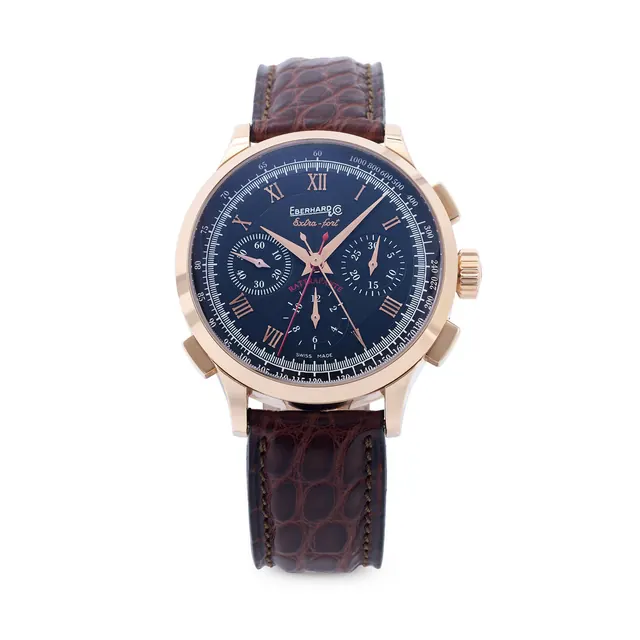
Eberhard wristwatch, ref. 30063, Extra-Fort Chrono Rattrapante Limited 011/121, originally sold in 2013
Antiquorum auction archive, Geneva
Wristwatches · c. 1950s
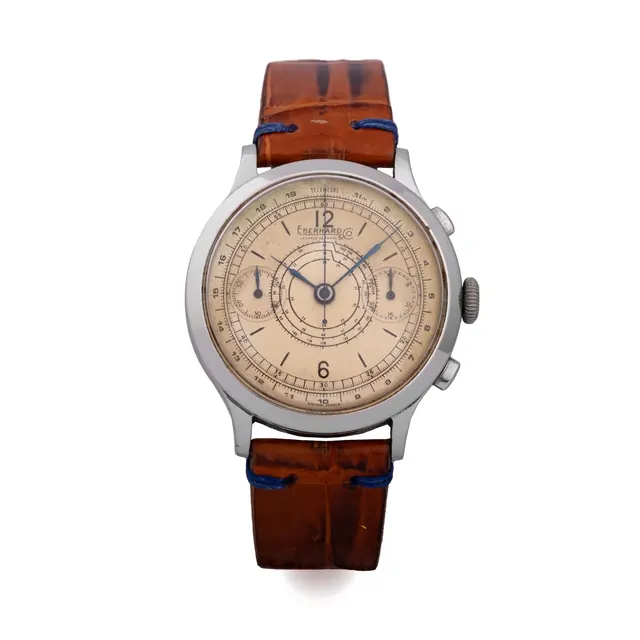
Eberhard wristwatch, Single Button Chronograph, circa 1950's
Antiquorum auction archive, Geneva
Wristwatches · 1960s
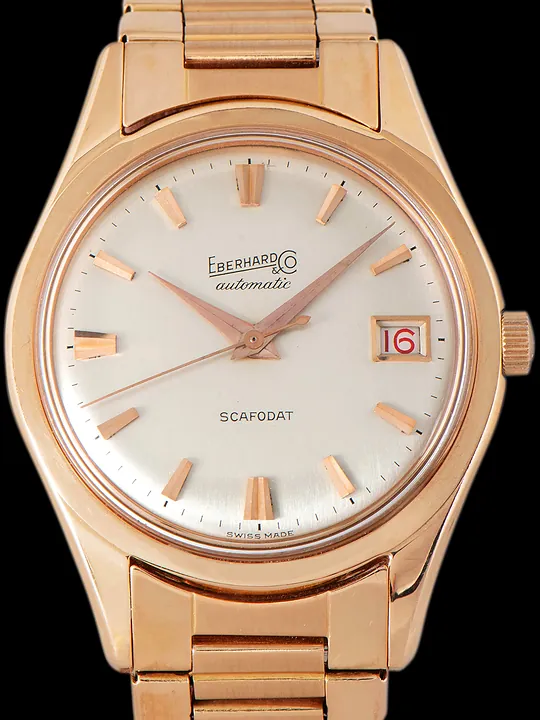
Eberhard Scafodat 18K RG (Ref. 11532-1) "Roulette Date Wheel", 1960s
Craft & Tailored (dealer), Los Angeles
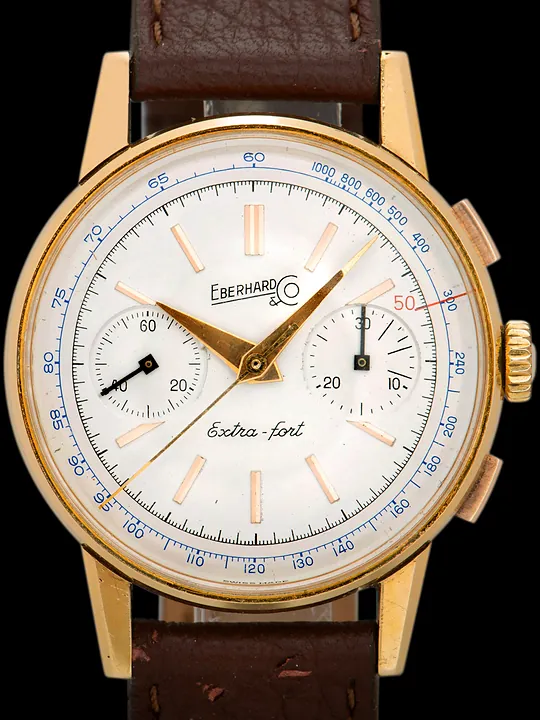
Wristwatches · 1950s
Eberhard Extra-Fort Chronograph (Ref. 14801) 18K YG, 1950s
Craft & Tailored (dealer), Los Angeles

Wristwatches · 1945
Wristwatch by Eterna, 1945
Museum Rotterdam

Wristwatches · c. 1945
Breitling Premier, ref. 790, c. 1945
Antiquorum auction archive, Geneva

Wristwatches · c. 1945
Universal Genève Uni-Compax, ref. 22492, c. 1945
Antiquorum auction archive, Geneva

Wristwatches · c. 1950s
Baume & Mercier wristwatch, c. 1950s
Antiquorum auction archive, Geneva