
Wristwatches · Wristwatch
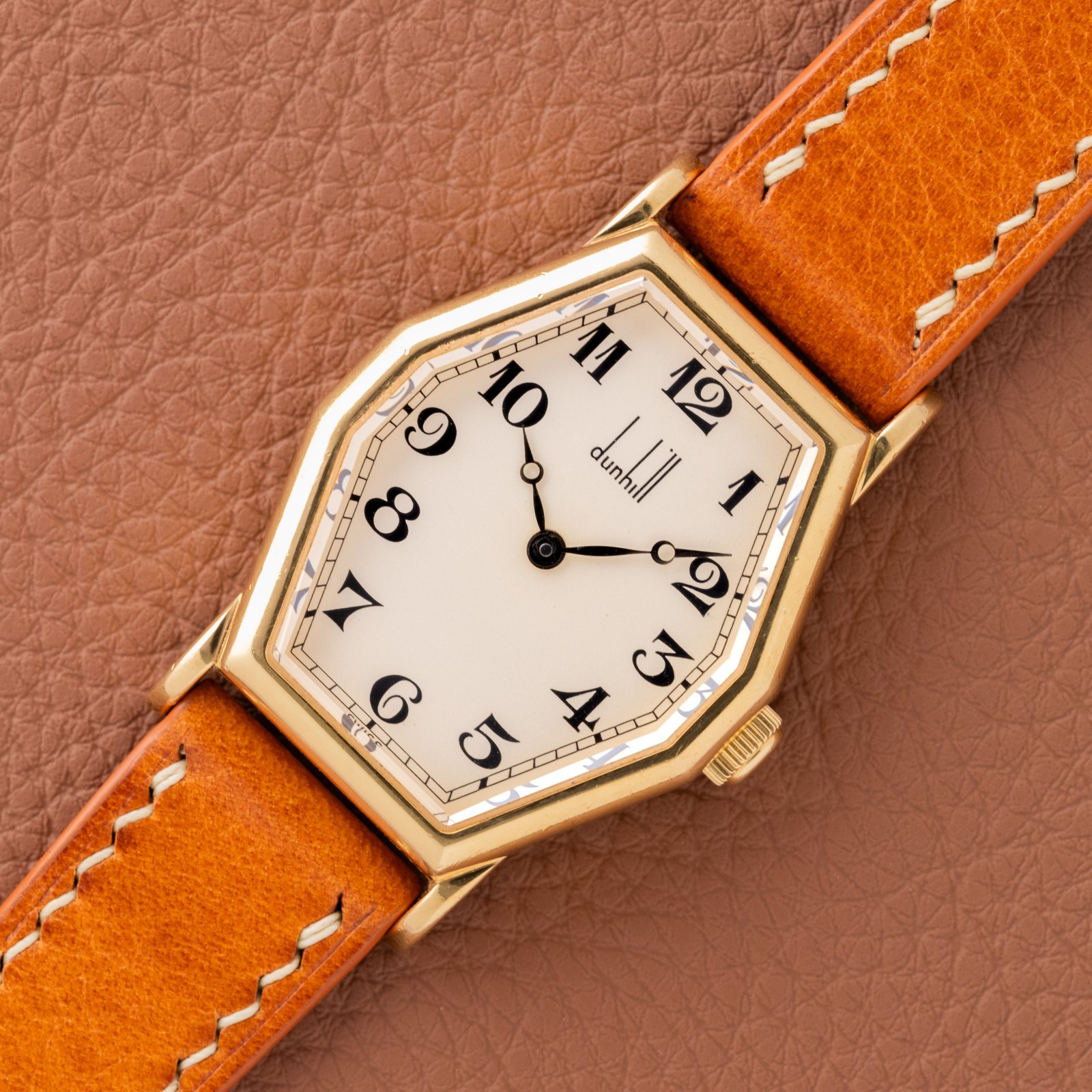
Dunhill Centenary Yellow Gold Octagon 100th Anniversary, 1990s
- Maker / attribution
- Dunhill (maker)
- Date
- 1990s
- Historical period
- Mechanical Renaissance (1990 – 2010)
- Country of origin
- Unrecorded in source
- Object type
- Wristwatch
- Materials / technique
- yellow gold
- Dimensions
- Case 28 mm
- Stock no.
- Product 15887128363191
- Credit line
- Dealer listing, Huntington Company (product 15887128363191)
- Catalogue title (original)
- 1990s Dunhill Centenary Yellow Gold Octagon 100th Anniversary (English)
View the source record (dealer listing) ↗ (opens another website in a new tab)Suggest a correction
Record summary
Catalogued by Huntington Company (dealer) (stock number Product 15887128363191), this is a wristwatch by Dunhill, dated 1990s. The Atlas places it in the Mechanical Renaissance period (1990 – 2010) of its Wristwatches collection. Materials and techniques recorded by the source: yellow gold. Recorded dimensions: Case 28 mm. The record is illustrated with 6 photographs.
Assembled from the source record's structured fields. Dates and attributions are given as the source states them; where a field is missing the Atlas leaves it blank rather than estimating.
Catalogue description
Dealer description — Huntington Company
History and Significance Alfred Dunhill's history began in London in 1893, long before the company became associated with fine wristwatches. Originally established as a saddlery business, Dunhill evolved into one of Britain's most recognizable luxury houses, developing a reputation for beautifully made accessories, writing instruments, and objects designed around the lifestyle of the modern gentleman. By the twentieth century, the company had become particularly celebrated for its ability to combine practical objects with imaginative design. Watches eventually became another expression of that philosophy, often incorporating unusual case shapes and architectural details that distinguished them from conventional Swiss dress watches. The Centenary Octagon is a particularly interesting example, created to commemorate the company's hundredth anniversary. The Centenary collection represents an interesting intersection between British design and traditional Swiss watchmaking. Rather than producing a conventional round dress watch to celebrate the anniversary, Dunhill adopted a striking geometric case that draws upon the decorative traditions of the early twentieth century. The octagonal construction immediately recalls the influence of Art Deco, a movement that embraced symmetry, angular forms, and the relationship between architecture and decorative objects. These influences were particularly important in the development of early wristwatches, when manufacturers were still experimenting with alternatives to the familiar round pocket watch case. The Centenary Octagon revisits that period with a design that feels deliberately historical without simply reproducing an existing vintage watch. The case is undoubtedly the defining feature of the watch. Its elongated octagonal shape combines sharply defined angles with a relatively narrow central dial, creating a silhouette that feels closer to a piece of fine jewelry than a conventional wristwatch. The broad gold surfaces surrounding the dial emphasize the unusual architecture, while the stepped transitions between the different sections of the case introduce additional depth. At 28mm by 40mm, the proportions give the watch a substantial presence despite its relatively narrow width. The result is a design that makes particularly effective use of its precious metal construction, allowing the shape and finishing of the case to become as important as the time display itself. Writer’s Thoughts There is a certain category of vintage and neo-vintage dress watches that feels more closely related to jewelry and industrial design than conventional horology. The Dunhill Centenary belongs firmly in that category. The case has an extraordinary amount of personality, with its elongated shape, sharp angles, and broad gold surfaces creating a silhouette that immediately stands apart from traditional round watches. What makes the design particularly successful is that the geometry never feels excessive. Every angle contributes to the overall appearance, giving the watch a sense of purpose that can be difficult to achieve with such an unconventional shape. The result is something that feels equally appropriate alongside a collection of fine watches or beautifully designed objects from the Art Deco period. Our Promise Every watch is thoroughly vetted, carefully described with complete transparency, and guaranteed authentic. Each piece is offered in honest condition, ensuring collectors receive a timepiece that reflects both originality and integrity. Specifications Brand: Dunhill Model: Centenary Octagon Reference: NA Year: 1990s Case Material: 18k Yellow Gold Case Size: 27mm x 40mm Dial: Cream Dial Movement: Caliber 750, Manual Wind Strap/Buckle: New H.C. Leather Strap Buckle/Clasp: Original Dunhill Gold Buckle Contents: Watch only Condition Case: Yellow gold case shows light surface wear consistent with age and use. The case retains its attractive octagonal shape and well-defined edges. Dial: Cream dial remains in excellent condition with well-preserved printing and an attractive overall finish. Hands: Hands remain in good condition with light signs of aging. Crystal: Crystal remains in good condition with light surface wear consistent with use. Strap/Buckle: Newly fitted H.C. leather strap is in excellent condition. Buckle/Clasp: Original Dunhill gold buckle remains in good condition with light surface wear. Notes: Watch has recently been serviced.
Historical context
Mechanical Renaissance (1990 – 2010)
Mechanical watches return as cultural objects; independent watchmaking flourishes.
Mechanical watches returned as cultural and luxury objects. Complications, tourbillons and new materials proliferated; independent watchmakers such as George Daniels, F.P. Journe and Philippe Dufour revived artisanal watchmaking; collecting vintage watches became a major field.
Read the period in the timelineMore wristwatches from this periodEarlier: Quartz Revolution
Atlas type guide
Wristwatches
Bracelet watches were worn by women from the early nineteenth century — Breguet made one for Caroline Murat, Queen of Naples, in 1810–12 — but the wristwatch only became a man's instrument with military use and aviation in the early twentieth century. Between the World Wars it overtook the pocket watch; the 1920s and 1930s brought rectangular Art Deco cases, water-resistant cases and the first automatic winding systems.
After 1945 the wristwatch became a carrier of identity — dress watches, sports and dive watches, chronographs, calendars — produced by Swiss, American, Japanese, German, Soviet and Chinese industries. The quartz revolution after 1969 and the mechanical renaissance since the 1990s, including the rise of independent watchmakers, complete the story.
What to look for
- The reference number (between the lugs or inside the case back) and serial number, the starting point for dating.
- The calibre: its maker and number are often stamped under the dial or on the bridge.
- Originality of dial, hands and crown — refinished ('redial') dials are common.
- Case material marks: 18K/750, 14K/585, stainless steel, gold-filled, plated.
Dating clues
- Wire-lug cases: before c. 1925.
- Water-resistant screw-down cases: from 1926.
- Quartz movements: from 1969; sapphire crystals widespread after c. 1980.
General guidance written by the Atlas editors about this kind of object. It is not a statement about this particular piece; for that, rely on the source record above and on physical examination.
Related records
Wristwatches · c. 1970s
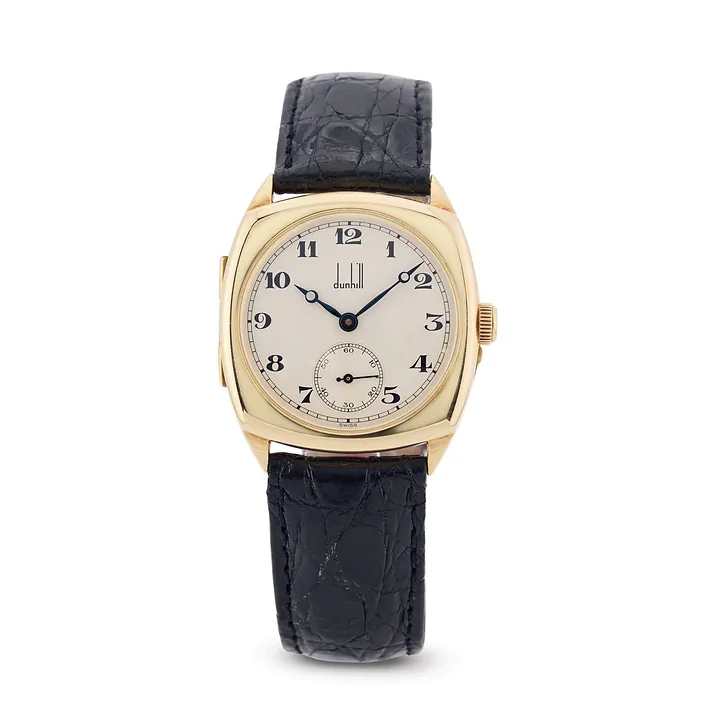
Dunhill wristwatch, c. 1970s
Antiquorum auction archive, Geneva
Wristwatches · c. 2000
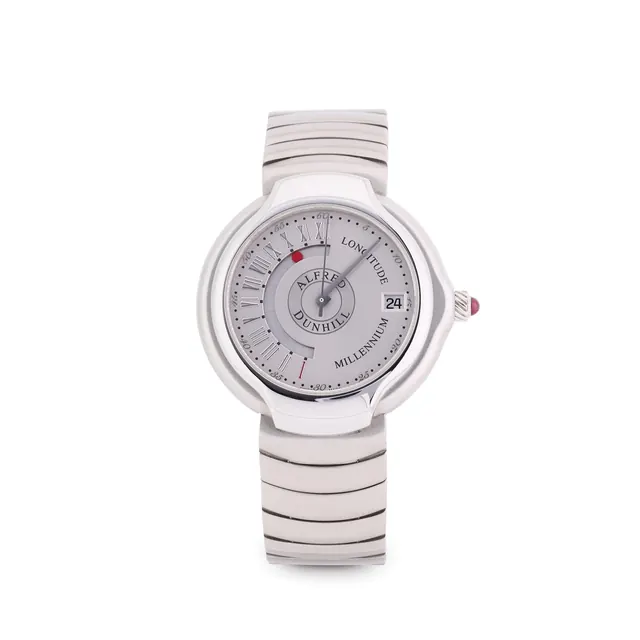
Dunhill wristwatch, ref. DC2600M/, Longitude Millennium Limited Edition of 1300 Pieces, circa 2000
Antiquorum auction archive, Geneva
Wristwatches · c. 1950s
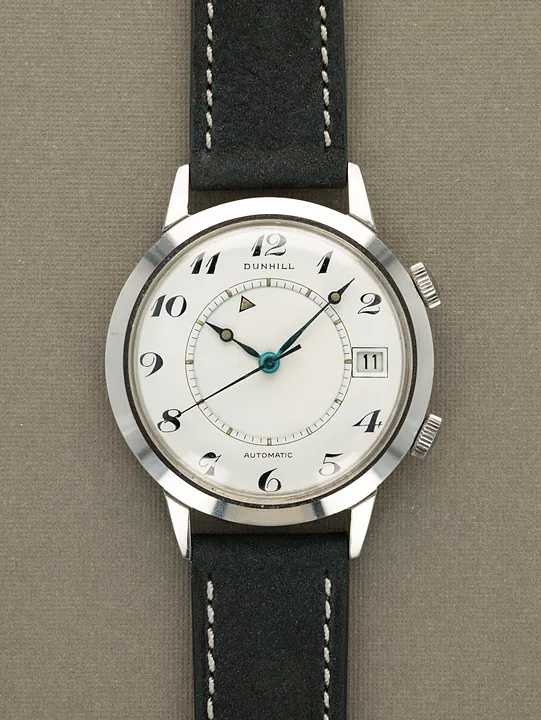
Dunhill 'Memovox' ref. 855 by Jaeger-LeCoultre, Gloss White 'Breguet' Dial
Oliver & Clarke (dealer), United Kingdom
Wristwatches · 1999
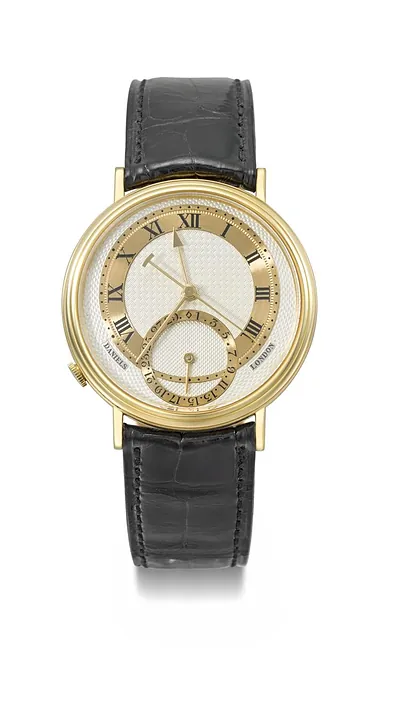
'Millennium' co-axial wristwatch by George Daniels and Omega, England, 1999
Science Museum Group, London

Wristwatches · 2008
Wristwatch by Breitling?, 2008
Museum Rotterdam
Wristwatches · 2008
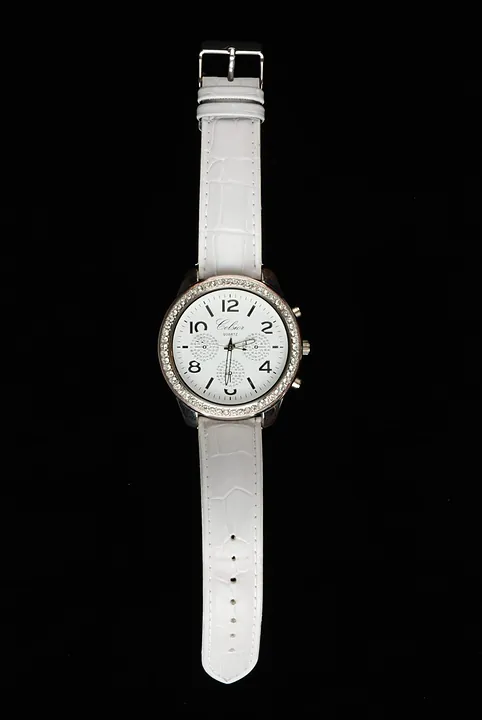
Wristwatch by Celsior Quartz, 2008
Museum Rotterdam
Wristwatches · 2008
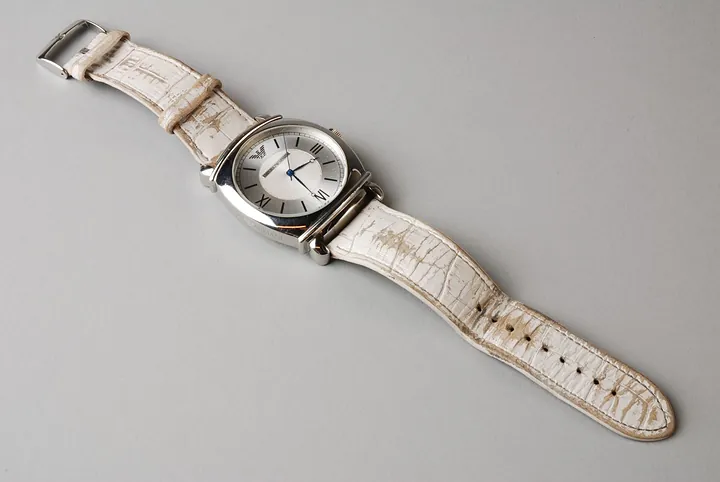
Wristwatch possibly by Emporio Armani, 2008
Museum Rotterdam

Wristwatches · c. 1990s
Audemars Piguet Bamboo, c. 1990s
Antiquorum auction archive, Geneva