
Wristwatches · Wristwatch
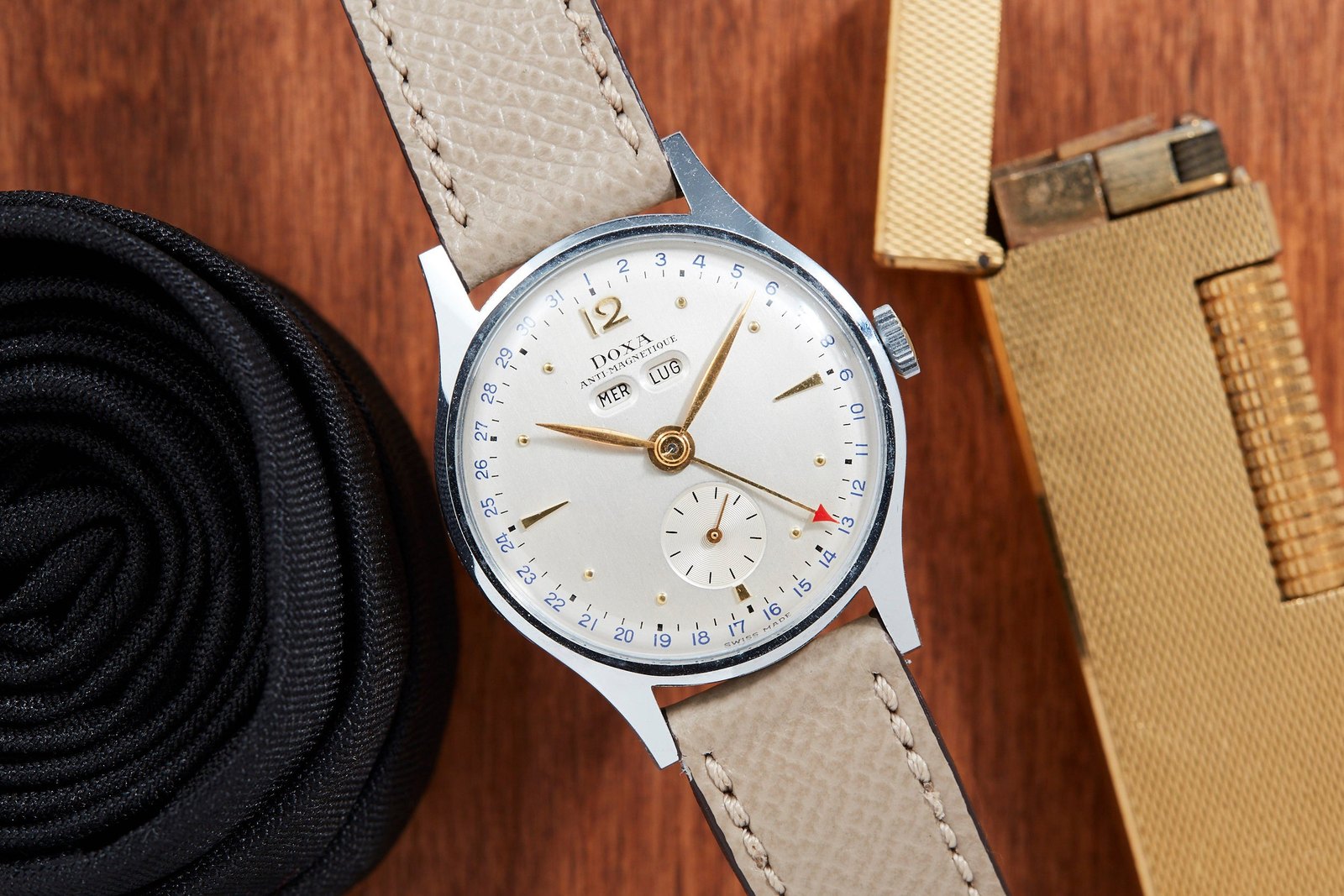
Doxa Steel Triple Calendar, early 1950
- Maker / attribution
- DOXA (maker)
- Date
- early 1950
- Historical period
- Modern Mechanical Horology (1945 – 1969)
- Country of origin
- Switzerland
- Object type
- Wristwatch
- Materials / technique
- steel
- Dimensions
- Case 28 mm
- Stock no.
- Product 140591333406
- Credit line
- Dealer listing, Analog/Shift (product 140591333406)
- Catalogue title (original)
- DOXA Steel Triple Calendar (English)
View the source record (dealer listing) ↗ (opens another website in a new tab)Suggest a correction
Record summary
Catalogued by Analog/Shift (dealer), New York (stock number Product 140591333406), this is a wristwatch by DOXA, made in Switzerland, dated early 1950. The Atlas places it in the Modern Mechanical Horology period (1945 – 1969) of its Wristwatches collection. Materials and techniques recorded by the source: steel. Recorded dimensions: Case 28 mm. The record is illustrated with 6 photographs.
Assembled from the source record's structured fields. Dates and attributions are given as the source states them; where a field is missing the Atlas leaves it blank rather than estimating.
Catalogue description
Dealer description — Analog/Shift
To watch collectors, and to anyone who’s been following us since the start, DOXA should mean one thing: dive watches. The bright-dialed, cushion-cased Sub 300T is beloved of Clive Cussler fans, divers (both professional and otherwise), and a certain individual here at Analog/Shift. Make no mistake, for the brand whose name means “glory” in Greek, the glory of DOXA has and probably always will be the Sub 300T. However, DOXA has a long-established tradition of making other watches; ones that would look out of place when paired with a wet suit. Established in 1889, DOXA kept abreast of the rapid technological advances of the late 19th and early 20th century. When other brands began introducing wrist-worn triple calendars in the mid-20th century, DOXA did as well. Like many of the brand’s time-only watches, these utilized robust movements made by ETA, but with bridges modified by DOXA itself. Throughout the 1940s and 1950s, DOXA housed these movements in a variety of cases, from chrome- or gold-plate to solid gold. They were available in a variety of sizes, from the minuscule (28mm) to the “jumbo” (38mm). Those on the smaller size, clad in precious metals, were as elegant as they were intricate. But in the 1950s DOXA made the transition to steel cases in its non-sporting watches, making a triple calendar wristwatch like this one ideal for the man about town. This particular example dates from the early 1950's — it has all the charm of a triple calendar of the period, with a svelte 35mm case in stainless steel. The beautiful dial—with its gold applied markers and hands—has an added touch of whimsy: an Italian calendar. Elegant and refined, yet sturdy enough for daily wear, it comes with a textured leather strap and DOXA hangtag—the perfect complement to a tailored blazer.
Historical context
Modern Mechanical Horology (1945 – 1969)
Tool watches for divers, pilots and astronauts; electric watches anticipate the electronic age.
The classic era of the mechanical wristwatch: dive watches, chronographs for motor racing and space flight, GMT watches for jet travel, slim dress watches, automatic calendars, and the rise of Japanese manufacturers alongside Swiss, American, German and Soviet industries.
Read the period in the timelineMore wristwatches from this periodEarlier: Golden Age of Mechanical Watchmaking
Atlas type guide
Calendar, moon-phase and perpetual calendar watches
Calendar complications range from a simple date to the perpetual calendar, which automatically allows for months of different lengths and leap years until 2100. Pocket watches with perpetual calendars were made in the eighteenth and nineteenth centuries; Patek Philippe made the first perpetual calendar wristwatch in 1925, and series production followed in 1941. The annual calendar (Patek Philippe, 1996) needs correction only once a year.
Moon-phase displays use a disc with two moons and 59 teeth advanced daily, approximating the 29.5-day lunation; more precise trains reduce the error to one day in over a century.
What to look for
- Apertures or subsidiary dials for day, date, month and leap year.
- Moon disc under a 'bosom' shaped aperture.
- Recessed correctors on the case band for setting the calendar.
Dating clues
- Triple-date wristwatches: popular c. 1940–1955.
- Perpetual calendar wristwatches: from 1925 (unique) and 1941 (series).
General guidance written by the Atlas editors about this kind of object. It is not a statement about this particular piece; for that, rely on the source record above and on physical examination.
Related records
Wristwatches · 2002
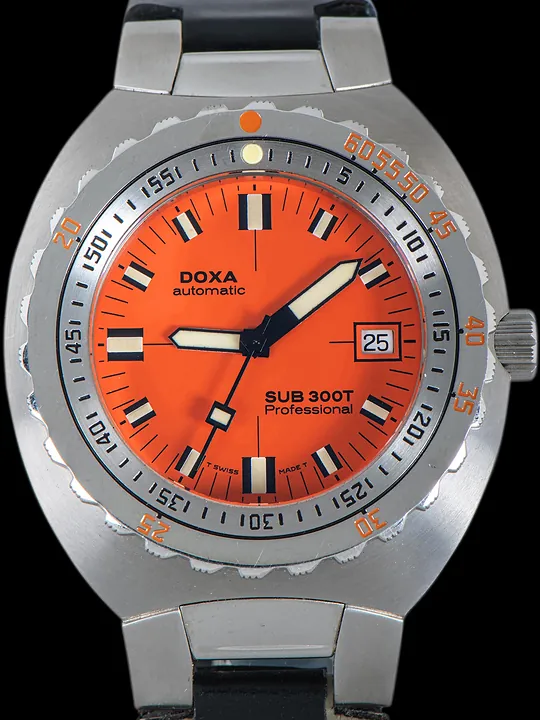
Doxa Sub 300T Professional (Ref. 30010), 2002
Craft & Tailored (dealer), Los Angeles
Wristwatches · 1970s
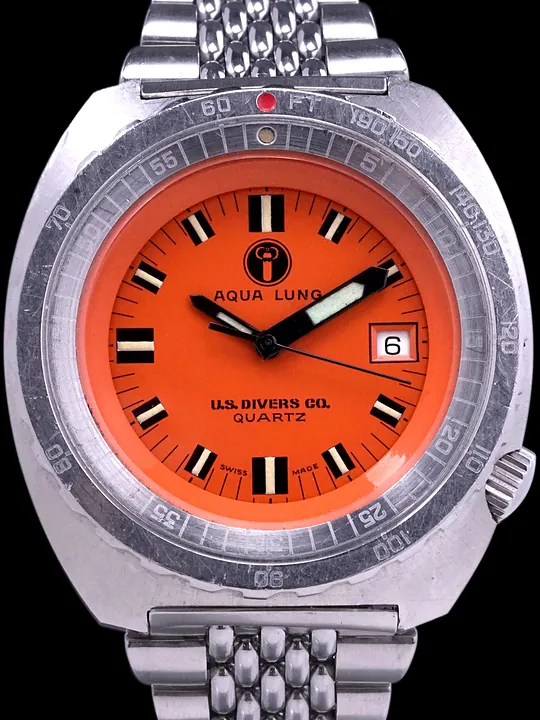
Aqua Lung Quartz Diver (Ref. 7336-000) "U.S Divers Co.", 1970s
Craft & Tailored (dealer), Los Angeles
Wristwatches · 1983
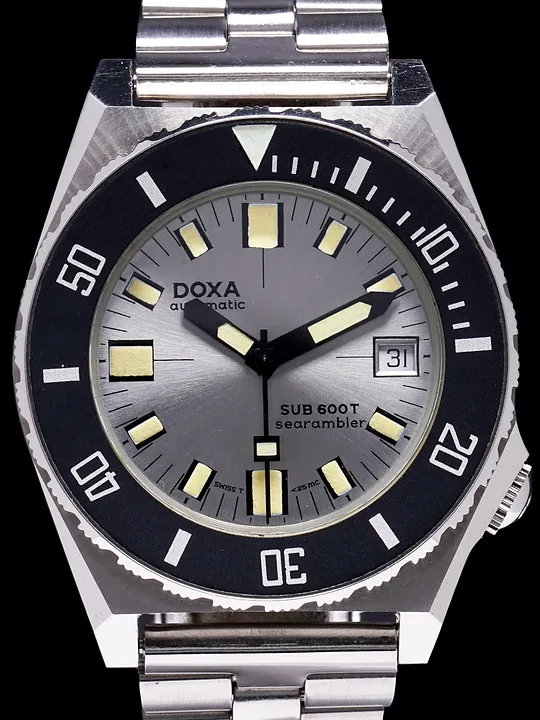
Doxa Sub 600T Searambler Silver Dial (Aubry Era), 1983
Craft & Tailored (dealer), Los Angeles
Wristwatches · 1970s
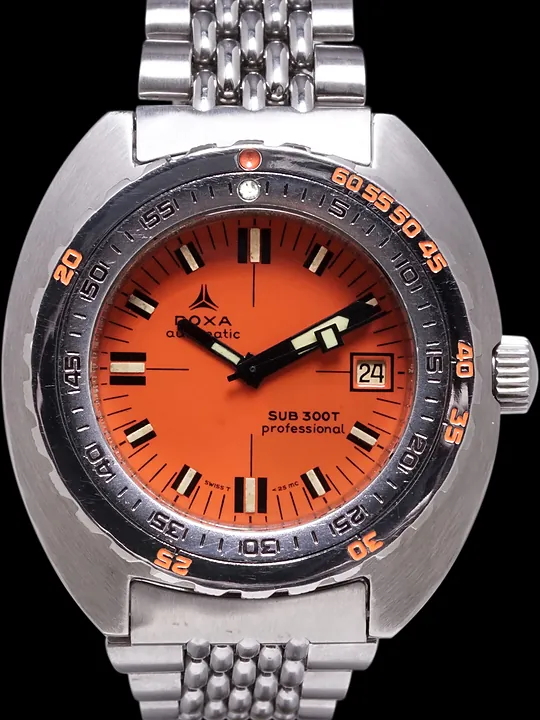
Doxa Sub 300T Professional (Synchron Era), 1970s
Craft & Tailored (dealer), Los Angeles

Wristwatches · 1945
Wristwatch by Eterna, 1945
Museum Rotterdam

Wristwatches · c. 1945
Breitling Premier, ref. 790, c. 1945
Antiquorum auction archive, Geneva

Wristwatches · c. 1945
Universal Genève Uni-Compax, ref. 22492, c. 1945
Antiquorum auction archive, Geneva

Wristwatches · c. 1950s
Baume & Mercier wristwatch, c. 1950s
Antiquorum auction archive, Geneva