
Wristwatches · Wristwatch
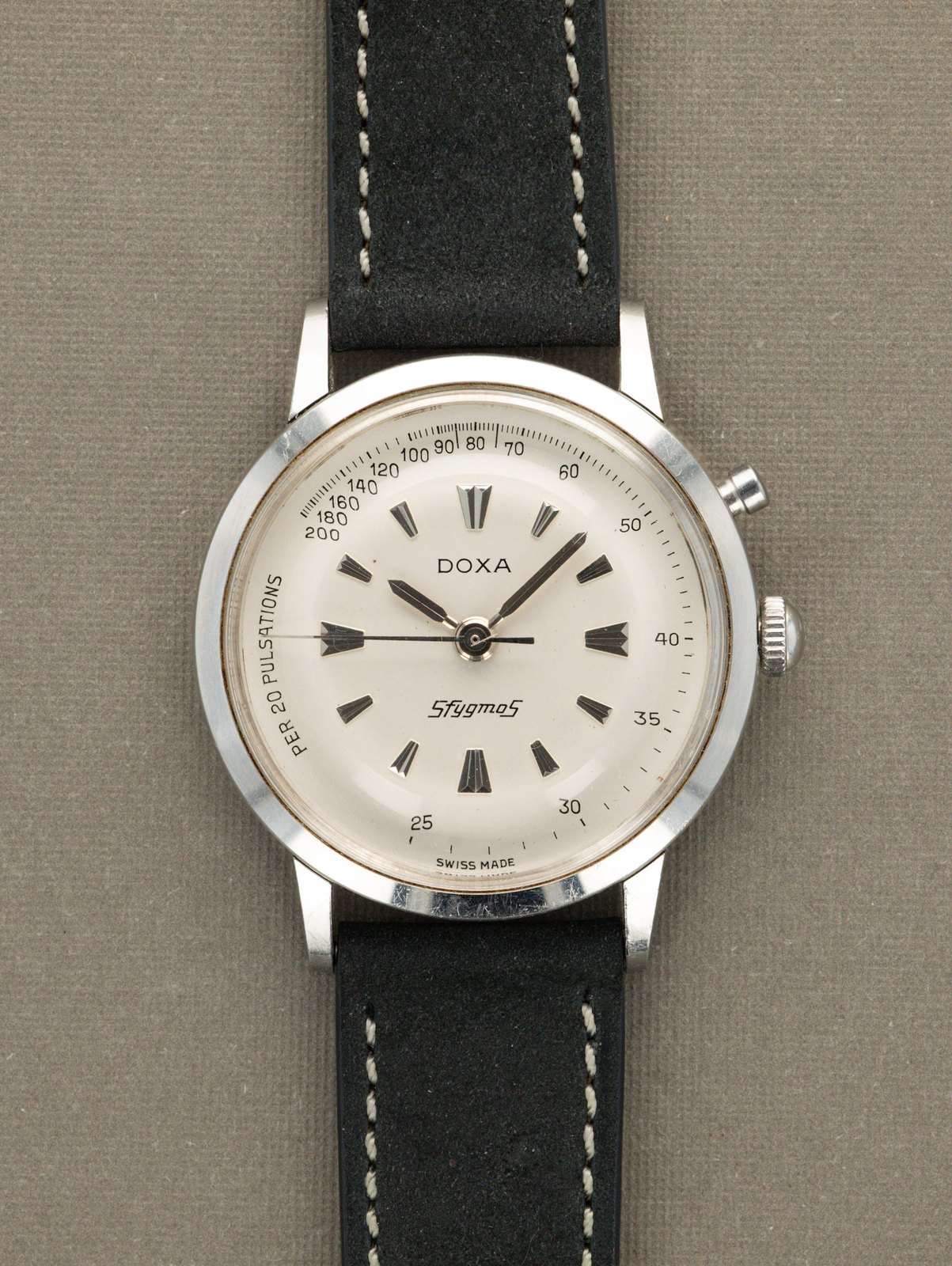
Doxa Sfygmos ref. 7003-4, Silver 'Pulsations' Dial, c. 1960
- Maker / attribution
- DOXA (maker)
- Date
- c. 1960
- Historical period
- Modern Mechanical Horology (1945 – 1969)
- Country of origin
- Switzerland
- Object type
- Wristwatch
- Materials / technique
- silver
- Dimensions
- Case 35 mm
- Stock no.
- OC3317
- Credit line
- Dealer listing, Oliver & Clarke (OC3317)
- Catalogue title (original)
- DOXA Sfygmos Ref. 7003-4 - Silver 'Pulsations' Dial Unpolished (English)
View the source record (dealer listing) ↗ (opens another website in a new tab)Suggest a correction
Record summary
Catalogued by Oliver & Clarke (dealer), United Kingdom (stock number OC3317), this is a wristwatch by DOXA, made in Switzerland, dated c. 1960. The Atlas places it in the Modern Mechanical Horology period (1945 – 1969) of its Wristwatches collection. Materials and techniques recorded by the source: silver. Recorded dimensions: Case 35 mm. The record is illustrated with 6 photographs.
Assembled from the source record's structured fields. Dates and attributions are given as the source states them; where a field is missing the Atlas leaves it blank rather than estimating.
Catalogue description
Dealer description — Oliver & Clarke
DOXA is without a doubt best known for their dive watches — the Sub 300 range in particular. And while today their entire range is dive watches or dive-watch adjacent, the full story is so much richer than that, stretching all the way back to the company's founding. Founded by Georges Ducommun 1889 in Le Locle, Switzerland, DOXA wasn't chasing depth ratings, rather expertly engineered dress watches and pocket watches. They even received a gold medal from the International Exhibition in Milan in 1906. From there, DOXA spent the better part of the 20th century all over the map, producing just about everything and anything that a large manufacturer might be during the first half of the twentieth century, including: opulent cocktail watches, precision chronographs, travel clocks, dress watches, and straightforward watches built for everyday use. The piece that we have here is is a very uncommon chronograph dating to circa 1960 that has a few interesting quirks and functions. The stainless steel case measures a very nice 35mm in diameter and features a snap caseback, a signed, 'domed' crown at 3 o'clock, and a single 'pump' pusher at the 2 o'clock position — more on that later. The dial within is a silver in color with a satin surface, applied 'faceted' indices, a matching non-luminous 'faceted' handset, and a printed 'pulsations scale on the outside. The dial itself appears to have a 'pie-pan' or 'domed' shape to it, but in reality the crystal uniquely functions as a massive cyclops, creating the effect that you see when viewing head-on. The chronograph hands natural resting and reset position in at 9 o'clock, rather than virtually every other chronograph that rests at 12 o'clock. Why? We cannot seems to find out exactly, why, but it is likely for legibility when reading the pulsations scale. Last but not least, it is powered by DOXA's gently breathed upon Valjoux Cal. 23 monopusher chronograph movement. DOXA may just be the single worst victim a brand being associated with one particular watch model... Mid-century gems like this versatile chronograph prove it.
Historical context
Modern Mechanical Horology (1945 – 1969)
Tool watches for divers, pilots and astronauts; electric watches anticipate the electronic age.
The classic era of the mechanical wristwatch: dive watches, chronographs for motor racing and space flight, GMT watches for jet travel, slim dress watches, automatic calendars, and the rise of Japanese manufacturers alongside Swiss, American, German and Soviet industries.
Read the period in the timelineMore wristwatches from this periodEarlier: Golden Age of Mechanical Watchmaking
Atlas type guide
Wristwatches
Bracelet watches were worn by women from the early nineteenth century — Breguet made one for Caroline Murat, Queen of Naples, in 1810–12 — but the wristwatch only became a man's instrument with military use and aviation in the early twentieth century. Between the World Wars it overtook the pocket watch; the 1920s and 1930s brought rectangular Art Deco cases, water-resistant cases and the first automatic winding systems.
After 1945 the wristwatch became a carrier of identity — dress watches, sports and dive watches, chronographs, calendars — produced by Swiss, American, Japanese, German, Soviet and Chinese industries. The quartz revolution after 1969 and the mechanical renaissance since the 1990s, including the rise of independent watchmakers, complete the story.
What to look for
- The reference number (between the lugs or inside the case back) and serial number, the starting point for dating.
- The calibre: its maker and number are often stamped under the dial or on the bridge.
- Originality of dial, hands and crown — refinished ('redial') dials are common.
- Case material marks: 18K/750, 14K/585, stainless steel, gold-filled, plated.
Dating clues
- Wire-lug cases: before c. 1925.
- Water-resistant screw-down cases: from 1926.
- Quartz movements: from 1969; sapphire crystals widespread after c. 1980.
General guidance written by the Atlas editors about this kind of object. It is not a statement about this particular piece; for that, rely on the source record above and on physical examination.
Related records
Wristwatches · 2002
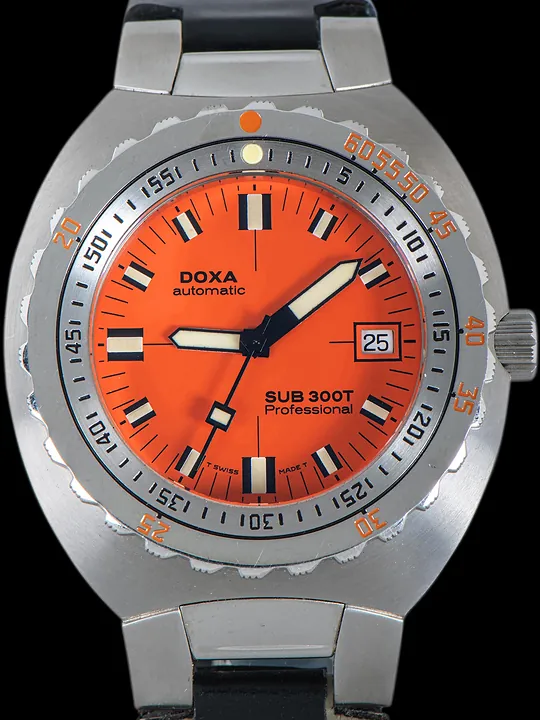
Doxa Sub 300T Professional (Ref. 30010), 2002
Craft & Tailored (dealer), Los Angeles
Wristwatches · 1970s
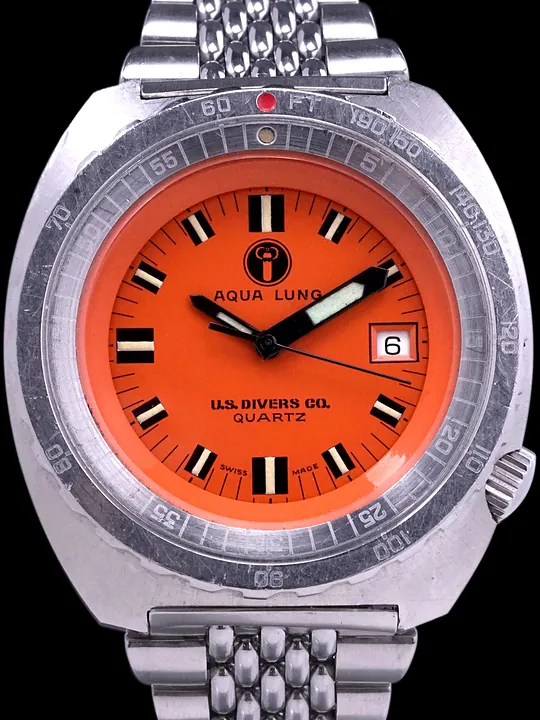
Aqua Lung Quartz Diver (Ref. 7336-000) "U.S Divers Co.", 1970s
Craft & Tailored (dealer), Los Angeles
Wristwatches · 1983
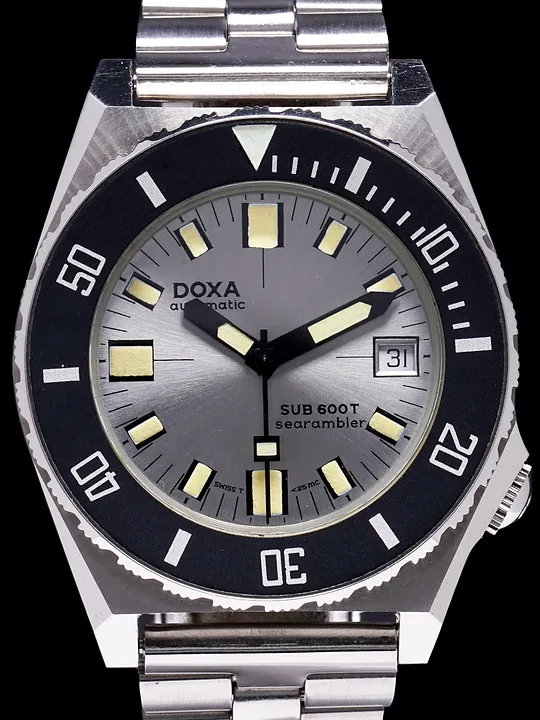
Doxa Sub 600T Searambler Silver Dial (Aubry Era), 1983
Craft & Tailored (dealer), Los Angeles
Wristwatches · 1970s
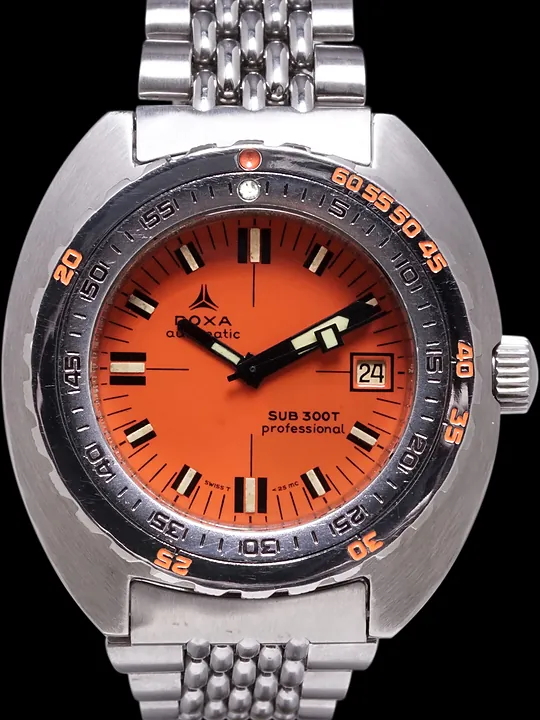
Doxa Sub 300T Professional (Synchron Era), 1970s
Craft & Tailored (dealer), Los Angeles

Wristwatches · 1945
Wristwatch by Eterna, 1945
Museum Rotterdam

Wristwatches · c. 1945
Breitling Premier, ref. 790, c. 1945
Antiquorum auction archive, Geneva

Wristwatches · c. 1945
Universal Genève Uni-Compax, ref. 22492, c. 1945
Antiquorum auction archive, Geneva

Wristwatches · c. 1950s
Baume & Mercier wristwatch, c. 1950s
Antiquorum auction archive, Geneva