
Wristwatches · Tactile wristwatch
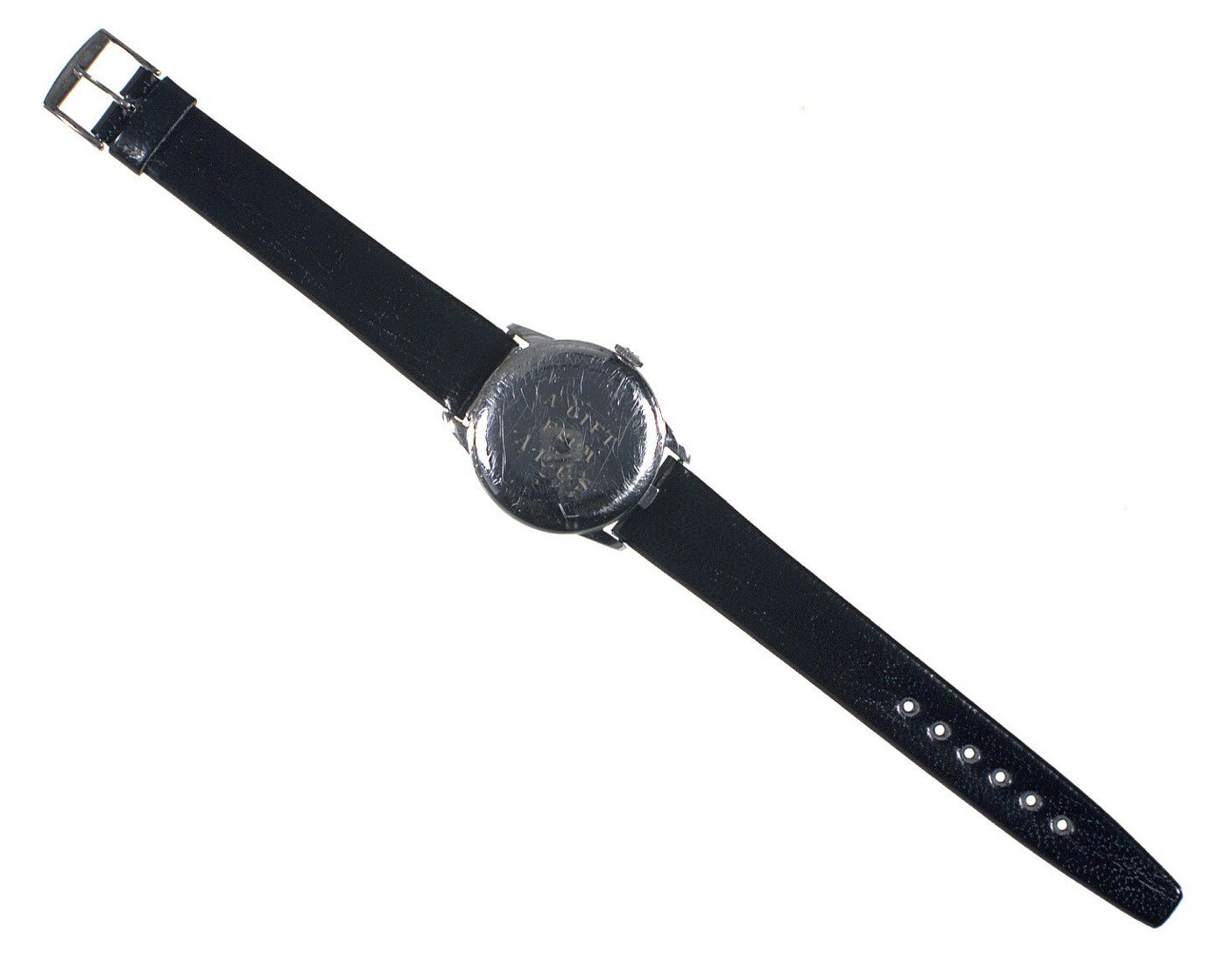
Cyma tactile wristwatch
- Maker / attribution
- Cyma (source attribution)
- Date
- c. 1950s-1960s
- Historical period
- Modern Mechanical Horology (1945 – 1969)
- Country of origin
- Switzerland
- Object type
- Tactile wristwatch
- Holding institution
- Museums Victoria
- Accession / object no.
- SH 931132
- Credit line
- Museums Victoria
- Catalogue title (original)
- Wrist Watch - Cyma, Raised Figures, Switzerland, circa 1950s-1960s (English)
View the source record ↗ (opens another website in a new tab)Suggest a correction
Record summary
Held and catalogued by Museums Victoria (object number SH 931132), this is a tactile wristwatch attributed to Cyma, made in Switzerland, dated c. 1950s-1960s. The Atlas places it in the Modern Mechanical Horology period (1945 – 1969) of its Wristwatches collection. The record is illustrated with 1 photograph.
Assembled from the source record's structured fields. Dates and attributions are given as the source states them; where a field is missing the Atlas leaves it blank rather than estimating.
Catalogue description
Original object description
Crafted in Switzerland during the 1950s or 1960s, this Cyma tactile watch is housed in polished Britannia metal with a hinged, ornamental front lid that opens to allow timekeeping by touch. The dial is white with raised hour indicators intended for visually impaired users, gold-painted central hands, and the labels 'Cyma', 'Cymaflex' (indicating the firm's proprietary shock-resistance mechanism), and 'Swiss Made'. It is fitted with a black plastic strap secured by a metal buckle, while the protective cover bears the inscribed text 'A Gift From A.R.C.S.' According to institutional documentation, the watch was used from the 1950s into the 1980s before being given to the museum in 1993 by the Royal Victorian Institute for the Blind in Melbourne, Australia.
Historical context
Modern Mechanical Horology (1945 – 1969)
Tool watches for divers, pilots and astronauts; electric watches anticipate the electronic age.
The classic era of the mechanical wristwatch: dive watches, chronographs for motor racing and space flight, GMT watches for jet travel, slim dress watches, automatic calendars, and the rise of Japanese manufacturers alongside Swiss, American, German and Soviet industries.
Read the period in the timelineMore wristwatches from this periodEarlier: Golden Age of Mechanical Watchmaking
Atlas type guide
Wristwatches
Bracelet watches were worn by women from the early nineteenth century — Breguet made one for Caroline Murat, Queen of Naples, in 1810–12 — but the wristwatch only became a man's instrument with military use and aviation in the early twentieth century. Between the World Wars it overtook the pocket watch; the 1920s and 1930s brought rectangular Art Deco cases, water-resistant cases and the first automatic winding systems.
After 1945 the wristwatch became a carrier of identity — dress watches, sports and dive watches, chronographs, calendars — produced by Swiss, American, Japanese, German, Soviet and Chinese industries. The quartz revolution after 1969 and the mechanical renaissance since the 1990s, including the rise of independent watchmakers, complete the story.
What to look for
- The reference number (between the lugs or inside the case back) and serial number, the starting point for dating.
- The calibre: its maker and number are often stamped under the dial or on the bridge.
- Originality of dial, hands and crown — refinished ('redial') dials are common.
- Case material marks: 18K/750, 14K/585, stainless steel, gold-filled, plated.
Dating clues
- Wire-lug cases: before c. 1925.
- Water-resistant screw-down cases: from 1926.
- Quartz movements: from 1969; sapphire crystals widespread after c. 1980.
General guidance written by the Atlas editors about this kind of object. It is not a statement about this particular piece; for that, rely on the source record above and on physical examination.
Related records
Pocket Watches · c. 1940
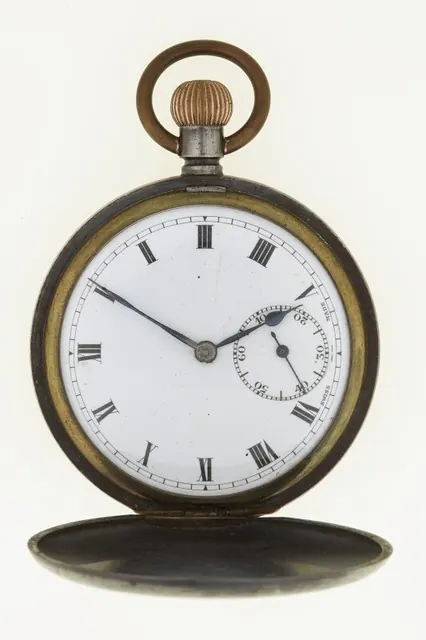
Pocket Watch - Cyma, Switzerland, c. 1940
Museums Victoria, Melbourne
Wristwatches · c. 1960s
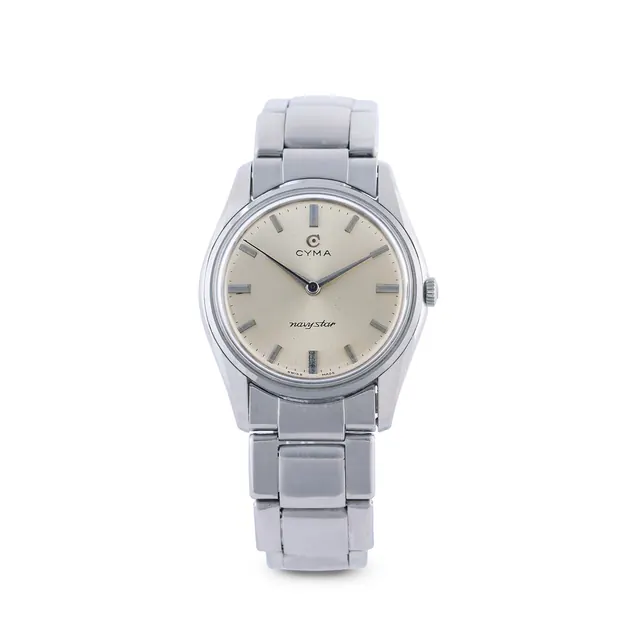
Cyma wristwatch, Navy Star, circa 1960s
Antiquorum auction archive, Geneva
Wristwatches · c. 1950
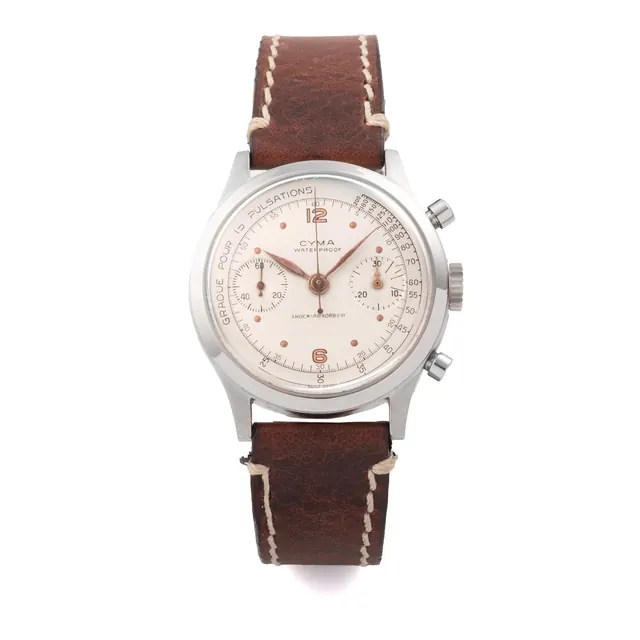
Cyma wristwatch, ref. 9803-178, Oversize Pulsation Scale, circa 1950
Antiquorum auction archive, Geneva
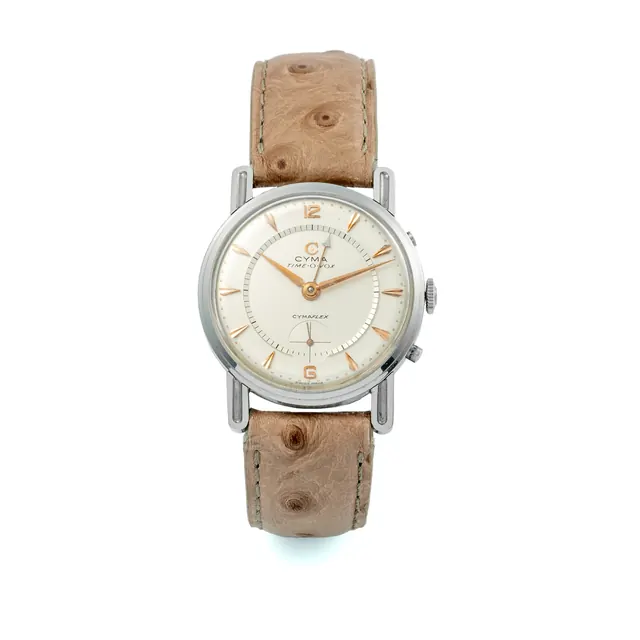
Wristwatches · c. 1950-1955
Cyma wristwatch, ref. 1261, Alarm;, circa 1950-1955
Antiquorum auction archive, Geneva

Wristwatches · 1945
Wristwatch by Eterna, 1945
Museum Rotterdam

Wristwatches · c. 1945
Breitling Premier, ref. 790, c. 1945
Antiquorum auction archive, Geneva

Wristwatches · c. 1945
Universal Genève Uni-Compax, ref. 22492, c. 1945
Antiquorum auction archive, Geneva

Wristwatches · c. 1950s
Baume & Mercier wristwatch, c. 1950s
Antiquorum auction archive, Geneva