
Wristwatches · Wristwatch
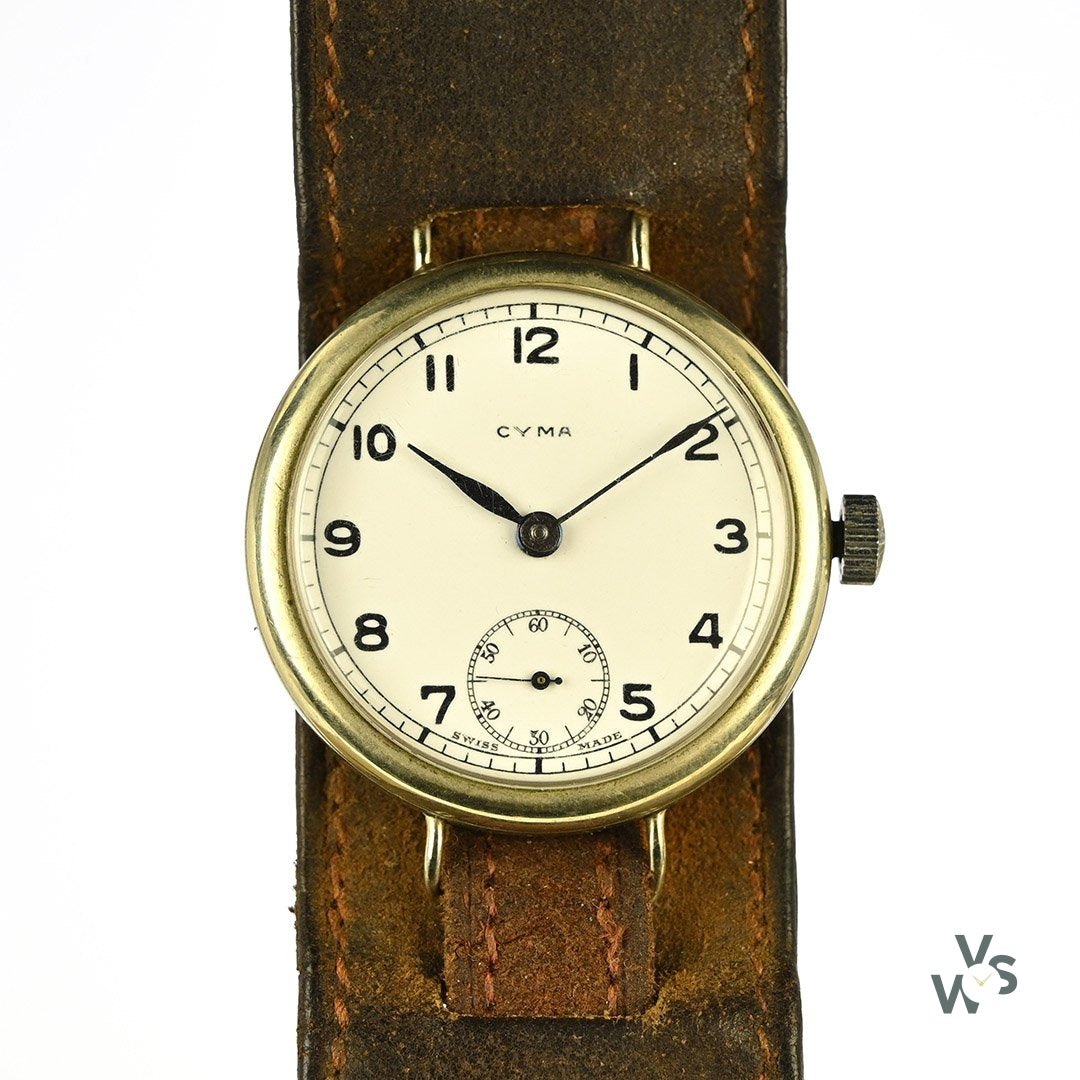
Cyma A Jumbo Sized WW1 Military Trench Watch, White Enamel Dial, Wire Lugs, circa 1916
- Maker / attribution
- Cyma (maker)
- Date
- c. 1916
- Historical period
- Golden Age of Mechanical Watchmaking (1900 – 1945)
- Country of origin
- Unrecorded in source
- Object type
- Wristwatch
- Dimensions
- Case 36 mm
- Stock no.
- vws1904cs
- Credit line
- Dealer listing, Vintage Watch Specialist (vws1904cs)
- Catalogue title (original)
- Cyma - A Jumbo Sized WW1 Military Trench Watch - White Enamel Dial - Wire Lugs - c.1916***SOLD*** (English)
View the source record (dealer listing) ↗ (opens another website in a new tab)Suggest a correction
Record summary
Catalogued by Vintage Watch Specialist (dealer), United Kingdom (stock number vws1904cs), this is a wristwatch by Cyma, dated c. 1916. The Atlas places it in the Golden Age of Mechanical Watchmaking period (1900 – 1945) of its Wristwatches collection. Recorded dimensions: Case 36 mm. The record is illustrated with 5 photographs.
Assembled from the source record's structured fields. Dates and attributions are given as the source states them; where a field is missing the Atlas leaves it blank rather than estimating.
Catalogue description
Dealer description — Vintage Watch Specialist
We Are Sorry But This Watch Is Now Sold - If However You Are Looking To Buy Or Sell Something Similar Then Please Email Sales@Vintagewatchspecialist.Com Or Whatsapp/Call +44 7831 454658. Thanks A Charming and Oversized Cyma World War 1 Trench Watch c.1916 With a Blemish-Free Glossy White Enamel Dial and Blued Steel Leaf Hands. The Trench watch (wristlet) was a type of watch that came into use by the military during World War I, as pocket watches were not practical in combat. It was a transitional design between pocket watches and wristwatches, incorporating features of both. The very first watch that somebody adapted to wear on a wrist is unknown. The first series of purpose-made men’s wristwatches were produced by Girard-Perregaux in 1880 for the German Navy. During World War I, numerous companies, including Omega, Longines, and others produced wristwatches for the military. These watches were of a virtually identical style with an enamel dial, wide white numerals, and a luminescent radium hour hand. Often they did not bear the name of the manufacturer, though the movement, originally designed in the 1890s for ladies’ pendant watches, was marked "Swiss". From pocket watches those trench watches inherited hinged front and back covers. The lugs for a strap looked like a thick wire attachment to the classical round shape of pocket watches rather than an integrated part of the body of the later modern wristwatches. The name "wristlet" was used until the early 1930s and was eventually replaced by the modern name "wristwatch". What’s On Offer A rather appealing trench watch from a watchmaker with historical ties to the military. The glossy white enamel dial with sub-second dial is blemish-free, the Arabic numerals are perfectly sharp. The elegant blued steel, leaf hands are an extravagant and stylish addition to this piece as the process for producing blued steel is rather involved- notably, the tiny second's hand is also in blued steel, a rather lovely detail. The substantial proportions (36mm) of this piece really give it a contemporary feel despite its obvious vintage. Best of both worlds! This watch could be styled with various straps to offer different looks, a real unique piece that is sure to be a talking point. This watch is running, however, it would benefit from being serviced as it has not been timed or tested due to its age, still, a stunning find which would make any military collectors day! We can arrange a service, should you wish, then please contact us before you pay for the watch! Additional information Made from Case: Stainless Steel Dial: White Enamel Crystal: Plexiglass Bracelet: Brown Leather Bund Strap Technical specifications Winding: Manual Movement Type: Mechanical (Signed Cyma 42040) Caliber: 574 Jewels: 15j Waterproof: NO Power reserve: Unknown Purchase details Condition: Excellent Model Reference: Trench Watch Date of issue: c.1916 Dimensions Width (without crown): 36mm Lug width: 12.5mm Lug height: (lug to lug) 45.5mm Wrist size: Adjustable
Historical context
Golden Age of Mechanical Watchmaking (1900 – 1945)
The wristwatch displaces the pocket watch; waterproof cases, self-winding and grand complications.
The wristwatch overtook the pocket watch. Military use in the First World War, aviation, water-resistant cases (1926), automatic winding (1923–31), rectangular Art Deco designs and early chronographs and calendars defined the period.
Read the period in the timelineMore wristwatches from this periodEarlier: Industrial Revolution
Atlas type guide
Military, pilot and travel watches
The wristwatch owes much of its adoption by men to warfare and aviation. Wristlets — small pocket watches soldered with lugs and worn on a strap — were used in colonial campaigns and became standard equipment in the First World War, with protective grilles over the crystal ('shrapnel guards'). Louis Cartier's Santos (1904), designed for the aviator Alberto Santos-Dumont, is often cited as an early purpose-made pilot's watch.
In the Second World War governments specified watches in detail: the German B-Uhr observation watches, the American A-11, and the British 'W.W.W.' (the 'Dirty Dozen' set of 1945). After the war, jet travel brought GMT and world-time watches, which show two or more time zones at once — Louis Cottier's world-time mechanism and the Rolex GMT-Master (1955) are examples.
What to look for
- Military markings on the case back: broad arrow, issue numbers, 'W.W.W.', 'A.T.P.'
- High-legibility black dials with luminous Arabic numerals; oversized crowns for gloved hands.
- 24-hour hands and rotating 24-hour bezels or city rings on GMT/world-time watches.
- Wire lugs on early wristlets converted from pocket watches.
Dating clues
- Wire-lug wristlets: c. 1900–1925.
- Military specifications of the Second World War: 1939–1945.
- GMT and world-time wristwatches: mainly after 1950.
General guidance written by the Atlas editors about this kind of object. It is not a statement about this particular piece; for that, rely on the source record above and on physical examination.
Related records
Pocket Watches · c. 1940
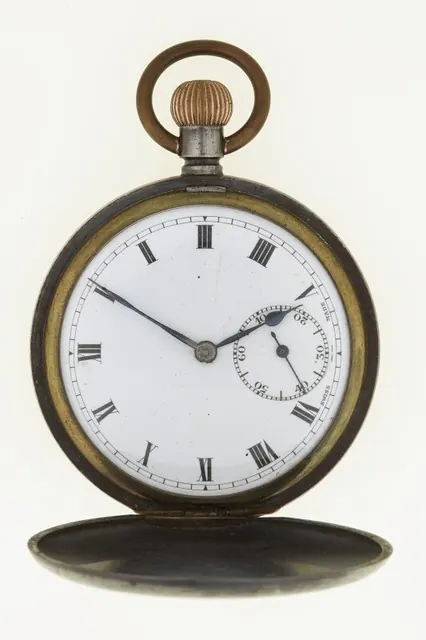
Pocket Watch - Cyma, Switzerland, c. 1940
Museums Victoria, Melbourne
Wristwatches · c. 1960s
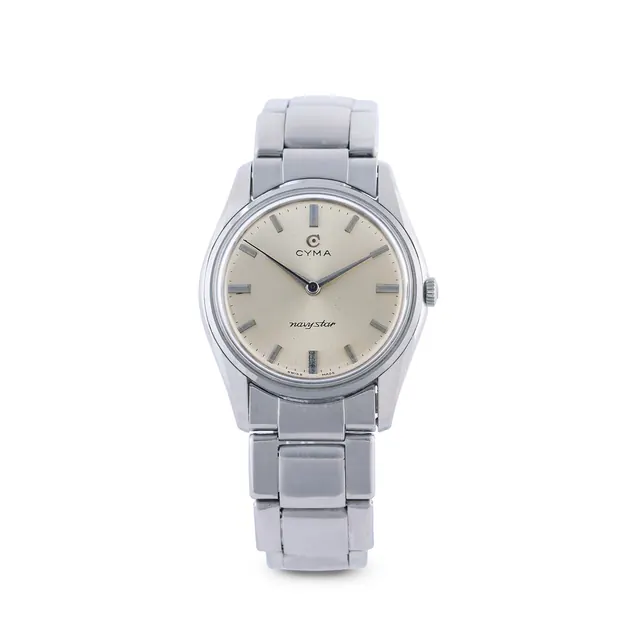
Cyma wristwatch, Navy Star, circa 1960s
Antiquorum auction archive, Geneva
Wristwatches · c. 1950
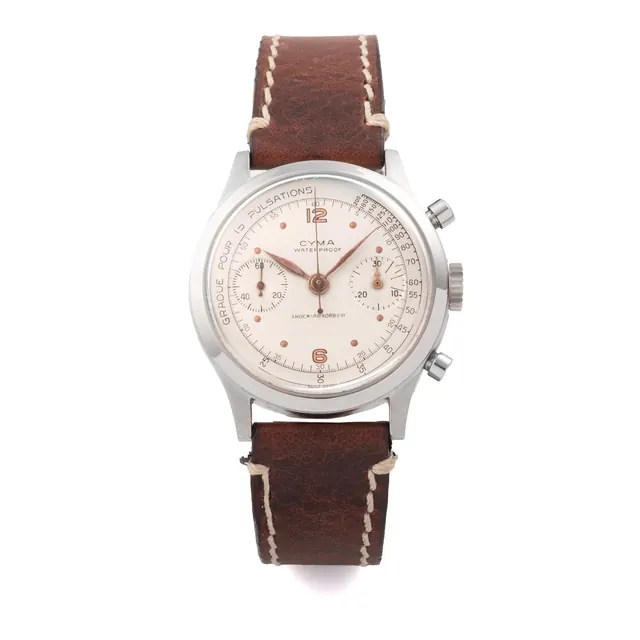
Cyma wristwatch, ref. 9803-178, Oversize Pulsation Scale, circa 1950
Antiquorum auction archive, Geneva
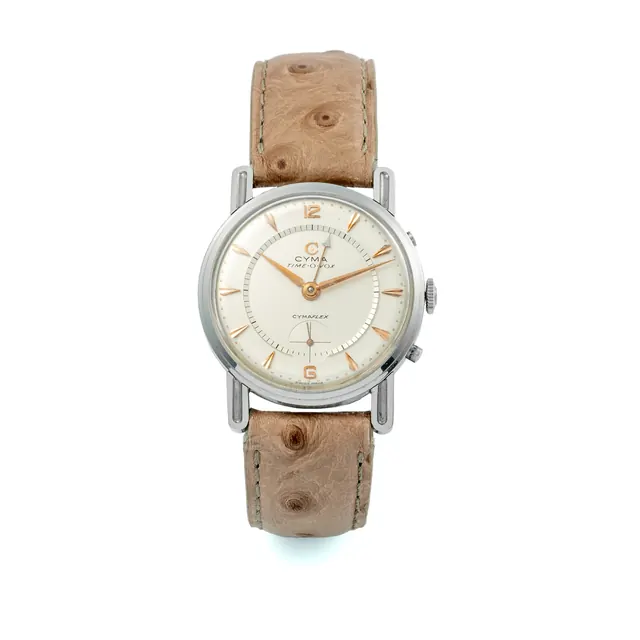
Wristwatches · c. 1950-1955
Cyma wristwatch, ref. 1261, Alarm;, circa 1950-1955
Antiquorum auction archive, Geneva
Wristwatches · 1900–1999
Wristwatch by Mercury, 1900–1999
Modemuseum Hasselt
Wristwatches · 1900–1999
Wristwatch by Nutrix, 1900–1999
Modemuseum Hasselt

Wristwatches · 1920
Wristwatch, 1920
Modemuseum Hasselt

Wristwatches · 1931
Rolex 'Oyster Perpetual' rotor self-winding wrist-watch, lever escapement, in steel case with glass in back, Montres Rolex SA, Geneva, Switzerland, 1931
Science Museum Group, London