
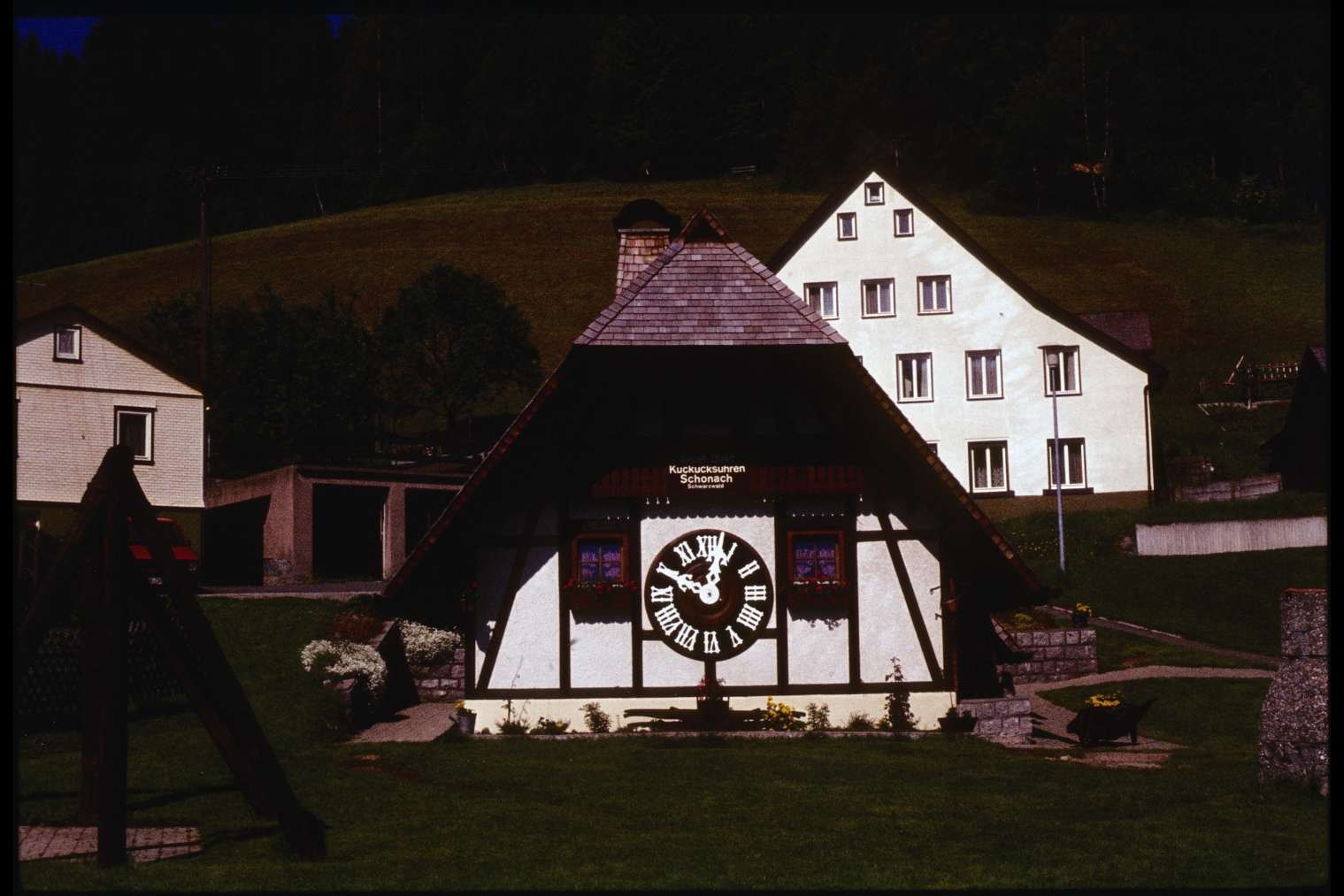
Clocks · Cuckoo clock
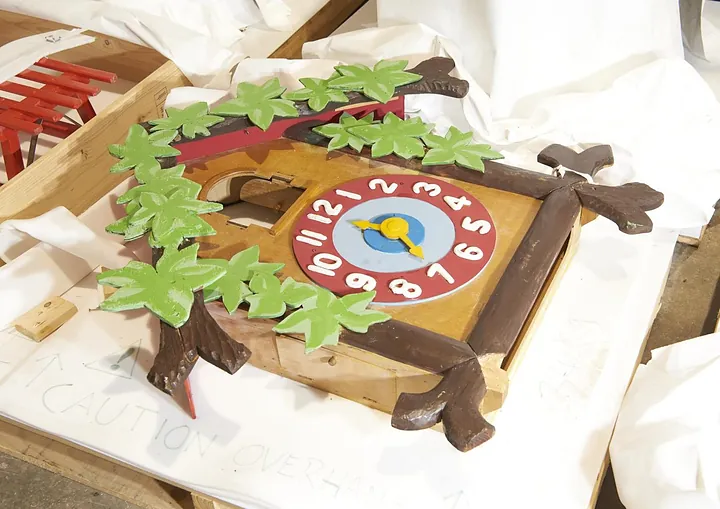
Cuckoo clock, 1980s
- Maker / attribution
- Unrecorded in source
- Date
- 1980s
- Historical period
- Quartz Revolution (1969 – 1990)
- Country of origin
- Unrecorded in source
- Object type
- Cuckoo clock
- Dimensions
- Höhe: 2.4 cm, Breite: 3.6 cm
- Holding institution
- Badisches Landesmuseum Karlsruhe
- Accession / object no.
- BA 91/6566 (Inventarnummer)
- Credit line
- Badisches Landesmuseum Karlsruhe
- Catalogue title (original)
- "Größte Kuckucksuhr" (German)
View the source record ↗ (opens another website in a new tab)Suggest a correction
Record summary
Held and catalogued by Badisches Landesmuseum Karlsruhe (object number BA 91/6566 (Inventarnummer)), this is a cuckoo clock, dated 1980s. The Atlas places it in the Quartz Revolution period (1969 – 1990) of its Clocks collection. Recorded dimensions: Höhe: 2.4 cm, Breite: 3.6 cm. The record is illustrated with 1 photograph.
Assembled from the source record's structured fields. Dates and attributions are given as the source states them; where a field is missing the Atlas leaves it blank rather than estimating.
Catalogue description
Catalogue description from Badisches Landesmuseum Karlsruhe
Schonach wirbt mit der größten Kuckucksuhr der Welt. Der Uhrmacher Dold baute die dreieinhalb Meter hohe Uhr, die man betreten kann.
Shown in the original language of the source catalogue. An editor-reviewed English translation has not yet been published; we do not publish machine translations as authoritative text.
Historical context
Quartz Revolution (1969 – 1990)
Seiko's Astron begins mass quartz timekeeping; traditional industries contract sharply.
Quartz movements and digital displays made accurate clocks cheap and ubiquitous after the early 1970s. LED and LCD clocks, clock radios and radio-controlled clocks appeared, while traditional mechanical clockmaking contracted sharply in Germany, France and Britain.
Read the period in the timelineMore clocks from this periodEarlier: Modern Mechanical Horology
Atlas type guide
Black Forest and cuckoo clocks
Clockmaking spread through the Black Forest in south-west Germany in the late seventeenth century as a winter occupation for farming families. Early clocks had wooden plates and wheels and a foliot ('Waaguhr') or short pendulum, with a painted wooden shield dial; pedlars (Uhrenträger) carried them across Europe. The cuckoo clock, which imitates the bird's call with two small bellows-driven pipes, appeared in the mid-eighteenth century.
The industry was organised around Furtwangen, Triberg, Schwenningen and Lenzkirch. The Furtwangen clockmaking school (1850) introduced the railway-house cuckoo clock design, and from the late nineteenth century factories such as Junghans, Kienzle and Hamburg-Amerikanische Uhrenfabrik produced clocks by the million. The German Clock Museum in Furtwangen preserves the region's history.
What to look for
- Wooden plates and wheels (earlier) versus brass movements (later).
- Painted shield dials (Lackschilduhr) with floral or figurative decoration.
- Cuckoo bellows and pipes, the carved 'railway house' or hunting-scene case.
- Trademarks and movement stamps of Black Forest factories.
Dating clues
- Wooden-wheeled foliot clocks: c. 1680–1750.
- Painted shield clocks: c. 1780–1880.
- Railway-house cuckoo clocks: after 1850; carved hunting-style cases after c. 1860.
General guidance written by the Atlas editors about this kind of object. It is not a statement about this particular piece; for that, rely on the source record above and on physical examination.
Read next:FoliotAnchor (recoil) escapement
Related records
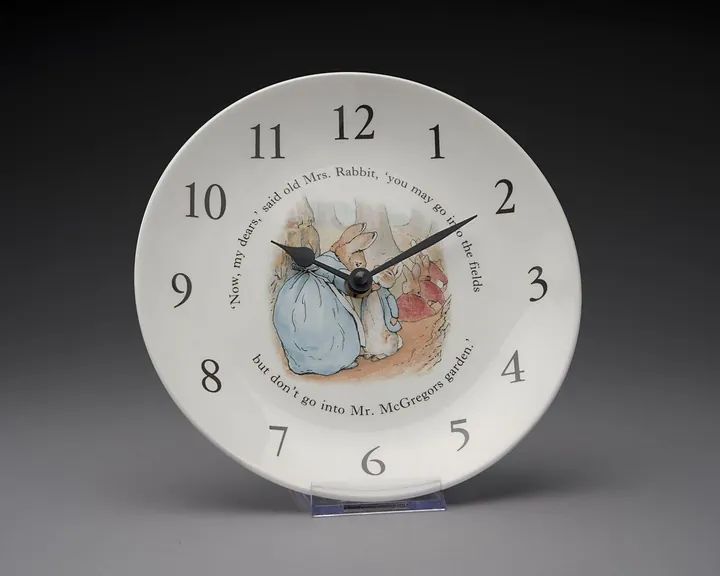
Clocks · late 20th century
Clock, 'Peter Rabbit', Queen's ware, transfer printing, Josiah Wedgwood and Sons, Barlaston, late 20th century (V&A WE.17466-2014)
Victoria and Albert Museum, London
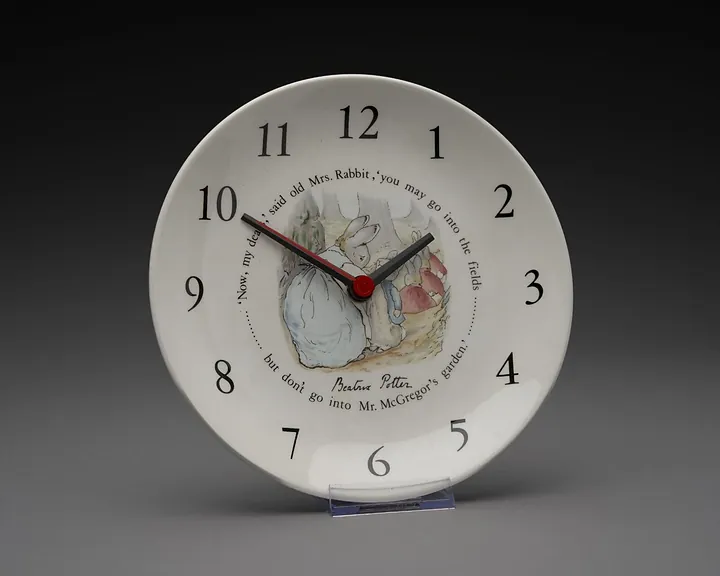
Clocks · late 20th century
Clock, 'Peter Rabbit', Queen's ware, transfer printing, Josiah Wedgwood and Sons, Barlaston, late 20th century (V&A WE.18029-2014)
Victoria and Albert Museum, London
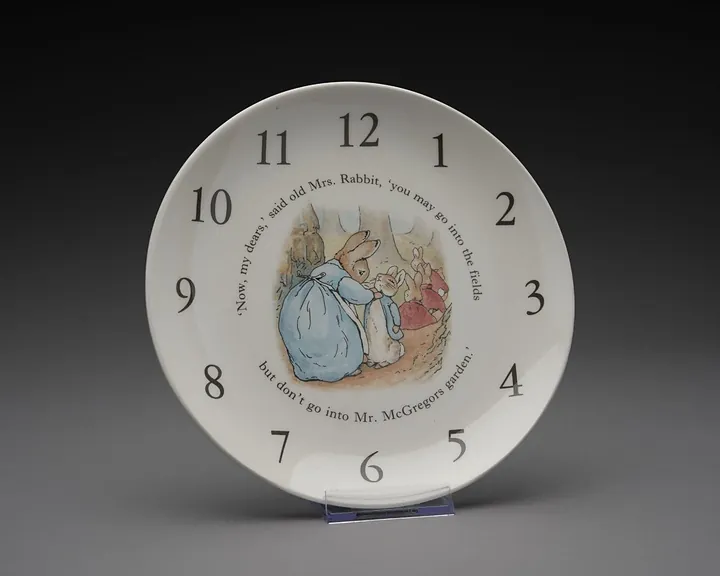
Clocks · late 20th century
Clock, 'Peter Rabbit', glazed earthenware, transfer printing, Josiah Wedgwood and Sons, Barlaston, late 20th century
Victoria and Albert Museum, London
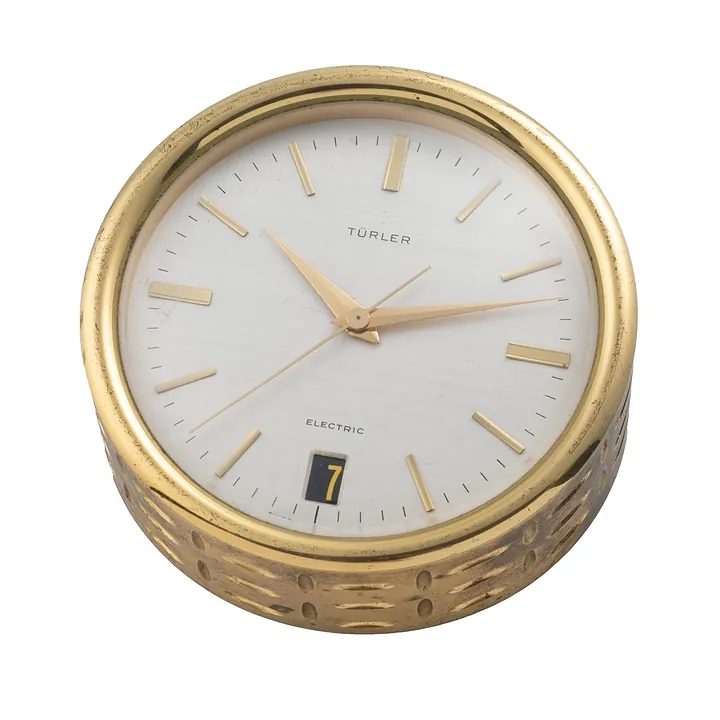
Clocks · c. 1960-1970s
Anonymous clock, c. 1960-1970s
Antiquorum auction archive, Geneva
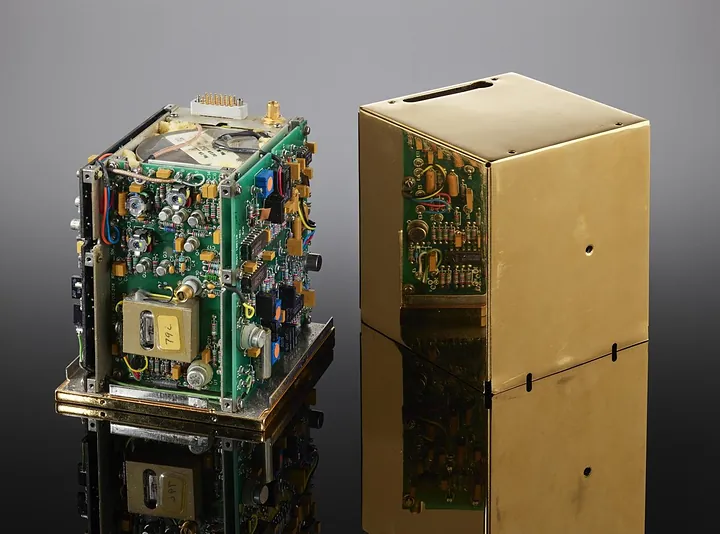
Clocks · 1960–1996
Electric clock by Efratom GmbH, Germany, 1960–1996
Science Museum Group, London
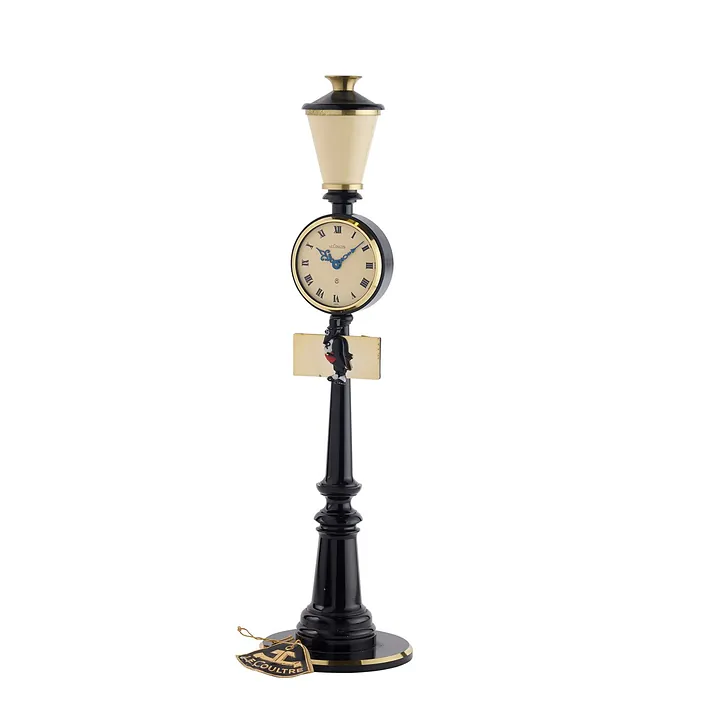
Clocks · c. 1960-1970s
Lecoultre Street Light Lamp, ref. 397, c. 1960-1970s
Antiquorum auction archive, Geneva
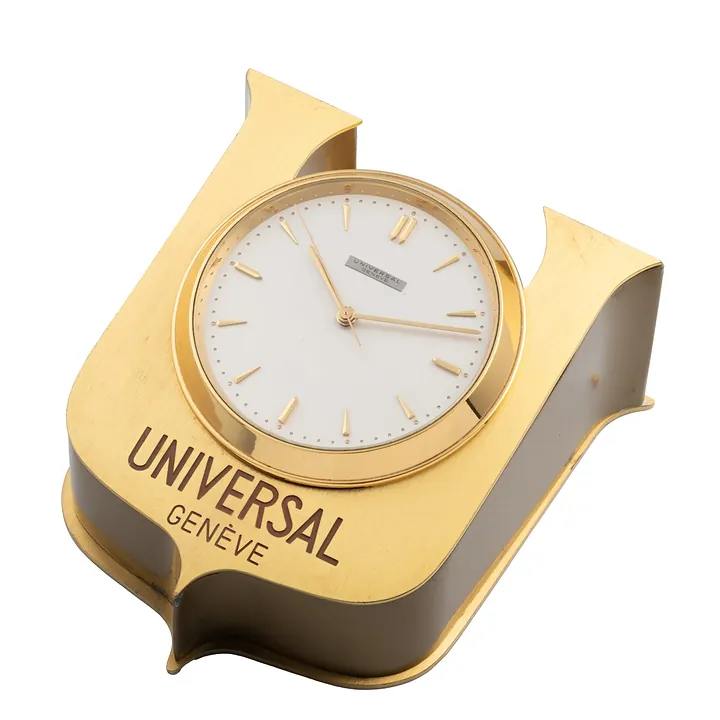
Clocks · c. 1960-1970s
Universal Genève clock, ref. 999.116.01, c. 1960-1970s
Antiquorum auction archive, Geneva
Clocks · 1964–1988
The clock from BBC children's television series 'Playschool', c 1977
Science Museum Group, London