
Wristwatches · Wristwatch
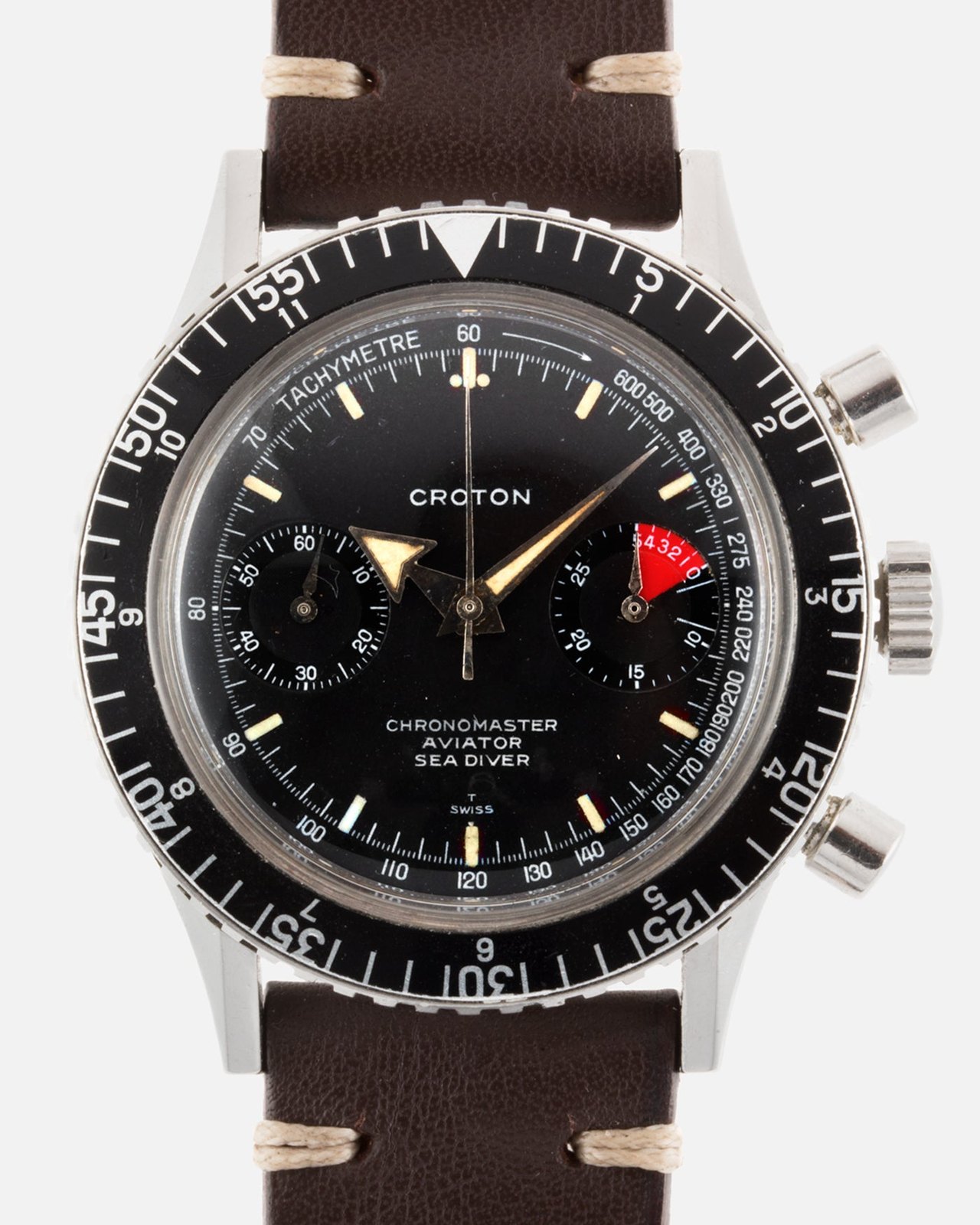
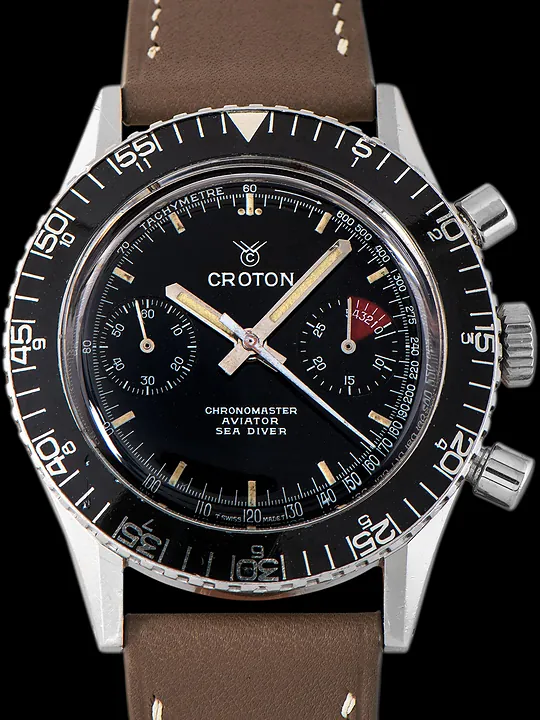
Croton Chronomaster Aviator Sea Diver, 1960s
- Maker / attribution
- Croton (maker)
- Date
- 1960s
- Historical period
- Modern Mechanical Horology (1945 – 1969)
- Country of origin
- Unrecorded in source
- Object type
- Wristwatch
- Dimensions
- Case 38 mm
- Stock no.
- Product 1385860300887
- Credit line
- Dealer listing, S.Song Watches (product 1385860300887)
- Catalogue title (original)
- Croton Chronomaster Aviator Sea Diver (English)
View the source record (dealer listing) ↗ (opens another website in a new tab)Suggest a correction
Record summary
Catalogued by S.Song Watches (dealer), Seattle (stock number Product 1385860300887), this is a wristwatch by Croton, dated 1960s. The Atlas places it in the Modern Mechanical Horology period (1945 – 1969) of its Wristwatches collection. Recorded dimensions: Case 38 mm. The record is illustrated with 6 photographs.
Assembled from the source record's structured fields. Dates and attributions are given as the source states them; where a field is missing the Atlas leaves it blank rather than estimating.
Catalogue description
Dealer description — S.Song Watches
This is perhaps one of the most epic watch model names to have come out of the 20th century- the Croton Chronomaster Aviator Sea Diver. Quite the mouthful, but talk about tapping into as many demographics as you can! The Chronomaster came about during a time where adventures and exploration was a hot topic and many watch manufacturers took advantage of this, releasing multiple sports watches. With this example, it is all about the aesthetics- a first execution model that features a classically 60s sports chronograph styling. It has a large 38mm stainless steel case with bevelled lugs, an aluminium minute/hour bi-directional bezel and of course, large broad arrow hands. This is exactly what the current market loves and it is no wonder the Chronomaster is a perennial favourite. The Chronomaster came in several variants. Some were branded under the Nivada Grenchen name which was powered by the Valjoux 92, but the Chronomasters that went to the US were branded Croton and this variant is by far the highest quality. While the others used lower grade movements, the American bound watches were powered by the industry-leading column wheel Valjoux 23. This example is particular is in particular collectable as it is in exceptional condition. With its deep black bezel in an almost unused condition, the unpolished stainless steel case along with a perfect dial, this is what the term ‘collectors grade’ means. While Chronomasters are fairly common, it is much harder to find the higher quality Croton variant. Furthermore, to find one in this condition? Not so easy.
Historical context
Modern Mechanical Horology (1945 – 1969)
Tool watches for divers, pilots and astronauts; electric watches anticipate the electronic age.
The classic era of the mechanical wristwatch: dive watches, chronographs for motor racing and space flight, GMT watches for jet travel, slim dress watches, automatic calendars, and the rise of Japanese manufacturers alongside Swiss, American, German and Soviet industries.
Read the period in the timelineMore wristwatches from this periodEarlier: Golden Age of Mechanical Watchmaking
Atlas type guide
Dive and water-resistant watches
Keeping water and dust out of a wristwatch was a long-standing challenge. Rolex's screw-down Oyster case (1926) and Omega's Marine (1932) were landmarks; in the early 1950s Blancpain's Fifty Fathoms and Rolex's Submariner defined the professional dive watch with rotating bezels for timing dives, luminous dials and high water resistance. The ISO 6425 standard (1982) later codified what a 'diver's watch' must do.
Dive watches became icons of post-war design and exploration, and their evolution — helium escape valves, ceramic bezels, saturation-diving depth ratings — records the history of underwater work.
What to look for
- Unidirectional or bidirectional rotating bezel with minute markings.
- Screw-down crown and case back; depth rating printed on the dial.
- Luminous hands and markers (radium before c. 1960, tritium c. 1960–1998, then Super-LumiNova).
- Reference numbers on the case between the lugs or inside the back.
Dating clues
- Screw-down Oyster cases: from 1926.
- Professional dive watches: from 1953.
- Tritium 'T' marks on dials: c. 1960–1998.
General guidance written by the Atlas editors about this kind of object. It is not a statement about this particular piece; for that, rely on the source record above and on physical examination.
Related records
Wristwatches · 1970s
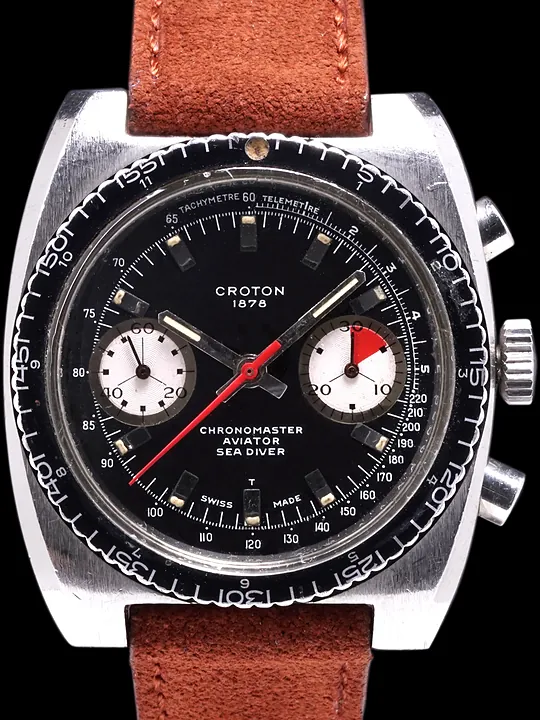
Croton 106 Chronomaster (Ref. 903011) "Paul Newman", 1970s
Craft & Tailored (dealer), Los Angeles
Wristwatches · 1970s
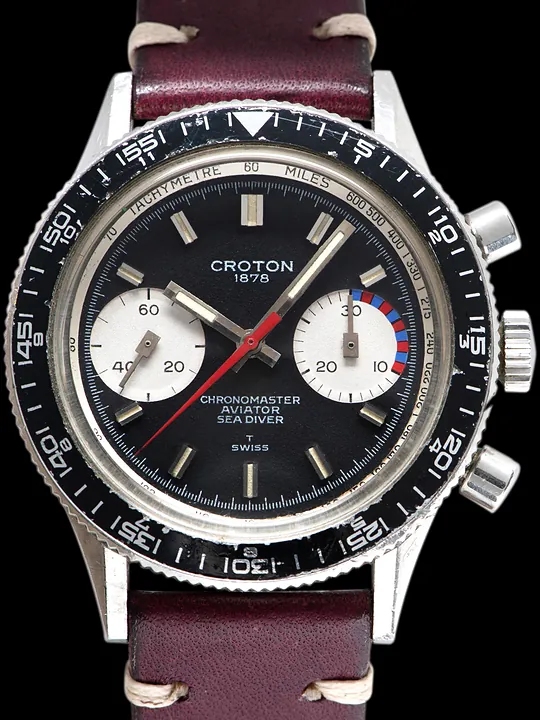
Croton Chronomaster Aviator Sea Diver (Ref. 106) "Yachting" Valjoux Cal. 7733, 1970s
Craft & Tailored (dealer), Los Angeles
Wristwatches · 1960s
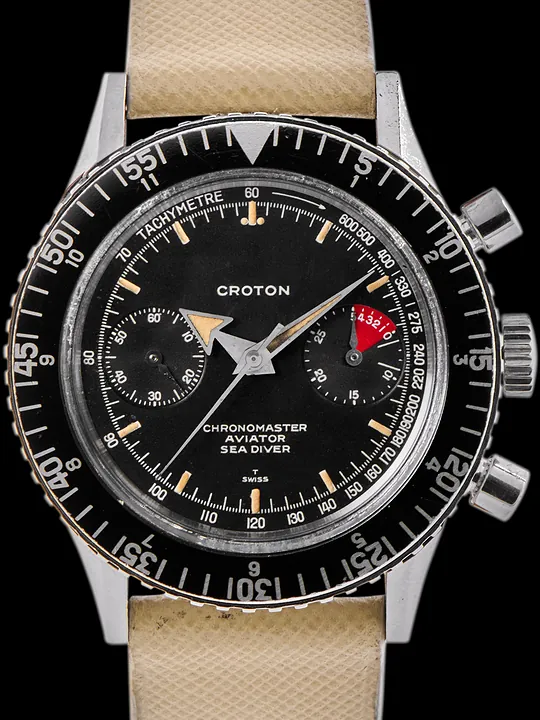
Croton Chronomaster Aviator Sea Diver (Ref. 105/9865) 'Valjoux Cal. 92', 1960s
Craft & Tailored (dealer), Los Angeles
Wristwatches · 1970s
Croton Aviator Sea Diver Chronograph (Ref. 105/903006), 1970s
Craft & Tailored (dealer), Los Angeles

Wristwatches · 1945
Wristwatch by Eterna, 1945
Museum Rotterdam

Wristwatches · c. 1945
Breitling Premier, ref. 790, c. 1945
Antiquorum auction archive, Geneva

Wristwatches · c. 1945
Universal Genève Uni-Compax, ref. 22492, c. 1945
Antiquorum auction archive, Geneva
Wristwatches · c. 1950s
Ami Watch Chronographe, c. 1950s
Antiquorum auction archive, Geneva