
Wristwatches · Wristwatch
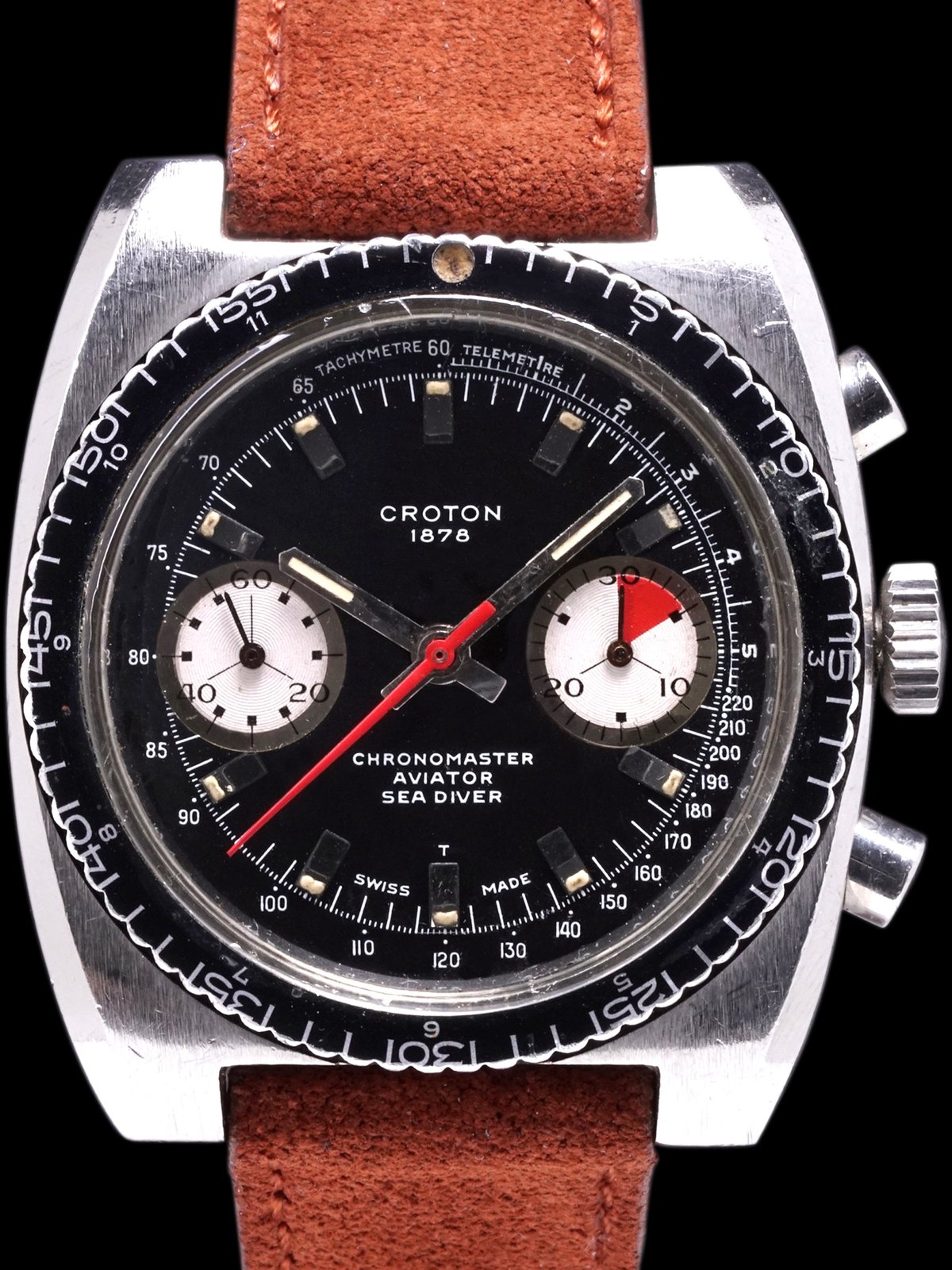
Croton 106 Chronomaster (Ref. 903011) "Paul Newman", 1970s
- Maker / attribution
- Croton (maker)
- Date
- 1970s
- Historical period
- Quartz Revolution (1969 – 1990)
- Country of origin
- Unrecorded in source
- Object type
- Wristwatch
- Dimensions
- Case 38 mm
- Stock no.
- CTN106903011
- Credit line
- Dealer listing, Craft & Tailored (CTN106903011)
- Catalogue title (original)
- 1970s Croton 106 Chronomaster (Ref. 903011) "Paul Newman" (English)
View the source record (dealer listing) ↗ (opens another website in a new tab)Suggest a correction
Record summary
Catalogued by Craft & Tailored (dealer), Los Angeles (stock number CTN106903011), this is a wristwatch by Croton, dated 1970s. The Atlas places it in the Quartz Revolution period (1969 – 1990) of its Wristwatches collection. Recorded dimensions: Case 38 mm. The record is illustrated with 6 photographs.
Assembled from the source record's structured fields. Dates and attributions are given as the source states them; where a field is missing the Atlas leaves it blank rather than estimating.
Catalogue description
Dealer description — Craft & Tailored
Croton began its roots in New York circa 1878 but was formally introduced as Croton Watch Co. in 1928 when the company began assembling watches under their own name. Nivada Grenchen was founded in1920s Grenchen, Switzerland, and was actually one of the first watch brands to manufacture automatic watches. Nivada encompassed other modern wristwatch innovations as well, creating waterproof and “rustless” watches that would stand up to the rigors of the outdoor adventures they were creating a watch for. In the 1930s Croton and Nivada Grenchen would form a strong partnership which allowed Nivada’s watches to be imported into the US without restrictions as long as they were sold under the Croton name, allowing Nivada Grenchen to grown they’re market tremendously, and for Croton to use the Nivada platform to continue assembling watches under their name. This Croton 106 Chronograph ref. 903011 features a beautiful and intricate dial designed by Singer and most notably features the same sub-dial printing as the famous "Paul Newman" Rolex Daytona dial which was also made by Singer. These incredibly rare examples have excellent art-deco styling and they're large case design for the era makes them an easy to wear option by today's standards. Powered by the Landeron cal. 248 chronograph movement, this Croton 106 Chronomaster is a durable choice for daily wear. SPECS Stock # CTN106903011 Brand Croton Style 106 Chronomaster Model 903011 Serial 59XXX Size Men's Material SS Dial Matte Black "Paul Newman" Millimeters 38mm Bracelet 2pc Handmade Leather Strap CASE & BRACELET The semi-square tonneau case design is a handsome and interesting design, and appears to remain unpolished featuring sharp lines and retains its factory dimensions and case finishing with light, honest signs of use. The black bezel sits flush with the top of the case and is in excellent condition, remaining deep black in coloration with light signs of use around the outer edges and retains its tritium pearl at the 12 o’clock position which shows some degradation. The case retains its original unsigned crown and pump-pushers. The case back factory engravings have slightly faded through wear but all still remain visible to the naked eye. The watch will come supplied on a 2pc handmade leather strap. DIAL & HANDS The stunning matte black, 2-register chronograph dial features a tachymetre and telemetre timing scale. The dial itself remarkable condition showing so signs of aging or blemishes. The "Paul Newman" style sub-dials remain bright white and feature metallic outer tracks that remain clean. The tritium topped markers have taken on a lovely golden patina and exhibit no degradation when inspected under U.V. light. All of the hands remain original to the watch and the tritium hour and minute hands match the dial patina perfectly, showing no degradation under U.V. light inspection. ACCESSORIES None. The watch is keeping time and functioning perfectly, previous service history is unknown.
Historical context
Quartz Revolution (1969 – 1990)
Seiko's Astron begins mass quartz timekeeping; traditional industries contract sharply.
Quartz and digital watches transformed the market after 1969. Swiss employment collapsed, Japanese and Hong Kong production soared, and the Swatch (1983) helped the Swiss industry recover; mechanical watches survived as luxury goods.
Read the period in the timelineMore wristwatches from this periodEarlier: Modern Mechanical Horology
Atlas type guide
Wristwatches
Bracelet watches were worn by women from the early nineteenth century — Breguet made one for Caroline Murat, Queen of Naples, in 1810–12 — but the wristwatch only became a man's instrument with military use and aviation in the early twentieth century. Between the World Wars it overtook the pocket watch; the 1920s and 1930s brought rectangular Art Deco cases, water-resistant cases and the first automatic winding systems.
After 1945 the wristwatch became a carrier of identity — dress watches, sports and dive watches, chronographs, calendars — produced by Swiss, American, Japanese, German, Soviet and Chinese industries. The quartz revolution after 1969 and the mechanical renaissance since the 1990s, including the rise of independent watchmakers, complete the story.
What to look for
- The reference number (between the lugs or inside the case back) and serial number, the starting point for dating.
- The calibre: its maker and number are often stamped under the dial or on the bridge.
- Originality of dial, hands and crown — refinished ('redial') dials are common.
- Case material marks: 18K/750, 14K/585, stainless steel, gold-filled, plated.
Dating clues
- Wire-lug cases: before c. 1925.
- Water-resistant screw-down cases: from 1926.
- Quartz movements: from 1969; sapphire crystals widespread after c. 1980.
General guidance written by the Atlas editors about this kind of object. It is not a statement about this particular piece; for that, rely on the source record above and on physical examination.
Related records
Wristwatches · 1970s
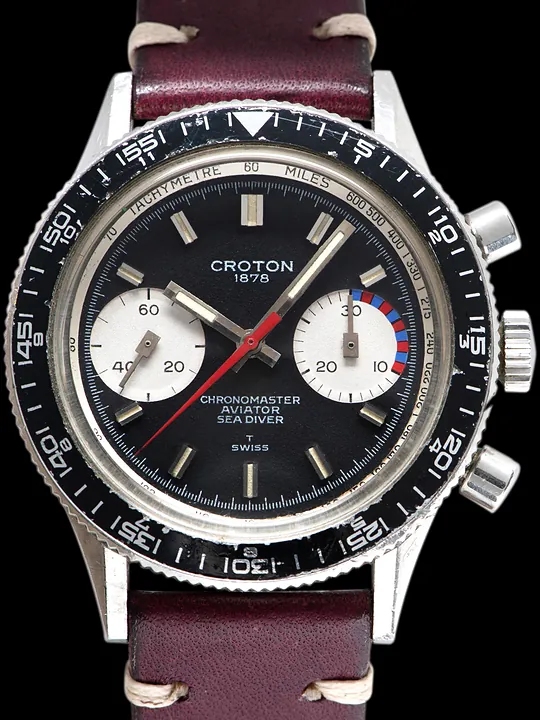
Croton Chronomaster Aviator Sea Diver (Ref. 106) "Yachting" Valjoux Cal. 7733, 1970s
Craft & Tailored (dealer), Los Angeles
Wristwatches · 1960s
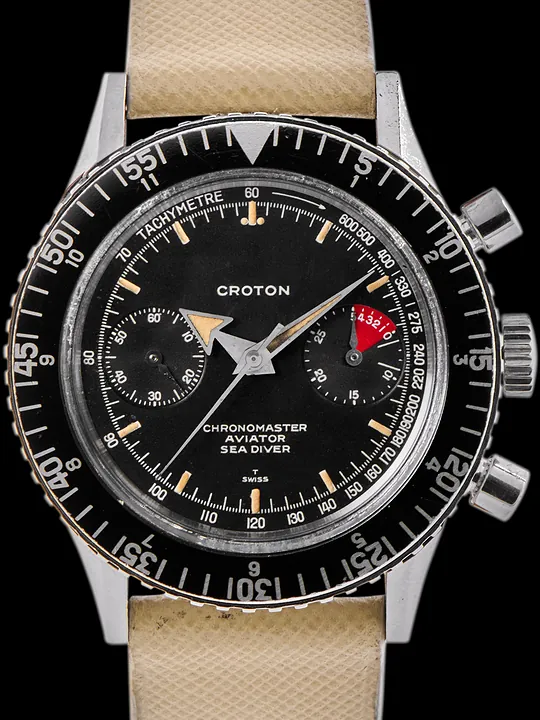
Croton Chronomaster Aviator Sea Diver (Ref. 105/9865) 'Valjoux Cal. 92', 1960s
Craft & Tailored (dealer), Los Angeles
Wristwatches · 1970s
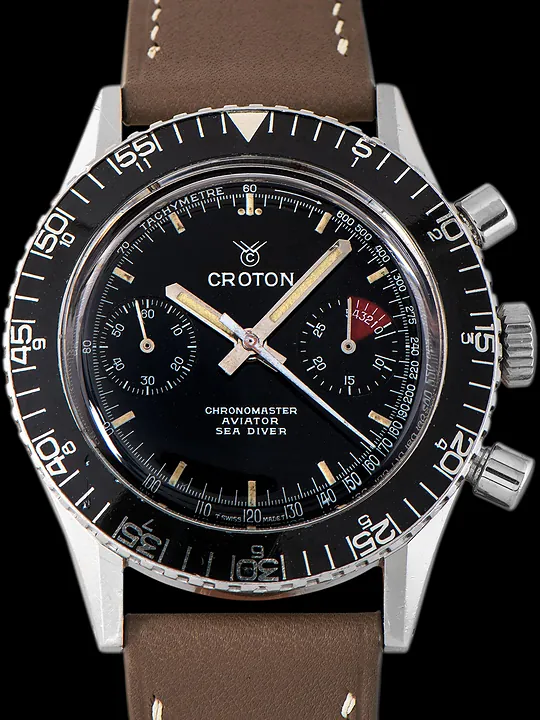
Croton Aviator Sea Diver Chronograph (Ref. 105/903006), 1970s
Craft & Tailored (dealer), Los Angeles
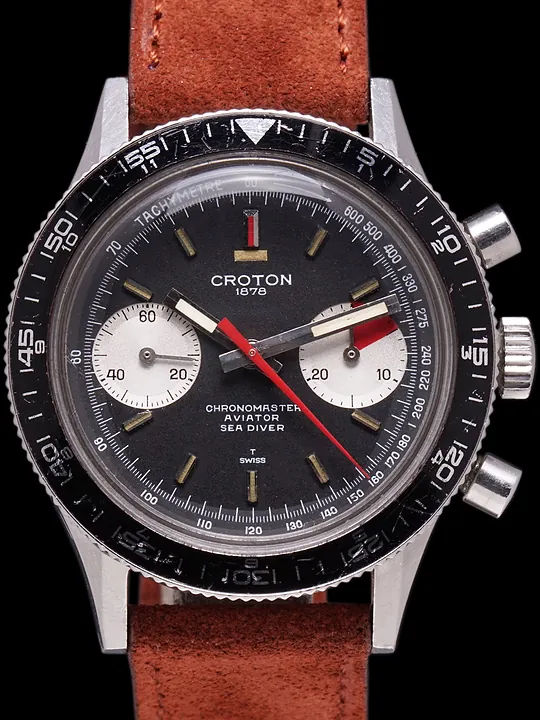
Wristwatches · 1970s
Croton Aviator Sea Diver Chronograph (Ref. 9870), 1970s
Craft & Tailored (dealer), Los Angeles

Wristwatches · 1970
Wristwatch by Heno, Switzerland, 1970
Museum Rotterdam
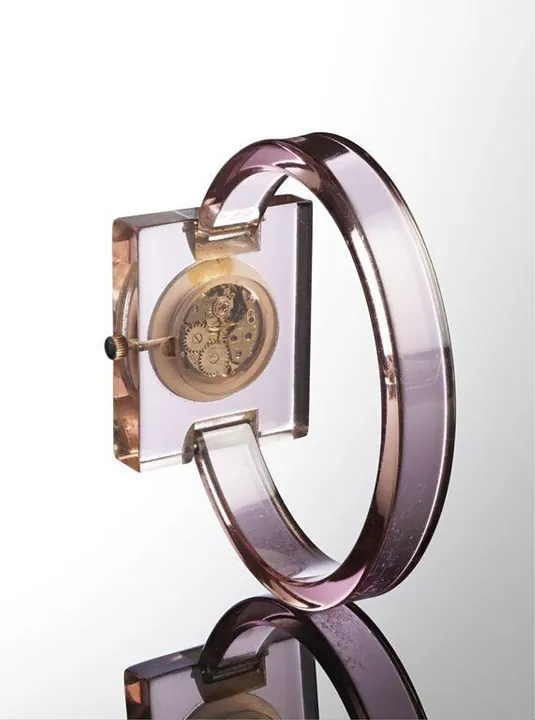
Wristwatches · 1970s
Wristwatch, plastic, by Gucci; Italy, 1970s.
Victoria and Albert Museum, London
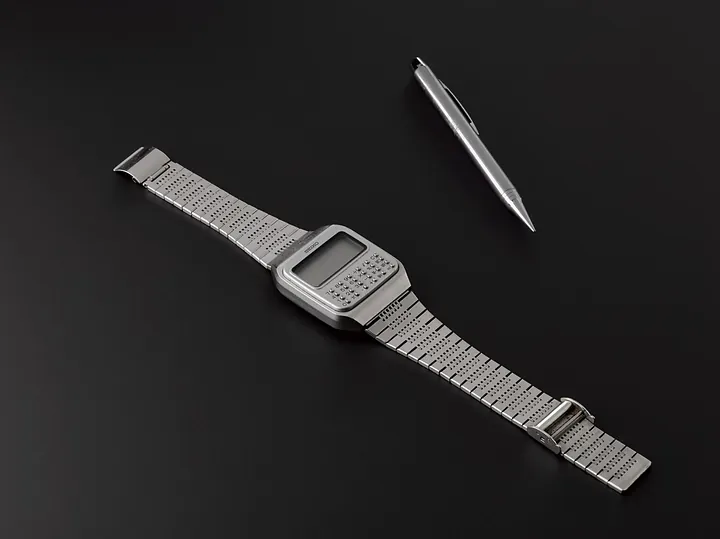
Wristwatches · 1978
Calculator wristwatch by Suwa Seikosha Co. Limited, Japan, 1978
Science Museum Group, London
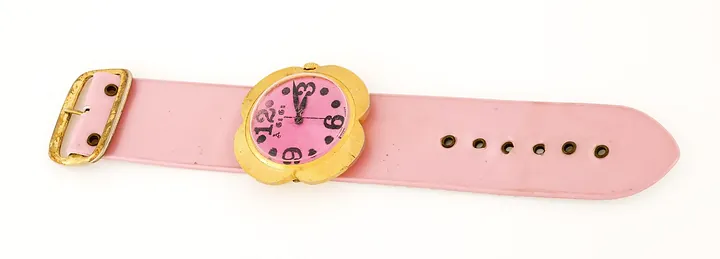
Wristwatches · 1980
Wristwatch, 1980 (no. 71413)
Museum Rotterdam