Clocks · Clock
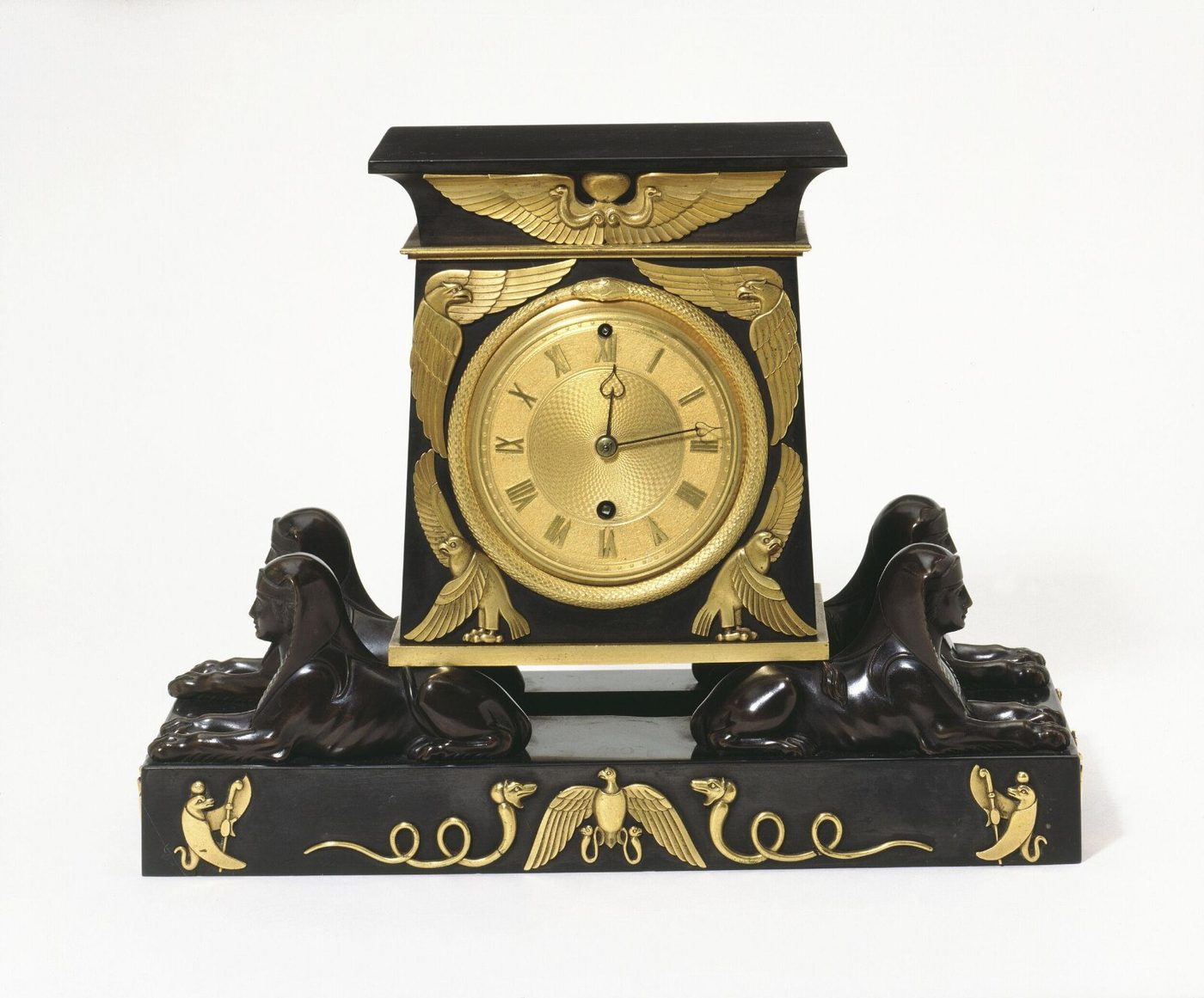
Clock with stand and keys, black marble with bronze dial and mounts, in the Egyptian style, made by Vulliamy & Son, London, 1807-1808
- Maker / attribution
- Vulliamy (maker)
- Date
- 1807-1808
- Historical period
- Precision & Scientific Horology (1750 – 1850)
- Country of origin
- England
- Place
- London
- Object type
- Clock
- Materials / technique
- Black marble, with dial and mounts of patinated and gilt bronze
- Dimensions
- Height: 22.8 cm; Width: 30.2 cm; Depth: 12.5 cm; Width: 1 7/8 in (depth of base)
- Holding institution
- Victoria and Albert Museum, London
- Accession / object no.
- M.119:1 to 3-1966
- Credit line
- Purchased in 1966
Record summary
Held and catalogued by Victoria and Albert Museum, London (object number M.119:1 to 3-1966), this is a clock by Vulliamy, made in London, England, dated 1807-1808. The Atlas places it in the Precision & Scientific Horology period (1750 – 1850) of its Clocks collection. Materials and techniques recorded by the source: Black marble, with dial and mounts of patinated and gilt bronze. Recorded dimensions: Height: 22.8 cm; Width: 30.2 cm; Depth: 12.5 cm; Width: 1 7/8 in (depth of base). The record is illustrated with 1 photograph.
Assembled from the source record's structured fields. Dates and attributions are given as the source states them; where a field is missing the Atlas leaves it blank rather than estimating.
Catalogue description
V&A — Summary
Object Type This marble clock with mounts of patinated bronze and ormolu (gilt bronze) was made by Benjamin Vulliamy between December 1807 and February 1808 at the same time as two other clocks of similar design. The clock movement is signed 'VULLIAMY LONDON No 438'. The Vulliamy account book describes No. 438 as an Egyptian ornamented clock. Design & Manufacture The figures of Horus (an ancient Egytian god) and the serpents that decorate the base come from plates in Vivant Denon's Voyage dans la Basse et la Haute Egypte , published in London in 1802. The account book lists the craftsmen who worked on the clock and the amounts they were paid: a craftsman named Houle was paid £8 for 'chasing the Sphinxes' (modelling them with a hammer and steel tools); the movement was supplied by a craftsman named Jackson and only cost £5 10s. The clock was sold to Princess Mary on 5 June 1812 for 50 guineas. People Benjamin Lewis Vulliamy (1780-1854) produced a number of bronzes in the Egyptian taste. These included a set of vases (garniture) in marble and bronze made about 1810, which inspired copies and models in Britain, France, and the United States throughout the 19th century. Thomas Hope (1769-1831), who did much to introduce the Egyptian style to England in the Regency period, was among Vulliamy's clients.
V&A — Physical description
The Mastaba-shaped case of black marble with ormolu mouldings is supported on four bronze sphinxes which rest on an oblong black marble base. Applied to the front and sides of the base, ormolu serpents with sceptres flank a central hawk. The gilt-brass dial is encircled by another serpent with its tail in its mouth (a symbol of eternity). The dial has Roman numerals, holes for winding and regulating and blued steel hands with heart-shaped points. In each of the spandrels is a hawk and above the dial a winged sun disc with double uraeus. The dial has cast raised chapters for hours and outside dots for minutes; the winding hole is above VI and the regulator hold pierces the top of XII. The slim steel hands have pierced heart-shaped outer ends. The eight day movement is reached through a circular opening in the back of the case fitted with a brass lid. The movement is signed on the backplate 'Vulliamy London No 438'. With the clock is an additional later base of ebony strengthened with strips of gilt brass along the edges. The top is covered with purple velvet and the bottom with black leather. In front is a gilt brass plate inscribed 'MARIA THERESA VILLIERS. PRESENTED ON HER MARRIAGE BY ERNEST AUGUSTUS KING OF HANOVER'. With the clock are a modern steel key for winding, numbered 2 & marked 'Made in England' with a letter P in a shaped frame; a steel watch key with a brass handle, for the regulation. It is numbered 11 and marked SWITZERLAND; steel pricked for cleaning the winding plate.
V&A — Historical context
The clock was made for display on a mantel shelf above a fireplace.
V&A — Object history
Made in London by Benjamin Vulliamy, 74 Pall Mall, London. This is listed in the earlier of Vulliamy's (1747-1811) two Clock Books (1797-1806) which has 467 entries (both surviving books are owned by the British Horological Institute at Upton Hall, (see references). This is entry number 438 which was sold to HRH Princess Mary on 5 June 1812 for £50 (Public Record Office C.104/52,58), shortly after Vulliamy's son Benjamin Lewis (1780-1854) had taken over the business. This is the same as entries 414 (delivered in December 1807) and 432 (delivered in February 1808) and is therefore one of three examples of this model manufactured by Vulliamy. A plaque records that it was given in 1864 to Maria Theresa Villiers by Ernest Augustus II, King of Hanover (1845-1901), on the occasion of her marriage. Ernest Augustus succeeded his father George V (1851-1878) on his death so the plaque was added to the clock at least 14 years after its presentation to Miss Villiers. Maria Theresa Villiers (d. 27 February 1925) was the daughter of Hon. Edward Villiers, she married Captain William Earle of the Rifle Brigade at St. Paul's Knightsbridge 14 April 1864. (The Gentleman's Magazine, CCXVI, 1864, p.654; Burke's Peerage, 1963, p. 508)
V&A — Production note
The account book of Vulliamy lists the craftsmen who worked on the clock and the amounts they were paid: a craftsman named Houle was paid £8 for 'chasing the Sphinxes' (modelling them with a hammer and steel tools); the movement was supplied by a craftsman named Jackson and only cost £5 10s. The Vulliamy Account Books for 1807-8 provide the following information on the manufacture of this clock which was finished and delivered on 4th March 1809: Jackson the movement £5 10 0 Day the case £6 9 0 Ourtz (Jacob Ourtz, engraver and guillocheur or engine-turner) was paid £1. 10. 0 for 'guil.g' - ie. 'guilloching' or decorating the dial with engine-turning. Jacot turning dial and ring 5s 6d Houle snake to go round dial 8s 0d Barnet casting snake 9s Couling filing up the little Egyptian ornaments £2 0 0 Barnett casting the 4 Sphinxes £1 1 6 Couling filing the 4 Sphinxes £2 8 0 Caney chasing same £4 4 0 Barnett casting the little ornaments 3s 6d Barket chasing the little ornaments 14s 0d Houle chasing the Sphinxes £8 0 0 Butler filing up the mouldings 3s 6d Seagrave gilding £3 1s 6d Seagrave bronzing the sphinxes 12s 0d Swift filing up steel hands 8s 0d Brownly the stand 16s 6d Osburn the shade £1 15s 0d The clock was sold to Princess Mary on 5 June 1812 for 50 guineas.
V&A gallery label
British Galleries: The design of the serpents and the Egyptian sun god Horus was based on engravings published by Baron Vivant Denon, published in 1802, in his 'Voyages dans la Basse et la Haute Egypte'. This was an account of the recent French archaeological investigations in Egypt. Manufacturers such as Vulliamy used these motifs to decorate a wide variety of popular goods.
Inscriptions & marks
VULLIAMY LONDON No.438; MARIA THERESA VILLIERS. PRESENTED ON HER MARRIAGE BY ERNEST AUGUSTUS KING OF HANOVER
Historical context
Precision & Scientific Horology (1750 – 1850)
Harrison solves longitude; Mudge invents the lever; Breguet's Paris workshop defines the modern watch.
The age of the deadbeat escapement, compensated pendulums and observatory regulators. Domestic clocks spread through the middle classes: English longcase and bracket clocks, French gilt-bronze mantel clocks, Viennese Biedermeier wall clocks, Black Forest painted-shield clocks, and the first American shelf clocks.
Read the period in the timelineMore clocks from this periodEarlier: Early Modern Horology
Atlas type guide
Domestic clocks
A clock combines four systems: a source of power (falling weight, coiled spring, or later electricity), a gear train that divides time, an escapement and oscillator that regulate it (foliot, pendulum or balance), and an indicating system of dial and hands or a bell. Its history runs from the large iron weight-driven clocks of the late thirteenth century to Renaissance spring-driven table clocks, the pendulum revolution of 1656, the factory clocks of the nineteenth century and electric and quartz clocks of the twentieth.
Domestic clocks also reflect regional furniture and decorative traditions — English longcase and bracket clocks, French pendules, Viennese regulators, Black Forest and American shelf clocks — and therefore record changing tastes as much as technical progress.
What to look for
- How the clock is powered: weights, spring barrel, fusee, electric coil.
- The oscillator: foliot, short pendulum, long seconds pendulum or balance.
- Whether it strikes: hour only (count wheel) or hours and quarters (rack striking).
- The maker or retailer's name on dial and movement, and any factory trademarks.
- Signs of alteration — replaced dials, converted escapements, 'married' cases.
Dating clues
- Before 1656 clocks used foliots or balances; after, most domestic clocks have pendulums.
- Anchor escapements spread after c. 1670; minute hands became common at the same time.
- Factory production in America and Germany transformed prices after c. 1840.
General guidance written by the Atlas editors about this kind of object. It is not a statement about this particular piece; for that, rely on the source record above and on physical examination.
Related records
Clocks · 1711–1827
Longcase clock by David Roentgen ( - ), England, 1711–1827
Badisches Landesmuseum Karlsruhe
Clocks · 1740-1760
Longcase clock, English, 1740-1760, japanned wood, John Ellicott
Victoria and Albert Museum, London
Clocks · 1751
Large wheel engine, signed and dated "John Tipping, Whildon Green, 1751".
Science Museum Group, London
Clocks · ca. 1760
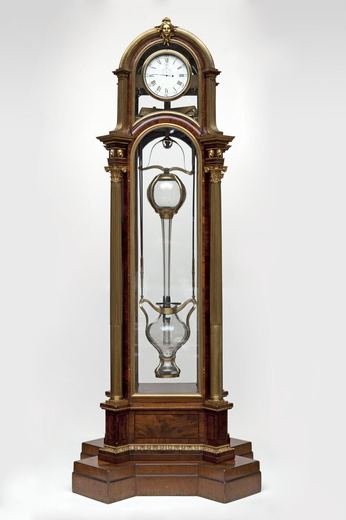
Longcase clock by James Cox, England, ca. 1760
Victoria and Albert Museum, London
Clocks · 1766
Clock by Cumming, Alexander, England, 1766
Science Museum Group, London
Clocks · 1768-1769
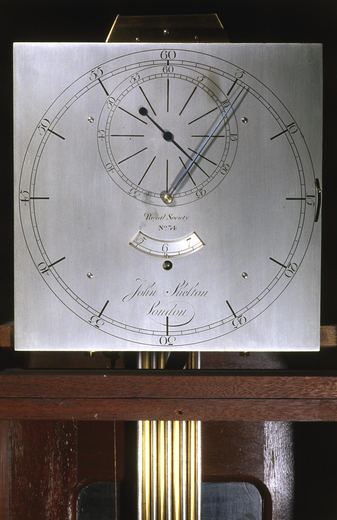
Regulator clock by Shelton, John, England, 1768-1769
Science Museum Group, London
Clocks · ca. 1775
Longcase clock, England, ca. 1775
Victoria and Albert Museum, London
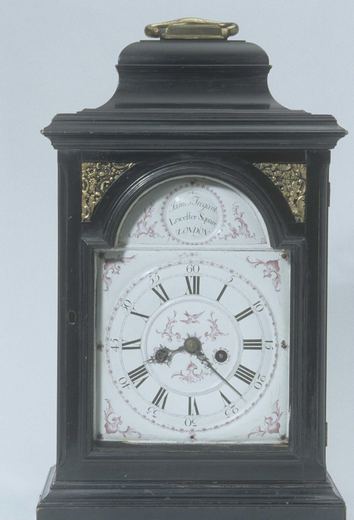
Clocks · ca. 1780
Bracket clock of ebony, with face of West Midlands enamel painted in black and crimson, made by James Tregent, London, England, about 1780
Victoria and Albert Museum, London