Clocks · Clock
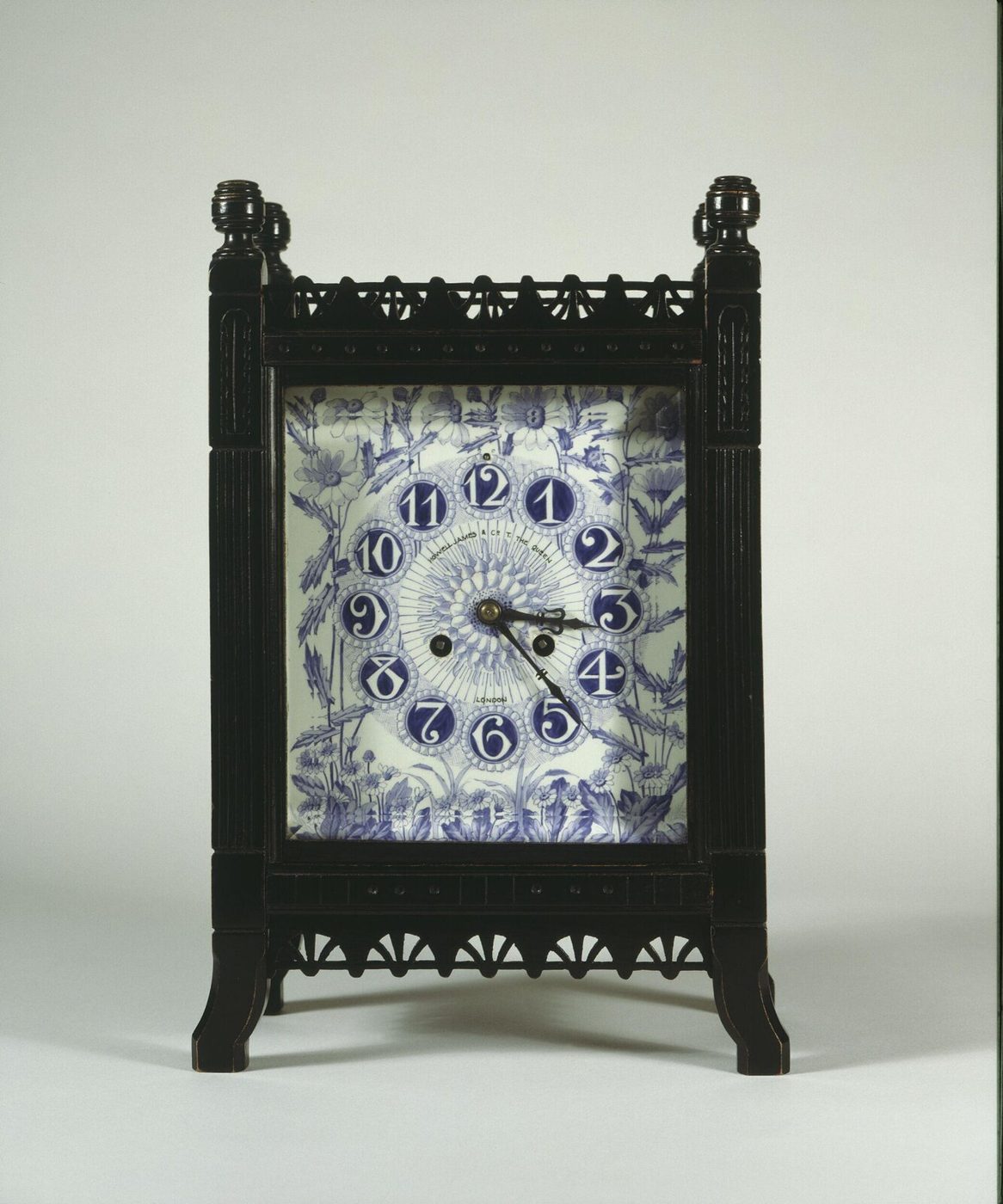
Clock by Lewis Foreman Day, England, ca. 1880
- Maker / attribution
- Lewis Foreman Day (designer); Howell James & Co. (maker)
- Date
- ca. 1880
- Historical period
- Industrial Revolution (1850 – 1900)
- Country of origin
- England
- Place
- London
- Object type
- Clock
- Materials / technique
- Ebonised birch wood case, with porcelain face
- Dimensions
- Height: 36.2 cm; Width: 24.1 cm; Depth: 13.5 cm
- Holding institution
- Victoria and Albert Museum, London
- Accession / object no.
- CIRC.662-1972
Record summary
Held and catalogued by Victoria and Albert Museum, London (object number CIRC.662-1972), this is a clock by Lewis Foreman Day, made in London, England, dated ca. 1880. The Atlas places it in the Industrial Revolution period (1850 – 1900) of its Clocks collection. Materials and techniques recorded by the source: Ebonised birch wood case, with porcelain face. Recorded dimensions: Height: 36.2 cm; Width: 24.1 cm; Depth: 13.5 cm. The record is illustrated with 3 photographs.
Assembled from the source record's structured fields. Dates and attributions are given as the source states them; where a field is missing the Atlas leaves it blank rather than estimating.
Catalogue description
V&A — Summary
Object Type This small clock was designed for fashionable homes of the late 19th century. The relatively crude carving of the case may mean it was an inexpensive clock, even though the lettering on the dial suggests the maker, Howell James & Co., supplied clocks to Queen Victoria. Time Japan was closed to most outsiders from 1639 to the 1850s, when direct trading with Europe was resumed. Displays of Japanese objects at International Fairs in London in 1862 and Paris in 1867 caused great excitement, and by the 1880s all things Japanese were the height of fashion. This influence is apparent in the decoration of the clock, although in fact it bears little resemblance to authentic Japanese design. People The clock's designer, Lewis F. Day (1845-1910), had a strong relationship with this Museum and the art school attached to it. He is best known for his ceramics and wallpapers, and for his writings on the philosophy of the Arts and Crafts Movement. Subjects Depicted Sunflowers, shown on the porcelain dial of the clock, were popular in Aesthetic Movement decoration. Lampooning the style, Edward Linley-Sambourne depicted the poet, playwright and aesthete Oscar Wilde as a sunflower in a Punch magazine cartoon in 1881.
V&A — Physical description
Clock, ebonised birch wood case, with porcelain face, fretwork decoration with flowers on its face
V&A — Object history
Designed by Lewis F. Day (born in London, 1845, died there in 1910); made by Howell James & Co., London "Day was a teacher and prolific designer within the South Kensington network, whose books frequently included Japanese examples. The ebonised case of this clock, with its fretwork decoration, and the flowers on its face have little to do with real Japanese decoration but would instantly have suggested the Japanese taste to Day’s contemporaries." Ornament Gallery text.
V&A gallery label
CLOCK English; about 1880 Ebonised wood case and porcelain face; designed by Lewis F. Day (1845-1910) and made by Howell James & Co of London Day was a teacher and prolific designer with the South Kensington network, whose books frequently included Japanese examples. The ebonised case of this clock, and the flowers on its face have little to do with real Japanese decoration but would instantly have suggested the Japanese taste to Day's contemporaries. CFirc. 662-1972
V&A gallery label
British Galleries: This clock combines Japanese-inspired ebonised wood and Chinese-inspired blue and white porcelain with the characteristic Aesthetic sunflower motif. It shows the extent to which the Aesthetic style was adopted for everday objects by commercially popular and versatile designers such as Lewis F. Day.
Historical context
Industrial Revolution (1850 – 1900)
American interchangeable-parts manufacture; railroad time standards; Swiss and German factory systems.
Factory production transformed the clock into an everyday object. American makers (Seth Thomas, Ansonia, Waterbury) and German factories (Junghans, Gustav Becker, Lenzkirch) sold millions of shelf, wall and alarm clocks worldwide; France produced standardised Paris movements and carriage clocks; electric time distribution began.
Read the period in the timelineMore clocks from this periodEarlier: Precision & Scientific Horology
Atlas type guide
Domestic clocks
A clock combines four systems: a source of power (falling weight, coiled spring, or later electricity), a gear train that divides time, an escapement and oscillator that regulate it (foliot, pendulum or balance), and an indicating system of dial and hands or a bell. Its history runs from the large iron weight-driven clocks of the late thirteenth century to Renaissance spring-driven table clocks, the pendulum revolution of 1656, the factory clocks of the nineteenth century and electric and quartz clocks of the twentieth.
Domestic clocks also reflect regional furniture and decorative traditions — English longcase and bracket clocks, French pendules, Viennese regulators, Black Forest and American shelf clocks — and therefore record changing tastes as much as technical progress.
What to look for
- How the clock is powered: weights, spring barrel, fusee, electric coil.
- The oscillator: foliot, short pendulum, long seconds pendulum or balance.
- Whether it strikes: hour only (count wheel) or hours and quarters (rack striking).
- The maker or retailer's name on dial and movement, and any factory trademarks.
- Signs of alteration — replaced dials, converted escapements, 'married' cases.
Dating clues
- Before 1656 clocks used foliots or balances; after, most domestic clocks have pendulums.
- Anchor escapements spread after c. 1670; minute hands became common at the same time.
- Factory production in America and Germany transformed prices after c. 1840.
General guidance written by the Atlas editors about this kind of object. It is not a statement about this particular piece; for that, rely on the source record above and on physical examination.
Related records
Clocks · 1879
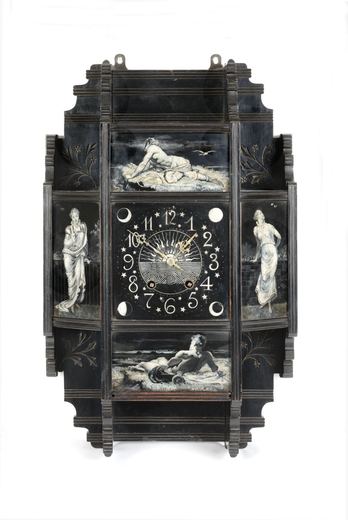
Wall clock of ebonised wood, painted en grisaille , signed 'Lewis F Day 1879'. Designed by Lewis F. Day, British 1879
Victoria and Albert Museum, London
Clocks · 1830-1870
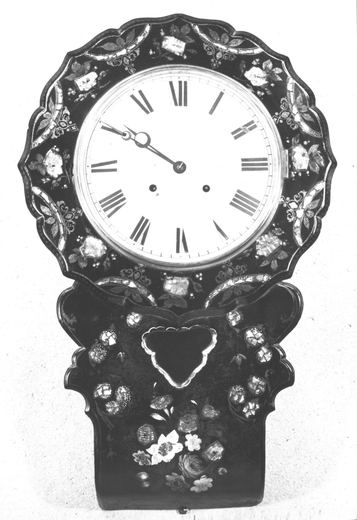
Wall clock in a papier mâché case with painted decoration. English, mid 19th century.
Victoria and Albert Museum, London
Clocks · 1840-1900
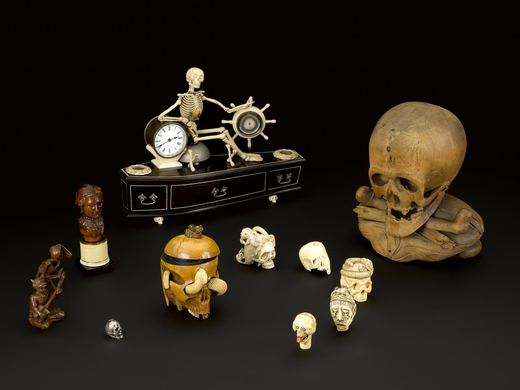
Alarm clock, mounted on model of coffin with skeleton, probably English, 1840-1900
Science Museum Group, London
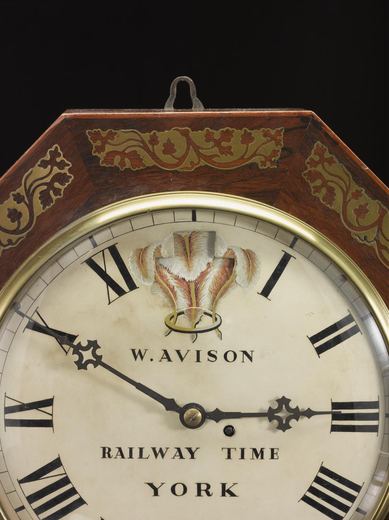
Clocks · 1840-1880
Wall Clock in octagonal case with Prince of Wales Feathers above makers name "W. Avison, Railway Time, York", made by William Avison, England, 1840-1880.
Science Museum Group, London
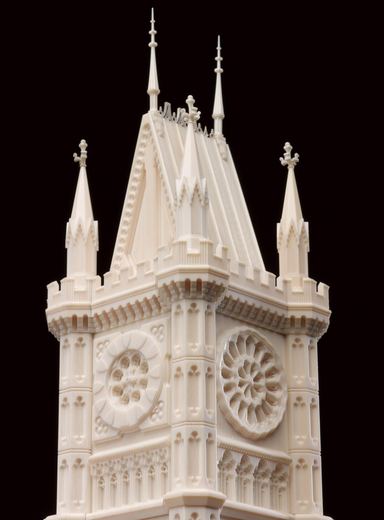
Clocks · 1843-1884
One ivory gothic clock tower & travelling case, by Holtzapffel and Company, London, England, 1843-1884
Science Museum Group, London
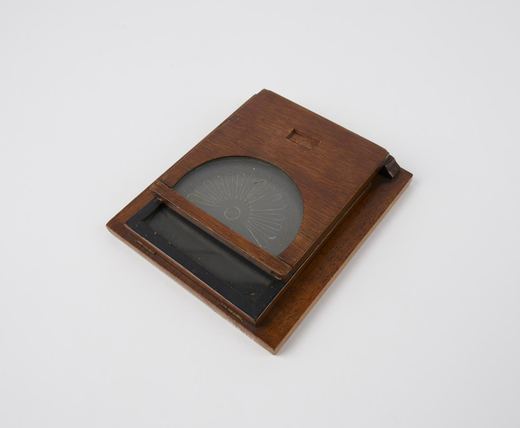
Clocks · 1845-1855
Clock by Darker, W. H., England, 1845-1855
Science Museum Group, London
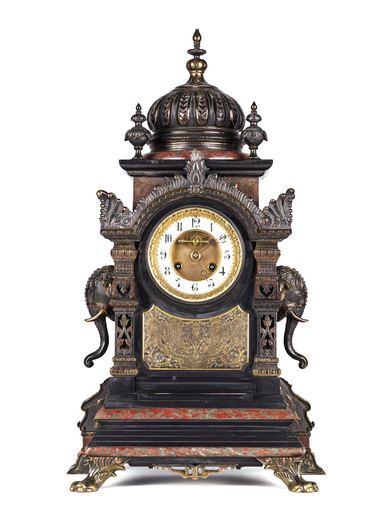
Clocks · 1845-1855
Clock, England, 1845-1855
Science Museum Group, London
Clocks · 1845-1855
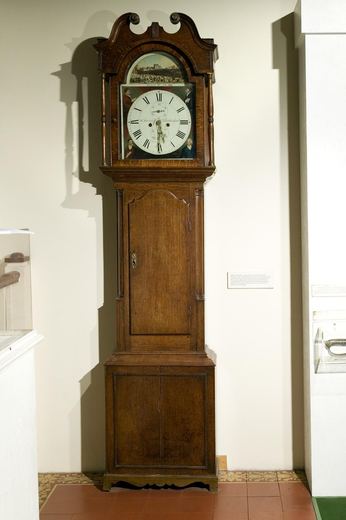
Longcase clock commemorating the Peterloo Massacre of 1819, made by W. Stancliffe, Barkisland.
Science Museum Group, London