Clocks · Clock
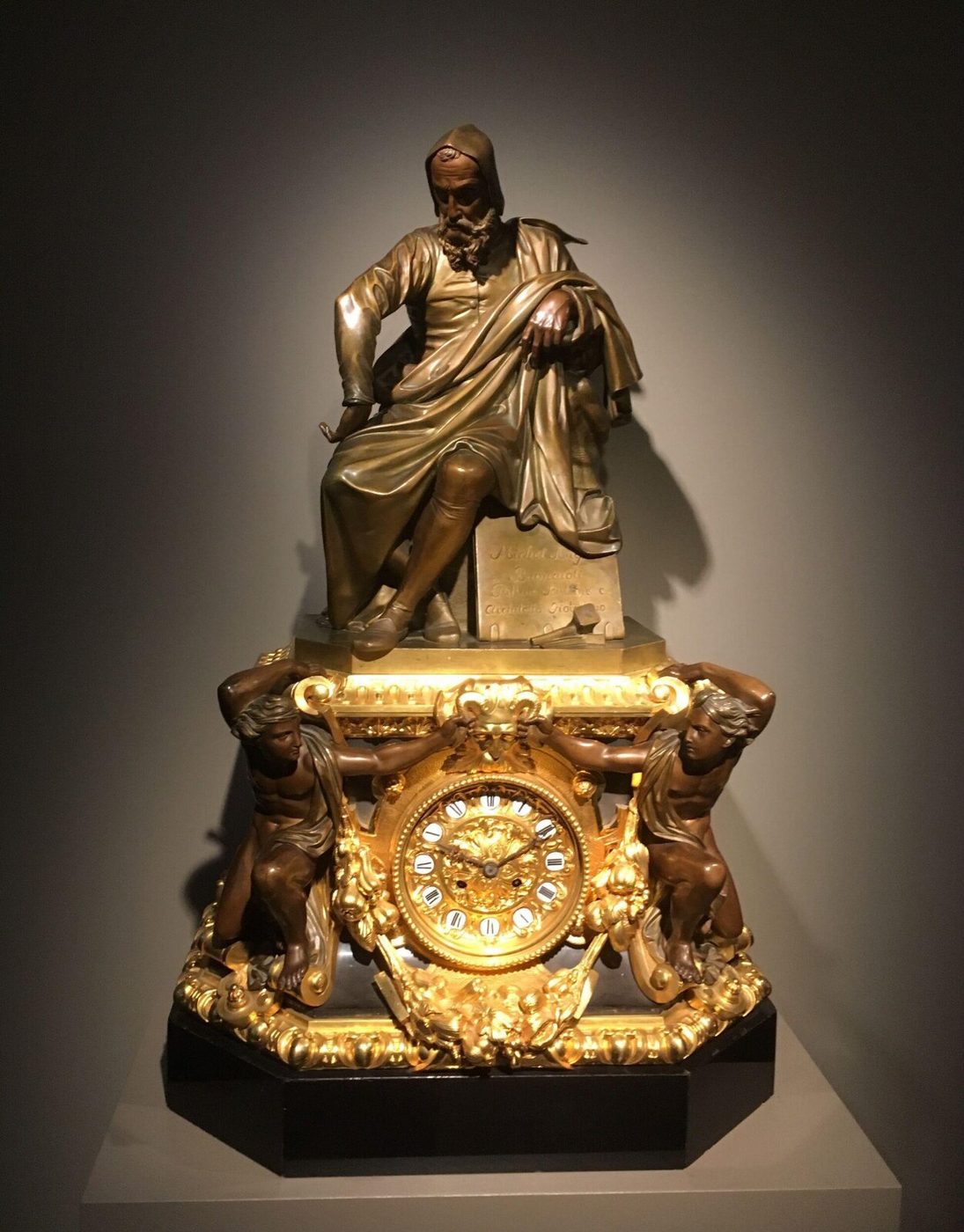
Clock by Jean-Jacques Feuchère, France, 1849
- Maker / attribution
- Jean-Jacques Feuchère (sculptor); Gaspard-Joseph Vittoz (founder); Mudesse (made); Victor Cailly d'Aliermont (made)
- Date
- 1849
- Historical period
- Precision & Scientific Horology (1750 – 1850)
- Country of origin
- France
- Place
- Paris
- Object type
- Clock
- Materials / technique
- Bronze ('Florentine' patina), gilt copper alloy, wood, marble, steel and enamel, cast in sections and assembled.
- Dimensions
- Height: 79 cm; Width: 50 cm; Depth: 31 cm
- Holding institution
- Victoria and Albert Museum, London
- Accession / object no.
- M.15-2019
- Credit line
- Purchased with support from the Hildburgh Bequest
- Catalogue title (original)
- The Michelangelo Clock
Record summary
Held and catalogued by Victoria and Albert Museum, London (object number M.15-2019), this is a clock by Jean-Jacques Feuchère, made in Paris, France, dated 1849. The Atlas places it in the Precision & Scientific Horology period (1750 – 1850) of its Clocks collection. Materials and techniques recorded by the source: Bronze ('Florentine' patina), gilt copper alloy, wood, marble, steel and enamel, cast in sections and assembled. Recorded dimensions: Height: 79 cm; Width: 50 cm; Depth: 31 cm. The record is illustrated with 4 photographs.
Assembled from the source record's structured fields. Dates and attributions are given as the source states them; where a field is missing the Atlas leaves it blank rather than estimating.
Catalogue description
V&A — Summary
This clock is an exhibition piece designed to have maximum visual impact. It combines the artistic and technical skills of four French makers each celebrated in their own right. The sculptor, Jean-Jacques Feuchère, a great connoisseur of the Renaissance period, modelled the Michelangelo figure showing him seated, half concealing under his cloak a statue of an enslaved figure on which he has been working. Feuchère worked with the bronze founder Gaspard-Joseph Vittoz to make the sculpture the centrepiece of this large clock which was once accompanied by two candelabra. Vittoz exhibited the clock in Paris in 1849 where he won a silver medal and again at the Great Exhibition in Hyde Park in 1851 where he won gold.
V&A — Physical description
Monumental clock. The upper section is in the form of a toned bronze ('Florentine' patina) sculpture of the artist, Michelangelo, who has downed his tools and is seated and leaning to his left on a sculpture of a slave on which he has been working. The slave figure is partly hidden under Michelangelo's cloak. The base is of wood veneered in black marble and is decorated with gilt copper-alloy mounts and at the sides by two bronze figues of adolescent males ('epehebes') supporting the gilt-metal and enamelled clock face. Inside the base is the movement, visible through a circular window at the back (although the glass is now missing). The clock has a detachable pendulum and key.
V&A — Object history
This monumental clock, made in Paris in around 1849, supports a bronze sculpture depicting the Florentine Renaissance artist Michelangelo Buonarroti (1475-1564) in a contemplative pose seated with his tools at his feet. He is leaning to the left half-concealing under his cloak a statue of a slave figure on which he has been working. The hexagonal wooden and marble plinth houses the clock movement and is richly decorated with gilt metal mounts and an enamelled and gilt metal clock face either side of which is a small bronze sculpture of an adolescent male posed as if supporting the weight of the sculpture above. The clock combines the artistic and technical skills of four French makers during the mid-nineteenth century Romantic period, each highly acclaimed in their own right. The Michelangelo figure is by the sculptor, Jean-Jacques Feuchère, a great connoisseur and admirer of the Renaissance period, who around this time also created figures of the goldsmith Benvenuto Cellini (1837) and the artists Raphael (1835) and Leonardo da Vinci (1843). Feuchère first exhibited a model of the Michelangelo figure alone at the Paris Salon of 1831 but it was rejected by the jury as it did not fit neatly into traditional artistic categories. Feuchère sold the rights to reproduce the figure to the prominent Paris bronze-foundry of Gaspard-Joseph Vittoz with whom he regularly collaborated. In the Vittoz workshop, they made the sculpture the focal point of this elaborate clock, fitting it onto a hexagonal wooden base with a black marble veneer decorated with gilt-metal mounts and bronze supporting figures. The veneer was supplied by the innovative marble worker, Mudesse. Hidden from view but central to the clock's function, the movement inside the base was produced in the workshop of Victor Cailly, a member of a celebrated family of clock makers of St Nicholas d'Aliermont near Dieppe in northern France. This Michelangelo figure demonstrates a striking mix of surface treatments. The precise and delicate stippling on the feet and hat contrast with the smooth drapery and flesh, which are in turn differentiated from each other with two unusually coloured patinas. The composition makes clear reference to three of Michelangelo's most celebrated works: the Sistine Chapel in the Vatican, the Medici Chapel in Florence and the series of slave sculptures planned for the tomb of Pope Julius II. Under the left arm of Feuchère's Michelangelo stands a slave, its crosshatching indicating the sculptural working of the original figure that it represents. The bronze figures on the clock base were inspired by Michelangelo's series of ignudi (idealised male nudes) on the Sistine Chapel ceiling, which may also have inspired the ox heads and garlanding on the gold-plated mounts. In keeping with the mid-19th-century revival of interest in Renaissance art, Vittoz created this clock as an exhibition piece designed for maximum visual impact that metaphorically puts Michelangelo on a pedestal. It is an ensemble of the highest quality materials and techniques from different disciplines. Vittoz showed the clock at the 'Exposition des Produits de l'Industrie et de l'Agriculture' (the' Exposition of Industrial and Agricultural Products') in Paris in 1849 where he won a silver medal and then again to great acclaim at the Great Exhibition in the Crystal Palace in Hyde Park in 1851 where he won gold. The clock was illustrated in the Art Journal catalogue along with a much simpler clock and other works by Vittoz. 'The boldness and breadth of the composition are strikingly apparent; there is an entire absence of everything approaching to petitesse in its details, the introduction of which would have marred the noble simplicity of design. The base of the clock serves as a pedestal to a well-modelled figure of Michel-Angelo. ... At the establishment of M. Vittoz are produced some of the largest bronze works made in Paris, as well as the more delicate and elaborate objects for merely ornamental purposes.' The Art Journal also stated that the clock was shown as the centrepiece between two candelabra although their whereabouts are not now known. The first owner of the clock is not recorded but it was recorded in 2019 as formerly in the collection of Johannes Count Moy de Sons'.
V&A — Production note
One of three examples known. One was bought by the Rijksmuseum, Amsterdam in 2019 (Museum no. BK-2019-101) while a slightly later one (1852-55) is in the Louvre, Paris (Museum no. OA 11911)
Inscriptions & marks
Michel Ange Buonaroti Pittore Scuttore e Architetto Fiorentino; Feuchère scpt.; Vittoz Bronzier; Mudesse, marbrier breveté; V TOR CAILLY À S T . NICOLAS; FABRIQUE VITTOZ À PARIS; 435 7 2
Historical context
Precision & Scientific Horology (1750 – 1850)
Harrison solves longitude; Mudge invents the lever; Breguet's Paris workshop defines the modern watch.
The age of the deadbeat escapement, compensated pendulums and observatory regulators. Domestic clocks spread through the middle classes: English longcase and bracket clocks, French gilt-bronze mantel clocks, Viennese Biedermeier wall clocks, Black Forest painted-shield clocks, and the first American shelf clocks.
Read the period in the timelineMore clocks from this periodEarlier: Early Modern Horology
Atlas type guide
Domestic clocks
A clock combines four systems: a source of power (falling weight, coiled spring, or later electricity), a gear train that divides time, an escapement and oscillator that regulate it (foliot, pendulum or balance), and an indicating system of dial and hands or a bell. Its history runs from the large iron weight-driven clocks of the late thirteenth century to Renaissance spring-driven table clocks, the pendulum revolution of 1656, the factory clocks of the nineteenth century and electric and quartz clocks of the twentieth.
Domestic clocks also reflect regional furniture and decorative traditions — English longcase and bracket clocks, French pendules, Viennese regulators, Black Forest and American shelf clocks — and therefore record changing tastes as much as technical progress.
What to look for
- How the clock is powered: weights, spring barrel, fusee, electric coil.
- The oscillator: foliot, short pendulum, long seconds pendulum or balance.
- Whether it strikes: hour only (count wheel) or hours and quarters (rack striking).
- The maker or retailer's name on dial and movement, and any factory trademarks.
- Signs of alteration — replaced dials, converted escapements, 'married' cases.
Dating clues
- Before 1656 clocks used foliots or balances; after, most domestic clocks have pendulums.
- Anchor escapements spread after c. 1670; minute hands became common at the same time.
- Factory production in America and Germany transformed prices after c. 1840.
General guidance written by the Atlas editors about this kind of object. It is not a statement about this particular piece; for that, rely on the source record above and on physical examination.
Related records
Clocks · 1723–1811
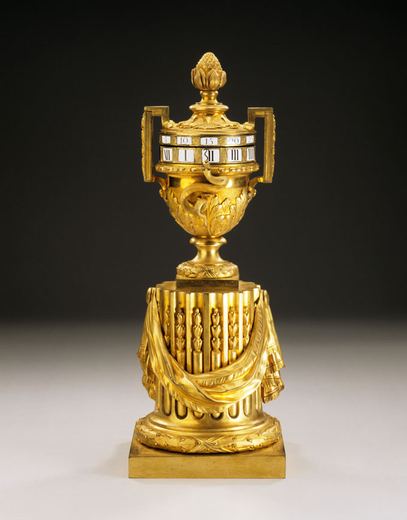
Table clock by Louis Montjoye, France, 1723–1811
Badisches Landesmuseum Karlsruhe
Clocks · 1738–1814
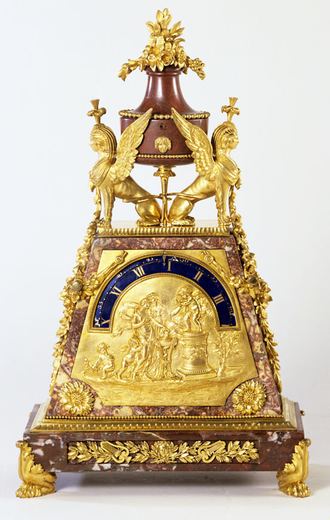
Table clock by Jean Simon Bourdier, France, 1738–1814
Badisches Landesmuseum Karlsruhe
Clocks · 1750-1800
Bracket clock in metal case with scroll handles and flamed-shaped top signed by Pierre Seignoret, Clockmaket to the the Comte d'Artois
Victoria and Albert Museum, London
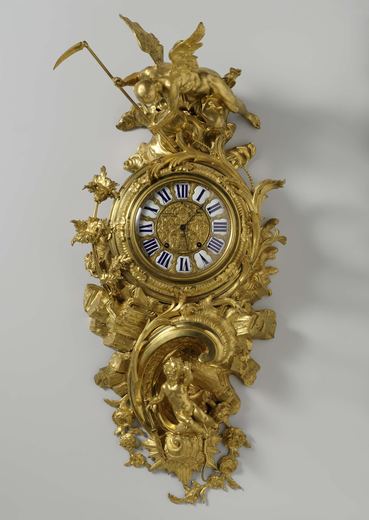
Clocks · 1756
Mantel clock, France, 1756
Rijksmuseum
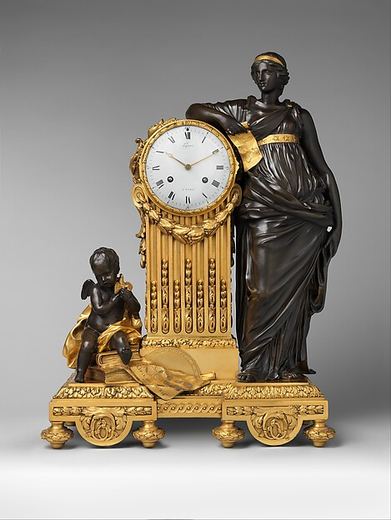
Clocks · ca. 1764–70
Mantel clock by Jean-André Lepaute, France, ca. 1764–70
The Metropolitan Museum of Art, New York
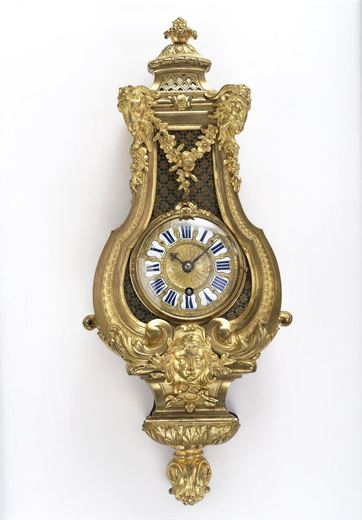
Clocks · 1760–1860
'Pendule d'alcove' wall clock, gilt-bronze and boulle marquetry, Paris, 1760-1860
Victoria and Albert Museum, London
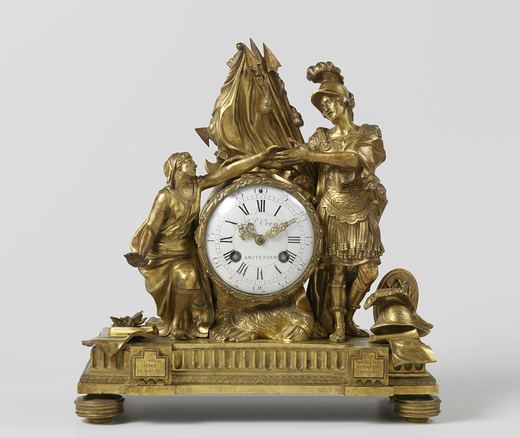
Clocks · 1760
Mantel clock, France, 1760
Rijksmuseum
Clocks · ca. 1768–70
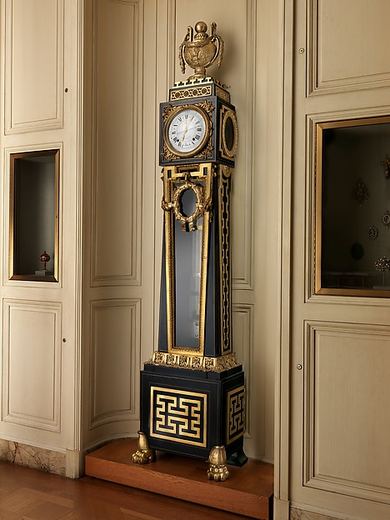
Longcase astronomical regulator by Ferdinand Berthoud, France, ca. 1768–70
The Metropolitan Museum of Art, New York