Clocks · Clock
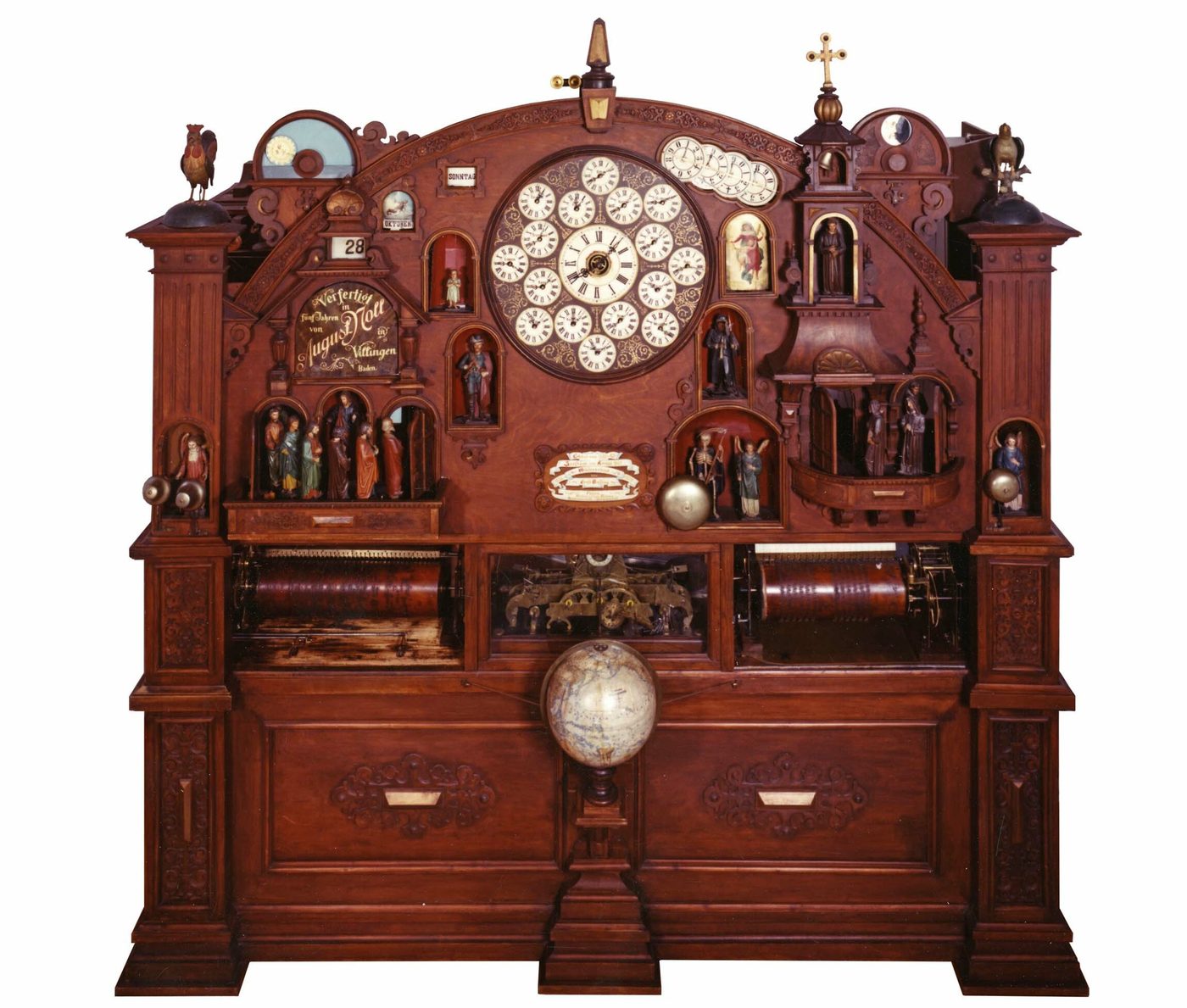
Clock by August Noll, France, 1800–1899
- Maker / attribution
- August Noll (creator); Ernst Blessing (creator)
- Date
- 1800–1899
- Historical period
- Precision & Scientific Horology (1750 – 1850)
- Country of origin
- France
- Place
- Unterkirnach
- Object type
- Clock
- Holding institution
- German Clock Museum
- Accession / object no.
- Museu_ProvidedCHO_museum_digital_58170__technical_number_
- Catalogue title (original)
- Astronomische Weltuhr, August Noll, Villingen, 1880-1885 (German)
Record summary
Held and catalogued by German Clock Museum (object number Museu_ProvidedCHO_museum_digital_58170__technical_number_), this is a clock by August Noll, made in Unterkirnach, France, dated 1800–1899. The Atlas places it in the Precision & Scientific Horology period (1750 – 1850) of its Clocks collection. The record is illustrated with 1 photograph.
Assembled from the source record's structured fields. Dates and attributions are given as the source states them; where a field is missing the Atlas leaves it blank rather than estimating.
Catalogue description
Catalogue description from German Clock Museum (German)
Diese monumentale Schauuhr wurde von August Noll aus Villingen gebaut, ab 1888 verdiente der gelernte Mechaniker sich damit seinen Lebensunterhalt als Schausteller. Bis 1897 war Noll mit seiner Uhr auf Reisen, bevor er sie durch eine größere Uhr mit ähnlichen Elementen ersetzte. Die Kunstuhr zeigt Funktionen, die teilweise der astronomischen Münsteruhr in Straßburg entlehnt sind: Einen Hahn, die vier Lebensalter, Christus und die Apostel, Sonne mit beweglichem Horizont und Mondphasen. Zusätzlich gibt es einen Kuckuck, Kapuzinermönche im Umlauf, den Trompeter von Säckingen, vier personifizierte Jahreszeiten, Engel und Sensenmann und das große Thema der Weltzeit. August Noll legte großen Wert darauf, dass seine Uhr(en) vollautomatisch funktionierten, um sich gegen andere Schauuhren, die ein sehr ähnliches Programm hatten, abzusetzen. Spätestens nach August Nolls Tod 1938 wurden die mechanischen Teile der Uhr in Unterkirnach eingelagert. Von 1956 bis 1959 setzte der Orchestrionbauer Ernst Blessing die Teile, nach einem Foto von 1887, zu einem funktionsfähigen Ganzen in einem neuen Gehäuse zusammen. Seit 1959 ist die Schauuhr im Pavillon des Uhrenmuseums Furtwangen zu sehen, wo sie bis heute täglich vorgeführt wird. (Deutsches Uhrenmuseum Furtwangen)
Shown in the original language of the source catalogue. An editor-reviewed English translation has not yet been published; we do not publish machine translations as authoritative text.
Historical context
Precision & Scientific Horology (1750 – 1850)
Harrison solves longitude; Mudge invents the lever; Breguet's Paris workshop defines the modern watch.
The age of the deadbeat escapement, compensated pendulums and observatory regulators. Domestic clocks spread through the middle classes: English longcase and bracket clocks, French gilt-bronze mantel clocks, Viennese Biedermeier wall clocks, Black Forest painted-shield clocks, and the first American shelf clocks.
Read the period in the timelineMore clocks from this periodEarlier: Early Modern Horology
Atlas type guide
Domestic clocks
A clock combines four systems: a source of power (falling weight, coiled spring, or later electricity), a gear train that divides time, an escapement and oscillator that regulate it (foliot, pendulum or balance), and an indicating system of dial and hands or a bell. Its history runs from the large iron weight-driven clocks of the late thirteenth century to Renaissance spring-driven table clocks, the pendulum revolution of 1656, the factory clocks of the nineteenth century and electric and quartz clocks of the twentieth.
Domestic clocks also reflect regional furniture and decorative traditions — English longcase and bracket clocks, French pendules, Viennese regulators, Black Forest and American shelf clocks — and therefore record changing tastes as much as technical progress.
What to look for
- How the clock is powered: weights, spring barrel, fusee, electric coil.
- The oscillator: foliot, short pendulum, long seconds pendulum or balance.
- Whether it strikes: hour only (count wheel) or hours and quarters (rack striking).
- The maker or retailer's name on dial and movement, and any factory trademarks.
- Signs of alteration — replaced dials, converted escapements, 'married' cases.
Dating clues
- Before 1656 clocks used foliots or balances; after, most domestic clocks have pendulums.
- Anchor escapements spread after c. 1670; minute hands became common at the same time.
- Factory production in America and Germany transformed prices after c. 1840.
General guidance written by the Atlas editors about this kind of object. It is not a statement about this particular piece; for that, rely on the source record above and on physical examination.
Related records
Clocks · 1723–1811
Table clock by Louis Montjoye, France, 1723–1811
Badisches Landesmuseum Karlsruhe
Clocks · 1738–1814
Table clock by Jean Simon Bourdier, France, 1738–1814
Badisches Landesmuseum Karlsruhe
Clocks · 1750-1800
Bracket clock in metal case with scroll handles and flamed-shaped top signed by Pierre Seignoret, Clockmaket to the the Comte d'Artois
Victoria and Albert Museum, London
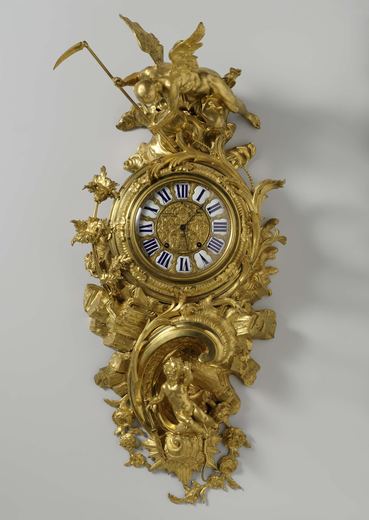
Clocks · 1756
Mantel clock, France, 1756
Rijksmuseum
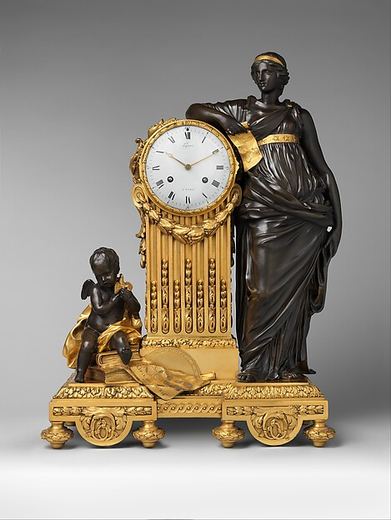
Clocks · ca. 1764–70
Mantel clock by Jean-André Lepaute, France, ca. 1764–70
The Metropolitan Museum of Art, New York
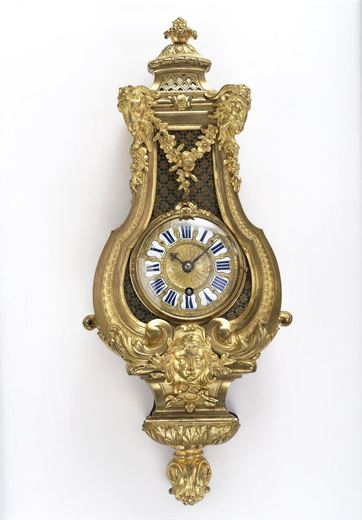
Clocks · 1760–1860
'Pendule d'alcove' wall clock, gilt-bronze and boulle marquetry, Paris, 1760-1860
Victoria and Albert Museum, London
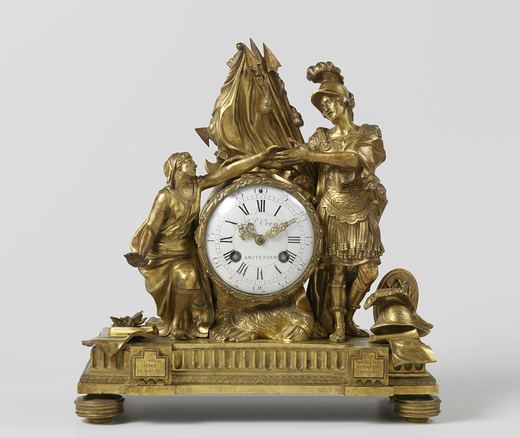
Clocks · 1760
Mantel clock, France, 1760
Rijksmuseum
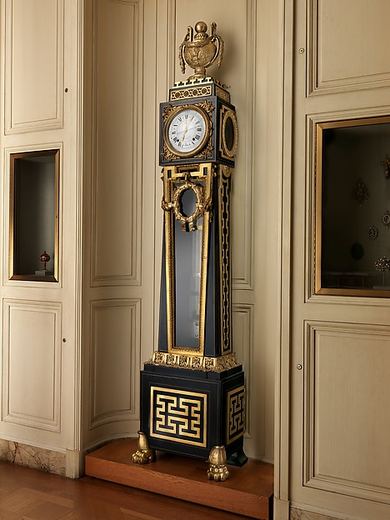
Clocks · ca. 1768–70
Longcase astronomical regulator by Ferdinand Berthoud, France, ca. 1768–70
The Metropolitan Museum of Art, New York