
Wristwatches · Wristwatch
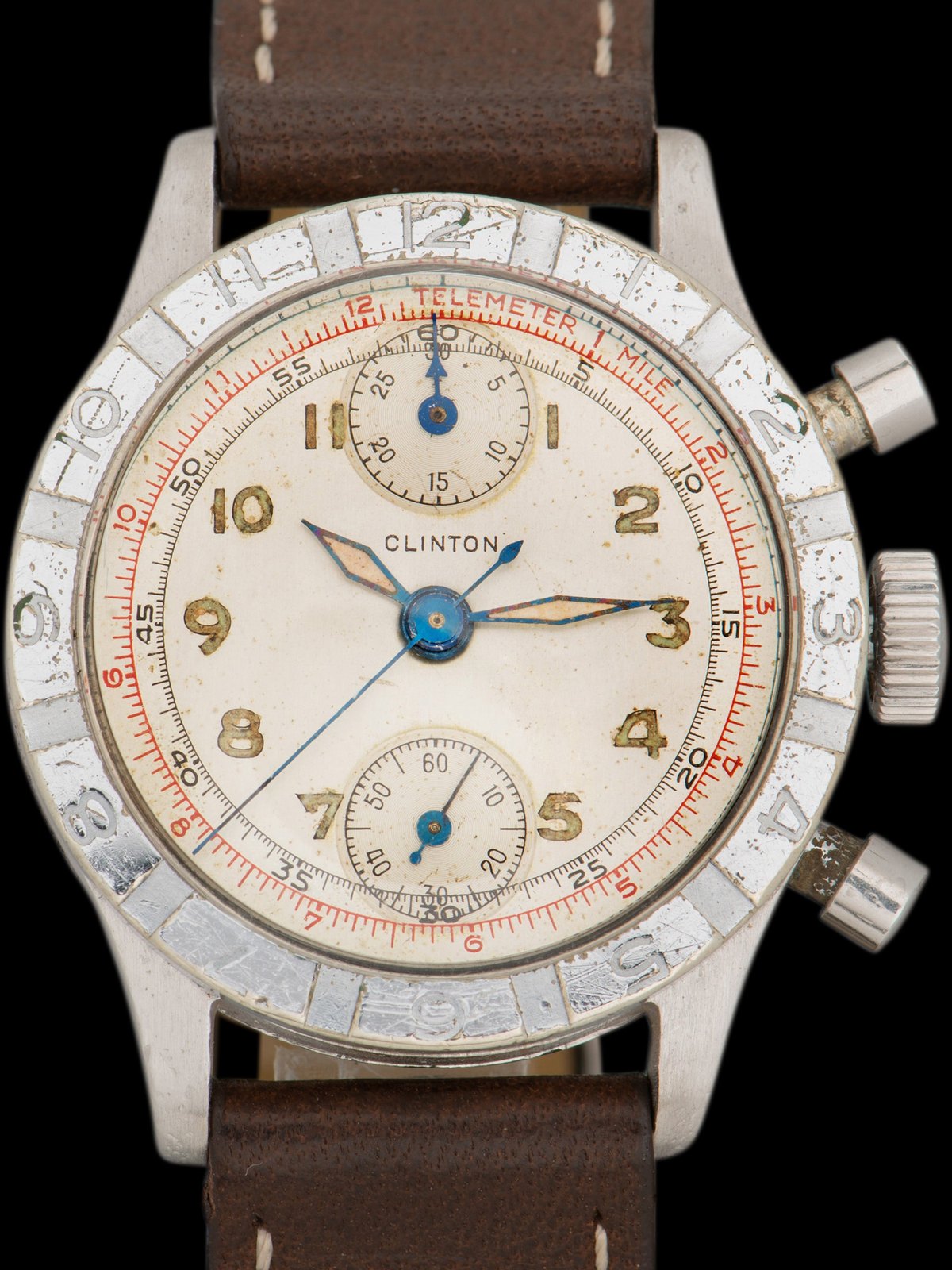
Clinton Chronograph, 1950s
- Maker / attribution
- Unrecorded in source
- Date
- 1950s
- Historical period
- Modern Mechanical Horology (1945 – 1969)
- Country of origin
- Unrecorded in source
- Object type
- Wristwatch
- Dimensions
- Case 36 mm
- Stock no.
- CLINCHRO
- Credit line
- Dealer listing, Craft & Tailored (CLINCHRO)
- Catalogue title (original)
- 1950s Clinton Chronograph (English)
View the source record (dealer listing) ↗ (opens another website in a new tab)Suggest a correction
Record summary
Catalogued by Craft & Tailored (dealer), Los Angeles (stock number CLINCHRO), this is a wristwatch, dated 1950s. The Atlas places it in the Modern Mechanical Horology period (1945 – 1969) of its Wristwatches collection. Recorded dimensions: Case 36 mm. The record is illustrated with 6 photographs.
Assembled from the source record's structured fields. Dates and attributions are given as the source states them; where a field is missing the Atlas leaves it blank rather than estimating.
Catalogue description
Dealer description — Craft & Tailored
Founded in Chicago, IL, in 1922 by Russian immigrant Hyman Wein, Clinton Watch Company was a small, family-owned brand that put out some fantastic pieces over the years. Before eventually moving production to Switzerland in the early 1960s—and ultimately ending up in the US Virgin Islands in the 70s—the brand focused on importing the finest Swiss parts and movements and assembling them in the States. This chronograph from the 1950s falls into the earlier era of the brand’s watches, assembled in Chicago using a Swiss movement. It exudes a whole lot of iconic mid-century style and sporty vibes, and at 36mm would look perfect on just about any wrist. SPECS Stock # CLINCHRO Brand CLINTON Style Chronograph Model N/A Serial 418736 Size Men's Material Stainless Steel Dial Cream Millimeters 34 Bracelet 2pc Handmade Leather Strap CASE & BRACELET The stainless steel case retains thick and symmetrical lugs that display signs of gentle polishing in the past and light pitting from previous corrosion. The rotating bezel shows wear fitting a 70-plus-year-old watch, and the case retains its original oversized unsigned crown and pushers. The case back is clean and retains all of its factory markings. The watch will be supplied on a 2pc brown leather strap. DIAL & HANDS The cream-colored dial features a red telemeter track on the outer edge followed by a black tachymeter track, both of which are impressively legible and in good shape. The lume in the numerals has aged to a mustard color, which complements the blued hour and minute hands quite well. The subdials at the 12 o’clock and 6 o’clock positions and their blued hands provide a sophisticated, uniquely vintage look that matches the overall feel and presence of this piece. ACCESSORIES None. The watch is keeping time and functioning perfectly, previous service history is unknown.
Historical context
Modern Mechanical Horology (1945 – 1969)
Tool watches for divers, pilots and astronauts; electric watches anticipate the electronic age.
The classic era of the mechanical wristwatch: dive watches, chronographs for motor racing and space flight, GMT watches for jet travel, slim dress watches, automatic calendars, and the rise of Japanese manufacturers alongside Swiss, American, German and Soviet industries.
Read the period in the timelineMore wristwatches from this periodEarlier: Golden Age of Mechanical Watchmaking
Atlas type guide
Chronographs and split-seconds watches
A chronograph is a watch with an additional seconds hand that can be started, stopped and returned to zero independently of the timekeeping. Louis Moinet built an early example in 1816 and Nicolas Rieussec a recording 'chronographe' in 1821; Adolphe Nicole's heart-shaped reset cam (patented 1862) made the modern return-to-zero possible. Split-seconds (rattrapante) chronographs add a second hand that can be stopped for intermediate times; flyback chronographs restart instantly.
Chronographs were essential tools for doctors (pulsometer scales), artillery (telemeter), engineers and sport. In wristwatches, Valjoux, Venus, Lemania and later the automatic chronographs of 1969 (Zenith El Primero, the Chronomatic Calibre 11 group and Seiko 6139) are milestones.
What to look for
- Push-pieces on the case band or a single button in the crown (monopusher).
- Subsidiary registers for minutes and hours; tachymeter, telemeter or pulsometer scales.
- Column wheel versus cam control visible in the movement.
- Calibre markings of specialist makers (Valjoux, Lemania, Venus, Landeron).
Dating clues
- Pocket chronographs with heart cam reset: after 1862.
- Wrist chronographs: from c. 1910; two-button designs from the 1930s.
- Automatic chronographs: from 1969.
General guidance written by the Atlas editors about this kind of object. It is not a statement about this particular piece; for that, rely on the source record above and on physical examination.
Read next:Flyback chronographChronograph
Related records

Wristwatches · 1945
Wristwatch by Eterna, 1945
Museum Rotterdam

Wristwatches · c. 1945
Breitling Premier, ref. 790, c. 1945
Antiquorum auction archive, Geneva

Wristwatches · c. 1945
Universal Genève Uni-Compax, ref. 22492, c. 1945
Antiquorum auction archive, Geneva
Wristwatches · c. 1950s
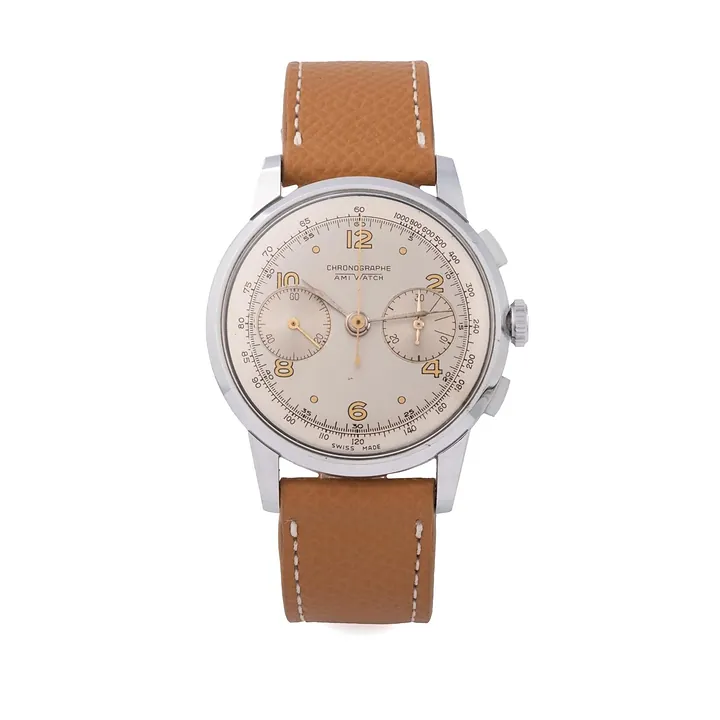
Ami Watch Chronographe, c. 1950s
Antiquorum auction archive, Geneva

Wristwatches · c. 1950s
Baume & Mercier wristwatch, c. 1950s
Antiquorum auction archive, Geneva
Wristwatches · c. 1955
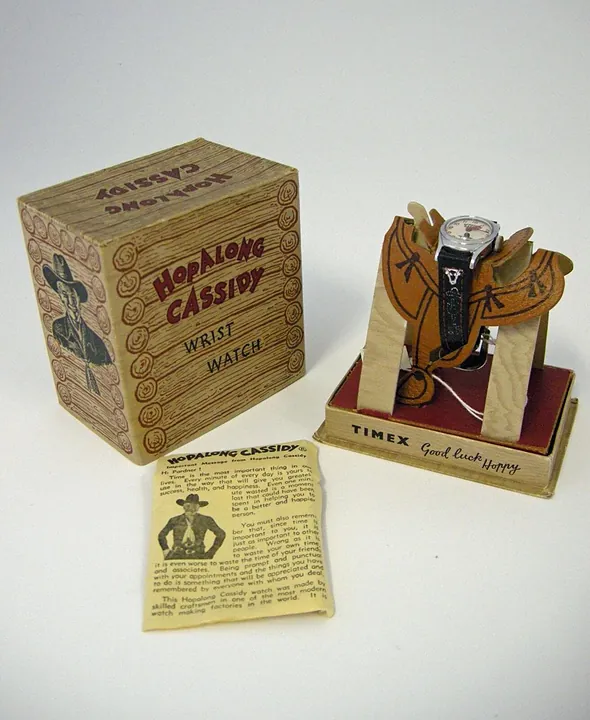
Child's wrist watch by Timex, Dundee, c. 1955
Victoria and Albert Museum, London
Wristwatches · c. 1950
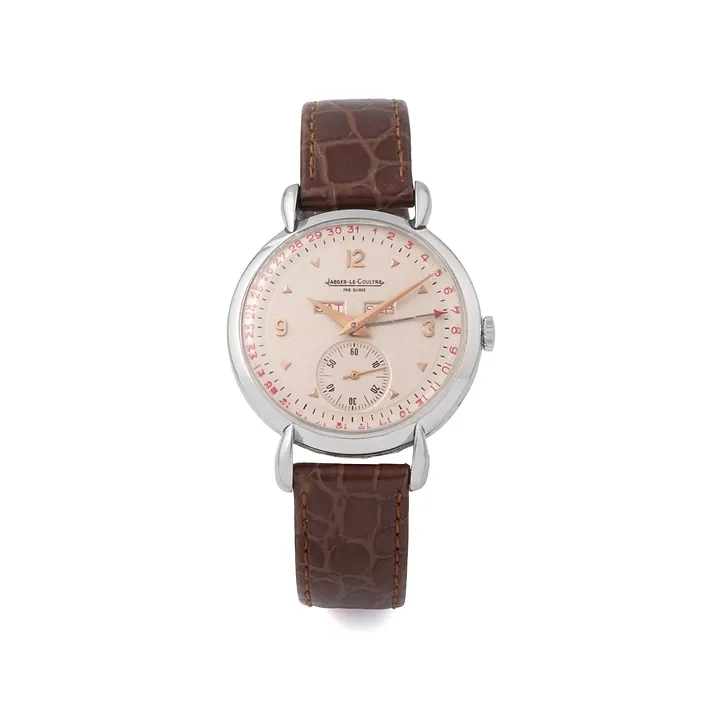
Jaeger Lecoultre Triple Calendar, c. 1950
Antiquorum auction archive, Geneva
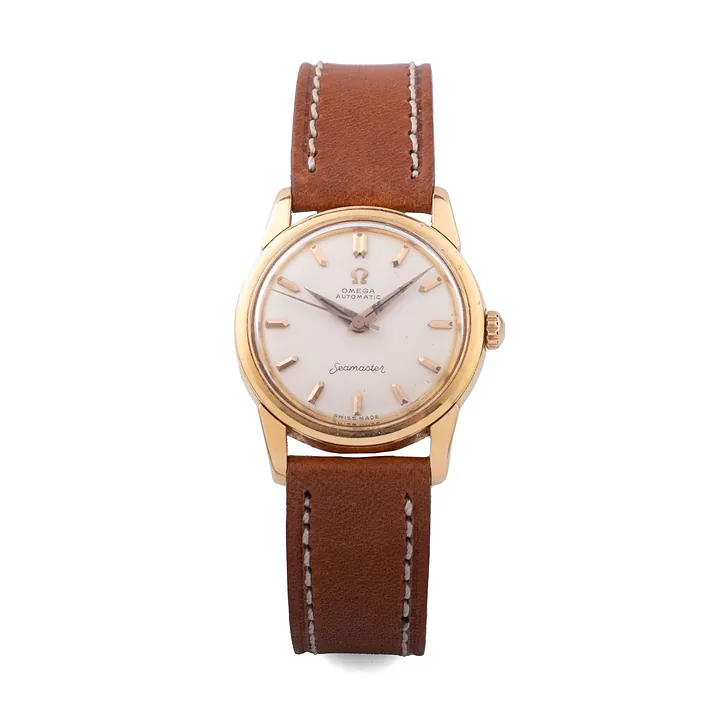
Wristwatches · c. 1950
Omega Seamaster Automatic, ref. 2991-1, c. 1950
Antiquorum auction archive, Geneva