
Wristwatches · Wristwatch
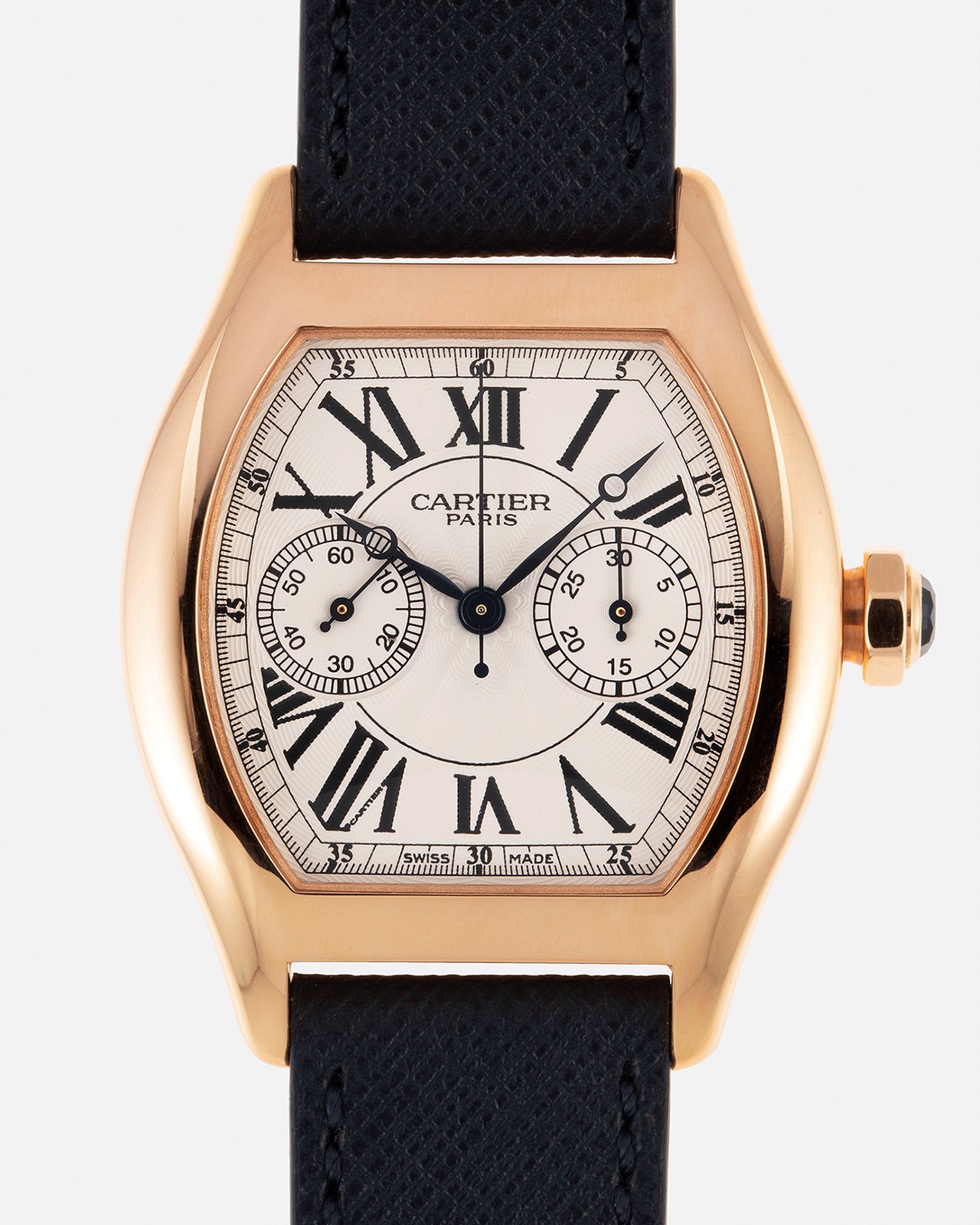
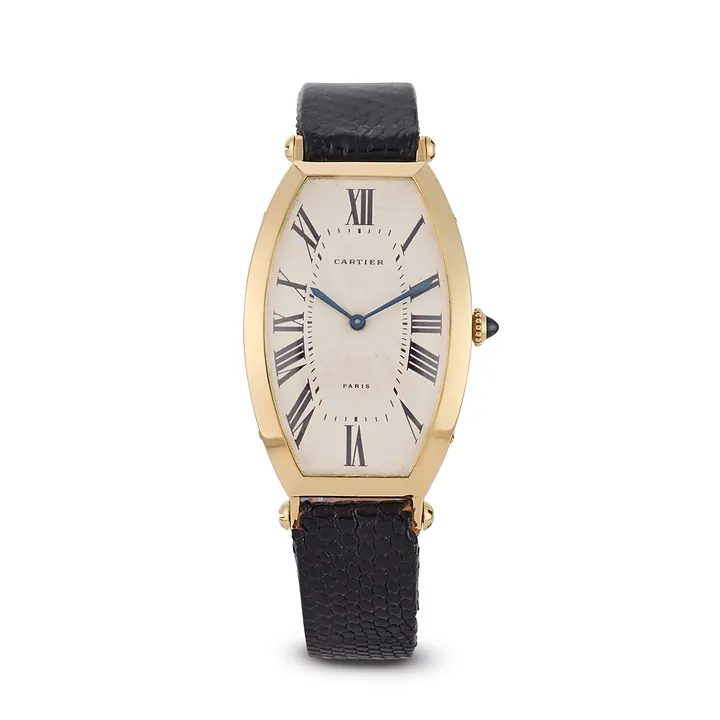
Cartier Tortue Monopoussoir CPCP, 2000s
- Maker / attribution
- Cartier (maker)
- Date
- 2000s
- Historical period
- Mechanical Renaissance (1990 – 2010)
- Country of origin
- France
- Object type
- Wristwatch
- Stock no.
- Product 6570285269079
- Credit line
- Dealer listing, S.Song Watches (product 6570285269079)
- Catalogue title (original)
- Cartier Tortue Monopoussoir CPCP (English)
View the source record (dealer listing) ↗ (opens another website in a new tab)Suggest a correction
Record summary
Catalogued by S.Song Watches (dealer), Seattle (stock number Product 6570285269079), this is a wristwatch by Cartier, made in France, dated 2000s. The Atlas places it in the Mechanical Renaissance period (1990 – 2010) of its Wristwatches collection. The record is illustrated with 6 photographs.
Assembled from the source record's structured fields. Dates and attributions are given as the source states them; where a field is missing the Atlas leaves it blank rather than estimating.
Catalogue description
Dealer description — S.Song Watches
The name Cartier needs no introduction. As one of the most influential and celebrated jewelry and watch brands of the last 100 years, it has always stood as a mark of luxury and desirability. Without taking away from its historical significance, I would say that when it comes to watches, Cartier has always been predominantly known as a ‘design’ brand rather than a pure watchmaking one, with stunningly iconic models such as the Tank, the Crash, and the Santos all seen as important due to how it looks. In fact, to this day, it is the beautiful and unconventional designs that attract collectors and a unique position in the watch brand hierarchy that no other possesses. As I have mentioned many times, the ’90s was an unconventional and murky time for watch brands, having just come out of the quartz crisis that decimated most of the industry. Brands were either experimenting like crazy or strictly conservative, wary of the fact they just survived the equivalent of a nuclear bomb. The industry was slowly coming back, with consumers beginning to take an interest in mechanical watches, and with this in mind, Cartier decided that it was time to improve its image as a true watchmaking brand. The result was the Collection Privé Cartier Paris division, referred to simply as the CPCP. The intention of the CPCP was to be the premier mechanical watchmaking division of Cartier and looking back on it today, it was one of the best decisions they ever made. The philosophy was simple, the CPCP took iconic models that were already loved by many, and reproduced them with high-grade movements, working with bonafide watch manufactures such as Piaget, Jaeger-LeCoultre, Frédéric Piguet, Girard-Perregaux, and more. The easiest way to differentiate a CPCP watch was by the dial, with all but one model (Tank Cintrée) featuring a ‘Cartier Paris’ inscription- an ode to its heritage. The dials were always crafted from solid gold and often featured a strong hand-turned guilloche pattern. Here, I have a Cartier Tortue Monopoussoir in 18kt in the rarely seen rose gold variant- one of the few pieces that came about from the CPCP. The Tortue was one of the earliest Cartier wristwatch designs and has always been an iconic shape for the house. First introduced in 1912 by Louis Cartier, it was modeled after the shape of a tortoise, hence the name ‘Tortue’. While it was arguably the white gold variant with the blue and white dial that really made the Monopoussoir famous, the rose gold version you see here today is arguably much rarer. I monitor the market regularly and rarely do I see this version appear. The case is spectacularly proportionate and what makes this model so special is the way in which the chronograph is designed. Usual watches would have pushers at 2 and 4 o’clock, but this Monopoussoir features a single pusher that starts, stops, and resets; all via the setting crown. The small gap you see between the crown and case is the space to activate the chronograph, which in my opinion is one of the most elegant ways to present this complication. Powered by the manually wound and incredibly finished Calibre 045MC movement, the Monopusher is an astounding piece of horology developed in conjunction with THA Èbauche, who was then a collaborative movement manufacture helmed by Vianney Halter, Danis Flageolet (who later founded De Bethune), and of course, Francois Paul Journe. Activated by a double swivel pin, the thud of the seconds hand which can occur in chronographs that are operated by a lateral clutch is removed and does not occur in the Monopusher. While this might seem like an insignificant detail, it is the sort of horological engineering Cartier was aiming for with the CPCP. Of all the CPCP models, I would say that the Tortue Monopoussoir is one of the most desired by collectors. This is partly due to the association with Francois-Paul Journe but mainly due to the genius design of it all. The CPCP collection ran for 10 years between 1998 and 2008 and I can confidently say it is one of the most significant periods in Cartier’s history. It’s beautiful to see that Cartier was doing ‘reissues’ before it was even a thing and doing it the right way- respecting the past while producing something that is modern. Not only this but the CPCP models were produced in truly limited numbers, with many having a designated run of 50 to 100 pieces. For those in the Collection Privé that weren’t strictly ‘limited’, it is estimated that only 250-300 pieces were made for each reference making any CPCP watch out there truly special. Collectors are finally taking notice of this, and Cartier in general is a brand worth collecting. With more knowledge available now, the demand for Cartier has been huge and I only see it getting larger, especially for important references such as those from the CPCP line.
Historical context
Mechanical Renaissance (1990 – 2010)
Mechanical watches return as cultural objects; independent watchmaking flourishes.
Mechanical watches returned as cultural and luxury objects. Complications, tourbillons and new materials proliferated; independent watchmakers such as George Daniels, F.P. Journe and Philippe Dufour revived artisanal watchmaking; collecting vintage watches became a major field.
Read the period in the timelineMore wristwatches from this periodEarlier: Quartz Revolution
Atlas type guide
Wristwatches
Bracelet watches were worn by women from the early nineteenth century — Breguet made one for Caroline Murat, Queen of Naples, in 1810–12 — but the wristwatch only became a man's instrument with military use and aviation in the early twentieth century. Between the World Wars it overtook the pocket watch; the 1920s and 1930s brought rectangular Art Deco cases, water-resistant cases and the first automatic winding systems.
After 1945 the wristwatch became a carrier of identity — dress watches, sports and dive watches, chronographs, calendars — produced by Swiss, American, Japanese, German, Soviet and Chinese industries. The quartz revolution after 1969 and the mechanical renaissance since the 1990s, including the rise of independent watchmakers, complete the story.
What to look for
- The reference number (between the lugs or inside the case back) and serial number, the starting point for dating.
- The calibre: its maker and number are often stamped under the dial or on the bridge.
- Originality of dial, hands and crown — refinished ('redial') dials are common.
- Case material marks: 18K/750, 14K/585, stainless steel, gold-filled, plated.
Dating clues
- Wire-lug cases: before c. 1925.
- Water-resistant screw-down cases: from 1926.
- Quartz movements: from 1969; sapphire crystals widespread after c. 1980.
General guidance written by the Atlas editors about this kind of object. It is not a statement about this particular piece; for that, rely on the source record above and on physical examination.
Related records

Clocks · 1863
Clock by Albert-Ernest Carrier-Belleuse, France, 1863
The Metropolitan Museum of Art, New York

Clocks · c. 1980s
Cartier "art Deco", c. 1980s
Antiquorum auction archive, Geneva

Clocks · c. 2000s
Cartier Desk Clock with Alarm, c. 2000s
Antiquorum auction archive, Geneva

Clocks · c. 2000s
Cartier Lacquer Arched Desk Clock with Alarm, ref. W0100037, c. 2000s
Antiquorum auction archive, Geneva
Wristwatches · c. 1990
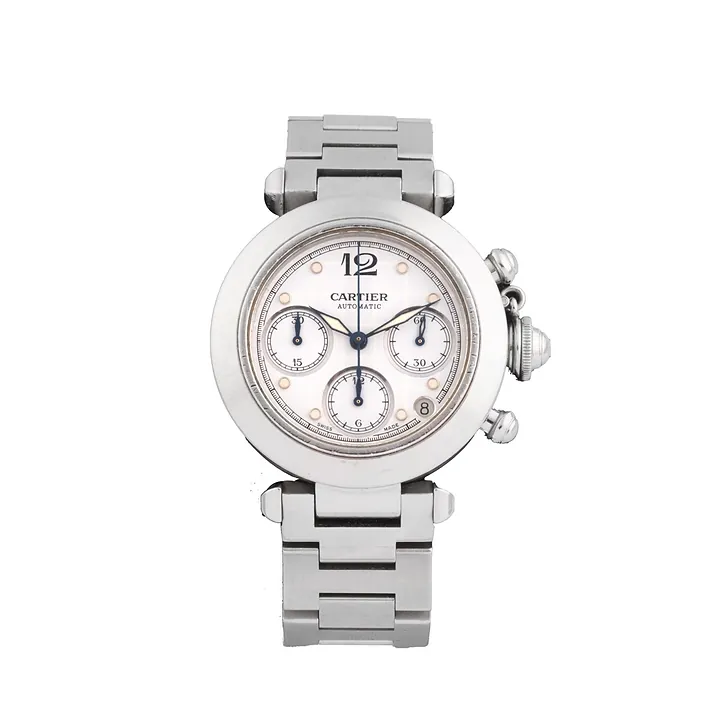
Cartier Pasha, ref. 2412, c. 1990
Antiquorum auction archive, Geneva
Wristwatches · c. 1990
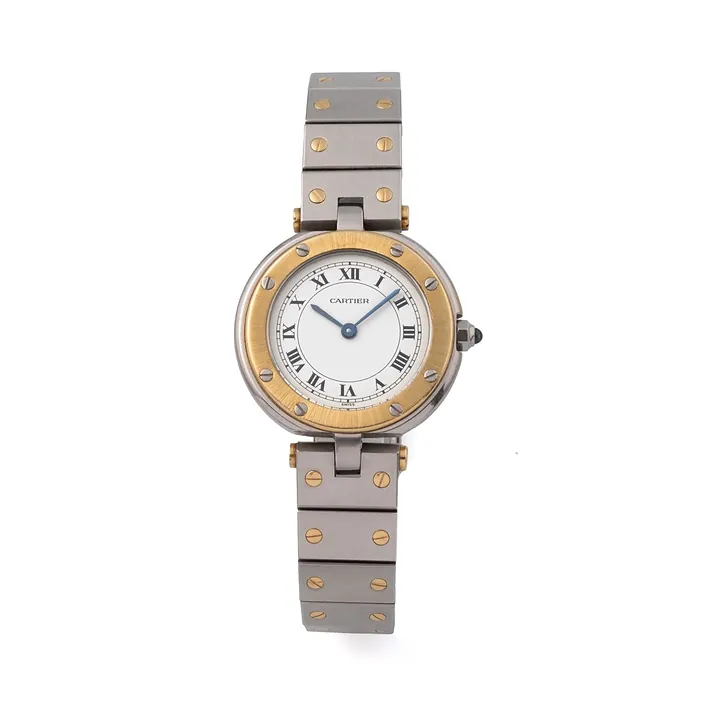
Cartier Santos Ronde Vendome, c. 1990
Antiquorum auction archive, Geneva
Wristwatches · c. 1990s
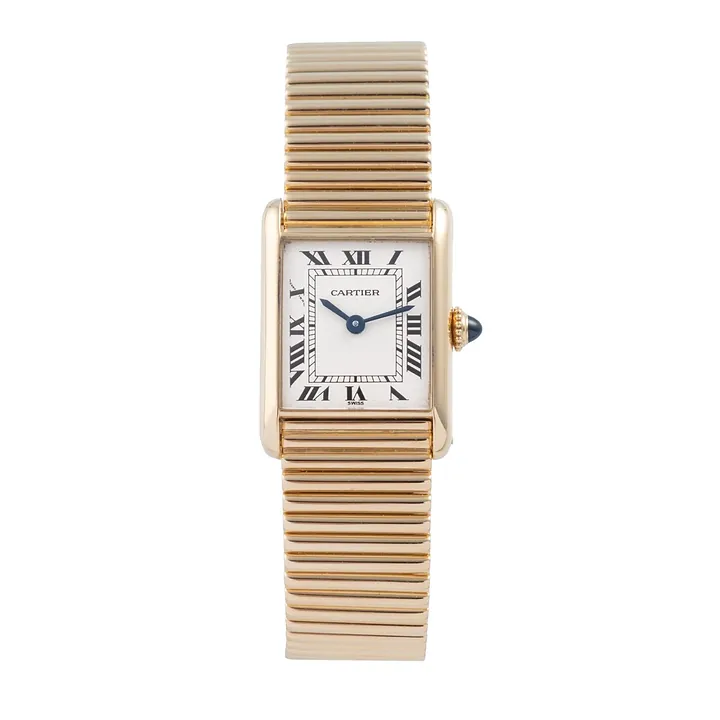
Cartier Tank Louis Cartier, ref. 6711, c. 1990s
Antiquorum auction archive, Geneva
Wristwatches · c. 1991
Cartier Tonneau Paris 1991, c. 1991
Antiquorum auction archive, Geneva