
Wristwatches · Wristwatch
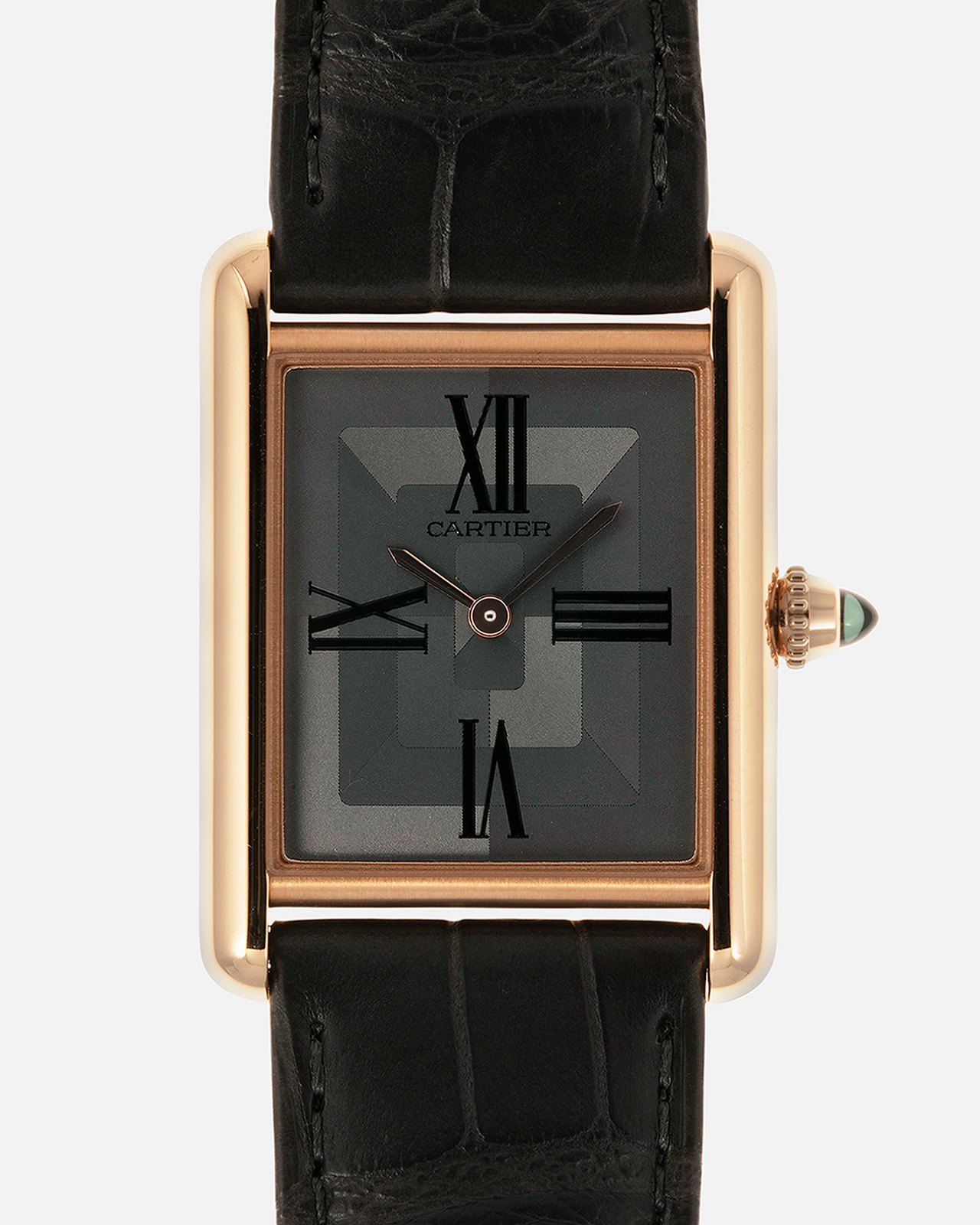
Cartier Tank Louis Cartier Large WGTA0092 Grey RG, 2022
- Maker / attribution
- Cartier (maker)
- Date
- 2022
- Historical period
- Contemporary Horology (2010 – Present)
- Country of origin
- France
- Object type
- Wristwatch
- Dimensions
- Case 25.5 mm
- Stock no.
- Product 7450301595735
- Credit line
- Dealer listing, S.Song Watches (product 7450301595735)
- Catalogue title (original)
- Cartier Tank Louis Cartier Large WGTA0092 Grey RG (English)
View the source record (dealer listing) ↗ (opens another website in a new tab)Suggest a correction
Record summary
Catalogued by S.Song Watches (dealer), Seattle (stock number Product 7450301595735), this is a wristwatch by Cartier, made in France, dated 2022. The Atlas places it in the Contemporary Horology period (2010 – Present) of its Wristwatches collection. Recorded dimensions: Case 25.5 mm. The record is illustrated with 6 photographs.
Assembled from the source record's structured fields. Dates and attributions are given as the source states them; where a field is missing the Atlas leaves it blank rather than estimating.
Catalogue description
Dealer description — S.Song Watches
The name Cartier requires no introduction. As one of the most influential and celebrated jewellery and watch brands of the last 100 years, it has always stood as a mark of luxury and desirability. Without taking away from its historical significance, I would say that when it comes to watches, Cartier has always been predominantly known as a ‘design’ brand rather than a pure watchmaking one, with stunningly iconic models such as the Tank, the Crash, and the Santos all seen as important due to how it looks. In fact, to this day, it is the beautiful and unconventional designs that attract collectors, and this allows it to hold a unique position in the watch brand hierarchy that no other brand possesses. Amongst the most famous watches lies a handful of timepieces that have stood the test of time for over an entire century. Released in 1917 and inspired by the Renault tanks Louis Cartier saw on the western front in WWI, the Cartier Tank is a classic timepiece that has become one of the famed French jewellery Maison's most important collections. Over its long and storied past, it has taken on many different shapes, styles, sizes, colours, and so much more. Offered here is a modern interpretation of the original: the Tank Louis Cartier 3816 in 18-carat rose gold, featuring a distinctive electrochemically engraved grey dial that, at the time of its debut, marked the Maison’s first use of this innovative technique. More on this later. In terms of case design, the Tank Louis Cartier retains the classic silhouette of the original—smooth, elegant, and restrained in its construction. The case measures 25.5mm x 33.7mm and is constructed entirely out of solid rose gold. Powering the Tank Louis Cartier from within is Cartier’s in-house, manual-winding Cal. 1917 MC. An ultra-thin movement that derives its namesake from the birth year of the Tank (1917), and holds a 38-hour power reserve on a full wind. The defining feature of this Tank Louis Cartier is undoubtedly its captivating anthracite grey Art Deco dial—a tribute to the designs of the 1990s, which themselves were inspired by timepieces from the Art Deco era of the 1910s and 1920s. While the time-only layout may not be revolutionary, the multi-toned grey palette harmonises beautifully with the warm, lustrous rose gold case. Adding visual depth, the electrochemically engraved pattern creates a dynamic surface enriched by subtle gradients of grey that shift with changes in light. This textured backdrop serves as the perfect canvas for four oversized Arabic numerals and a pair of case-matching sword-shaped hands. For those unfamiliar, electrochemical engraving, also known as electrochemical etching, is a process that uses electrical current and a chemical solution to etch metal surfaces without applying heat or physical force. It is widely used across various industries to permanently mark items such as surgical instruments, knives, and components like watch dials with logos, serial numbers, or detailed patterns. In the case of the Tank Louis Cartier, this engraving technique creates a rich and striking dial, engraved in different directions to form intricate sections that subtly reveal themselves as the light shifts. The result is a visually engaging effect that feels both refined and understated. This particular design draws inspiration from the graphic motifs found on Must de Cartier watches from the 1980s. Although the dial may appear to show multiple shades of grey, this is purely a visual illusion caused by the variation in engraving depth and direction, rather than any difference in pigment. As a whole, the restraint demonstrated in this design is exceptional. Cartier has masterfully balanced vintage inspiration with modern minimalism, lending the classic dial a refreshed and contemporary character. Completing the overall aesthetic, the signature sapphire-blue cabochon on the crown adds a vivid touch of contrast against the watch’s otherwise subdued palette. Again, Cartier isn’t exactly a brand that is historically known for high-end technical watchmaking, but the Maison represents something so much more than that. There is a certain sense of transcendence in their designs that speaks to multiple generations of watch enthusiasts and connoisseurs. For me, that transcendence is represented in the form of a Cartier Tank, especially the Tank Louis. It holds a special place in my heart and is a big reason why I love Cartier. The Cartier Tank Louis is simply a watch that never goes out of style, and especially so with its Art Deco variants. It is discrete and restrained in design but yet always manages to catch the attention of the room in whatever situation.
Historical context
Contemporary Horology (2010 – Present)
Silicon components, connected watches, optical-lattice research clocks and a thriving independent scene.
Smartwatches became the world's best-selling watches, while mechanical watchmaking focuses on craft, innovation (silicon components, new escapements) and independent makers.
Read the period in the timelineMore wristwatches from this periodEarlier: Mechanical Renaissance
Atlas type guide
Wristwatches
Bracelet watches were worn by women from the early nineteenth century — Breguet made one for Caroline Murat, Queen of Naples, in 1810–12 — but the wristwatch only became a man's instrument with military use and aviation in the early twentieth century. Between the World Wars it overtook the pocket watch; the 1920s and 1930s brought rectangular Art Deco cases, water-resistant cases and the first automatic winding systems.
After 1945 the wristwatch became a carrier of identity — dress watches, sports and dive watches, chronographs, calendars — produced by Swiss, American, Japanese, German, Soviet and Chinese industries. The quartz revolution after 1969 and the mechanical renaissance since the 1990s, including the rise of independent watchmakers, complete the story.
What to look for
- The reference number (between the lugs or inside the case back) and serial number, the starting point for dating.
- The calibre: its maker and number are often stamped under the dial or on the bridge.
- Originality of dial, hands and crown — refinished ('redial') dials are common.
- Case material marks: 18K/750, 14K/585, stainless steel, gold-filled, plated.
Dating clues
- Wire-lug cases: before c. 1925.
- Water-resistant screw-down cases: from 1926.
- Quartz movements: from 1969; sapphire crystals widespread after c. 1980.
General guidance written by the Atlas editors about this kind of object. It is not a statement about this particular piece; for that, rely on the source record above and on physical examination.
Related records

Clocks · 1863
Clock by Albert-Ernest Carrier-Belleuse, France, 1863
The Metropolitan Museum of Art, New York

Clocks · c. 1980s
Cartier "art Deco", c. 1980s
Antiquorum auction archive, Geneva

Clocks · c. 2000s
Cartier Desk Clock with Alarm, c. 2000s
Antiquorum auction archive, Geneva

Clocks · c. 2000s
Cartier Lacquer Arched Desk Clock with Alarm, ref. W0100037, c. 2000s
Antiquorum auction archive, Geneva
Wristwatches · c. 2010s
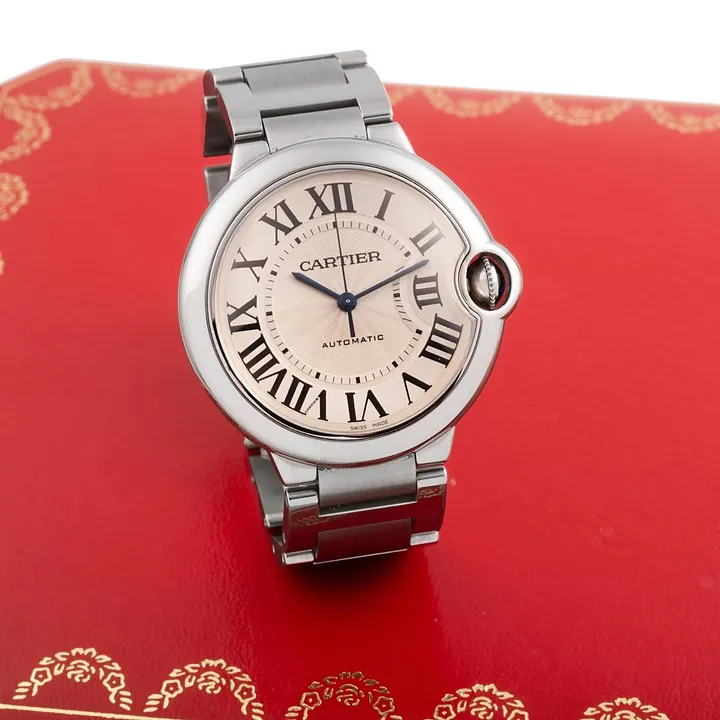
Cartier Ballon Bleu, ref. 3284, c. 2010s
Antiquorum auction archive, Geneva

Wristwatches · originally sold in December 2021 (per the lot record)
Cartier Tank Must, ref. CRWSTA0054, originally sold in December 2021
Antiquorum auction archive, Geneva
Wristwatches · originally sold in 2023 (per the lot record)
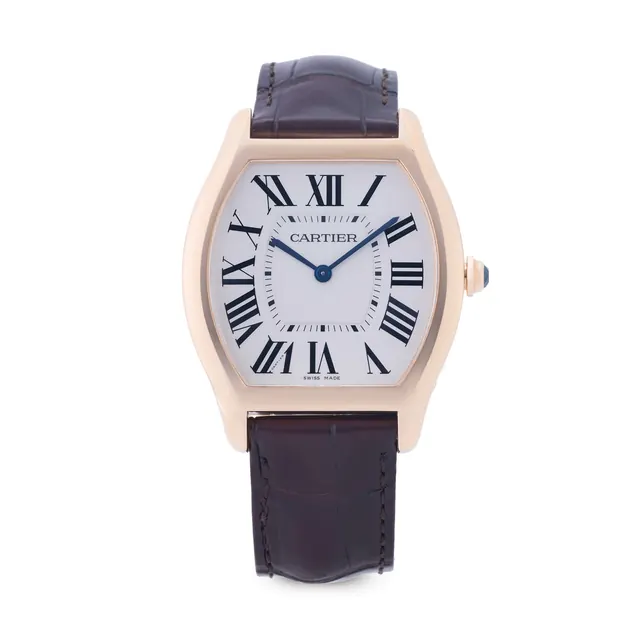
Cartier wristwatch, ref. WGTO0002, Tortue, originally sold in 2023
Antiquorum auction archive, Geneva
Wristwatches · c. 2020
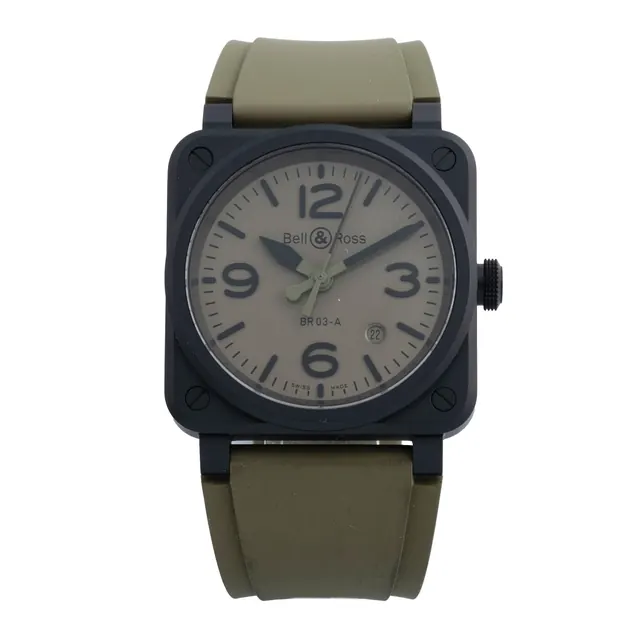
Bell & Ross wristwatch, ref. BR, Aviation Type, circa 2020
Antiquorum auction archive, Geneva