
Wristwatches · Wristwatch
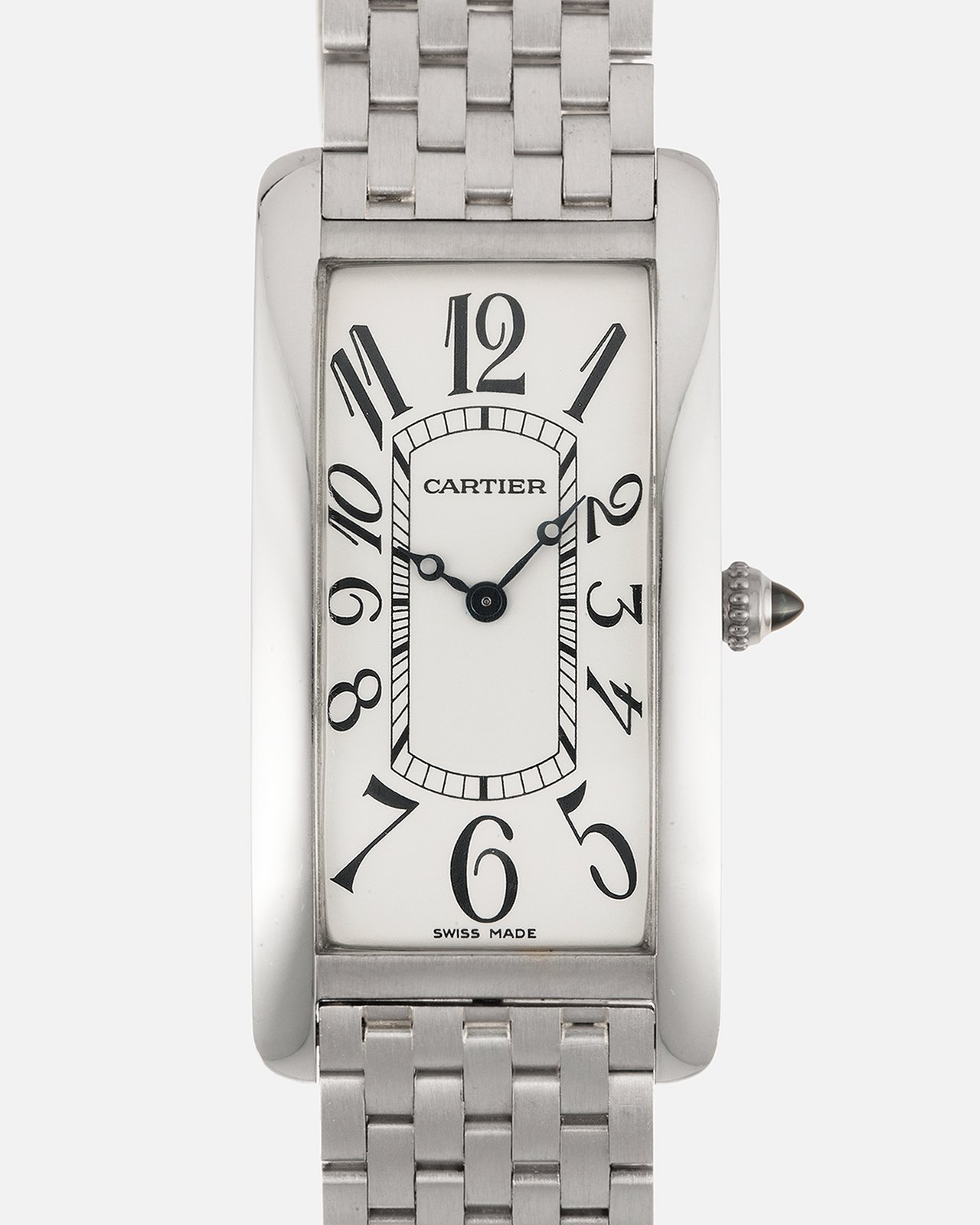
Cartier Tank Cintree Bracelet Collection Prive CPCP Platinum, 2005
- Maker / attribution
- Cartier (maker)
- Date
- 2005
- Historical period
- Mechanical Renaissance (1990 – 2010)
- Country of origin
- France
- Object type
- Wristwatch
- Materials / technique
- platinum
- Dimensions
- Case 46 mm
- Stock no.
- Product 7261134553175
- Credit line
- Dealer listing, S.Song Watches (product 7261134553175)
- Catalogue title (original)
- Cartier Tank Cintree Bracelet Collection Prive CPCP Platinum (English)
View the source record (dealer listing) ↗ (opens another website in a new tab)Suggest a correction
Record summary
Catalogued by S.Song Watches (dealer), Seattle (stock number Product 7261134553175), this is a wristwatch by Cartier, made in France, dated 2005. The Atlas places it in the Mechanical Renaissance period (1990 – 2010) of its Wristwatches collection. Materials and techniques recorded by the source: platinum. Recorded dimensions: Case 46 mm. The record is illustrated with 6 photographs.
Assembled from the source record's structured fields. Dates and attributions are given as the source states them; where a field is missing the Atlas leaves it blank rather than estimating.
Catalogue description
Dealer description — S.Song Watches
The name Cartier needs no introduction. As one of the most influential and celebrated jewelry and watch brands of the last century, it has always stood as a mark of luxury and desirability. Without taking away from its historical significance, I would say that when it comes to watches, Cartier has always been predominantly known as a ‘design’ brand rather than a pure watchmaking one, with stunningly iconic models such as the Tank, the Crash, and the Santos all seen as important due to how it looks. In fact, to this day, it is the beautiful and unconventional designs that attract collectors and allow it to hold a unique position in the watch brand hierarchy that no other possesses. As I have mentioned many times before, the '90s were a challenging time for watch brands recovering from the quartz crisis, with many brands either experimenting wildly or remaining conservative. As interest in mechanical watches grew, Cartier decided that it was time to show the world what the Maison was capable of. With that in mind, Cartier launched the Collection Privée Cartier Paris (CPCP) division, which was an initiative focused on recreating beloved models with high-quality movements, collaborating with renowned manufacturers like Piaget, Jaeger-LeCoultre, and others. Looking back, it was a pivotal and defining decision for the Maison . What we have here today is an exceptional example of a Cartier Tank Cintrée from the said CPCP era (between 1998 – 2008), with a case crafted from a stunning platinum 950 and comes fitted with a stunning brick bracelet in 18-carat white gold. For historical context, the Tank Cintrée made its debut in 1921, a mere two years following the introduction of the original Tank and has intermittently held its place in the brand's repertoire ever since. While Cartier produces many models under the CPCP banner, the most ardent Cartier collectors will all collectively agree that the holy grail, end game piece from this era is undoubtedly the platinum Tank Cintrée. Of course, any Tank Cintrée would be special in its own right irrespective of variant, but the CPCP version stands its ground as one of the most desirable Cartier pieces ever produced. Limited to only 50 pieces, these do not come on the market very often. While it is hard enough to come by a Platinum Collection Prive Cintree, to find one fitted on a brick bracelet, inspired by Cartier’s past is truly, truly special. The brick bracelet is one of Cartier’s finest designs and in my opinion completely transforms the feel and wear on the Cintree. I cannot emphasise just how good it is. Designed as a more refined and graceful iteration of the Tank, the Tank Cintrée boasts a distinctive case profile characterized by a seemingly broad, elongated yet slender design (this example measuring 46mm x 23mm) with a subtle arch, seamlessly embracing any wrist it graces and effortlessly fitting under the cuff. As with all Tank Cintrées, it is hard to describe in mere words just how elegant and thoughtful the case design is. It is only once after one wears a Tank Cintrée, that they truly understand what the hype is all about. I have never seen a watch sit so perfectly flush against my wrist, and that is a true testament to the masterful design of the Tank Cintrée. Moving on to its matte silver dial, this Tank Cintrée encapsulates quintessential Cartier aesthetic codes, showcasing a lavish design with exploded Arabic numerals in black that fill up the space along the periphery, a contrasting railway minutes track, a set of blued steel apple-shaped hands, as well as the iconic and striking sapphire blue cabochon set on its beaded crown which makes an excellent complementary design element to the blued steel hands. It is also worth mentioning that this CPCP version was modelled after one of the most famous unique examples, the luminous 1929 ‘Fred Astaire’, worn by the man himself. Powered by the manually wound Cartier Cal. 9770 MC (based on a Jaeger-LeCoultre ébauche), this Tank Cintrée is truly exceptional. The uniqueness of the Tank Cintrée, along with its significance from the CPCP era, makes it one of the most collectable pieces in Cartier’s collection and in the realm of watch collecting as a whole. Given everything I have discussed above, it's no mystery why the Tank Cintrée has prominently held the esteemed position of the flagship model within the renowned Maison — it simply looks and wears like a dream. Undoubtedly, it stands out as one of the most iconic Cartier timepieces and an absolute must-have for any serious collector.
Historical context
Mechanical Renaissance (1990 – 2010)
Mechanical watches return as cultural objects; independent watchmaking flourishes.
Mechanical watches returned as cultural and luxury objects. Complications, tourbillons and new materials proliferated; independent watchmakers such as George Daniels, F.P. Journe and Philippe Dufour revived artisanal watchmaking; collecting vintage watches became a major field.
Read the period in the timelineMore wristwatches from this periodEarlier: Quartz Revolution
Atlas type guide
Wristwatches
Bracelet watches were worn by women from the early nineteenth century — Breguet made one for Caroline Murat, Queen of Naples, in 1810–12 — but the wristwatch only became a man's instrument with military use and aviation in the early twentieth century. Between the World Wars it overtook the pocket watch; the 1920s and 1930s brought rectangular Art Deco cases, water-resistant cases and the first automatic winding systems.
After 1945 the wristwatch became a carrier of identity — dress watches, sports and dive watches, chronographs, calendars — produced by Swiss, American, Japanese, German, Soviet and Chinese industries. The quartz revolution after 1969 and the mechanical renaissance since the 1990s, including the rise of independent watchmakers, complete the story.
What to look for
- The reference number (between the lugs or inside the case back) and serial number, the starting point for dating.
- The calibre: its maker and number are often stamped under the dial or on the bridge.
- Originality of dial, hands and crown — refinished ('redial') dials are common.
- Case material marks: 18K/750, 14K/585, stainless steel, gold-filled, plated.
Dating clues
- Wire-lug cases: before c. 1925.
- Water-resistant screw-down cases: from 1926.
- Quartz movements: from 1969; sapphire crystals widespread after c. 1980.
General guidance written by the Atlas editors about this kind of object. It is not a statement about this particular piece; for that, rely on the source record above and on physical examination.
Related records
Clocks · 1863
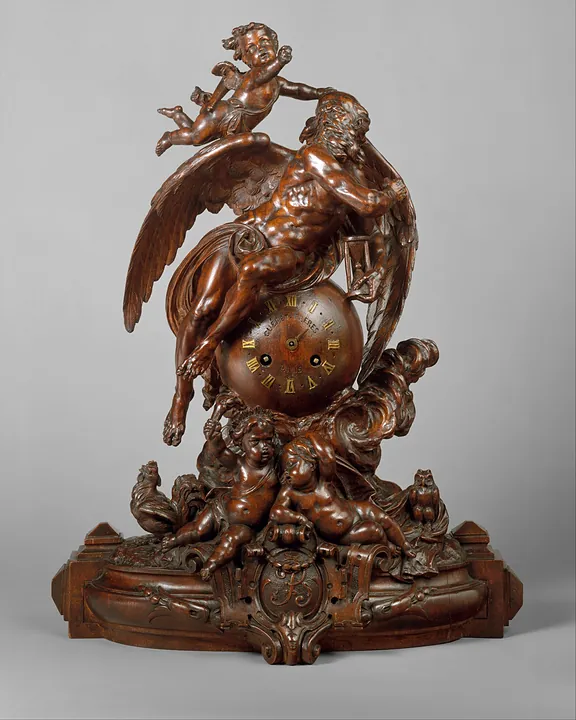
Clock by Albert-Ernest Carrier-Belleuse, France, 1863
The Metropolitan Museum of Art, New York
Clocks · c. 1980s
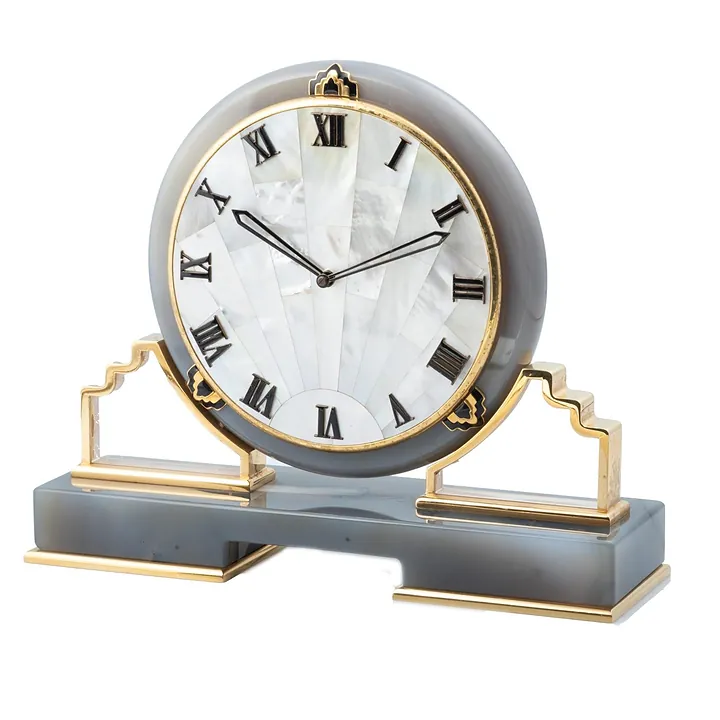
Cartier "art Deco", c. 1980s
Antiquorum auction archive, Geneva
Clocks · c. 2000s
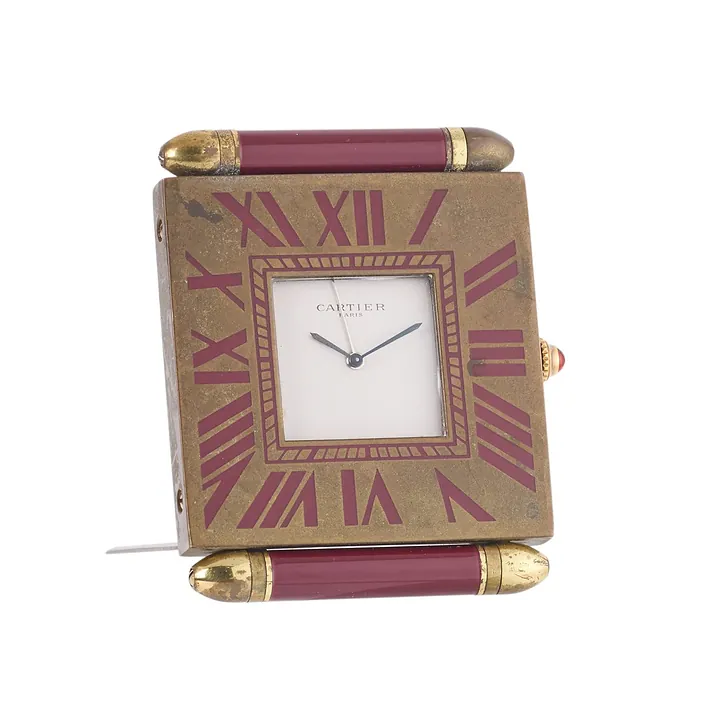
Cartier Desk Clock with Alarm, c. 2000s
Antiquorum auction archive, Geneva
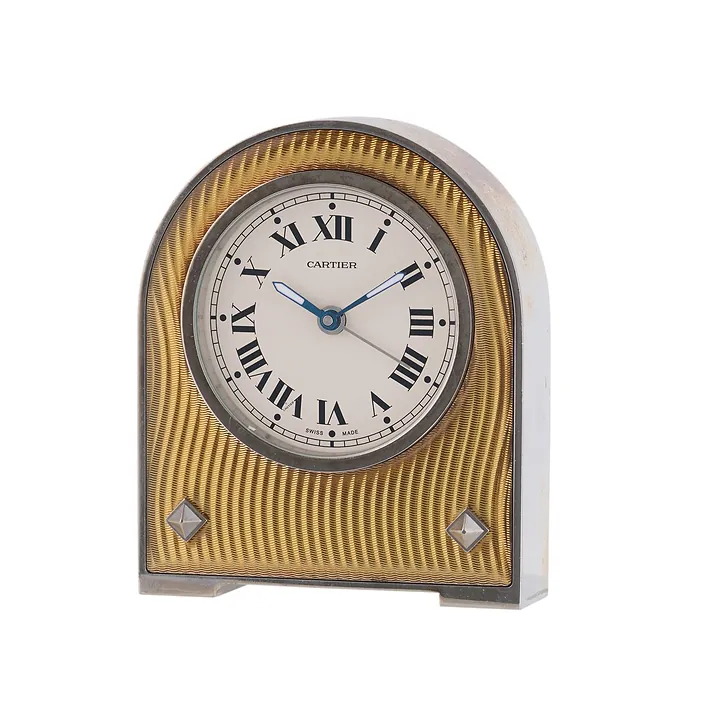
Clocks · c. 2000s
Cartier Lacquer Arched Desk Clock with Alarm, ref. W0100037, c. 2000s
Antiquorum auction archive, Geneva
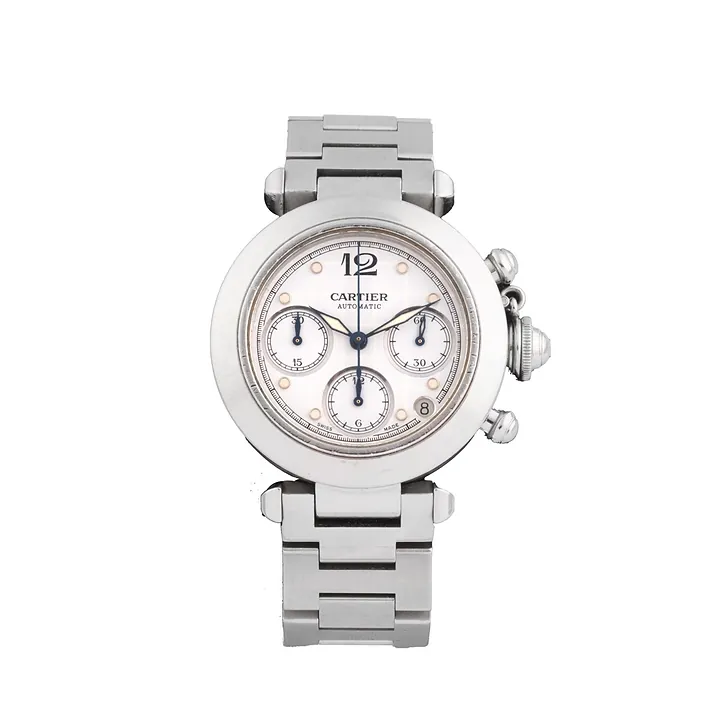
Wristwatches · c. 1990
Cartier Pasha, ref. 2412, c. 1990
Antiquorum auction archive, Geneva
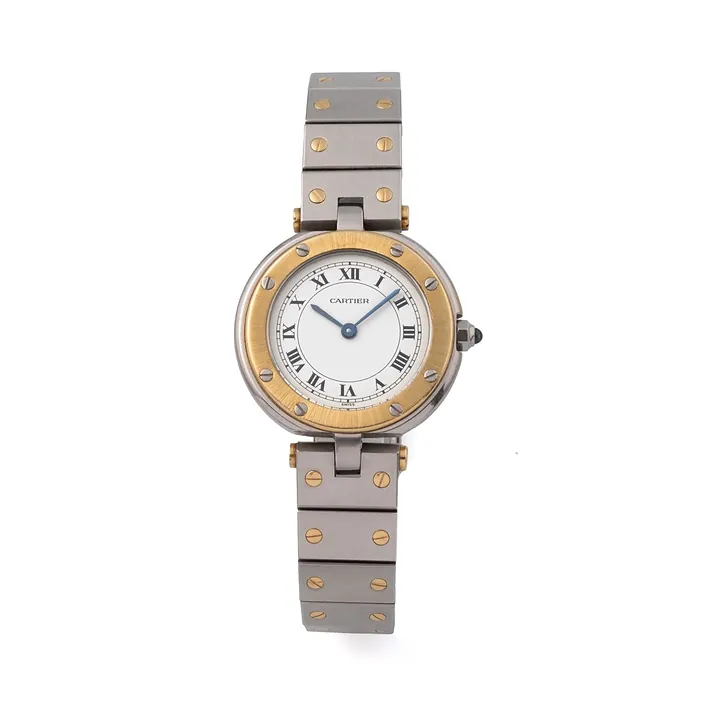
Wristwatches · c. 1990
Cartier Santos Ronde Vendome, c. 1990
Antiquorum auction archive, Geneva
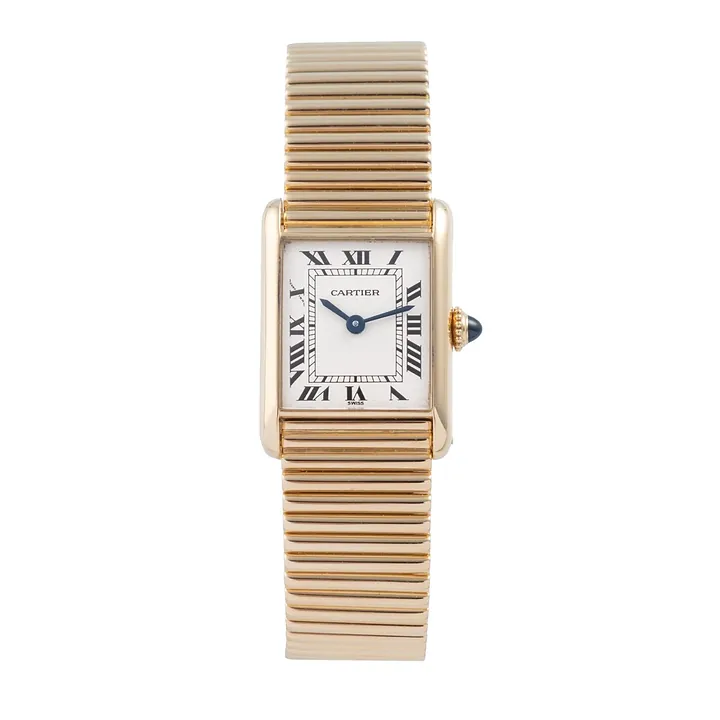
Wristwatches · c. 1990s
Cartier Tank Louis Cartier, ref. 6711, c. 1990s
Antiquorum auction archive, Geneva
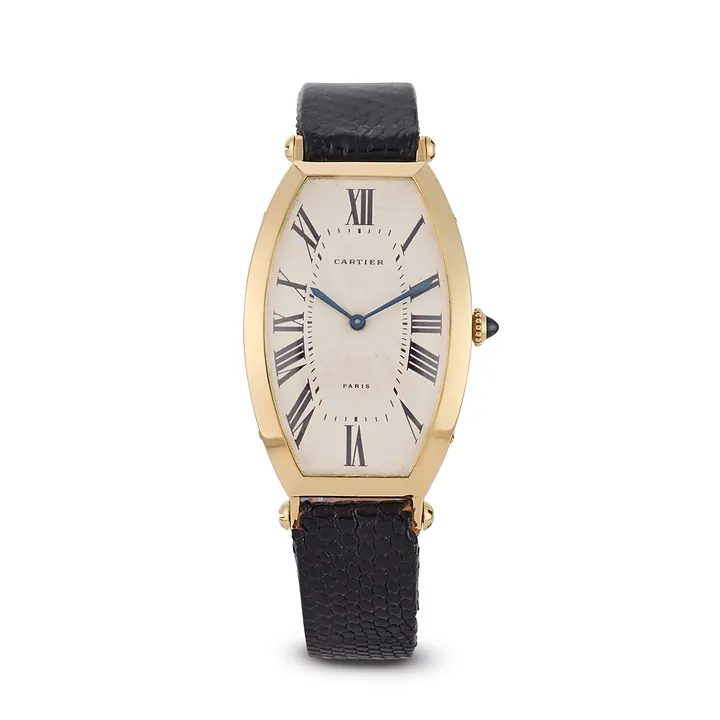
Wristwatches · c. 1991
Cartier Tonneau Paris 1991, c. 1991
Antiquorum auction archive, Geneva