
Wristwatches · Wristwatch
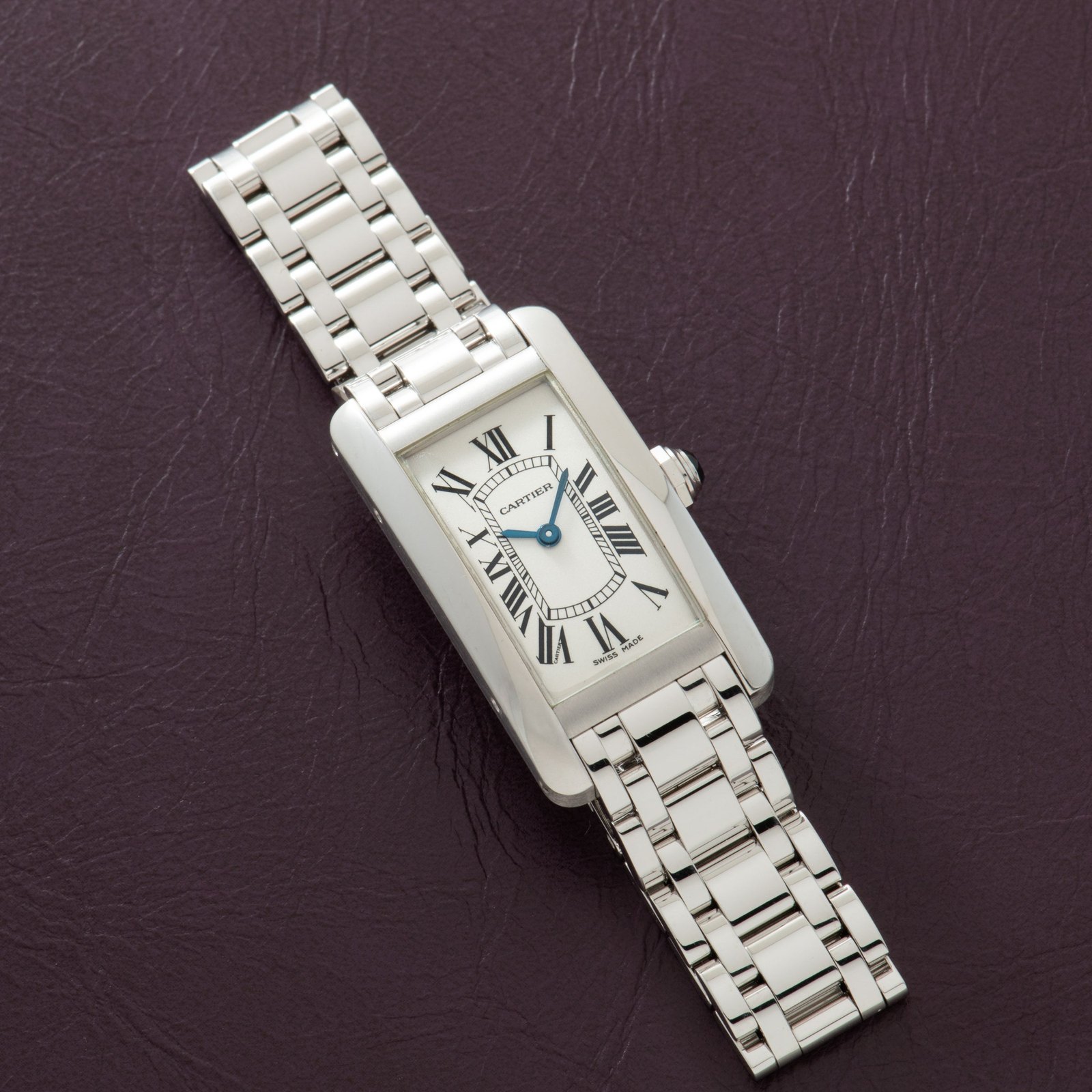
Cartier Tank Américaine Small, 1990s
- Maker / attribution
- Cartier (maker)
- Date
- 1990s
- Historical period
- Mechanical Renaissance (1990 – 2010)
- Country of origin
- France
- Object type
- Wristwatch
- Stock no.
- 40950647
- Credit line
- Dealer listing, Analog/Shift (40950647)
- Catalogue title (original)
- Cartier Tank Américaine Small (English)
View the source record (dealer listing) ↗ (opens another website in a new tab)Suggest a correction
Record summary
Catalogued by Analog/Shift (dealer), New York (stock number 40950647), this is a wristwatch by Cartier, made in France, dated 1990s. The Atlas places it in the Mechanical Renaissance period (1990 – 2010) of its Wristwatches collection. The record is illustrated with 6 photographs.
Assembled from the source record's structured fields. Dates and attributions are given as the source states them; where a field is missing the Atlas leaves it blank rather than estimating.
Catalogue description
Dealer description — Analog/Shift
Cartier has never been particularly interested in following the rules of conventional watchmaking. From the Santos to the Tank, the maison’s greatest successes have come from treating the wristwatch as an exercise in design rather than simply a means of telling time. Introduced in 1989, the Tank Américaine was a continuation of that thinking, borrowing the elongated, curved proportions of the Tank Cintrée from 1921 and reinterpreting them for a new generation. The result was a watch that felt unmistakably Cartier, but with a slightly more contemporary attitude. Dating to the 1990s, this small-model Tank Américaine is executed entirely in 18K white gold, including its beautifully articulated multi-link bracelet. The elongated rectangular case features the collection’s distinctive curved profile, with generously proportioned brancards that give the watch an almost sculptural quality. The silver-toned dial is pure Cartier: oversized black Roman numerals, an inner railroad-track minute track, and blued-steel sword-shaped hands. A blue cabochon crown provides the finishing touch. There’s nothing particularly complicated about the design, but the proportions and subtle interplay of polished and brushed surfaces make it considerably more interesting than a conventional rectangular dress watch. Powered by a quartz movement, this example is particularly appealing for its integrated white-gold bracelet, which transforms the Américaine into something that sits comfortably between a wristwatch and jewelry. There’s a certain late-1980s and early-1990s confidence to the combination, when precious-metal watches were as much about personal style as traditional horology. The Tank Américaine has never quite enjoyed the universal recognition of the Tank Louis Cartier, which is perhaps part of its appeal. It takes one of watchmaking’s most familiar designs, stretches the proportions, softens the geometry, and arrives somewhere altogether different. More architectural than ornamental, it’s a reminder that Cartier’s greatest complication has always been design itself.
Historical context
Mechanical Renaissance (1990 – 2010)
Mechanical watches return as cultural objects; independent watchmaking flourishes.
Mechanical watches returned as cultural and luxury objects. Complications, tourbillons and new materials proliferated; independent watchmakers such as George Daniels, F.P. Journe and Philippe Dufour revived artisanal watchmaking; collecting vintage watches became a major field.
Read the period in the timelineMore wristwatches from this periodEarlier: Quartz Revolution
Atlas type guide
Wristwatches
Bracelet watches were worn by women from the early nineteenth century — Breguet made one for Caroline Murat, Queen of Naples, in 1810–12 — but the wristwatch only became a man's instrument with military use and aviation in the early twentieth century. Between the World Wars it overtook the pocket watch; the 1920s and 1930s brought rectangular Art Deco cases, water-resistant cases and the first automatic winding systems.
After 1945 the wristwatch became a carrier of identity — dress watches, sports and dive watches, chronographs, calendars — produced by Swiss, American, Japanese, German, Soviet and Chinese industries. The quartz revolution after 1969 and the mechanical renaissance since the 1990s, including the rise of independent watchmakers, complete the story.
What to look for
- The reference number (between the lugs or inside the case back) and serial number, the starting point for dating.
- The calibre: its maker and number are often stamped under the dial or on the bridge.
- Originality of dial, hands and crown — refinished ('redial') dials are common.
- Case material marks: 18K/750, 14K/585, stainless steel, gold-filled, plated.
Dating clues
- Wire-lug cases: before c. 1925.
- Water-resistant screw-down cases: from 1926.
- Quartz movements: from 1969; sapphire crystals widespread after c. 1980.
General guidance written by the Atlas editors about this kind of object. It is not a statement about this particular piece; for that, rely on the source record above and on physical examination.
Related records

Clocks · 1863
Clock by Albert-Ernest Carrier-Belleuse, France, 1863
The Metropolitan Museum of Art, New York

Clocks · c. 1980s
Cartier "art Deco", c. 1980s
Antiquorum auction archive, Geneva

Clocks · c. 2000s
Cartier Desk Clock with Alarm, c. 2000s
Antiquorum auction archive, Geneva

Clocks · c. 2000s
Cartier Lacquer Arched Desk Clock with Alarm, ref. W0100037, c. 2000s
Antiquorum auction archive, Geneva
Wristwatches · c. 1990
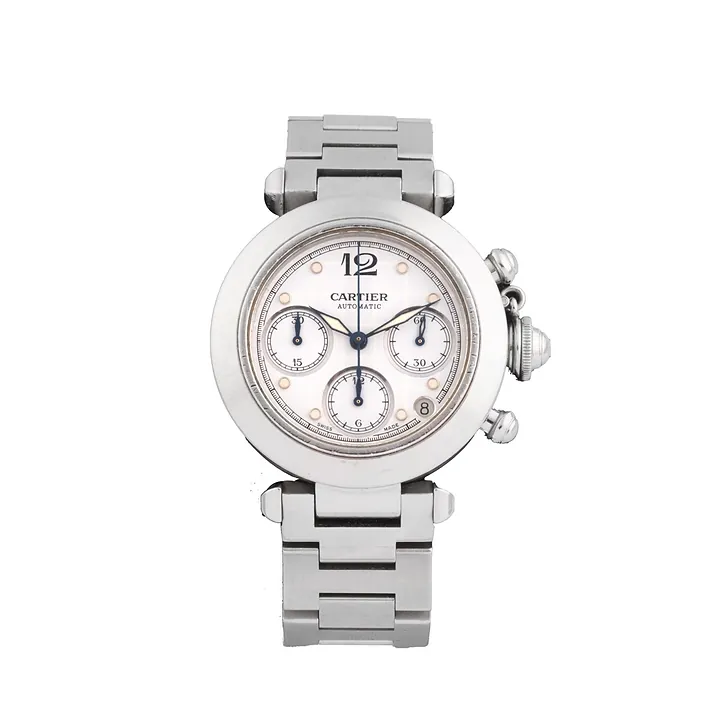
Cartier Pasha, ref. 2412, c. 1990
Antiquorum auction archive, Geneva
Wristwatches · c. 1990
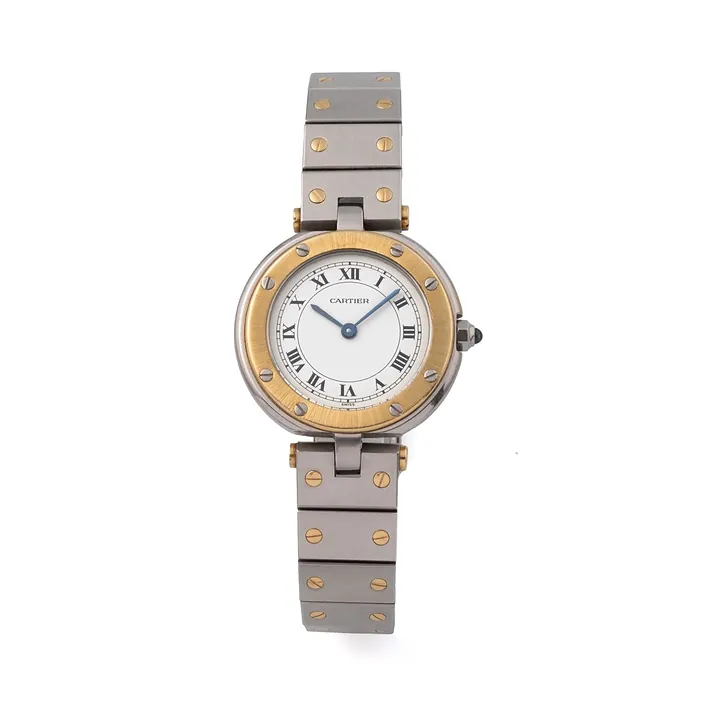
Cartier Santos Ronde Vendome, c. 1990
Antiquorum auction archive, Geneva
Wristwatches · c. 1990s
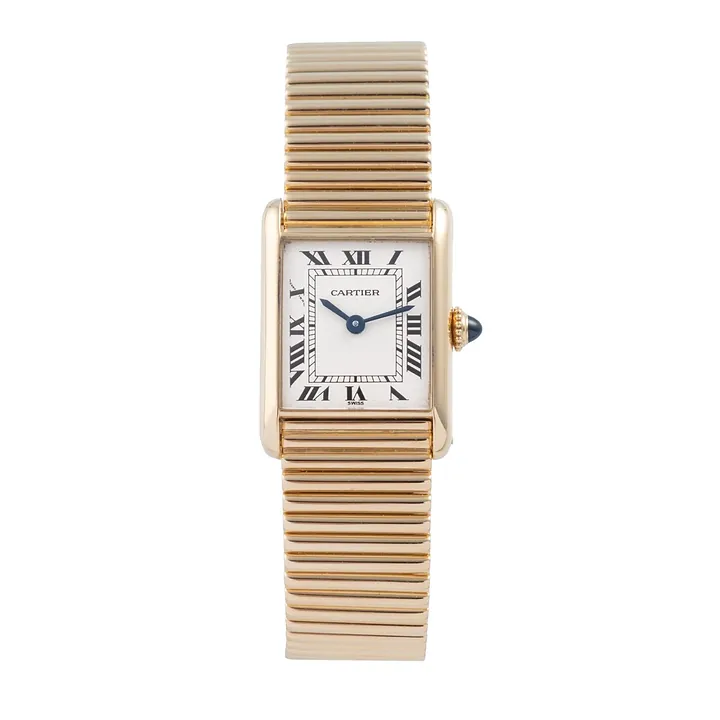
Cartier Tank Louis Cartier, ref. 6711, c. 1990s
Antiquorum auction archive, Geneva
Wristwatches · c. 1991
Cartier Tonneau Paris 1991, c. 1991
Antiquorum auction archive, Geneva