
Wristwatches · Wristwatch
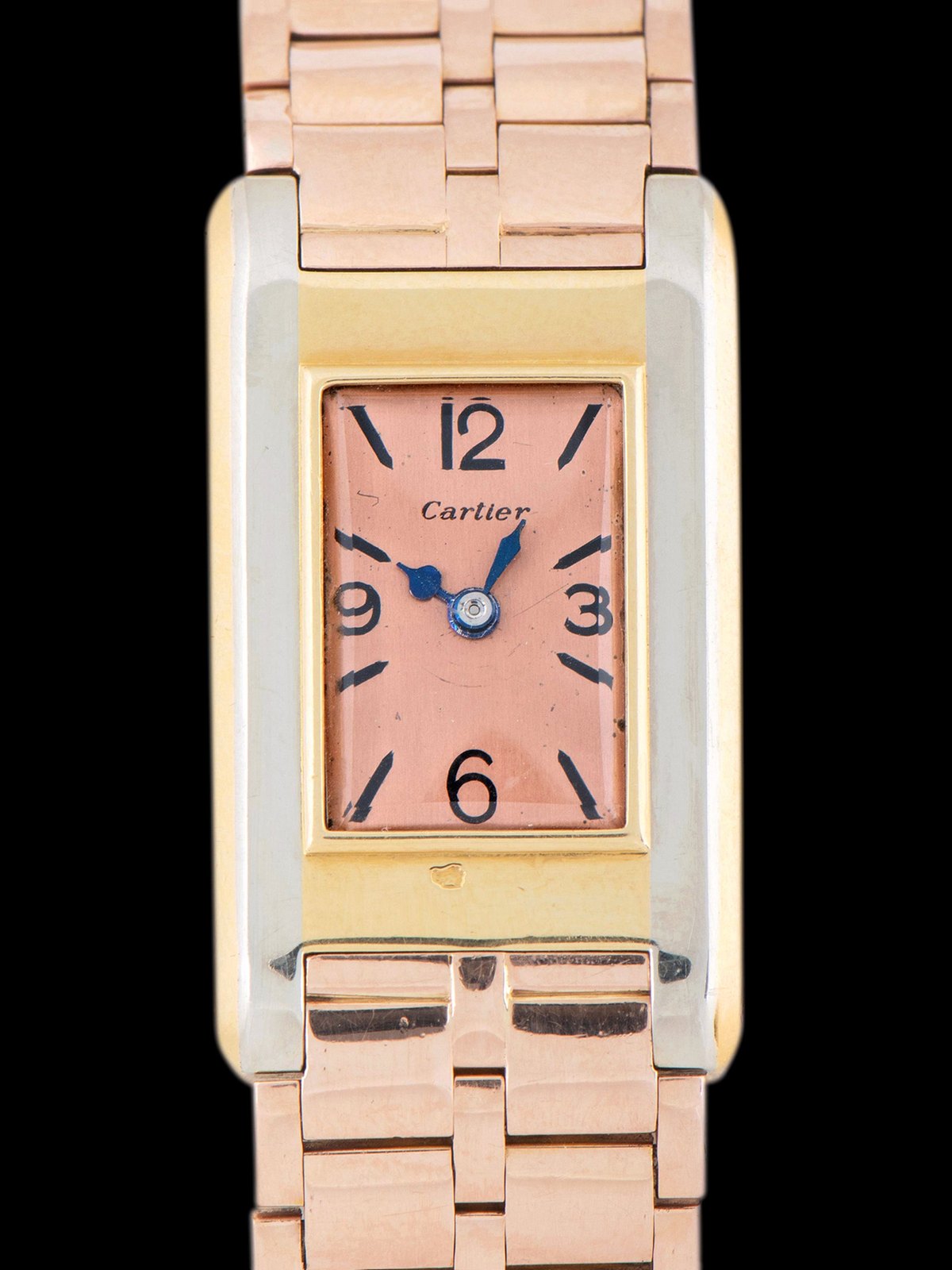
Cartier Tank Allongée 'Duoplan' Two-Tone 18K YG & WG Case W/ 18K RG Bracelet, 1940s
- Maker / attribution
- Cartier (maker)
- Date
- 1940s
- Historical period
- Golden Age of Mechanical Watchmaking (1900 – 1945)
- Country of origin
- France
- Object type
- Wristwatch
- Materials / technique
- two-tone
- Stock no.
- CRTDPTA
- Credit line
- Dealer listing, Craft & Tailored (CRTDPTA)
- Catalogue title (original)
- 1940s Cartier Tank Allongée 'Duoplan' Two-Tone 18K YG & WG Case W/ 18K RG Bracelet (English)
View the source record (dealer listing) ↗ (opens another website in a new tab)Suggest a correction
Record summary
Catalogued by Craft & Tailored (dealer), Los Angeles (stock number CRTDPTA), this is a wristwatch by Cartier, made in France, dated 1940s. The Atlas places it in the Golden Age of Mechanical Watchmaking period (1900 – 1945) of its Wristwatches collection. Materials and techniques recorded by the source: two-tone. The record is illustrated with 6 photographs.
Assembled from the source record's structured fields. Dates and attributions are given as the source states them; where a field is missing the Atlas leaves it blank rather than estimating.
Catalogue description
Dealer description — Craft & Tailored
The Cartier name is synonymous with luxury and has been since the brand's inception in 1847. Offering bespoke and unique jewelry to the world’s elite allowed Cartier to grow steadily through the 19th century and eventually introduced new offerings to their clientele. While the most recognizable watch models such as the Tank, Baignoire, and Santos Dumont are primarily celebrated and deseringly so, throughout Cartier's illustrious heritage the Maison created and produced numerous watch designs, from the most simple to extravagant. Being that Cartier was always a design and jewelry house first, they never really entered the realm of high-watchmaking themselves. Instead, the Maison was a resourceful collaborator with master watchmakers to supply the movement for their designs to encase, most notably Audemars Piguet and Jaeger-LeCoultre, as well as the European Watch & Clock Company which was a joint venture between Edmund Jaeger and Cartier. It's believed that one of the most innovative movements was developed through this collaboration, the Duo-Plan, changing the possibilities of watchmaking forever. Allegedly, Jaeger-LeCoultre developed the Duo-Plan movement for Cartier exclusively at first. This unique system was created to make the smallest possible watch movements, and this was accomplished by stacking the movement components on two planes, hence the name "Duo-Plan". This effectively reduced the footprint of the movement by half without compromising the integrity or quality of the components. The Duo-Plan movement family consisted of 4 calibers, with the cal. 101 being the smallest and still sparingly produced today, followed by the cal. 104, cal. 403, and the cal. 409 all slightly increasing in size respectively. It's believed that Cartier's exclusivity of the Duo-Plan ended in 1922, opening up JLC and other brands to create their own designs using the Duo-Plan system. That didn't stop Cartier from utilizing the Duo-Plan movement, however, with some incredibly unique watches being created by Cartier using the system throughout the 20th century. This extravagant, unique, and beautiful Cartier Tank Allongée from the 1940s employs the iconic cal. 409 Duo-Plan movement, which accomplishes a very symmetrical aesthetic with the backwind design. More interestingly, however, is the construction of the case itself, consisting of a seamless 18K yellow gold and 18K white gold two-tone construction. Completing this tri-metal design is the 18K rose gold bracelet, which perfectly complements the bright salmon-colored dial. SPECS Stock # CRTDPTA Brand Cartier Style Tank Allongée 'Duoplan' Model N/A Serial 4621 / 14XX Size Men's / Unisex Material 18K Yellow Gold / 18K White Gold Dial Salmon Millimeters 19 X 32.5 Bracelet 18K RG Bracelet W/ 18K WG Clasp CASE & BRACELET The impressive 18K yellow gold and 18K white gold construction is beautifully executed and remains extremely well-preserved, showing evidence of only very gentle polishing in the past and nominal signs of use. The hallmarks present on both the front and back of the case remain deep and fully present. The Cartier inventory number is located on the top right lug and remains present and legible, accompanied by two other hand engravings on the top left and bottom right lugs as well. The sloped-glass crystal is in great condition with minor marks from wear present. The 18K rose gold bracelet also features an 18K white gold deployant clasp, keeping with the multi-color tone theme of the watch. The bracelet was sourced with the watch and we believe it to either be original or custom made for the watch soon after it was originally purchased as it appears to be of Cartier make or closely resembling similar Cartier bracelets of the era, however, it does not feature Cartier stamps or hallmarks. The bracelet is currently sized to fit a 6 1/2-inch wrist. DIAL & HANDS The vibrant salmon dial is in exceptional condition, especially for its age, showing only minor marks and subtle hand drag below the hand stack. The black text and printing of the dial all remain in exceptional condition. The original blued hands are in excellent condition as well. ACCESSORIES None. The watch is running, but is not keeping time, a movement service can be provided upon request when purchased.
Historical context
Golden Age of Mechanical Watchmaking (1900 – 1945)
The wristwatch displaces the pocket watch; waterproof cases, self-winding and grand complications.
The wristwatch overtook the pocket watch. Military use in the First World War, aviation, water-resistant cases (1926), automatic winding (1923–31), rectangular Art Deco designs and early chronographs and calendars defined the period.
Read the period in the timelineMore wristwatches from this periodEarlier: Industrial Revolution
Atlas type guide
Wristwatches
Bracelet watches were worn by women from the early nineteenth century — Breguet made one for Caroline Murat, Queen of Naples, in 1810–12 — but the wristwatch only became a man's instrument with military use and aviation in the early twentieth century. Between the World Wars it overtook the pocket watch; the 1920s and 1930s brought rectangular Art Deco cases, water-resistant cases and the first automatic winding systems.
After 1945 the wristwatch became a carrier of identity — dress watches, sports and dive watches, chronographs, calendars — produced by Swiss, American, Japanese, German, Soviet and Chinese industries. The quartz revolution after 1969 and the mechanical renaissance since the 1990s, including the rise of independent watchmakers, complete the story.
What to look for
- The reference number (between the lugs or inside the case back) and serial number, the starting point for dating.
- The calibre: its maker and number are often stamped under the dial or on the bridge.
- Originality of dial, hands and crown — refinished ('redial') dials are common.
- Case material marks: 18K/750, 14K/585, stainless steel, gold-filled, plated.
Dating clues
- Wire-lug cases: before c. 1925.
- Water-resistant screw-down cases: from 1926.
- Quartz movements: from 1969; sapphire crystals widespread after c. 1980.
General guidance written by the Atlas editors about this kind of object. It is not a statement about this particular piece; for that, rely on the source record above and on physical examination.
Related records

Clocks · 1863
Clock by Albert-Ernest Carrier-Belleuse, France, 1863
The Metropolitan Museum of Art, New York

Clocks · c. 1980s
Cartier "art Deco", c. 1980s
Antiquorum auction archive, Geneva

Clocks · c. 2000s
Cartier Desk Clock with Alarm, c. 2000s
Antiquorum auction archive, Geneva

Clocks · c. 2000s
Cartier Lacquer Arched Desk Clock with Alarm, ref. W0100037, c. 2000s
Antiquorum auction archive, Geneva
Wristwatches · c. 1936
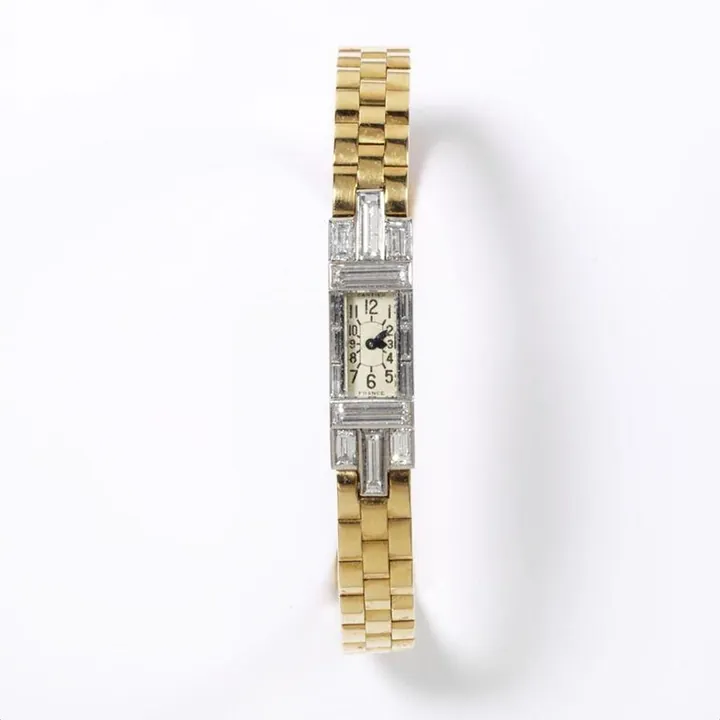
Watch with diamond-set platinum case and gold link bracelet, Cartier, Paris, c. 1936.
Victoria and Albert Museum, London
Wristwatches · c. 1920
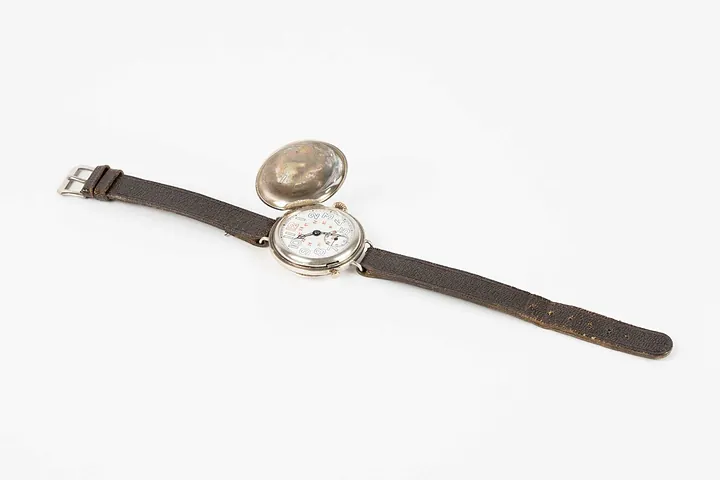
Wristwatch by dazwischen Schwert J S, France, c. 1920
German Clock Museum
Wristwatches · 1928
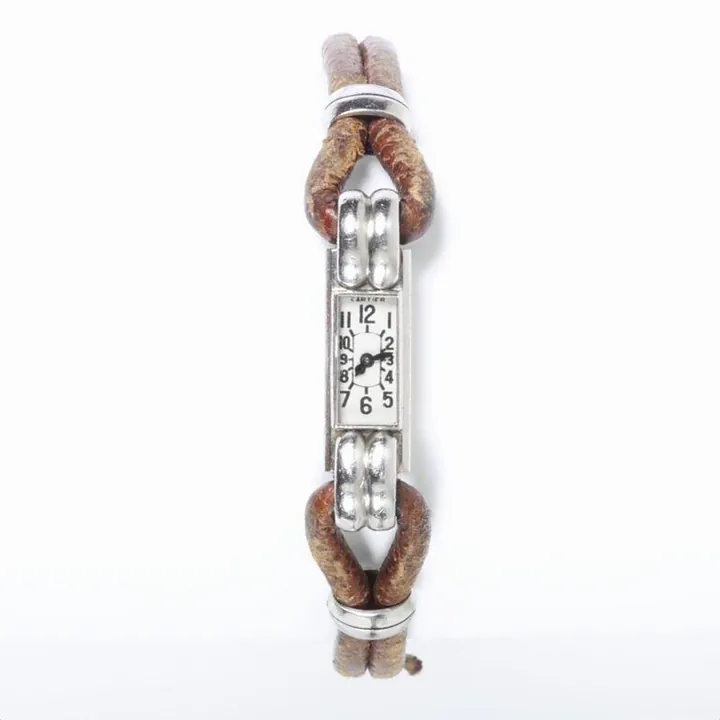
Platinum watch with leather strap with gold deployant buckle, Cartier, Paris, mark of Edmond Jaeger, 1928
Victoria and Albert Museum, London
Wristwatches · c. 1930s
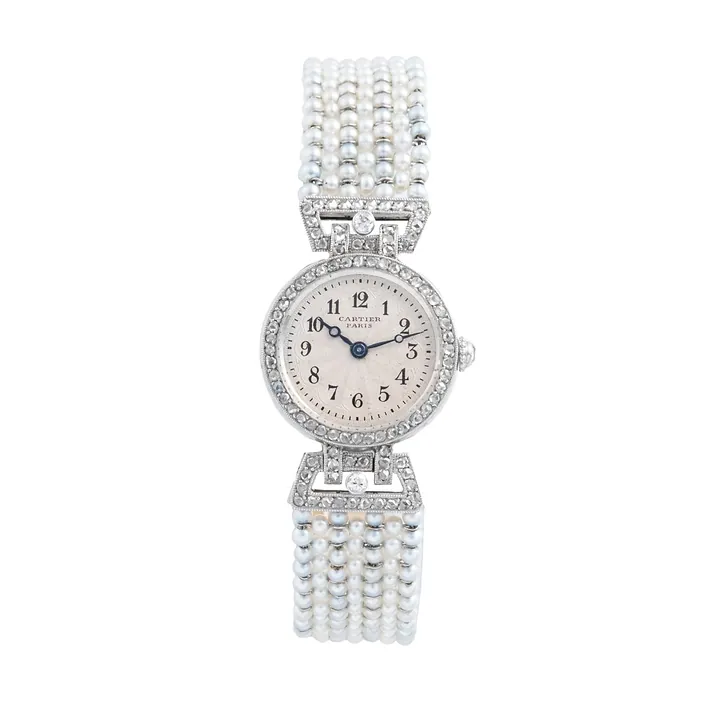
Cartier wristwatch, c. 1930s
Antiquorum auction archive, Geneva