
Wristwatches · Wristwatch
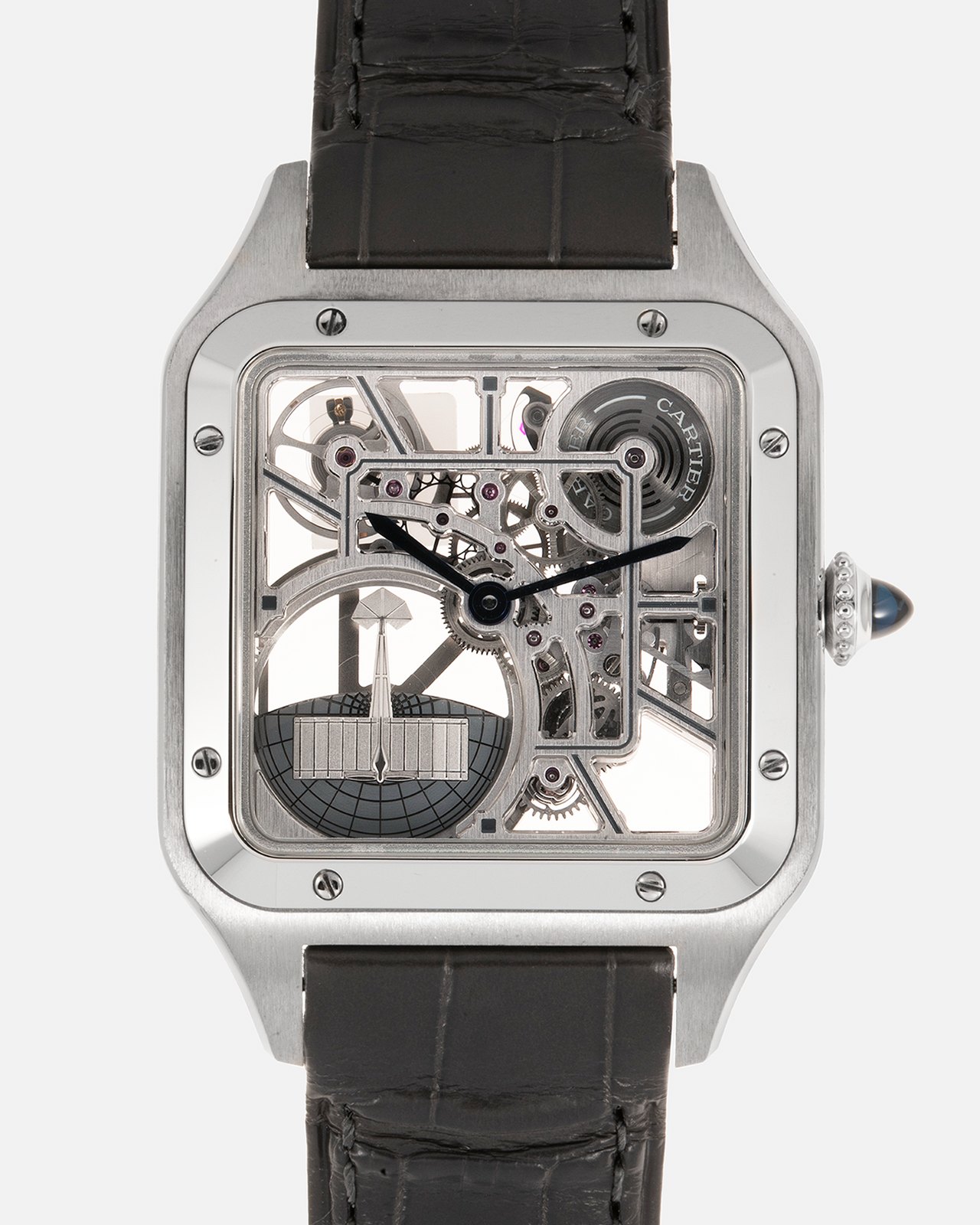
Cartier Santos Dumont Skeleton Micro-Rotor Steel, 2023
- Maker / attribution
- Cartier (maker)
- Date
- 2023
- Historical period
- Contemporary Horology (2010 – Present)
- Country of origin
- France
- Object type
- Wristwatch
- Materials / technique
- steel
- Dimensions
- Case 31.4 mm
- Stock no.
- Product 6964290289751
- Credit line
- Dealer listing, S.Song Watches (product 6964290289751)
- Catalogue title (original)
- Cartier Santos Dumont Skeleton Micro-Rotor Steel (English)
View the source record (dealer listing) ↗ (opens another website in a new tab)Suggest a correction
Record summary
Catalogued by S.Song Watches (dealer), Seattle (stock number Product 6964290289751), this is a wristwatch by Cartier, made in France, dated 2023. The Atlas places it in the Contemporary Horology period (2010 – Present) of its Wristwatches collection. Materials and techniques recorded by the source: steel. Recorded dimensions: Case 31.4 mm. The record is illustrated with 6 photographs.
Assembled from the source record's structured fields. Dates and attributions are given as the source states them; where a field is missing the Atlas leaves it blank rather than estimating.
Catalogue description
Dealer description — S.Song Watches
The name Cartier needs no introduction. As one of the most influential and celebrated jewelry and watch brands of the last 100 years, it has always stood as a mark of luxury and desirability. Without taking away from its historical significance, I would say that when it comes to watches, Cartier has always been predominantly known as a ‘design’ brand rather than a pure watchmaking one, with stunningly iconic models such as the Tank, the Crash, and the Santos all seen as important due to how it looks. In fact, to this day, it is the beautiful and unconventional designs that attract collectors and allows it to hold a unique position in the watch brand hierarchy that no other possesses. For those unfamiliar with its rich history, the Cartier Santos traces its origins back to 1904, standing as one of Cartier's oldest and exclusively male-focused collections. Named after Brazilian aviator Alberto Santos-Dumont, who enlisted the expertise of his friend Louis Cartier in 1904 to craft a wristwatch for his aerial endeavors, the Cartier Santos holds the distinction of possibly being the inaugural men's (and pilot's) wristwatch ever created. Distinguished from its contemporaries by being purposefully designed for wristwear, as opposed to being a modified pocket watch typical of its time, the Santos holds immense significance not just for Cartier but also for the broader history of horology. Since its inception, Cartier has continued to introduce numerous variations of the Santos, further cementing its enduring legacy. Earlier this year at Watches and Wonders (2023), the Maison introduced three new variations of the Santos-Dumont Skeleton Micro-Rotor; one in 18-carat rose gold, one in 18-carat yellow gold with a lacquer treatment on the case, and the other being this exact one offered here in stainless steel. Before we discuss any further, I feel the need to preface this by saying that this particular Santos-Dumont is unlike any other modern Cartiers I have handled so far as it commands a certain type of presence that is hard to describe in mere words. I don’t think it has anything to do with its case material, size or proportions, but mostly due to the way Cartier has tastefully incorporated an eye-catching skeleton dial and a micro-rotor into a nicely sized 31.4mm x 43.5mm stainless steel case. While I am not exactly a huge fan of skeletonized dials in general (due to their typically overwhelming and in-your-face visuals), for some reason I feel drawn to this example despite its seemingly polarising appearance. There is just something about the synergy between the overall monochromatic color scheme and the skeletonized dial that just speaks to me, and I am fairly certain I could say the same for many Cartier enthusiasts as well. The most distinguishing design element of this Santos-Dumont is obviously the beautiful skeletonized dial that showcases Cartier’s newly developed Cal. 9629 MC, which features stunning finishing and decorative details throughout, all held together by bridges which have inlays filled with delicate grey lacquer that can only be seen when examined up close. The skeleton dial also hosts a set of polished blued-steel sword hands and a micro-rotor in the form of a miniature model of the famous La Demoiselle aircraft, which was developed by Alberto Santos-Dumont. As far as power reserve goes, the Cal. 9629 MC can hold a total capacity of 44 hours when fully wound. While this series of skeletonized Santos-Dumonts doesn't incorporate the traditional Cartier-signature Roman numerals, I appreciate how the screws on the bezel can effectively serve as hour markers anyway, simplifying time-telling on the somewhat busy dial. When viewed from a distance, the Santos-Dumont Skeleton Micro-Rotor is just absolutely visually striking. As an avid fan of the Santos-Dumont (the small to mid-sized ones, of course), the Skeleton Micro-Rotor exemplifies the qualities that make Cartier one of the most exciting brands to look out for in the current landscape of contemporary watchmaking. Again, I am personally drawn to this variant, especially because of the compelling contrast achieved by pairing a relatively subdued stainless-steel case with a captivating skeletonized dial. I am not sure how, but as you can see here; when all these elements come together, the end result is a stunningly elegant timepiece. Period.
Historical context
Contemporary Horology (2010 – Present)
Silicon components, connected watches, optical-lattice research clocks and a thriving independent scene.
Smartwatches became the world's best-selling watches, while mechanical watchmaking focuses on craft, innovation (silicon components, new escapements) and independent makers.
Read the period in the timelineMore wristwatches from this periodEarlier: Mechanical Renaissance
Atlas type guide
Automatic (self-winding) watches
Self-winding watches use the wearer's motion to wind the mainspring. Abraham-Louis Perrelet and Breguet made 'perpétuelle' pocket watches with oscillating weights in the late eighteenth century, but the principle only became practical in the wristwatch. John Harwood patented a bumper automatic in 1923; Rolex's Perpetual rotor (1931) winding in one direction, and later bidirectional rotors (Eterna, Felsa Bidynator), established the modern form. Micro-rotors (Universal Genève, Buren) and peripheral rotors made automatic watches thinner.
What to look for
- A semicircular rotor turning 360° over the movement, or a 'bumper' weight that rebounds between springs.
- 'Automatic', 'Perpetual' or 'Self-winding' on the dial.
- A sealed screw-back case, since automatic watches are wound less often by the crown.
Dating clues
- Bumper automatics: 1923–c. 1955.
- Full rotors: from 1931 (Rolex); widespread after c. 1950.
- Micro-rotors: from 1954–1958.
General guidance written by the Atlas editors about this kind of object. It is not a statement about this particular piece; for that, rely on the source record above and on physical examination.
Related records

Clocks · 1863
Clock by Albert-Ernest Carrier-Belleuse, France, 1863
The Metropolitan Museum of Art, New York

Clocks · c. 1980s
Cartier "art Deco", c. 1980s
Antiquorum auction archive, Geneva

Clocks · c. 2000s
Cartier Desk Clock with Alarm, c. 2000s
Antiquorum auction archive, Geneva

Clocks · c. 2000s
Cartier Lacquer Arched Desk Clock with Alarm, ref. W0100037, c. 2000s
Antiquorum auction archive, Geneva
Wristwatches · c. 2010s
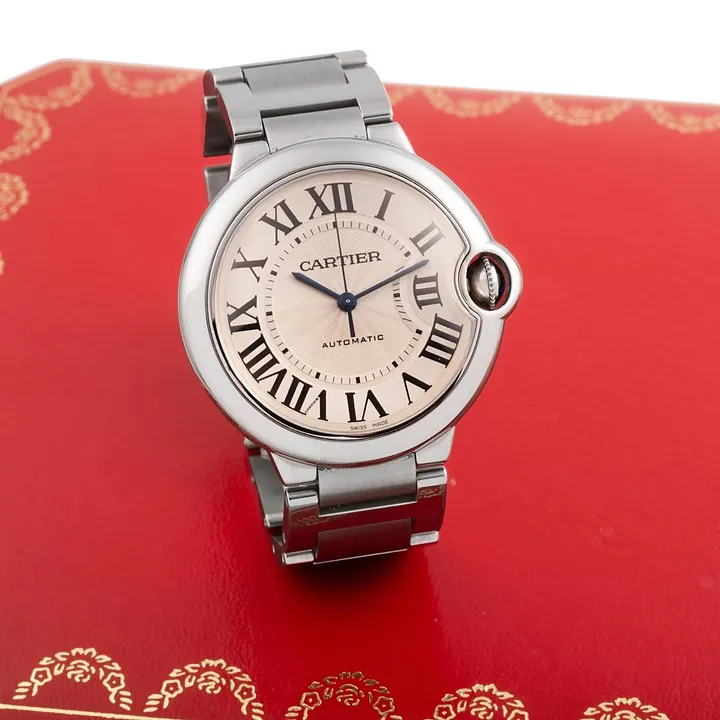
Cartier Ballon Bleu, ref. 3284, c. 2010s
Antiquorum auction archive, Geneva

Wristwatches · originally sold in December 2021 (per the lot record)
Cartier Tank Must, ref. CRWSTA0054, originally sold in December 2021
Antiquorum auction archive, Geneva
Wristwatches · originally sold in 2023 (per the lot record)
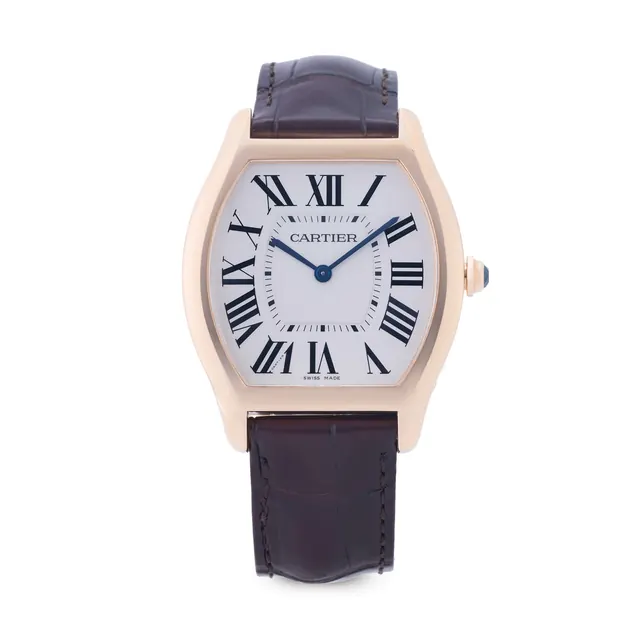
Cartier wristwatch, ref. WGTO0002, Tortue, originally sold in 2023
Antiquorum auction archive, Geneva

Wristwatches · c. 2020
Bell & Ross wristwatch, ref. BR, Aviation Type, circa 2020
Antiquorum auction archive, Geneva