
Wristwatches · Wristwatch
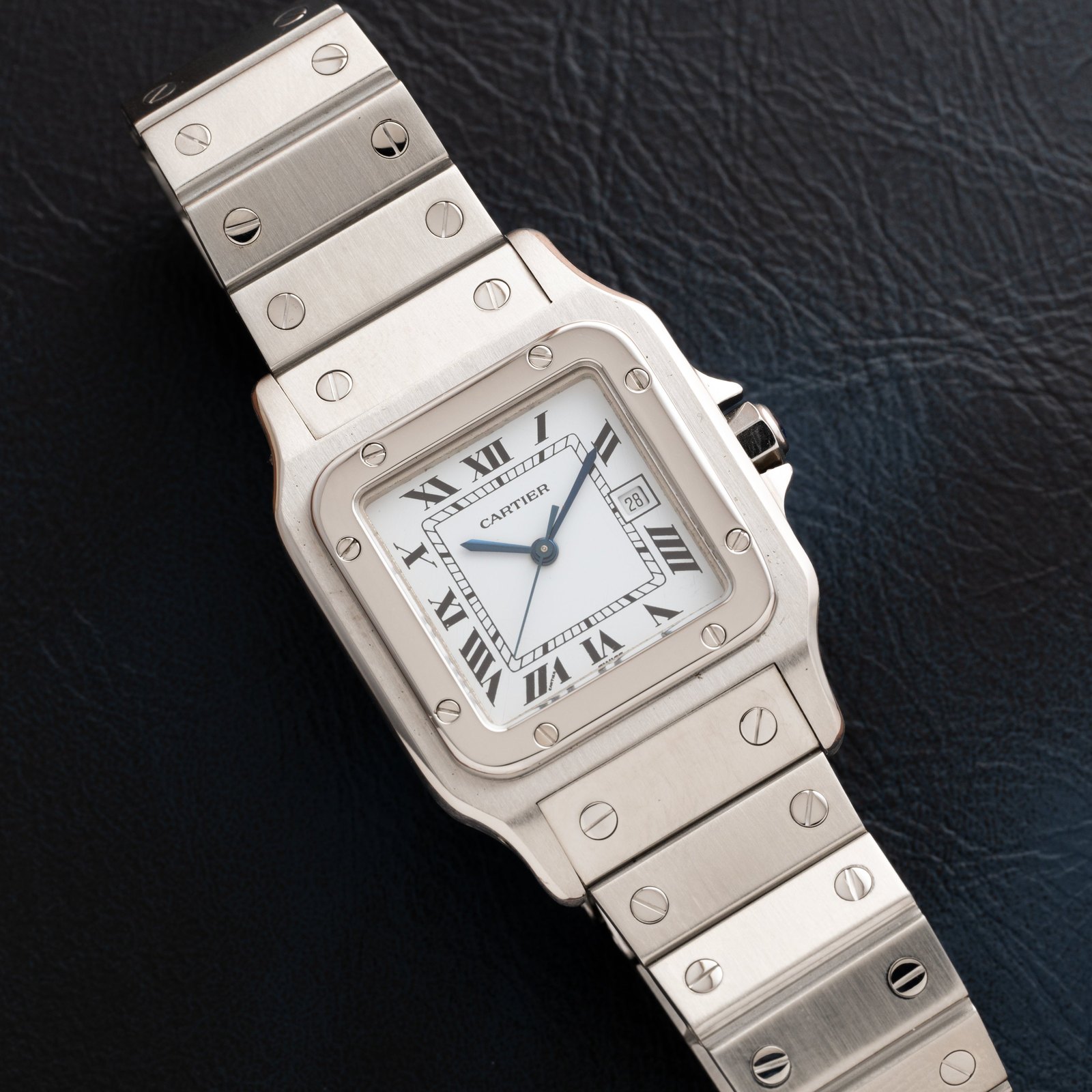
Cartier Santos Carrée, 1985
- Maker / attribution
- Cartier (maker)
- Date
- 1985
- Historical period
- Quartz Revolution (1969 – 1990)
- Country of origin
- France
- Object type
- Wristwatch
- Dimensions
- Case 30 mm
- Stock no.
- 40950313
- Credit line
- Dealer listing, Analog/Shift (40950313)
- Catalogue title (original)
- Cartier Santos Carrée (English)
Editor's note
Date taken from the listing's sentence dating this example, not from the model's history.View the source record (dealer listing) ↗ (opens another website in a new tab)Suggest a correction
Record summary
Catalogued by Analog/Shift (dealer), New York (stock number 40950313), this is a wristwatch by Cartier, made in France, dated 1985. The Atlas places it in the Quartz Revolution period (1969 – 1990) of its Wristwatches collection. Recorded dimensions: Case 30 mm. The record is illustrated with 6 photographs.
Assembled from the source record's structured fields. Dates and attributions are given as the source states them; where a field is missing the Atlas leaves it blank rather than estimating.
Catalogue description
Dealer description — Analog/Shift
The story of the Cartier Santos dates back to the early 1900s and a fascinating man named Alberto Santos-Dumont. Born in 1873 into a family of engineers and farmers, Alberto’s father was involved in railroad construction, instilling in Alberto a passion for travel and exploration. This naturally led to a fascination with aviation, Alberto’s greatest passion. After moving to France, Santos-Dumont built a number of balloons, airships, and later, primitive aircraft. He quickly made significant breakthroughs, including manning the very first publicly viewed manned flight in Europe. Santos-Dumont’s high-profile, daring escapades put him in company with some of the most prominent personalities of France, including Louis Cartier. Cartier and Santos-Dumont’s friendship blossomed from mutual respect for innovation, creativity, and legacy. In 1904, Louis Cartier gave Santos-Dumont a special watch designed to be worn on the wrist during flight — a novel concept at the time. The primitive, sturdy square timepiece was essentially the first true sports watch, which was subsequently produced in series. The commercial debut in 1911 Cartier Santos-Dumont was the birth of one of Cartier’s most iconic watch designs in history. Since 1911, Cartier has made dozens of Santos models — manually-wound pieces, automatics, quartz watches, complicated references, and more. This particular Santos is known as the Carrée. Introduced in 1978, this was the maison's way of re-introducing the Santos to a new generation during a time of radical change. It was also Cartier's answer to the Royal Oak and Nautilus. Dating to 1985, this piece features a 30mm stainless steel case with a flat sapphire crystal, a polished bezel with exposed screws, and an octagonal stainless steel crown with a sapphire cabochon. You'll notice that this case is sharper and edgier compared to its Galbee sibling giving it more of a utilitarian aesthetic. Its white dial is printed with ‘Roman’ indices and features a chemin de fer minute track, a date window at 3 o’clock, a blued steel ‘sword’ handset. Paired to the watch is a matching stainless steel bracelet with exposed screws and a “CC”-signed locking clasp. It also includes its original factory presentation box and factory certificate. If you're Cartier-curious but the Tank Louis doesn't speak to you, the slightly more versatile Santos might just be a perfect match. Give this one a try!
Historical context
Quartz Revolution (1969 – 1990)
Seiko's Astron begins mass quartz timekeeping; traditional industries contract sharply.
Quartz and digital watches transformed the market after 1969. Swiss employment collapsed, Japanese and Hong Kong production soared, and the Swatch (1983) helped the Swiss industry recover; mechanical watches survived as luxury goods.
Read the period in the timelineMore wristwatches from this periodEarlier: Modern Mechanical Horology
Atlas type guide
Wristwatches
Bracelet watches were worn by women from the early nineteenth century — Breguet made one for Caroline Murat, Queen of Naples, in 1810–12 — but the wristwatch only became a man's instrument with military use and aviation in the early twentieth century. Between the World Wars it overtook the pocket watch; the 1920s and 1930s brought rectangular Art Deco cases, water-resistant cases and the first automatic winding systems.
After 1945 the wristwatch became a carrier of identity — dress watches, sports and dive watches, chronographs, calendars — produced by Swiss, American, Japanese, German, Soviet and Chinese industries. The quartz revolution after 1969 and the mechanical renaissance since the 1990s, including the rise of independent watchmakers, complete the story.
What to look for
- The reference number (between the lugs or inside the case back) and serial number, the starting point for dating.
- The calibre: its maker and number are often stamped under the dial or on the bridge.
- Originality of dial, hands and crown — refinished ('redial') dials are common.
- Case material marks: 18K/750, 14K/585, stainless steel, gold-filled, plated.
Dating clues
- Wire-lug cases: before c. 1925.
- Water-resistant screw-down cases: from 1926.
- Quartz movements: from 1969; sapphire crystals widespread after c. 1980.
General guidance written by the Atlas editors about this kind of object. It is not a statement about this particular piece; for that, rely on the source record above and on physical examination.
Related records

Clocks · 1863
Clock by Albert-Ernest Carrier-Belleuse, France, 1863
The Metropolitan Museum of Art, New York

Clocks · c. 1980s
Cartier "art Deco", c. 1980s
Antiquorum auction archive, Geneva

Clocks · c. 2000s
Cartier Desk Clock with Alarm, c. 2000s
Antiquorum auction archive, Geneva

Clocks · c. 2000s
Cartier Lacquer Arched Desk Clock with Alarm, ref. W0100037, c. 2000s
Antiquorum auction archive, Geneva
Wristwatches · c.1989
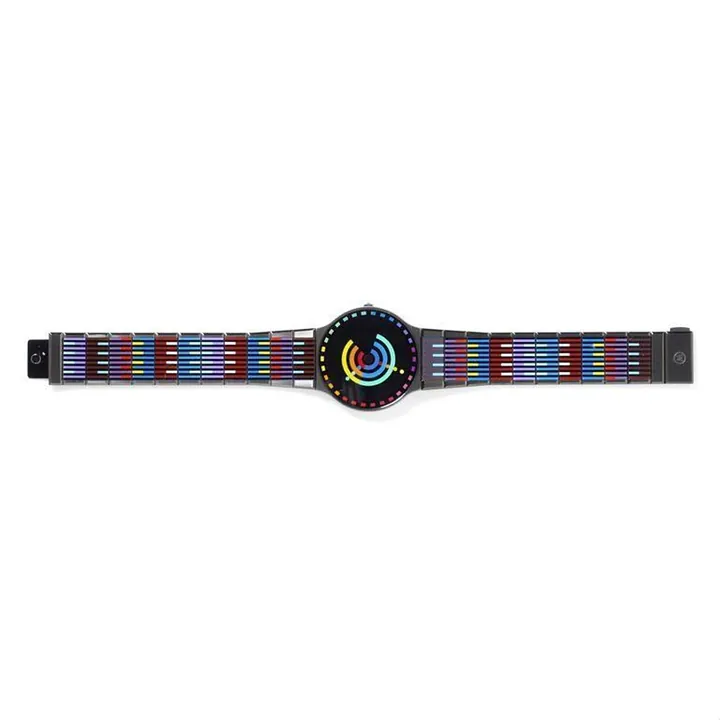
Steel, France and Switzerland, 1989; designed by Yaacov Agam (born 1928) for a limited edition by Movado
Victoria and Albert Museum, London
Wristwatches · c. 1972
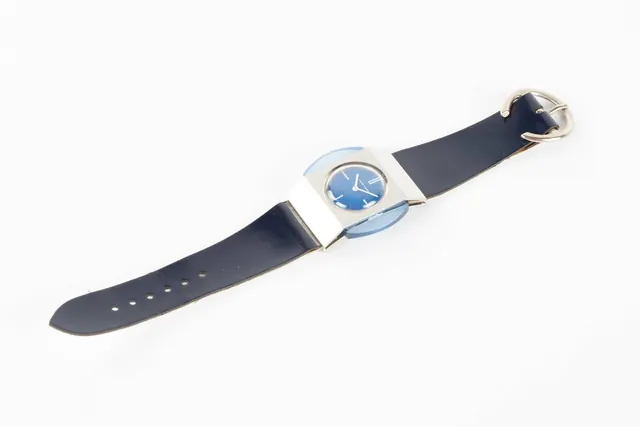
Wristwatch, France, c. 1972
German Clock Museum

Wristwatches · 1986
Wristwatch, France, 1986
Työväenmuseo Werstas
Wristwatches · c. 1970-1980s
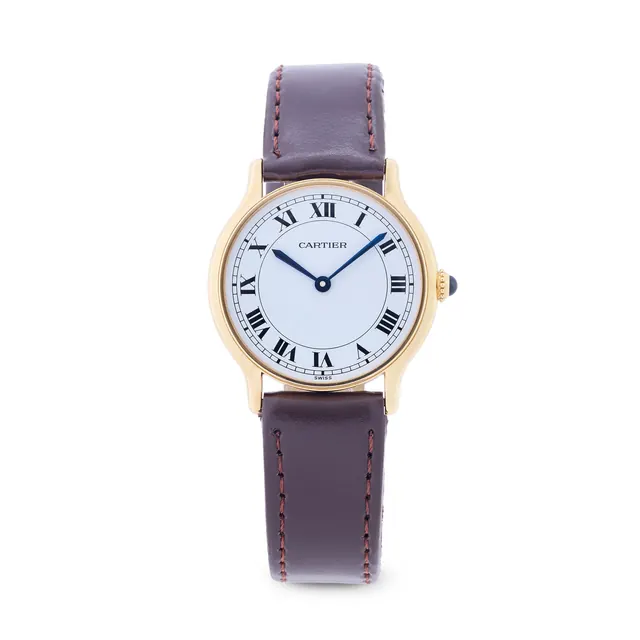
Cartier wristwatch, ref. 10713, Riviera, circa 1970-1980s
Antiquorum auction archive, Geneva