
Wristwatches · Wristwatch
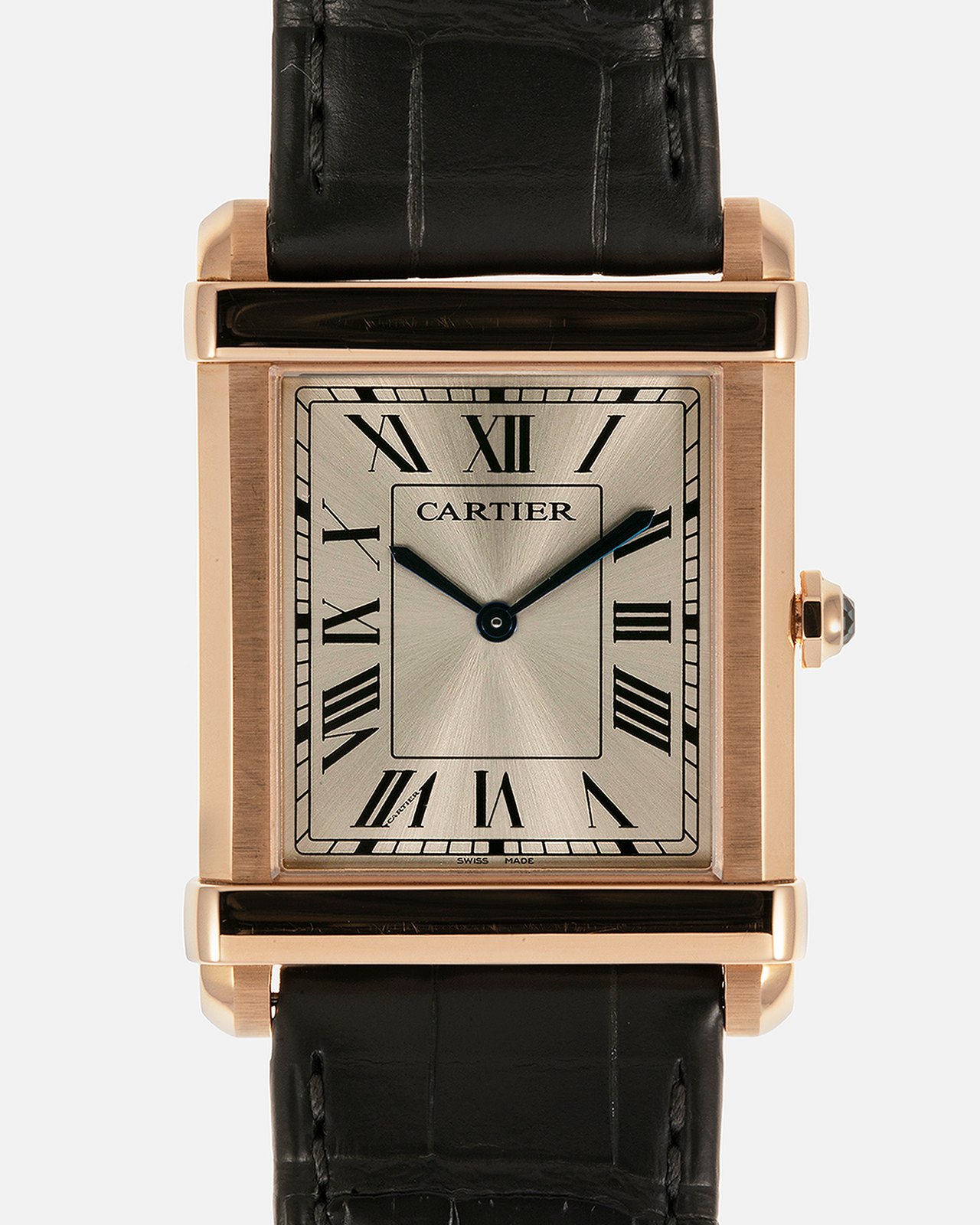
Cartier Privé Tank Chinoise RG, 2022
- Maker / attribution
- Cartier (maker)
- Date
- 2022
- Historical period
- Contemporary Horology (2010 – Present)
- Country of origin
- France
- Object type
- Wristwatch
- Dimensions
- Case 39.5 mm
- Stock no.
- Product 7301745016919
- Credit line
- Dealer listing, S.Song Watches (product 7301745016919)
- Catalogue title (original)
- Cartier Privé Tank Chinoise RG (English)
View the source record (dealer listing) ↗ (opens another website in a new tab)Suggest a correction
Record summary
Catalogued by S.Song Watches (dealer), Seattle (stock number Product 7301745016919), this is a wristwatch by Cartier, made in France, dated 2022. The Atlas places it in the Contemporary Horology period (2010 – Present) of its Wristwatches collection. Recorded dimensions: Case 39.5 mm. The record is illustrated with 6 photographs.
Assembled from the source record's structured fields. Dates and attributions are given as the source states them; where a field is missing the Atlas leaves it blank rather than estimating.
Catalogue description
Dealer description — S.Song Watches
The name Cartier needs no introduction. As one of the most influential and celebrated jewellery and watch brands of the last 100 years, it has always stood as a mark of luxury and desirability. While acknowledging its historical significance, it is also important to note that Cartier has traditionally been known more as a ‘design’ brand rather than a pure watchmaking one. Iconic models such as the Tank, the Crash, and the Santos are celebrated not only for their technical aspects but also for their stunning design. Even today, it is the beautiful and unconventional designs that attract collectors and secure Cartier’s unique position in the watch brand hierarchy. Among the most famous watches, a few timepieces have withstood the test of time for over a century. Released in 1917 and inspired by the Renault tanks Louis Cartier observed on the Western Front during WWI, the Cartier Tank has become a classic timepiece and, to some extent, a cornerstone design for Cartier. It is also known today as one of the Maison ’s most important and versatile collections. There is a certain elegance and opulence often associated with its design language. Given its long and storied history, it has taken on many shapes, styles, sizes, colours, and more, yet the versatility of its foundational design allows each model to embrace a distinct identity while remaining unmistakably a Cartier Tank at its core. Here, we have a stunning example of a Cartier Privé Tank Chinoise in lustrous 18-carat rose gold. This model was introduced as part of the Cartier Privé collection at Watches and Wonders 2022 to mark the 100th anniversary of the original Tank Chinoise. First unveiled by the French Maison in 1922, the Tank Chinoise design emerged during a time when 'Far Eastern' aesthetics significantly influenced European design sensibilities. The term "Chinoise" translates from French to "Chinese," and this model reinterprets the iconic Tank design of 1917 by incorporating wide, pronounced horizontal bars above and below the dial, which overlap the brancards. These bars are inspired by lintels—horizontal beam-like structures found above entrances and doorways of Chinese and East Asian temples—the design of the case as a whole evokes the porticos or entry gates of these temples and their respective architectural elements. Historically, the Tank Chinoise has always been a relatively rare design offering from Cartier, appearing infrequently in their catalogues since its debut in 1922. This rarity makes it notably elusive and highly collectable. As previously mentioned, this rose gold example hails from the 2022 Cartier Privé collection and was released as part of a trio that also includes platinum and yellow gold versions, with each variant limited only to 150 pieces respectively. Encased within a 39.5mm x 29mm 18-carat rose gold case, the Tank Chinoise features a sunray-brushed dial with a subtle, complementary rose hue that perfectly matches the exquisitely finished case. Unlike the CPCP version which faithfully adhered to the original 1922 design, this Privé Tank Chinoise features a more modern, rectangular case profile instead of a square one. The restyled case is adorned with highly polished horizontal brancards that create a striking contrast with the brushed brancards on each side which adds a certain dynamic quality to the Tank Chinoise’s overall visual. As for its dial, as shown in the photographs, it features a clean layout typical of many Cartier Tanks, both past and present. It showcases Cartier’s signature Roman numerals, a railroad-style minute track, and thermal-blued épée (sword) hands. Powering the beautiful Tank Chinoise from within is Cartier’s manual-winding Cal. 430 MC, a movement that is technically based on the ultra-thin (2.15mm) Piaget Cal. 430P, and holds a power reserve of 38 hours on a full wind. Limited to just 150 pieces worldwide in this exquisite 18-carat rose gold variant, I think the Tank Chinoise stands out as one of the most unique and rare Cartier Tank variants you can buy today. As an avid fan of the Cartier Tank myself, I can certainly appreciate how the Tank Chinoise offers a refreshing take on a classic and timeless design, masterfully blending European and Eastern design sensibilities in a way that is distinctive, synergistic and seldom seen in other watch designs. With all that being said, I believe that this is a reference that will undoubtedly age well and be fondly remembered by collectors for years to come.
Historical context
Contemporary Horology (2010 – Present)
Silicon components, connected watches, optical-lattice research clocks and a thriving independent scene.
Smartwatches became the world's best-selling watches, while mechanical watchmaking focuses on craft, innovation (silicon components, new escapements) and independent makers.
Read the period in the timelineMore wristwatches from this periodEarlier: Mechanical Renaissance
Atlas type guide
Wristwatches
Bracelet watches were worn by women from the early nineteenth century — Breguet made one for Caroline Murat, Queen of Naples, in 1810–12 — but the wristwatch only became a man's instrument with military use and aviation in the early twentieth century. Between the World Wars it overtook the pocket watch; the 1920s and 1930s brought rectangular Art Deco cases, water-resistant cases and the first automatic winding systems.
After 1945 the wristwatch became a carrier of identity — dress watches, sports and dive watches, chronographs, calendars — produced by Swiss, American, Japanese, German, Soviet and Chinese industries. The quartz revolution after 1969 and the mechanical renaissance since the 1990s, including the rise of independent watchmakers, complete the story.
What to look for
- The reference number (between the lugs or inside the case back) and serial number, the starting point for dating.
- The calibre: its maker and number are often stamped under the dial or on the bridge.
- Originality of dial, hands and crown — refinished ('redial') dials are common.
- Case material marks: 18K/750, 14K/585, stainless steel, gold-filled, plated.
Dating clues
- Wire-lug cases: before c. 1925.
- Water-resistant screw-down cases: from 1926.
- Quartz movements: from 1969; sapphire crystals widespread after c. 1980.
General guidance written by the Atlas editors about this kind of object. It is not a statement about this particular piece; for that, rely on the source record above and on physical examination.
Related records
Clocks · 1863
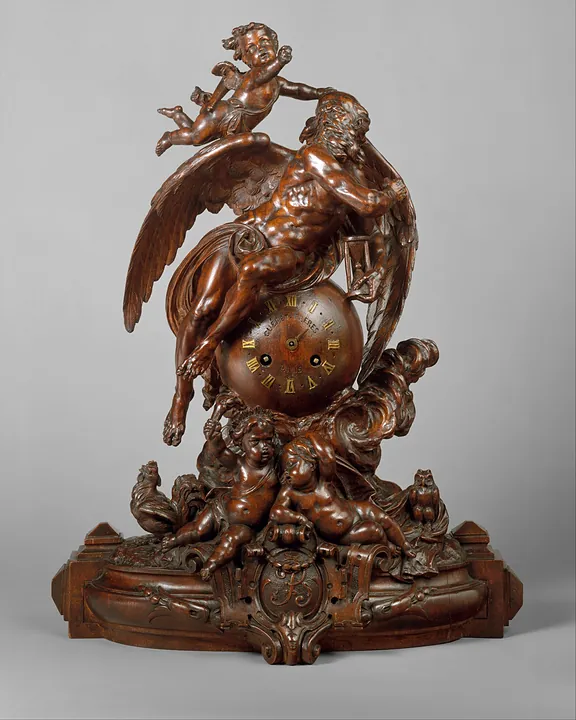
Clock by Albert-Ernest Carrier-Belleuse, France, 1863
The Metropolitan Museum of Art, New York
Clocks · c. 1980s
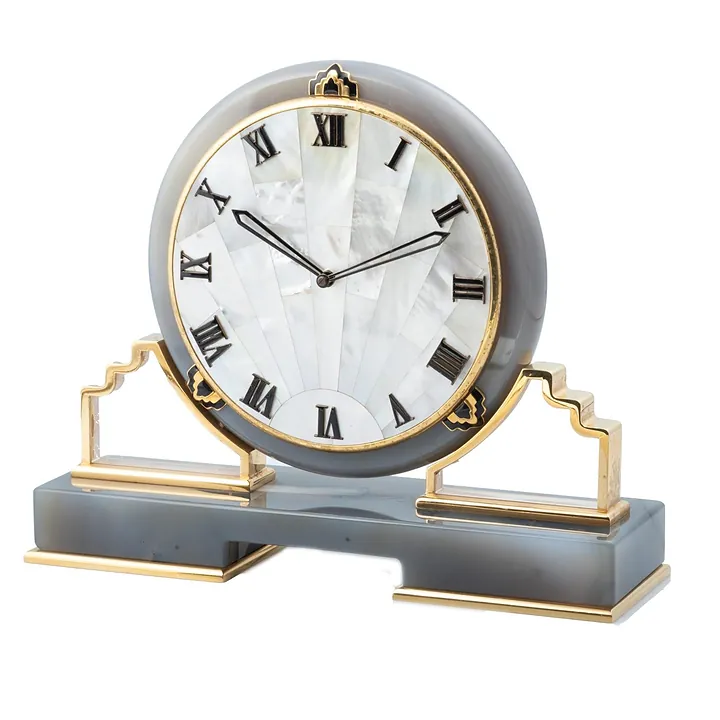
Cartier "art Deco", c. 1980s
Antiquorum auction archive, Geneva
Clocks · c. 2000s
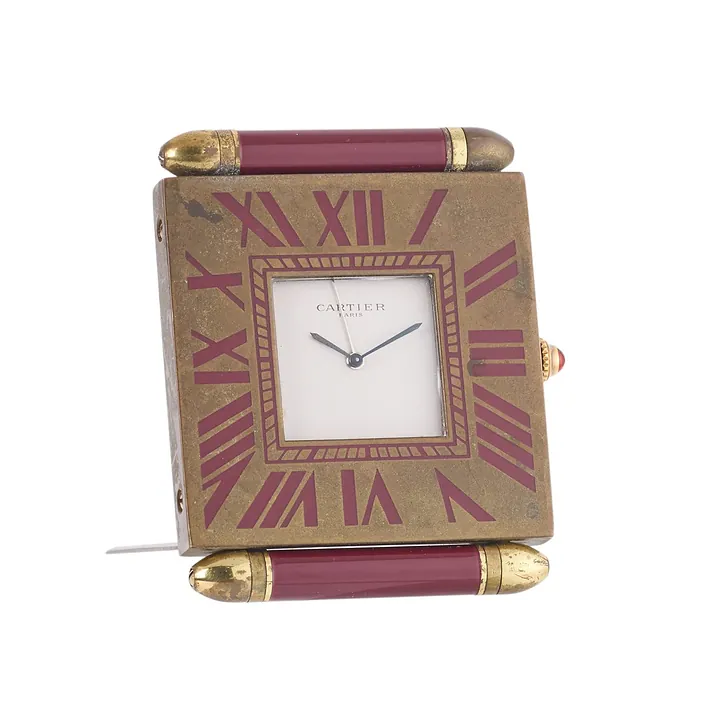
Cartier Desk Clock with Alarm, c. 2000s
Antiquorum auction archive, Geneva
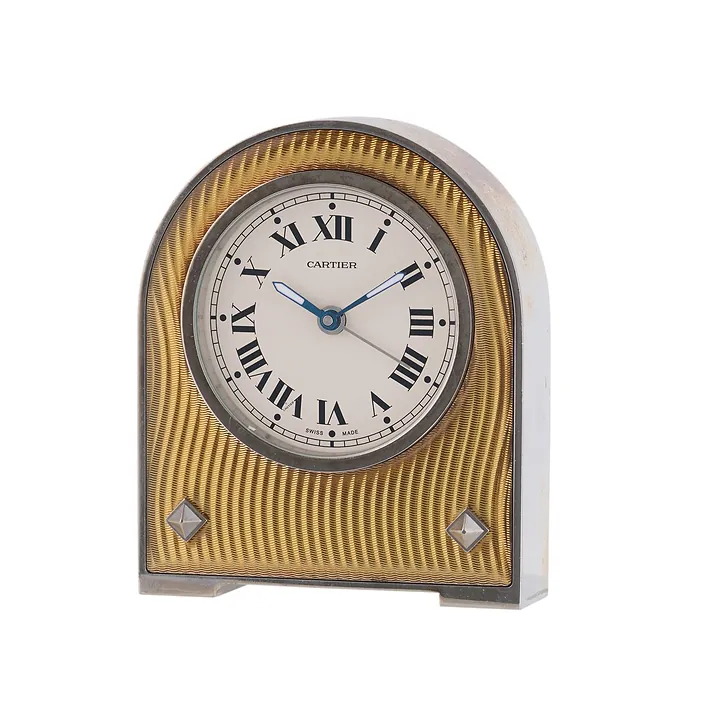
Clocks · c. 2000s
Cartier Lacquer Arched Desk Clock with Alarm, ref. W0100037, c. 2000s
Antiquorum auction archive, Geneva
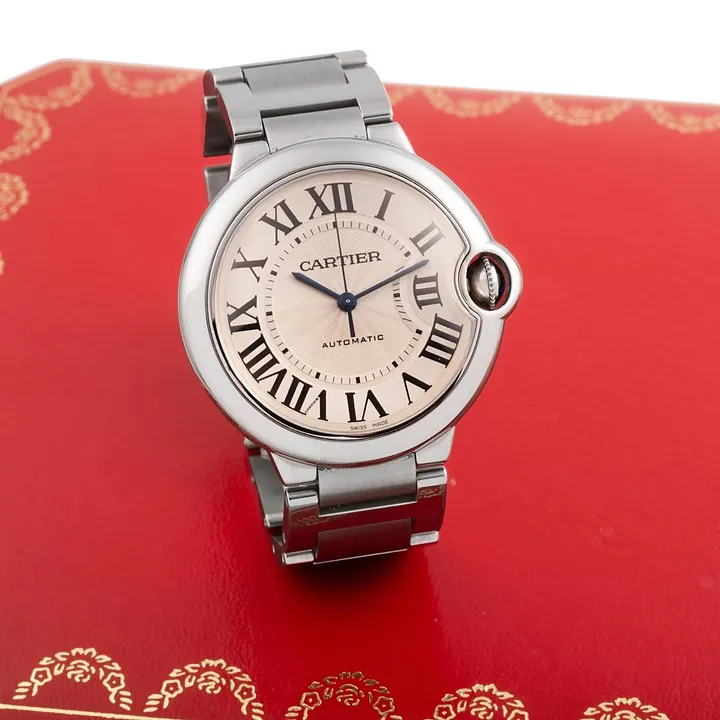
Wristwatches · c. 2010s
Cartier Ballon Bleu, ref. 3284, c. 2010s
Antiquorum auction archive, Geneva

Wristwatches · originally sold in December 2021 (per the lot record)
Cartier Tank Must, ref. CRWSTA0054, originally sold in December 2021
Antiquorum auction archive, Geneva
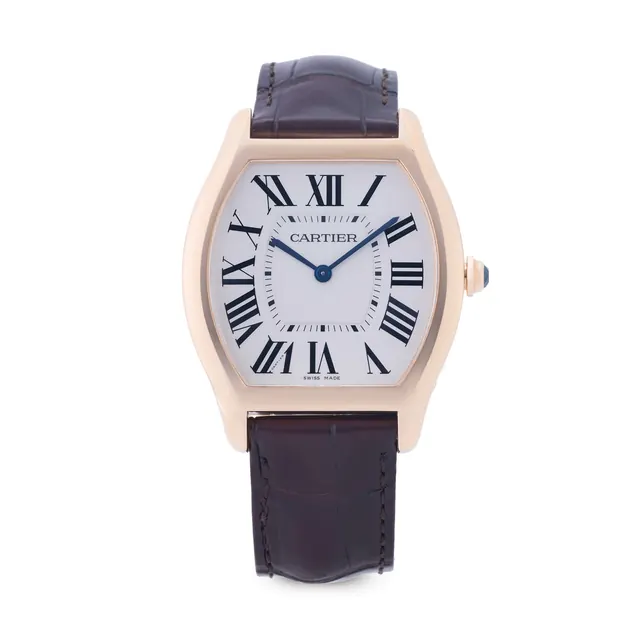
Wristwatches · originally sold in 2023 (per the lot record)
Cartier wristwatch, ref. WGTO0002, Tortue, originally sold in 2023
Antiquorum auction archive, Geneva
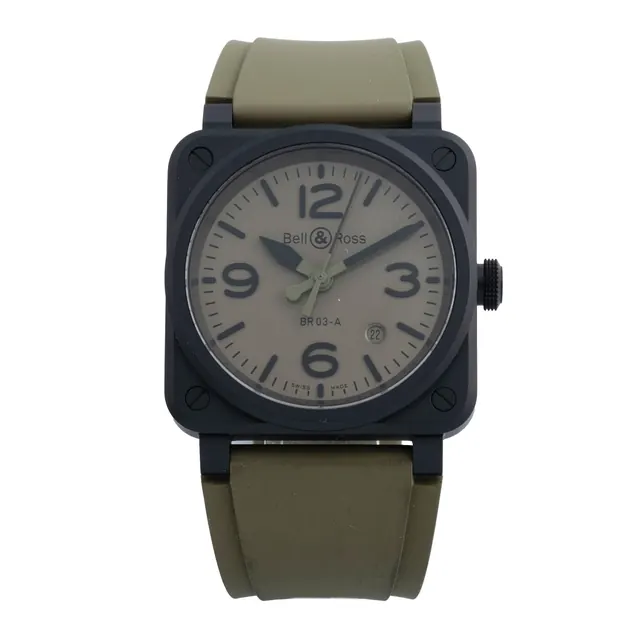
Wristwatches · c. 2020
Bell & Ross wristwatch, ref. BR, Aviation Type, circa 2020
Antiquorum auction archive, Geneva