
Wristwatches · Wristwatch
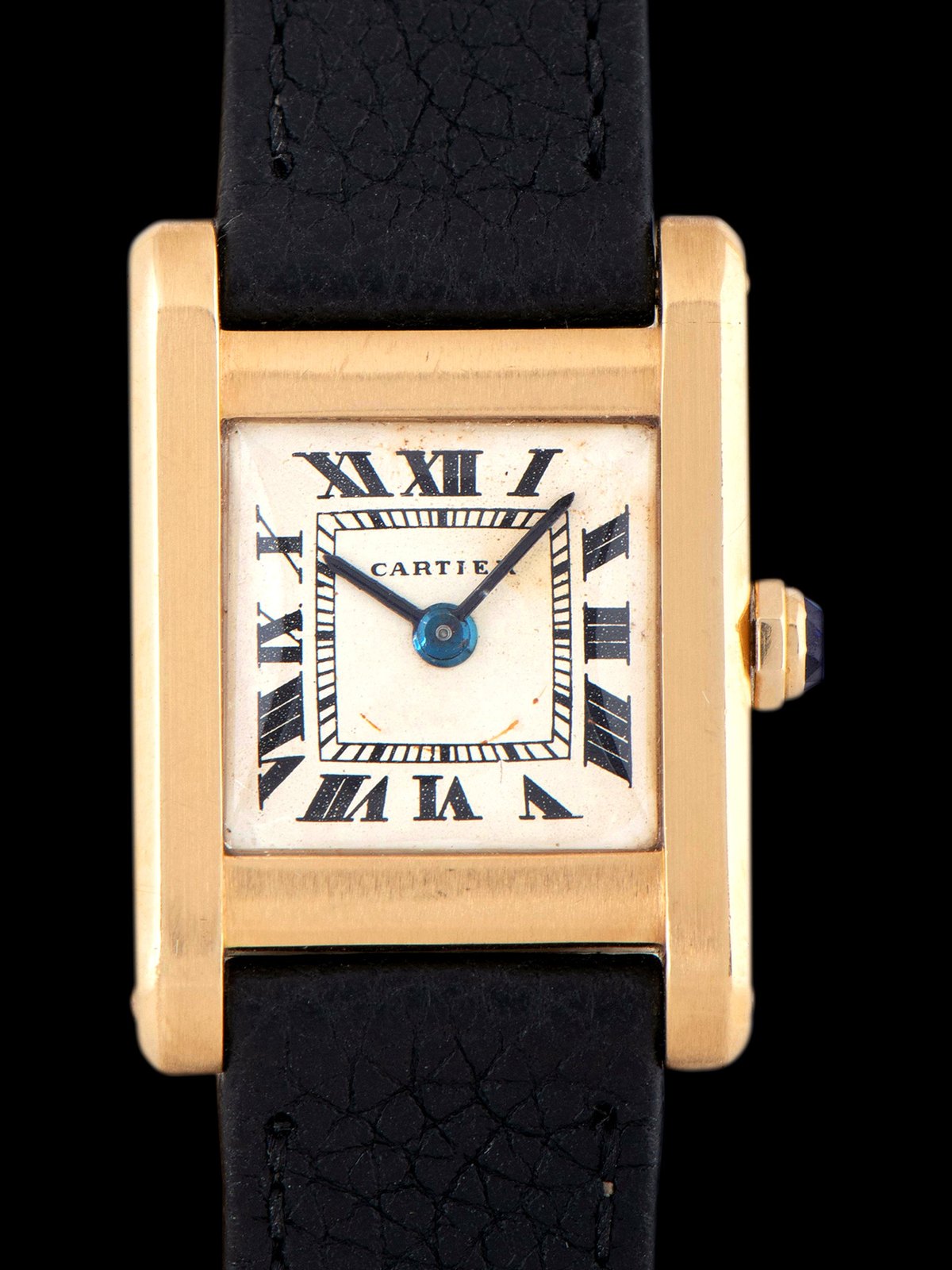
Cartier Paris Tank Normale 18K YG "Pussykin", 1960s
- Maker / attribution
- Cartier (maker)
- Date
- 1960s
- Historical period
- Modern Mechanical Horology (1945 – 1969)
- Country of origin
- France
- Object type
- Wristwatch
- Stock no.
- CTRTNPK
- Credit line
- Dealer listing, Craft & Tailored (CTRTNPK)
- Catalogue title (original)
- 1960s Cartier Paris Tank Normale 18K YG "Pussykin" (English)
View the source record (dealer listing) ↗ (opens another website in a new tab)Suggest a correction
Record summary
Catalogued by Craft & Tailored (dealer), Los Angeles (stock number CTRTNPK), this is a wristwatch by Cartier, made in France, dated 1960s. The Atlas places it in the Modern Mechanical Horology period (1945 – 1969) of its Wristwatches collection. The record is illustrated with 6 photographs.
Assembled from the source record's structured fields. Dates and attributions are given as the source states them; where a field is missing the Atlas leaves it blank rather than estimating.
Catalogue description
Dealer description — Craft & Tailored
The Cartier Tank is the perfect example of excellent design transcending generations. The Tank moved through the early 20th century only to become more relevant during the mid-century design era, and is once again seeing a massive resurgence amongst the watch-collecting community today. The Cartier Tank Normale is the original Tank design brought to us by Louis Cartier in 1917 and made commercially available in 1919. The Normale design was inspired by the Renault FT-17 tank used by the French Military in the First World War, which the watch resembles very closely. The Tank Normale started what has become one of the most celebrated watch designs of all time, and has evolved into the many variations that make up the Cartier brand today. Though it is the original Tank model, the Tank Normale has always been a niche offering from the Maison, with the Tank Louis Cartier being the most commercially known Tank, and while the Tank LC is an incredible watch, to the true Cartier collector, the Tank Normale is the truest essence and form of a Tank watch, bar none. Being the more niche offering, the Tank Normale has only been brought back into production sparingly since its inception by Cartier, usually as a limited or special offering. With that, finding Tank Normale examples in an original state of condition prior to the 1970s is exceptionally uncommon, and are some of the most cherished and valued watches within the Cartier collecting community. We are proud to present this original Cartier Tank Normale from the 1960s, starring one of the most curious case back engravings we've come across, "Pussykin", whether it be a last name or a nickname, we can't be for certain, but whatever it may be we know this was a valued and cherished timepiece for many years given the beautifully-preserved state of which it remains. SPECS Stock # CTRTNPK Brand Cartier Style Tank Normale Model N/A Serial 44XXX Size Men's / Unisex Material 18K Yellow Gold Dial White Roman Millimeters 20 X 28 Bracelet Cartier Strap W/ Cartier 18K YG Deployant Clasp CASE & BRACELET The impressive and remarkably crisp 18K yellow gold case retains the original factory finishing throughout, with the original bold chamfers around the "tank" lugs fully intact, while the orignial eagle head hallmark on the left side of the case remains in unaltered, deep, and fully present condition. The sloped-glass crystal is in excellent condition with no notable wear present. The case retains its original faceted sapphire crown. The case back was polished at some point in order to be engraved, and features the hand engraving "Pussykin" in crisp font across the back of the watch. The watch comes with its era-correct 18K yellow gold Cartier deployant clasp, fitted to the clasp is a brand new black Cartier strap. The watch is sized to fit a 6-inch wrist. DIAL & HANDS The original cream-colored Roman numeral dial is in wonderful vintage condition, exhibiting some warmer spots and speckling expected for the age of the watch along with some light marks from hand drag on the bottom half of the dial. Apart from the age, the dial presents a beautiful vintage aesthetic with the original fonts and printing remaining in excellent condition. The orignial blued hands are in excellent condition. ACCESSORIES
Historical context
Modern Mechanical Horology (1945 – 1969)
Tool watches for divers, pilots and astronauts; electric watches anticipate the electronic age.
The classic era of the mechanical wristwatch: dive watches, chronographs for motor racing and space flight, GMT watches for jet travel, slim dress watches, automatic calendars, and the rise of Japanese manufacturers alongside Swiss, American, German and Soviet industries.
Read the period in the timelineMore wristwatches from this periodEarlier: Golden Age of Mechanical Watchmaking
Atlas type guide
Wristwatches
Bracelet watches were worn by women from the early nineteenth century — Breguet made one for Caroline Murat, Queen of Naples, in 1810–12 — but the wristwatch only became a man's instrument with military use and aviation in the early twentieth century. Between the World Wars it overtook the pocket watch; the 1920s and 1930s brought rectangular Art Deco cases, water-resistant cases and the first automatic winding systems.
After 1945 the wristwatch became a carrier of identity — dress watches, sports and dive watches, chronographs, calendars — produced by Swiss, American, Japanese, German, Soviet and Chinese industries. The quartz revolution after 1969 and the mechanical renaissance since the 1990s, including the rise of independent watchmakers, complete the story.
What to look for
- The reference number (between the lugs or inside the case back) and serial number, the starting point for dating.
- The calibre: its maker and number are often stamped under the dial or on the bridge.
- Originality of dial, hands and crown — refinished ('redial') dials are common.
- Case material marks: 18K/750, 14K/585, stainless steel, gold-filled, plated.
Dating clues
- Wire-lug cases: before c. 1925.
- Water-resistant screw-down cases: from 1926.
- Quartz movements: from 1969; sapphire crystals widespread after c. 1980.
General guidance written by the Atlas editors about this kind of object. It is not a statement about this particular piece; for that, rely on the source record above and on physical examination.
Related records

Clocks · 1863
Clock by Albert-Ernest Carrier-Belleuse, France, 1863
The Metropolitan Museum of Art, New York

Clocks · c. 1980s
Cartier "art Deco", c. 1980s
Antiquorum auction archive, Geneva

Clocks · c. 2000s
Cartier Desk Clock with Alarm, c. 2000s
Antiquorum auction archive, Geneva

Clocks · c. 2000s
Cartier Lacquer Arched Desk Clock with Alarm, ref. W0100037, c. 2000s
Antiquorum auction archive, Geneva
Wristwatches · c. 1963
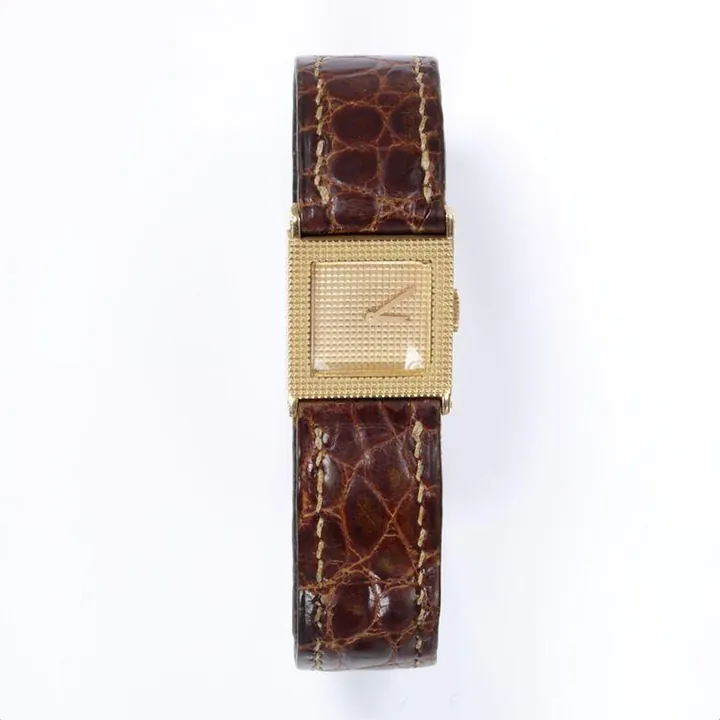
Wristwatch with gold case and leather strap, Boucheron, Paris, about 1963.
Victoria and Albert Museum, London
Wristwatches · 1960–1965
Wristwatch, France, 1960–1965
Suomen kansallismuseo
Wristwatches · c. 1960s
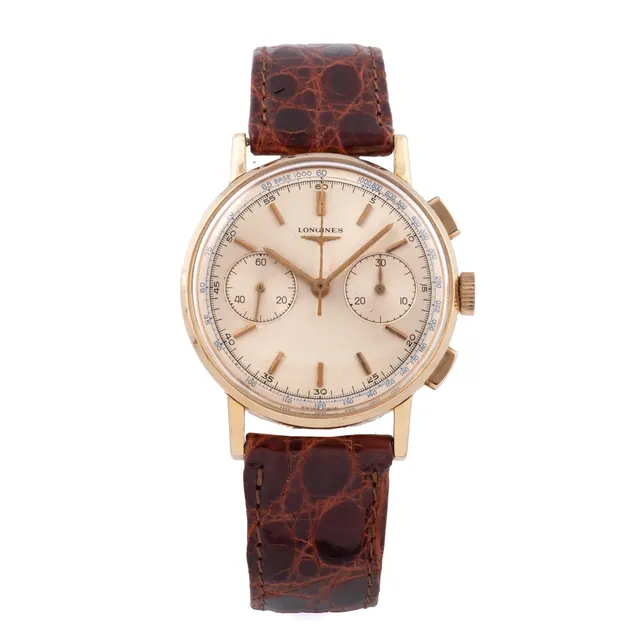
Longines wristwatch, 30 Ch French Case, circa 1960's
Antiquorum auction archive, Geneva
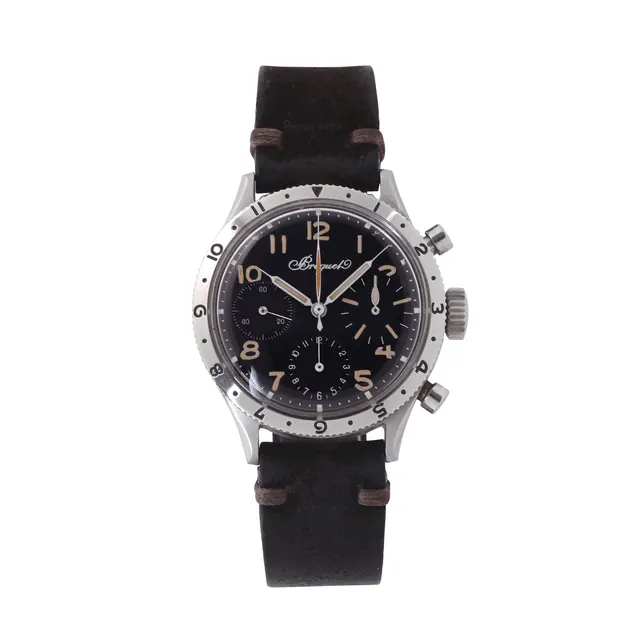
Wristwatches · 1958
Breguet wristwatch, 1958
Antiquorum auction archive, Geneva