
Wristwatches · Wristwatch
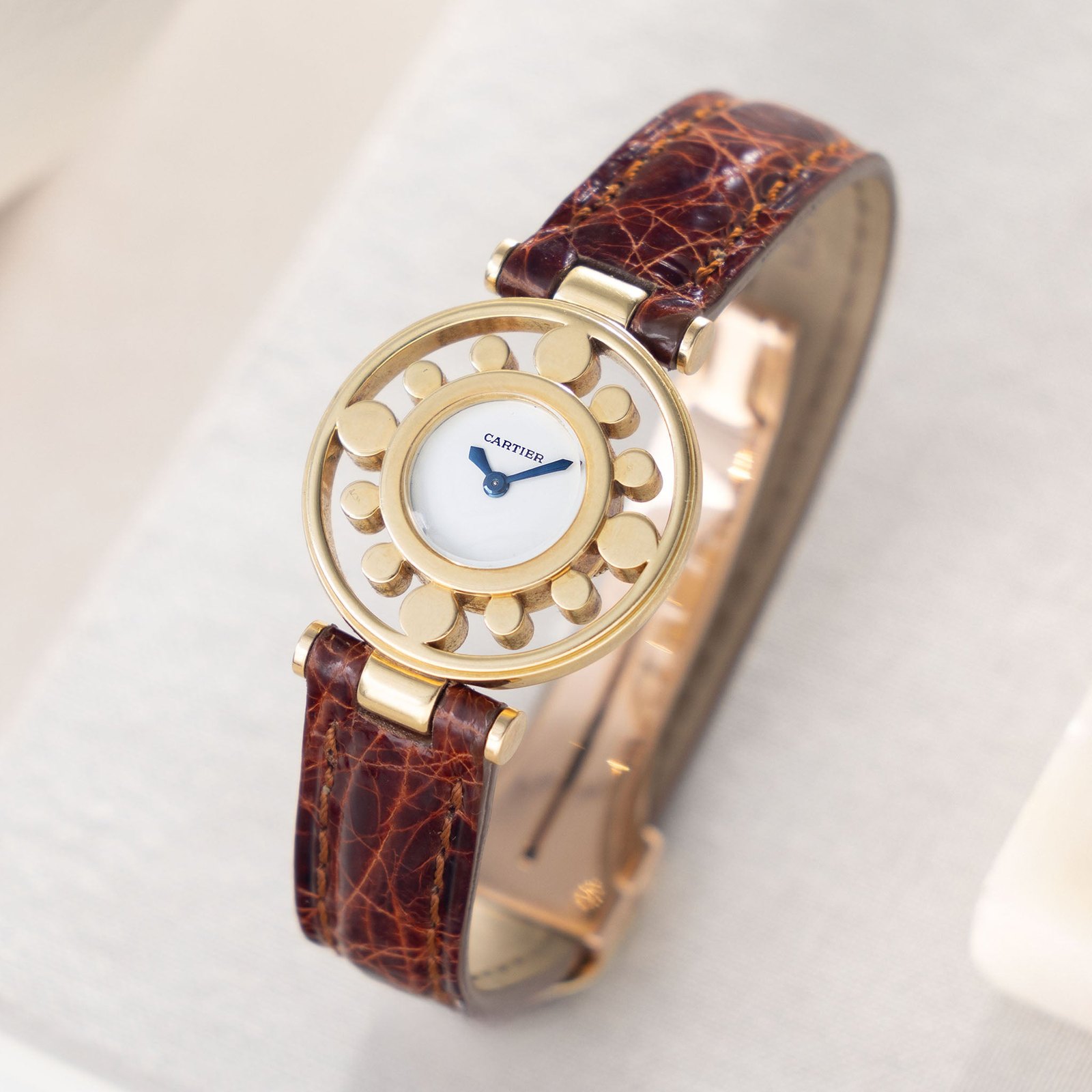
Cartier "Gouvernail" in 18K Yellow Gold, late 1940s
- Maker / attribution
- Cartier (maker)
- Date
- late 1940s
- Historical period
- Golden Age of Mechanical Watchmaking (1900 – 1945)
- Country of origin
- France
- Object type
- Wristwatch
- Materials / technique
- 18k yellow gold
- Dimensions
- Case 24 mm
- Stock no.
- W-3169
- Credit line
- Dealer listing, Bulang & Sons (W-3169)
- Catalogue title (original)
- Cartier "Gouvernail" in 18K Yellow Gold (English)
View the source record (dealer listing) ↗ (opens another website in a new tab)Suggest a correction
Record summary
Catalogued by Bulang & Sons (dealer), Copenhagen (stock number W-3169), this is a wristwatch by Cartier, made in France, dated late 1940s. The Atlas places it in the Golden Age of Mechanical Watchmaking period (1900 – 1945) of its Wristwatches collection. Materials and techniques recorded by the source: 18k yellow gold. Recorded dimensions: Case 24 mm. The record is illustrated with 6 photographs.
Assembled from the source record's structured fields. Dates and attributions are given as the source states them; where a field is missing the Atlas leaves it blank rather than estimating.
Catalogue description
Dealer description — Bulang & Sons
This is a very seldom-seen “Gouvernail” model – in English, “Rudder,” the “steering wheel” of a boat or ship. Cartier cases rarely come in a perfectly round shape; there’s usually a gentle twist, something that draws your eye and leaves you wondering. This one features 12 round pillars holding the dial, no winding crown on the side, Vendôme-style lugs, a very "sterile" dial, and blued sword hands… very odd! These wristwatches are RARE. There are several sizes (ranging from 24mm up to 40mm), several metals (yellow gold, white gold, and platinum), and ONLY around 35 of these, in all combinations, are known to exist! These watches were produced from the 1940s until the end of the 1960s. The initial models featured a Jaeger (yes, the same Jaeger from Jaeger-LeCoultre) 'Duoplan' movement. The gear train and components were arranged across two levels (hence 'Duo Plan'), and to conserve even more space, the crown was placed at the back, eliminating any visible winding mechanism – just like the watch we have here! The 24mm case (wearing larger due to the Vendôme-style lugs) is in excellent condition and is fitted with a fine leather strap and an original Cartier 18K gold folding buckle. This super rare Cartier has been fully serviced by our watchmaker, and the 'Ship-Wheel' is certainly a design that stands out. Wearing this would surely mean you’d have something on your wrist that your peers are unlikely to have! Specifications: - Cartier “Gouvernail” - 18K Yellow gold case with Vendôme-style lugs, backwinded, 24mm - Serial 104xxx dating to the late 1940s - White dial with blued sword hands - Comes on the photographed leather strap with an 18K yellow gold folding buckle - JLC 'Duoplan' hand-wound movement - Fully serviced by our watchmaker
Historical context
Golden Age of Mechanical Watchmaking (1900 – 1945)
The wristwatch displaces the pocket watch; waterproof cases, self-winding and grand complications.
The wristwatch overtook the pocket watch. Military use in the First World War, aviation, water-resistant cases (1926), automatic winding (1923–31), rectangular Art Deco designs and early chronographs and calendars defined the period.
Read the period in the timelineMore wristwatches from this periodEarlier: Industrial Revolution
Atlas type guide
Wristwatches
Bracelet watches were worn by women from the early nineteenth century — Breguet made one for Caroline Murat, Queen of Naples, in 1810–12 — but the wristwatch only became a man's instrument with military use and aviation in the early twentieth century. Between the World Wars it overtook the pocket watch; the 1920s and 1930s brought rectangular Art Deco cases, water-resistant cases and the first automatic winding systems.
After 1945 the wristwatch became a carrier of identity — dress watches, sports and dive watches, chronographs, calendars — produced by Swiss, American, Japanese, German, Soviet and Chinese industries. The quartz revolution after 1969 and the mechanical renaissance since the 1990s, including the rise of independent watchmakers, complete the story.
What to look for
- The reference number (between the lugs or inside the case back) and serial number, the starting point for dating.
- The calibre: its maker and number are often stamped under the dial or on the bridge.
- Originality of dial, hands and crown — refinished ('redial') dials are common.
- Case material marks: 18K/750, 14K/585, stainless steel, gold-filled, plated.
Dating clues
- Wire-lug cases: before c. 1925.
- Water-resistant screw-down cases: from 1926.
- Quartz movements: from 1969; sapphire crystals widespread after c. 1980.
General guidance written by the Atlas editors about this kind of object. It is not a statement about this particular piece; for that, rely on the source record above and on physical examination.
Related records

Clocks · 1863
Clock by Albert-Ernest Carrier-Belleuse, France, 1863
The Metropolitan Museum of Art, New York

Clocks · c. 1980s
Cartier "art Deco", c. 1980s
Antiquorum auction archive, Geneva

Clocks · c. 2000s
Cartier Desk Clock with Alarm, c. 2000s
Antiquorum auction archive, Geneva

Clocks · c. 2000s
Cartier Lacquer Arched Desk Clock with Alarm, ref. W0100037, c. 2000s
Antiquorum auction archive, Geneva
Wristwatches · c. 1936
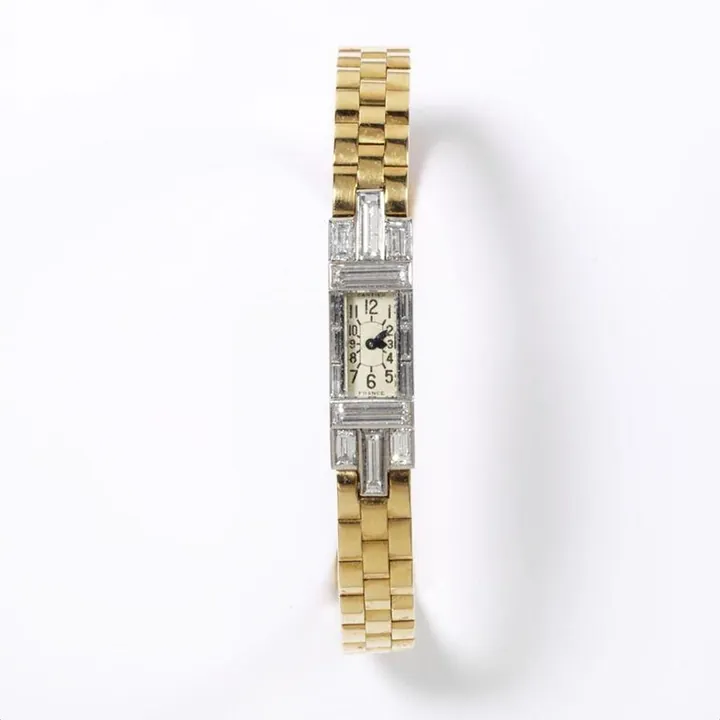
Watch with diamond-set platinum case and gold link bracelet, Cartier, Paris, c. 1936.
Victoria and Albert Museum, London
Wristwatches · c. 1920
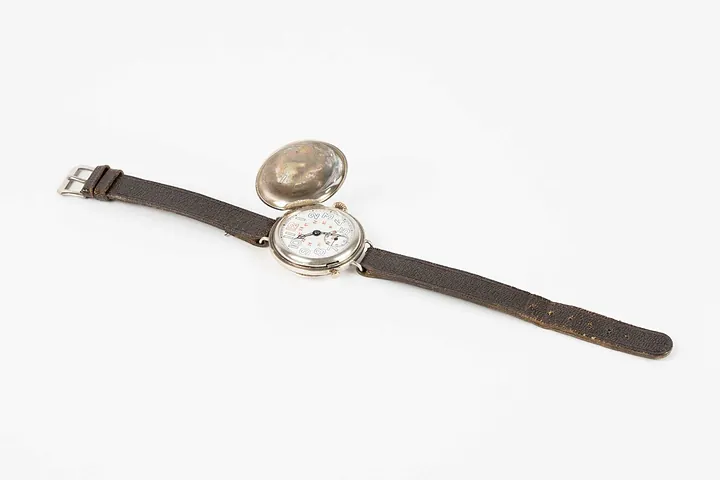
Wristwatch by dazwischen Schwert J S, France, c. 1920
German Clock Museum
Wristwatches · 1928
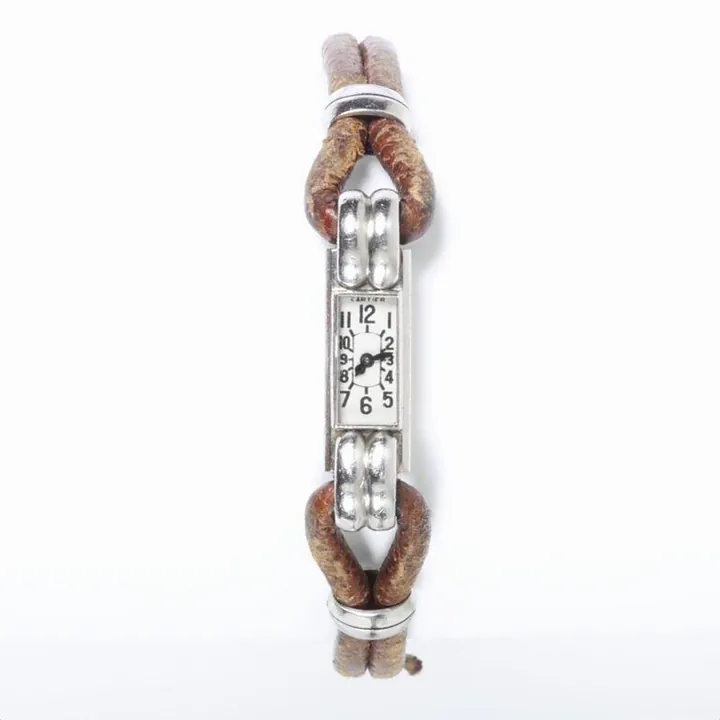
Platinum watch with leather strap with gold deployant buckle, Cartier, Paris, mark of Edmond Jaeger, 1928
Victoria and Albert Museum, London
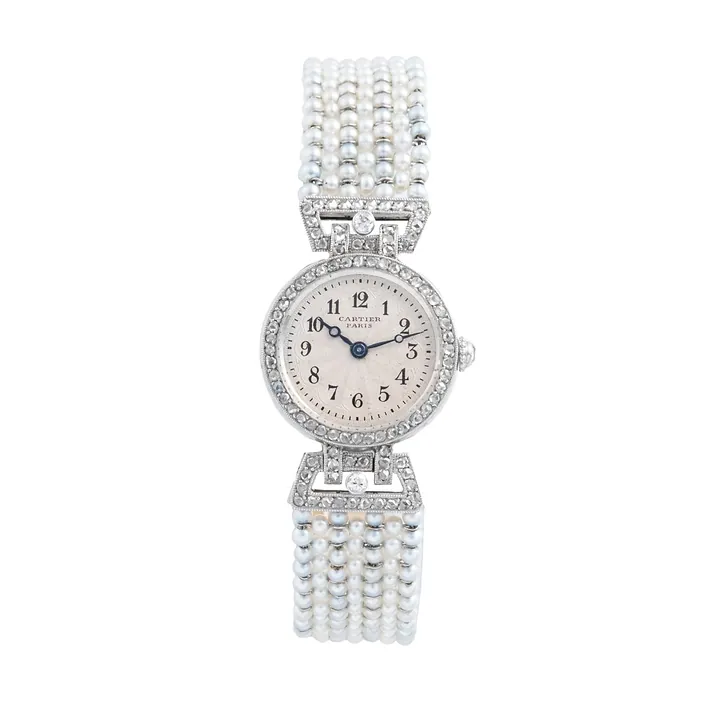
Wristwatches · c. 1930s
Cartier wristwatch, c. 1930s
Antiquorum auction archive, Geneva